

Feeling tired all the time can be part of the ADHD experience, especially when overwhelm, procrastination, emotional reactivity, time blindness and the effort of getting started keep your brain working hard. This article explains how executive functioning and burnout can drain your energy, then offers practical CBT informed tools for task initiation, focus, time management and follow through, whether you are in Ireland or accessing support elsewhere.
Key takeaways
ADHD fatigue is not a character flaw. It can build when everyday planning, inhibition, emotional regulation and goal directed behaviour require sustained effort (Boonstra et al., 2005; Barkley, 2010).
• Learn how task paralysis, time blindness, sensory overload and emotional strain can contribute to burnout.
• Use practical CBT strategies to make starting, planning and following through easier.
• Build systems around your actual energy, including low energy options for difficult days.
• Understand how late diagnosis, parenting, rejection sensitivity and fitness routines can affect focus and capacity.
• Explore flexible, 100% online support through The Adult ADHD Foundations Program™, a self paced educational programme that does not replace formal therapy.
Why ADHD can feel exhausting
ADHD fatigue is often a deep mental weariness rather than ordinary sleepiness. You may have slept for eight hours and still feel unable to answer an email, organise the school run or begin a report. Executive functioning difficulties can affect planning, inhibition, organisation and goal directed behaviour, all of which influence how much effort an ordinary day requires (Boonstra et al., 2005; Barkley, 2010).
That effort can become more noticeable when you are filtering distractions, switching between tasks or trying to regulate impulses and emotions. Fatigue is not proof that you are lazy or lacking commitment. It is useful information about the demands placed on your attention and self regulation, particularly when a busy workday, a commute through Dublin traffic or several competing responsibilities leave little room to recover.
Many adults describe this as a puzzle. You know what needs to be done, you want to do it, and yet the gap between intention and action feels enormous. Difficulties with executive functioning and self regulation are well documented in adults with ADHD (Boonstra et al., 2005; Barkley, 2010), and they help explain why an ordinary day can take so much out of you. If you have typed "why am i so tired all the time adhd" into a search bar, you are asking a reasonable question with a real answer.
Collins Psychology supports adults with ADHD who feel overwhelmed and stuck to build practical systems that improve daily life. In this guide we will look at overwhelm, procrastination and time blindness, and at how structured, evidence based tools can help you manage your energy rather than simply push through. If you would like a wider look at this topic, our article on mental fatigue and ADHD covers more of the everyday experience.
Executive function uses energy
Imagine trying to hold a conversation in a room where ten radios are playing different stations at once. Your brain constantly filters this "noise", from a humming fridge to your own internal monologue. This filtering requires real mental energy, and trying harder only increases the rate of exhaustion. For many adults, the energy spent simply preparing to start a task can feel equivalent to an hour of focused work for someone else.
The effort also builds quietly across the day. Each decision about what to do next, each reminder you have to hold in mind and each time you pull your attention back from a tangent draws on the same limited supply. By late afternoon the reserves can be thin, which is why you may manage a morning meeting well and then struggle to choose what to cook for dinner. Seeing this pattern as a matter of cognitive load, rather than weak willpower, is the first step towards a kinder and more effective approach (Barkley, 2010).
Starting is a real task
Task initiation is a high energy process that often feels like pushing a heavy boulder uphill. Your brain must decide where to start and how to sequence the steps, which frequently leads to mental gridlock. Before you have done anything visible, you may already have spent a great deal of effort weighing options, imagining problems and feeling the pressure of the deadline.
Consider a simple example. You sit down to write a work report. You open the document, then wonder whether you should check your inbox first, then remember a bill, then notice you are thirsty. None of this looks like work from the outside, but it is tiring, and it is the reason you can end a day feeling drained without having much to show for it. These challenges are central to our CBT for ADHD Executive Function course, which builds practical systems to reduce this mental friction. Identifying these energy leaks is the first step towards reclaiming your energy and building a more sustainable daily rhythm.
Spotting burnout and overload
Burnout can develop when you repeatedly push through tasks, social expectations and unfinished decisions without enough recovery. Masking, correcting forgotten details and searching for misplaced items can add to that load. You might manage well at work and then have no energy left for dinner, conversation or basic household tasks. Noticing this pattern helps you plan support before you reach shutdown.
Overwhelm in ADHD can happen when demands accumulate more quickly than your brain can organise and respond to them, and it can show up as avoidance, tears, shutdown or a strong need to escape. If this sounds familiar, our guides to burnout in adults with ADHD and the ADHD burnout cycle explain how it tends to build and how recovery works.
Sensory processing sensitivity also plays a large role in daily fatigue. Loud offices, bright supermarket lights or even the texture of your clothing can trigger a low level "fight or flight" response in your nervous system. This state of high alert is not just a mental distraction. It is a physical drain on your reserves. Identifying these specific energy leaks is essential for building a life that feels manageable rather than exhausting.
There is also what many people call the "ADHD Tax": the extra time, money and energy spent because of executive functioning challenges. It includes the energy used to find lost keys, the stress of paying a late fee, or the effort of redoing something after a small mistake. Each one is minor on its own, but together they act as a constant leak in your energy reservoir.
ADHD energy leaks
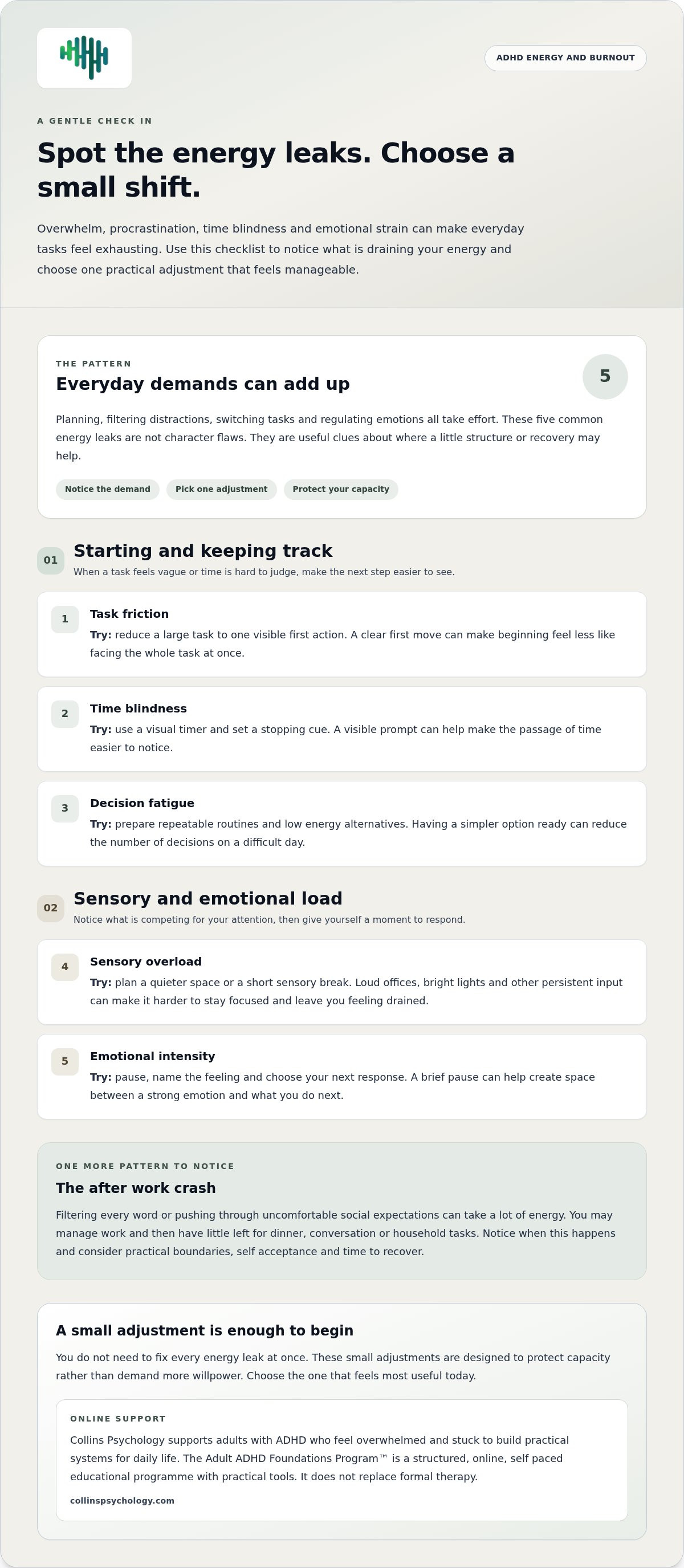
Task friction
reduce a large task to one visible first action.
Time blindness
use a visual timer and schedule a stopping cue.
Sensory overload
plan a quieter space or short sensory break.
Emotional intensity
pause, name the feeling and choose the next response.
Decision fatigue
prepare repeatable routines and low energy alternatives.
These small adjustments are designed to protect capacity rather than demand more willpower.
Masking and the after work crash
Masking often looks like filtering every word before you speak or forcing yourself to maintain eye contact when it feels uncomfortable. It is a high stakes performance designed to manage the anxiety of being judged by others. By the time 5 PM arrives, many adults experience an "after work collapse" because their social battery has been completely used up.
The collapse can look like lying on the sofa unable to answer a text, or snapping at someone you love over something small. It is not ingratitude or poor character. It is what often follows a day of monitoring yourself closely. We focus on building self acceptance and practical boundaries to reduce reliance on masking, such as a short quiet reset between work and home. If you struggle with the emotional weight of these triggers, our ADHD emotional regulation course provides tools to manage the anxiety and fatigue associated with masking.
Make overload easier to notice
For an ADHD brain, background noise is rarely just in the background. It is a constant, competing signal that demands attention. This persistent sensory input keeps your nervous system in a state of high alert, which is physically exhausting over several hours. Small irritants, like a flickering light or a colleague's tapping pen, have a cumulative effect that can lead to total shutdown by mid afternoon.
A practical response is to notice your personal warning signs, such as a tight jaw, shallow breathing or rereading the same line three times. Then build in scheduled "sensory breaks" before you hit the wall: a few minutes outside, headphones for a stretch of focused work, or a quiet corner at lunchtime. Planning breaks in advance is a vital behavioural strategy because it protects your limited cognitive resources instead of waiting until you are already depleted.
CBT for starting and time
CBT for ADHD looks closely at the link between a situation, your thoughts, your feelings and what you do next. If you see a pile of laundry and think, "I must finish all of it now", overwhelm can lead to avoidance. A more workable thought is, "I only need to put five items in the basket." This shift reduces the size of the task and creates an opportunity to act. Collins Psychology provides online CBT informed support for adults who feel stuck and overwhelmed.
The shutdown that follows an overwhelming thought is a protective mechanism, yet it consumes more energy than the task itself. By shifting from a focus on willpower to a focus on structured systems, you can begin to lower the cognitive load. Evidence based strategies help you recognise these patterns before they lead to total depletion, and they allow you to build a more predictable daily rhythm that respects your brain's unique wiring. Our guide to procrastination and ADHD explores this link further.
Research reflects how connected these difficulties are. Procrastination is consistently associated with ADHD symptoms and with processes involving executive function, emotion regulation and motivation, and emotional dysregulation in adult ADHD has been linked with symptom severity and executive functioning (Soler Gutiérrez et al., 2023; Suriano, 2026). That is why an approach that treats starting, feeling and planning as one connected cycle tends to make more sense than tackling each in isolation.
Use a five minute beginning
Think about staring at a pile of laundry for two hours. You are not resting. You are actively fighting what is often called the "Wall of Awful", a mental barrier built from past failures and current overwhelm. This state of paralysis is exhausting because your nervous system is in high gear while your body remains still.
Try a five minute rule. You commit to only five minutes of action, with permission to stop afterwards. Often you will carry on, but even if you do not, you have taken a first step. To make it stick, choose a first action that is visible and specific, such as "put the document on screen and type the title", and place any needed items where you can see them.
Externalise time
Many adults with ADHD live in a world of "now versus not now", which creates a persistent undercurrent of stress (Ramsay, 2022). This time blindness means you are often fighting time rather than using it as a resource. You might fall into deep hyperfocus, only to experience a significant energy crash once the spell is broken, often realising you have skipped lunch and water along the way.
To manage this, we encourage externalising time through visual timers, wall calendars and structured schedules. These tools act as a prosthetic for your brain's internal clock, reducing the mental strain of constantly guessing how much time has passed. Add a stopping cue to hyperfocus sessions, such as an alarm that prompts you to stand, drink water and decide on the next step. Our evidence based guide to ADHD and time blindness strategies offers more examples you can try.
Build practical daily systems
Managing energy is often more effective than managing time for those wondering why am i so tired all the time adhd. A structured four step system can help you regain control. First, Audit your day to identify which tasks are high drain. Second, Automate recurring decisions like meal planning or bill payments to reduce cognitive load. Third, Delegate tasks that fall outside your strengths where possible. Finally, Accept that your capacity fluctuates, which helps remove the shame that often fuels further exhaustion.
A simple way to begin the audit is to note for one week which activities leave you drained and which leave you steadier. You may find that unplanned phone calls, open plan noise or a chaotic morning routine cost far more than a longer but predictable task. Automating a few of those choices, for example a standing weekly meal plan or a fixed time for paperwork, removes dozens of small decisions and leaves more energy for what matters to you.
Emotional fatigue is frequently tied to Rejection Sensitive Dysphoria (RSD). This intense emotional response to perceived criticism can trigger a physical stress reaction that leaves you feeling overwhelmed and stuck for hours or even days. Learning to regulate these spikes is a core part of our CBT for ADHD Emotional Regulation course. By building a buffer between a situation and your emotional reaction, you protect your mental reserves from unnecessary depletion. You can read more in our guide to rejection sensitive dysphoria in adults with ADHD.
Regulate before you react
Mindfulness in an ADHD context is about "noticing without judgement" to break the cycle of self criticism. Zylowska (2017) describes how mindfulness based approaches can support emotional regulation and focus in adults with ADHD. A simple body scan can help you identify physical tension before it turns into a full energy crash, and it takes only a few minutes at your desk or in the car before you go inside.
The aim is not to remove strong emotions. It is to increase the amount of choice you have while experiencing them. There is an important difference between "I feel angry" and "Because I feel angry, I need to act immediately." With practice, you can create a little more space between the emotional trigger and your response. That pause may be very small at first, but over time it becomes the place where emotional regulation happens, and it helps prevent the sharp energy spikes and dips that often lead to the question, why am i so tired all the time adhd.
Set goals that survive busy weeks
We replace traditional time blocking with "Energy Budgeting". This involves categorising tasks by the mental effort they require rather than just their duration. A forty minute task that needs deep concentration may cost more than a two hour task you can do on autopilot, so plan one or two high effort items per day and surround them with lighter work.
It is equally important to have "low energy backup plans" for days when your executive functions are not at full strength. A backup plan might be a ten minute tidy instead of a full clean, or a short email instead of the full report draft. This structured approach ensures you still make progress without triggering burnout. To build a system that respects your brain's natural rhythm, explore our CBT for ADHD Goal Setting course.
Online ADHD support
Online support can be useful when appointments, travel or a fixed timetable add friction to an already demanding week. The Adult ADHD Foundations Program™ is a psychologist developed, self paced online educational programme available worldwide. It brings together emotional regulation, executive function, goal setting, time management and rejection sensitive dysphoria in one structured pathway. It provides practical daily functioning tools, but it does not replace formal therapy.
Many adults already understand why they procrastinate, lose track of time or struggle to begin something they genuinely want to do. The difficulty is that knowing what is happening and knowing what to do while it is happening are two different things. The programme is designed to work on that gap between knowing and doing. The aim is not to make you perfectly organised or endlessly productive. It is to give you more awareness, more practical strategies and more choice when familiar ADHD patterns appear.
Because the programme is self paced, you can return to lessons and workbooks when your attention and energy allow, rather than forcing yourself to attend at a set time each week. That matters when tiredness is the very thing you are trying to address. If you are not sure where to begin, the programme's short Adult ADHD Reflection Quiz can help you identify which patterns place the most pressure on your daily life. It is for education and self reflection and does not diagnose ADHD.
Learn in manageable steps
The five foundations are relevant whether you are managing a career, parenting, studying, rebuilding a fitness routine or simply trying to keep up with daily chores. Collins Psychology's online support is designed to reduce friction by turning broad intentions into practical actions you can rehearse in ordinary settings, in Ireland or anywhere else with internet access.
Each foundation addresses a separate pressure point. Emotional regulation helps you build the pause between feeling and reaction. Executive function work focuses on initiation, memory and organisation. Goal setting teaches you to plan around fluctuating motivation, time management gives you external supports for the hours of your day, and the rejection sensitive dysphoria module helps you respond to criticism and perceived rejection with more choice. Taken together, they address the connected cycle that so often leaves people exhausted, rather than treating each difficulty as an isolated problem.
Late diagnosis, parenting and focus
A late diagnosis can bring relief and frustration at the same time. It may explain years of missed deadlines, intense reactions or routines that worked briefly and then disappeared. Once you understand the "why" behind your brain, you can stop blaming yourself and start building supports. Our article on understanding adult ADHD may help you make sense of that journey.
Parenting can add another layer of interruptions, planning and emotional demands, so a useful system might be a visible family calendar, a short evening reset and a low energy plan for difficult mornings. Fitness and focus can be approached in the same way. Choose a small, clearly defined action, such as putting on trainers or walking for ten minutes, rather than relying on motivation to carry the whole routine. Exercise often works best when it is attached to an existing habit and when missing a day does not mean abandoning the plan.
Move from burnout to focus
ADHD fatigue often reflects the combined effort of executive functioning, emotional regulation, time management and task initiation. Understanding that pattern can reduce shame and make room for useful changes, such as energy budgeting, sensory breaks, visible reminders and smaller goals. The aim is not to force yourself into someone else's system, but to create support that fits your brain and your life.
Progress does not require perfect routines. It comes from noticing what drains you, making important actions easier to start and creating enough structure to support follow through. With practical CBT informed tools and flexible online learning, you can develop a more sustainable rhythm for work, parenting, relationships, fitness and rest. If you are working through a longer period of exhaustion, our guide to ADHD burnout recovery sets out a structured path.
Explore The Adult ADHD Foundations Program™ and begin building practical support around your real day, your real energy and your real priorities. It is self paced, 100% online and available worldwide, so you can start when it suits you and come back to the lessons and workbooks when your energy allows.
Collins Psychology supports adults with ADHD who feel stuck and overwhelmed to develop practical systems for daily life. The programme is an educational resource rather than formal therapy, giving you structured tools to practise at your own pace.
Frequently asked questions
These answers summarise common questions about ADHD fatigue, burnout, emotional regulation and practical online support.
Why can ADHD feel physically exhausting?
Planning, filtering distractions, switching tasks and regulating attention can all require sustained mental effort (Barkley, 2010). That is why a day spent at a desk, in meetings or managing household demands can leave you depleted even without much physical activity. Fatigue can also be influenced by stress, sleep and other health factors, so it is worth viewing your energy pattern in context rather than blaming yourself.
How is ADHD fatigue different from low mood?
ADHD fatigue often changes with task interest, structure and cognitive demand. You may feel unable to start an administrative task but become absorbed in a creative project. Burnout can still affect mood and motivation, so noticing patterns over time can help you describe your experience clearly when seeking appropriate support.
Can CBT help with task paralysis?
CBT can help you identify all or nothing thoughts, reduce an overwhelming task to a first step and test a more workable routine. For example, instead of aiming to complete every form in one sitting, you might open the document, write the heading and set a ten minute timer. Repeated small starts can make follow through more predictable.
What is the ADHD Tax and how does it contribute to daily burnout?
The ADHD Tax refers to the additional time, money and energy spent because of executive functioning challenges. This includes the energy used to find lost keys, the stress of paying late fees or the effort of redoing a task after a small mistake. These cumulative drains act as a constant leak in your energy reservoir, and over time the extra effort can contribute to burnout. A visible place for keys, automatic reminders for bills and a weekly review can reduce these invisible costs.
Why do I feel a crash in the afternoon even if I have been productive?
An afternoon crash often occurs because you have used up much of your executive function and decision making energy by midday. If you have been in a state of hyperfocus, you may also have missed hunger or thirst cues, leading to a sudden drop once the focus breaks. This is a common experience for those wondering why am i so tired all the time adhd. Scheduled sensory breaks, a stopping cue and a planned lighter task for the afternoon can help smooth out these dips.
How can rejection sensitivity drain energy?
Perceived criticism or rejection can trigger a strong emotional response, rumination and an urge to withdraw. The emotional intensity may continue long after the original conversation, leaving you exhausted. A pause, a written account of what was actually said and a compassionate alternative interpretation can create space before you respond.
What does a self paced programme offer?
A self paced programme lets you return to practical lessons and workbooks when your attention and energy allow. The Adult ADHD Foundations Program™ is an educational online programme, available worldwide, with tools across five connected areas of daily functioning. It does not replace formal therapy, but it can help you practise structured skills in everyday life.
Where should I begin?
Begin with one energy leak that is causing repeated friction. Make the next action visible, add an external cue such as a timer or reminder, and decide what a low energy version looks like. Over time, these small adjustments can help you build systems that work WITH your ADHD brain.
Our private services are not appropriate for acute incidents or urgent support. If you are in crisis, contact Samaritans 116 123, your GP, or dial 112 or 999.
Start with one small change today, and keep going until you build systems that work WITH your ADHD brain.
Medical and Mental Health Disclaimer
The information provided on this page, in the Adult ADHD Foundations Program™, individual Collins Psychology programs and the Adult ADHD Reflection Quiz is for general educational and informational purposes only and is not a substitute for individual medical, psychological or psychiatric assessment, diagnosis or treatment. These resources do not diagnose ADHD or any other condition and are not psychotherapy, counselling, crisis support or personalised treatment. Although the material is psychologist-developed and informed by psychological research and evidence-based approaches, individual outcomes will vary and no specific result can be guaranteed. If you are experiencing severe or worsening psychological symptoms, significant impairment, thoughts of harming yourself or another person, or concerns about your safety, seek support from an appropriately qualified health professional or contact the emergency or crisis service appropriate to your location.