.png)

For adults with ADHD, life can often feel like a repeating pattern of intense productivity followed by a complete and debilitating crash. This experience, known as the ADHD burnout cycle, is more than just feeling tired; it is a state of profound mental and physical depletion driven by the unique wiring of the ADHD brain. Understanding the psychological mechanics behind this cycle is the first step toward breaking free. This guide explains the predictable stages of ADHD burnout and introduces evidence-based Cognitive Behavioural Therapy (CBT) strategies designed to help you build sustainable systems, manage your energy, and work with your brain, not against it.
Key Takeaways
• ADHD burnout is a distinct cycle of over-extension, stagnation, collapse, and shame-driven recovery, caused by chronic executive function strain and masking.
• Conventional advice like "try harder" or standard time management often fails because it does not address the underlying neurological differences in dopamine regulation and executive functioning.
• Masking, or concealing ADHD traits to meet neurotypical expectations, is a significant and often overlooked driver of cognitive and emotional exhaustion.
• Cognitive Behavioural Therapy (CBT) offers practical, evidence-based techniques like cognitive restructuring and pacing to challenge unhelpful thought patterns and build sustainable energy management systems.
• Recovery is possible through structured, self-paced learning systems that allow you to build skills at your own pace, which is particularly beneficial when you are already experiencing burnout.
Table of Contents
• Defining the ADHD Burnout Cycle in Adults
• The Role of Executive Function and Masking in Chronic Fatigue
• Identifying the Stages of the Burnout Loop
• Practical CBT Techniques for Emotional Regulation and Energy Management
• Navigating Recovery through Self-Paced CBT Programmes
Defining the ADHD Burnout Cycle in Adults
ADHD burnout is a state of severe physical and mental depletion that results from the chronic stress of trying to manage ADHD symptoms and meet daily demands. It is not simply occupational burnout, which is tied to work, nor is it the same as clinical depression, though they can co-occur. The core of ADHD burnout is a predictable cycle: a period of intense hyper-focus and over-compensation, often driven by deadlines or a new passion, which inevitably leads to a state of total withdrawal and functional collapse. This cycle is frequently fuelled by a deep-seated desire to appear neurotypical, pushing an already strained system past its limits.
The Difference Between Stress and ADHD Burnout
While stress is a common human experience, ADHD burnout is a more profound state of exhaustion that conventional rest does not resolve. A weekend off or even a week’s holiday often is not enough to recharge. This is because the exhaustion stems from a chronically overtaxed nervous system and depleted executive functions. The brain’s dopamine regulation system, which is different in individuals with ADHD, plays a significant role in the feeling of being "stuck" or "paralysed" during the collapse phase (Barkley, 2021). The Psychological Society of Ireland acknowledges that supporting neurodiversity involves creating environments that reduce this chronic strain rather than demanding conformity (Psychological Society of Ireland, 2022).
Why Conventional Advice Often Fails
Well-meaning advice like "use a planner" or "just break tasks down" can increase the pressure on an already exhausted brain. When these standard time management tips fail, it can lead to intense feelings of shame and inadequacy. You may wonder, "Why can't I follow these simple routines?" The issue is not a lack of willpower but a mismatch between the advice and the brain's neurobiology. According to leading research, ADHD burnout is a "predictable, cyclical pattern of over-activity followed by a crash, often exacerbated by executive function deficits in self-regulation and inhibition" (Barkley, 2021). Trying to force a neurodivergent brain into a neurotypical productivity model is like trying to run software on incompatible hardware; it causes the system to crash.
The Role of Executive Function and Masking in Chronic Fatigue
Executive functions are the high-level cognitive skills that help us plan, organise, initiate tasks, and regulate emotions. For adults with ADHD, these functions are impaired, meaning it can take twice the mental effort to achieve the same results as a neurotypical peer. This constant, high-level exertion is a primary cause of chronic fatigue.
Compounding this is the phenomenon of "masking," the conscious or unconscious effort to hide ADHD symptoms to fit in. Masking can include forcing eye contact, suppressing fidgeting, or meticulously rehearsing conversations. While it can be a useful short-term survival strategy, it is a primary driver of emotional and cognitive depletion over the long term. The internalised pressure to meet neurotypical standards at work and home means you are constantly running a second, invisible programme in the background, consuming vast amounts of mental energy. The principles of Cognitive Behavioural Therapy (CBT) help us identify and challenge the core beliefs that drive this need to mask, such as "I must not show my struggles" (Safren et al., 2017).
The Cognitive Cost of Compensatory Strategies
The energy required for constant self-monitoring, task-switching, and managing impulsivity is immense. This is often referred to as the "ADHD tax," a term that describes the extra resources (time, money, and energy) spent compensating for executive function challenges. This tax is not just financial; it is a daily drain on your cognitive reserves. Building stronger executive function skills is crucial to reducing this cost. Our CBT for ADHD Executive Function course provides a structured system to develop these skills.
Sensory Overload and Emotional Dysregulation
When the brain is already taxed from managing executive functions and masking, its ability to filter sensory input diminishes. Sounds may seem louder, lights brighter, and textures more irritating. This sensory overload can quickly lead to emotional dysregulation, where emotional responses are more intense and harder to manage. A minor setback, like a misplaced set of keys or a critical comment, can trigger a major "shutdown" response, pushing you further into the burnout phase.
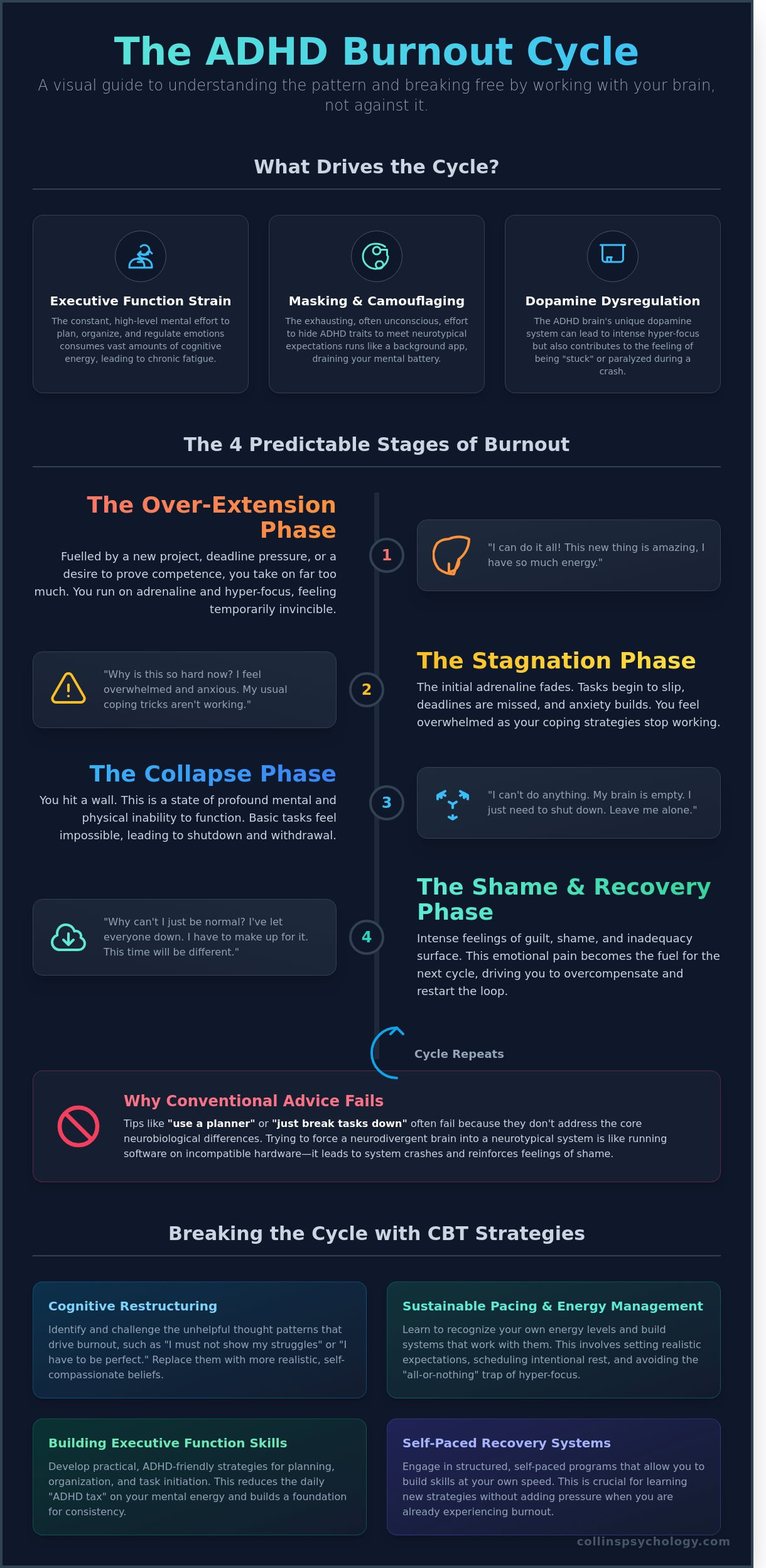
[INFOGRAPHIC: The 4 Stages of the ADHD Burnout Cycle: 1. Over-Extension (Taking on too much), 2. Stagnation (Anxiety rises, tasks slip), 3. Collapse (Mental & physical shutdown), 4. Shame Recovery (Guilt-driven restart)]
Identifying the Stages of the Burnout Loop
The ADHD burnout cycle is not random; it follows a predictable pattern. Recognising the stages can empower you to intervene before you hit a complete collapse.
The Over-Extension Phase
Fuelled by a new project, a tight deadline, or a desire to prove your competence, you take on far too much. You might be running on adrenaline and hyper-focus, feeling temporarily invincible.
The Stagnation Phase
The initial energy wanes. Tasks begin to slip through the cracks, deadlines are missed, and anxiety starts to build. You feel overwhelmed, and your usual coping strategies stop working.
The Collapse Phase
You hit a wall. This is a state of profound physical and mental inability to continue. You may experience extreme fatigue, brain fog, and emotional numbness. Basic tasks feel impossible.
The Shame Recovery Phase
After a period of forced rest, guilt and shame set in. You feel pressure to "catch up" on everything you missed, which often leads directly back into the Over-Extension Phase, restarting the cycle.
Recognising Early Warning Signs
Learning to spot the early signs of burnout is a critical skill. It allows you to step back and reduce demands before you reach the collapse phase.
Physical Indicators
Increased sensitivity to noise or light, persistent fatigue that sleep does not fix, changes in sleep patterns (insomnia or oversleeping), and an increase in headaches or general aches.
Cognitive Indicators
Worsening "brain fog," increased forgetfulness, difficulty making decisions, and losing your train of thought more frequently.
Emotional Indicators
A noticeable loss of interest in hobbies or socialising, increased irritability or emotional reactivity, and a growing sense of dread about your to-do list.
The Impact on Daily Life and Focus
Burnout makes long-term planning and goal-setting feel impossible. The primary focus becomes just getting through the day. The struggle to "re-start" after a period of collapse is a significant challenge, as the brain's reward and motivation systems are depleted. The stagnation phase, in particular, is characterised by a growing discrepancy between intended actions and actual performance, which significantly heightens internal anxiety and self-criticism (Safren et al., 2017). Learning effective strategies for task initiation is key to breaking this paralysis.
Practical CBT Techniques for Emotional Regulation and Energy Management
The goal is not to find more motivation or to force yourself to "just do it." The goal is to build systems that work with your brain. Cognitive Behavioural Therapy (CBT) provides a structured, evidence-based framework for changing the patterns that fuel the burnout cycle.
Cognitive Restructuring
This technique involves identifying and challenging the negative, automatic thoughts that drive burnout, such as "I am lazy" or "I am a failure." You learn to replace them with more balanced and compassionate self-talk.
Pacing
Instead of the all-or-nothing approach to productivity, pacing involves breaking down tasks into manageable chunks and scheduling regular, restorative breaks. This helps you maintain energy levels and avoid over-extension.
Setting Realistic Boundaries
Learn to say "no" to new commitments when you are at capacity. This reduces the need for masking and preserves your energy for what truly matters.
Self-Compassion
Treating yourself with the same kindness you would offer a friend is a clinical tool for recovery. It reduces the shame that drives the cycle and promotes a more sustainable relationship with yourself.
Evidence-Based Strategies for Emotional Stability
Emotional dysregulation is a core component of ADHD that worsens with burnout. CBT offers tools to regain control. A "thought record," adapted for the ADHD brain, can help you track the connection between situations, thoughts, and emotional reactions, allowing you to intervene before you become overwhelmed. Alongside cognitive tools, focusing on the fundamentals of sleep hygiene and physical fitness helps maintain your "window of tolerance," making you less susceptible to emotional volatility. For guided exercises, explore our Emotional Regulation module.
Restructuring Your Environment for Success
Instead of trying to change your brain, change your environment to support it. This can involve simple adjustments like using noise-cancelling headphones to reduce sensory friction, decluttering your workspace to minimise distractions, or using visual timers. Social structures like "body doubling," where you work quietly alongside another person, can also be incredibly effective for initiating tasks. The key is to use structured goal setting to create small, manageable wins that build momentum without leading to depletion.
Navigating Recovery through Self-Paced CBT Programmes
When you are in the midst of burnout, the thought of adding weekly therapy appointments to your schedule can be overwhelming. This is why online, self-paced learning is an ideal format for recovery. It removes the pressure of appointments and allows you to engage with the material when you have the cognitive and emotional energy to do so.
It is important to clarify that Collins Psychology provides structured, CBT-based systems for adults with ADHD. This is not therapy. Not coaching. A system. Our programmes are designed for people who are tired of knowing what to do but still struggling to do it. You can learn at your own pace, revisiting key concepts as needed, and build a toolkit of strategies that leads to long-term resilience against future burnout cycles.
The Collins Psychology Approach to Adult ADHD
Our focus is on providing practical, evidence-based tools that you can apply to your daily life. We help you stop relying on motivation and stop starting over every Monday. Instead, you learn to build systems that work with your unique brain. You can start where you struggle most, whether it is with emotional regulation, executive function, or focus. It is one system with multiple entry points, allowing you to build your ADHD support system over time. Explore our full collection of CBT programmes to see how a structured approach can help.
Taking the First Step Toward Sustainable Change
Recovery from burnout is not a race. We encourage a "slow and steady" approach when starting a new programme. The goal is to make small, sustainable changes that build on each other over time. Having professional guidance in a flexible, on-demand format allows you to access support without adding more stress to your life. If you are ready to move from knowing what to do to actually doing it, we invite you to take the first step.
Enrol in our self-paced CBT for ADHD programme today and start building a system that works for you.
Frequently Asked Questions
What is the ADHD burnout cycle?
The ADHD burnout cycle is a recurring pattern where a period of intense productivity and over-exertion (often driven by hyper-focus) is followed by a crash into a state of profound mental and physical exhaustion, making it difficult to function. This is often followed by a shame-driven attempt to restart, which perpetuates the cycle.
How long does ADHD burnout usually last?
The duration of ADHD burnout can vary significantly, from a few days to several months or even longer. The recovery time depends on the severity of the burnout, the individual's circumstances, and the implementation of effective recovery strategies like those found in Cognitive Behavioural Therapy (CBT).
Is ADHD burnout the same as clinical depression?
No, they are distinct conditions, although they can overlap and co-exist. ADHD burnout is primarily a state of exhaustion caused by executive function strain and masking. While it can include feelings of hopelessness, depression is a broader mood disorder with specific diagnostic criteria. It is important to consult a healthcare professional for an accurate diagnosis.
Can you recover from ADHD burnout without one-to-one therapy?
Yes. For many, recovery is possible through structured, self-paced programmes that teach evidence-based skills. Online CBT systems provide the tools and frameworks needed to understand the cycle and build resilience, offering a flexible alternative for those who find traditional therapy schedules difficult to manage during burnout.
What are the first signs that I am entering a burnout phase?
Early signs often include increased sensory sensitivity (to light, sound, or touch), persistent "brain fog" or forgetfulness, a shorter temper, loss of interest in hobbies, and a feeling of dread associated with your daily tasks.
How does masking contribute to chronic exhaustion in adults?
Masking involves constantly suppressing natural ADHD traits to appear neurotypical. This requires immense, continuous mental effort for self-monitoring and self-regulation, acting as a constant drain on cognitive resources and leading directly to chronic mental fatigue.
What role does executive function play in the burnout loop?
Executive function deficits mean that tasks involving planning, organisation, and self-regulation require significantly more mental energy. This constant over-exertion depletes cognitive resources much faster, making individuals with ADHD more susceptible to entering the burnout loop.
Are there specific CBT exercises for ADHD burnout recovery?
Yes, CBT for ADHD includes exercises like cognitive restructuring to challenge the "I'm lazy" narrative, thought records to manage emotional dysregulation, and behavioural techniques like "pacing" to break the all-or-nothing productivity pattern and build sustainable energy management habits.
References
Barkley, R. A. (2021). ADHD in adults: The nature of the disorder and its diagnosis. Guilford Press.
Psychological Society of Ireland. (2022). Guidelines on neurodiversity and psychological wellbeing. PSI.
Safren, S. A., Sprich, S. E., Perlman, C. A., & Otto, M. W. (2017). Mastering your adult ADHD: A cognitive-behavioral treatment program, therapist guide (2nd ed.). Oxford University Press.