.png)

If you have ADHD, you might have asked yourself, "Why does rejection hurt so much more for me than for other people?" This article will help you understand the intense emotional impact of rejection sensitive dysphoria (RSD) and how it connects to the ADHD brain. You will learn how to identify your triggers and manage these overwhelming feelings using structured cognitive behavioural strategies. It is time to stop starting over every Monday and instead build systems that work with your brain, so you can know what to do and actually do it.
Key Takeaways:
• Rejection Sensitive Dysphoria (RSD) is an intense, painful emotional response to perceived or real rejection, common in adults with ADHD due to differences in brain structure and function.
• RSD is not a character flaw but a challenge related to emotional regulation, an executive function often impacted by ADHD.
• Cognitive Behavioural Therapy (CBT) provides a structured, evidence-based framework for managing RSD by teaching you to identify triggers, challenge distorted thoughts, and build emotional resilience.
• Practical strategies like cognitive reframing, grounding techniques, and building structured routines can significantly reduce the impact of RSD on your daily life, relationships, and confidence.
Table of Contents:
• What is Rejection Sensitive Dysphoria in Adults with ADHD?
• The Neurological Link Between ADHD and Emotional Intensity
• Distinguishing RSD from Social Anxiety and Depression
• Managing RSD with Cognitive Behavioural Therapy Strategies
• A Structured Path Forward with Self-Paced CBT Programmes
• Frequently Asked Questions
What is Rejection Sensitive Dysphoria in Adults with ADHD?
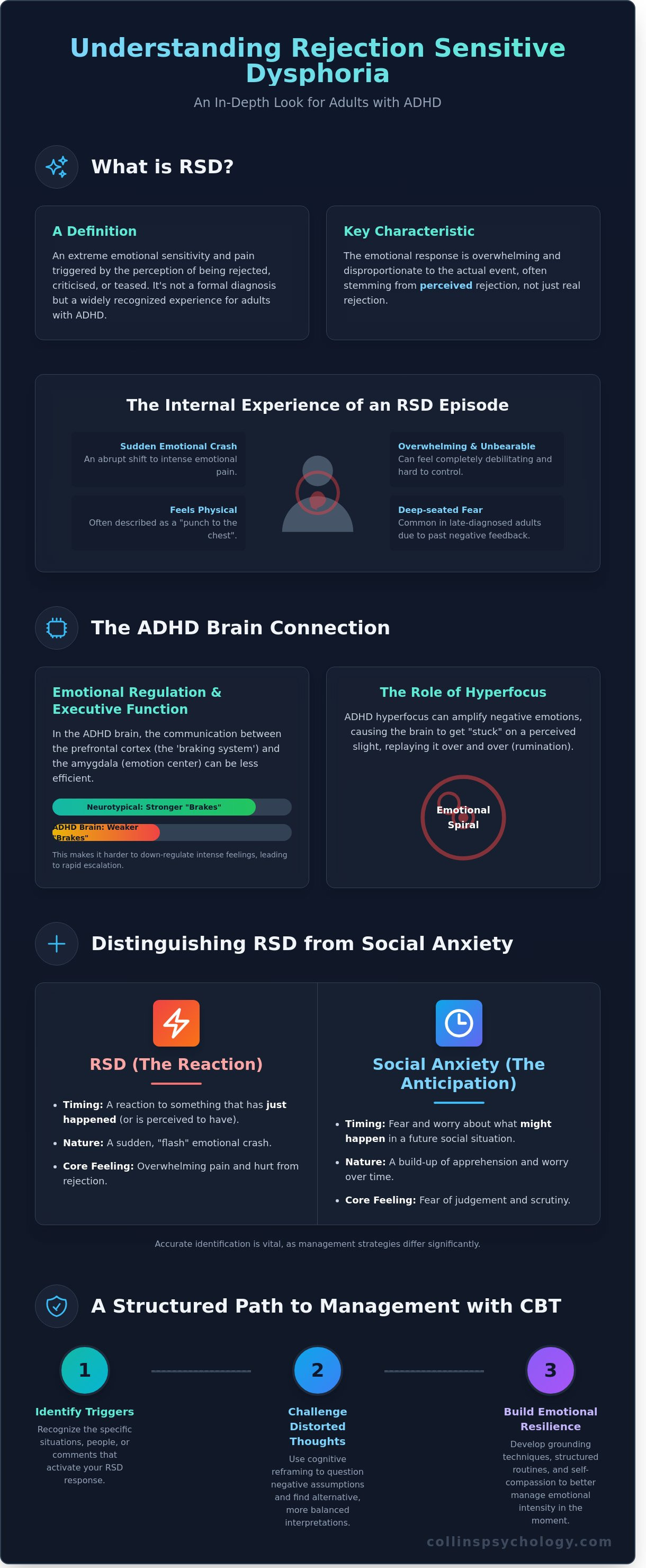
Rejection sensitive dysphoria is a term used to describe an extreme emotional sensitivity and pain triggered by the perception of being rejected, criticised, or teased. Although not a formal diagnosis, it is a widely recognised experience for many adults with ADHD, originating from the way the ADHD brain processes emotions. This response is not just feeling sad or disappointed; it manifests as a sudden, overwhelming, and unbearable emotional crash that can feel completely debilitating.
The Internal Experience of RSD
The internal experience of RSD is often described in intensely physical terms, such as a literal "punch to the chest" or a sudden, painful blow. This dysphoria, or state of profound unease and unhappiness, arises because the emotional response is disproportionate to the actual event. The key is understanding the difference between actual rejection and perceived rejection, as the ADHD brain can often misinterpret neutral social cues as negative, triggering a full blown RSD episode.
Why RSD is Common in Late-Diagnosed Adults
For adults diagnosed with ADHD later in life, RSD can be particularly severe due to the cumulative effect of years of misunderstood struggles and negative feedback. Growing up, you may have been labelled as "lazy" or "not trying hard enough," leading to a deep-seated fear of failure and criticism. This often results in developing "masking" behaviours, where you work tirelessly to hide your ADHD traits and please others, which is an exhausting survival mechanism. Understanding that RSD is a component of your neurotype, not a personal failing, can be a powerful turning point toward self compassion and learning new ways to cope. You can learn more about this journey by reframing your story from a cognitive behavioural perspective.
The Neurological Link Between ADHD and Emotional Intensity
The powerful connection between ADHD and emotional intensity is rooted in the brain's executive functioning system. These brain-based skills, largely managed by the prefrontal cortex, are responsible for regulating our responses, including our emotions. In the ADHD brain, the communication pathways between the prefrontal cortex (the brain's "braking system") and the amygdala (the emotional processing centre) can be less efficient, making it harder to down-regulate intense feelings (Shaw et al., 2014).
Emotional Regulation as an Executive Function
Emotional regulation is the ability to manage and control your emotional responses to situations. For adults with ADHD, the "brakes" on these responses are often weaker, meaning that once an emotion like hurt or anger is triggered, it can escalate very quickly and intensely. This is not a choice or a lack of willpower; it is a direct result of neurological differences (Barkley, 2015). Building skills in this area is foundational, which is why our CBT for ADHD emotional regulation course provides a structured system to help you develop stronger control.
The Role of Hyperfocus in Emotional Spirals
Hyperfocus, the ADHD trait of intense concentration, can be a great strength, but it can also amplify negative emotional states. When an RSD episode is triggered by a perceived slight, the brain can hyperfocus on the negative feeling and the thoughts surrounding it. This leads to rumination, where you replay the interaction over and over, deepening the emotional pain. For example, a brief, neutral comment from a manager at work could trigger an hours long spiral of self doubt and worry about your job security.
Distinguishing RSD from Social Anxiety and Depression
While RSD shares some surface level similarities with other conditions, it has distinct features that set it apart. Misidentifying RSD as social anxiety or depression can lead to using coping strategies that are not effective for its sudden, intense nature. Understanding the differences is crucial for finding the right support and building systems that work for your brain.
RSD versus Social Anxiety Disorder
The primary difference between RSD and social anxiety lies in the timing of the emotional response. Social anxiety is often anticipatory; it is the fear and worry about what might happen in a future social situation. In contrast, RSD is a reaction to something that has just happened or is perceived to have just happened. While the two can certainly coexist, and structured CBT can help manage both, it is important to recognise that social anxiety is about the anticipation of rejection, while RSD is the overwhelming pain in reaction to it.
The Importance of Accurate Identification
Accurate identification is vital because the management strategies differ. While general anxiety might respond to broad relaxation techniques, the "flash" nature of an RSD episode requires more immediate, in the moment interventions. Following evidence based approaches, such as those outlined in professional psychological practice guidelines from bodies like the Psychological Society of Ireland (PSI), ensures you are using proven methods. At Collins Psychology, our programmes are built on these evidence based Cognitive Behavioural Therapy principles to provide practical and effective tools.
The 3-Step Cognitive Reframing Method for RSD
Step 1: Pause and Label
Action
The moment you feel that "punch to the chest," stop. Take a deep breath.
Thought
Acknowledge the feeling without judgement. Say to yourself, "This is an RSD episode. The feeling is intense, but it is a reaction."
Why it works
Labelling the emotion separates you from it, giving you a moment of space before the spiral begins.
Step 2: Fact Check Your Thoughts
Action
Ask yourself: "What is the evidence for my interpretation?" and "What are three alternative explanations for what just happened?"
Example
Your friend didn't reply to your text. Instead of "They are angry with me," consider: 1. They are busy at work. 2. Their phone is on silent. 3. They saw it and forgot to reply (a common ADHD trait!).
Why it works
This challenges the automatic negative thought and forces your brain to consider more likely, less catastrophic possibilities.
Step 3: Choose a Balanced Response
Action
Based on your alternative explanations, decide on a neutral or positive thought to focus on.
Thought
"My friend is probably just busy. I will hear from them later. In the meantime, I will focus on my work."
Why it works
You are consciously shifting your focus away from the emotional spiral and onto a more realistic, manageable thought, which calms the nervous system.
Managing RSD with Cognitive Behavioural Therapy Strategies
The good news is that rejection sensitive dysphoria is manageable. Cognitive Behavioural Therapy (CBT) offers a structured, skills based approach to change the thought patterns that fuel these intense emotional reactions. The goal is not to stop feeling emotions, but to prevent them from becoming overwhelming and derailing your day. These are skills that are learned through consistent practice, not overnight fixes.
Cognitive Reframing for Perceived Rejection
Cognitive reframing is a core CBT technique that teaches you to challenge your initial, often negative, interpretations of social cues. It involves actively looking for alternative explanations for someone's behaviour before jumping to the conclusion that you have been rejected. The "fact checking" method is a powerful tool here: you treat your emotional reaction as a hypothesis, not a fact, and then gather evidence for and against it. This process is a key part of building stronger executive functions, and our CBT for ADHD executive function course provides detailed systems for implementing it.
Building Emotional Resilience Through Structure
Building emotional resilience involves creating a lifestyle that supports your emotional baseline, making you less vulnerable to RSD triggers. Consistent sleep, regular physical fitness, and balanced nutrition are non negotiable foundations for emotional stability in the ADHD brain. Furthermore, using effective time management systems reduces the chronic stress and overwhelm that can shorten your fuse. A simple three step exercise for post trigger recovery involves: 1. Acknowledge the feeling without judgement, 2. Use a grounding technique like holding a cold object or splashing water on your face, and 3. Engage in a completely different, absorbing activity for 15 minutes to break the hyperfocus spiral.
A Structured Path Forward with Self-Paced CBT Programmes
At Collins Psychology, we provide online, self paced CBT programmes designed specifically for the unique challenges of adults with ADHD. It is important to clarify that we do not offer one to one therapy; instead, we provide a comprehensive system for you to build skills independently. This approach allows you to learn practical strategies at your own pace, with a wealth of resources, exercises, and tools to help you know what to do and actually do it.
The Flexibility of Online Learning for ADHD
Self paced learning modules are often a great fit for the ADHD brain, allowing you to engage with material when you are most focused and motivated, without the pressure of fixed appointments. Our programmes contain practical exercises and tools you can immediately apply to your life. This is not therapy and not coaching; it is a system. You can start where you struggle most, whether it is emotional regulation or time management, and build your ADHD support system over time. Explore our full collection of CBT for Adult ADHD training materials to see how it works.
Starting Your Journey to Emotional Regulation
Taking the first step toward better emotional regulation can feel daunting, but it is achievable with the right framework. Our programmes are designed to help you stop relying on motivation and build systems that work with your brain. We believe in one system with multiple entry points, allowing you to focus on what matters most to you right now. If you have any questions about how our programmes can help you, please visit our Contact Us page for further enquiries.
Frequently Asked Questions
Is rejection sensitive dysphoria a formal medical diagnosis?
No, RSD is not a formal diagnosis listed in the Diagnostic and Statistical Manual of Mental Disorders (DSM-5). It is a term used to describe a common set of symptoms and experiences associated with ADHD and some other conditions. It is a useful concept for understanding the severe emotional pain that can accompany perceived rejection.
How long does an RSD episode typically last in adults?
An RSD episode is typically very sudden and intense but can also be short lived. The acute, overwhelming pain might last from a few minutes to a few hours. However, the lingering feelings of shame or sadness can sometimes persist for a day or two if not managed with effective coping strategies.
Can CBT help with the physical symptoms of RSD?
Yes, CBT can help manage the physical symptoms. By learning to identify triggers and reframe the catastrophic thoughts that fuel the emotional reaction, you can calm your body's stress response. Grounding techniques taught in CBT can also directly address the physical sensations by bringing your focus back to the present moment.
What is the difference between RSD and being "too sensitive"?
Being told you are "too sensitive" is often a dismissive judgement of your feelings. RSD, on the other hand, is a concept rooted in the neurobiology of ADHD, describing an involuntary and extremely painful reaction that is beyond the person's immediate control. It is a physiological and emotional response, not a character trait.
Does RSD improve as adults with ADHD get older?
RSD does not necessarily improve on its own with age. However, with increased self awareness, a formal diagnosis, and the implementation of structured coping strategies like those found in CBT, adults can significantly reduce the frequency and intensity of their RSD episodes and improve their emotional resilience over time.
How can I explain RSD to my partner or employer?
You can explain it as an intense, involuntary pain response to perceived criticism or rejection that is linked to your ADHD. You might describe it as a "mental bee sting" where the pain is instant, sharp, and disproportionate to the event. For your employer, you could find helpful tips in our guide on how to explain ADHD to your boss.
Are the Collins Psychology programmes suitable for people without a formal diagnosis?
Yes, our programmes are designed to teach practical, life-improving skills based on CBT principles that can be beneficial for anyone who struggles with ADHD-like symptoms, such as emotional dysregulation, procrastination, or disorganisation, regardless of whether they have a formal diagnosis.
How much time do I need to commit to the self-paced CBT modules?
The beauty of a self-paced system is its flexibility. You can commit as little or as much time as your schedule allows. Many users find that dedicating a few hours per week is effective, but you can move faster or slower depending on your needs and energy levels.
References
Barkley, R. A. (2015). Attention-deficit hyperactivity disorder: A handbook for diagnosis and treatment (4th ed.). The Guilford Press.
Shaw, P., Stringaris, A., Nigg, J., & Leibenluft, E. (2014). Emotion dysregulation in attention deficit hyperactivity disorder. American Journal of Psychiatry, 171(3), 276-293. https://doi.org/10.1176/appi.ajp.2013.13070966
```
Disclaimer
Our programmes are designed to provide educational, evidence based CBT strategies to support adults with ADHD in everyday life. They are not a substitute for individual therapy or personalised care. If you are experiencing significant difficulties, we encourage you to seek support from a local qualified healthcare professional.