

ADHD burnout can make overwhelm, procrastination, emotional reactivity, focus and time management feel harder than usual. This guide explains why task initiation and follow-through can break down, and shows how practical CBT-informed strategies can help you reduce pressure, rebuild routines and take manageable steps in everyday life.
In this article
• Understanding executive functioning and emotional load
• Using practical CBT strategies
• Finding structured online support
Key takeaways
• ADHD burnout may involve reduced capacity, task paralysis, time blindness and stronger emotional reactions.
• Executive-function supports can make planning, starting and following through less effortful.
• Small CBT-informed experiments are often more sustainable than an all-or-nothing reset.
• Online learning can offer flexible support for adults with ADHD in Ireland and internationally.
Recovering from ADHD burnout usually involves more than waiting until you feel rested. You will learn how to identify the cycle of overwhelm and avoidance, use external supports for time management, set realistic goals and respond to emotional triggers with greater choice. These approaches reflect established understanding of executive functioning and self-regulation difficulties in ADHD (Barkley, 2010; Boonstra et al., 2005).
What ADHD burnout can feel like, and why recovery needs a different approach
When your messages are piling up, routine chores feel enormous and your focus keeps slipping, it can be hard to know where to begin. You might put something off, then feel frustrated or ashamed, or react more strongly than you expected when one more demand appears. These experiences can be exhausting, especially when you’re already trying hard to keep up.
“ADHD burnout” can be a useful description for feeling depleted after sustained effort to manage demands alongside ADHD related challenges. It isn’t a formal diagnosis, and not everyone experiences it in the same way. ADHD can affect attention, activity and impulse control in different combinations, as outlined in this overview of Attention deficit hyperactivity disorder. Burnout like experiences can have other contributors too, so the label shouldn’t be treated as an explanation for every difficulty.
A drop in capacity isn’t a character flaw or proof that you’re lazy. If planning, prioritising or getting started already takes significant effort, a build up of everyday demands can leave less energy for each task. You may find that even familiar responsibilities need more thought than usual, or that a small change to the day derails your plans. That doesn’t mean you’ve stopped caring.
How to recover from ADHD burnout doesn’t have to begin with a push to become productive again. It can begin by lowering demands where possible, making one responsibility easier to approach, and giving yourself room to notice what is manageable today. Compassionate pacing isn’t giving up on meaningful responsibilities. It’s a way to approach them without treating every task as equally urgent or expecting your capacity to stay constant.
How ADHD burnout may show up in everyday life
You might leave messages unopened because working out what to say feels like another task, or start tidying and get stuck deciding what to do first. Time blindness can make a day seem spacious until appointments, chores and work demands arrive sooner than expected. When tasks accumulate, even a routine job can feel unmanageable. These examples may resonate, but they don’t apply to everyone or establish a diagnosis.
Why pushing harder can keep overwhelm going
A difficult cycle can develop: you take on too much, run short of energy, avoid tasks to get temporary relief, then face a bigger backlog and more self criticism. Avoidance can be an understandable response to overwhelm, but it may leave the original pressure in place. The ADHD burnout cycle offers a closer look at how this pattern can build. A gentler pace means choosing what matters and adjusting the next step, not abandoning responsibilities.
How ADHD patterns can contribute to burnout and reduced capacity
ADHD does not affect everyone in the same way, and burnout can have more than one cause. Repeated difficulty organising tasks, keeping track of time, shifting attention or inhibiting impulses can make ordinary demands take more effort. Executive-function difficulties can affect planning, prioritising and goal-directed behaviour, particularly when several demands compete for attention (Barkley, 2010; Boonstra et al., 2005). If each day involves recovering from missed steps or rushing to catch up, that ongoing friction may add to stress and leave less capacity for other parts of life.
Executive functioning refers to mental skills that help us plan, prioritise, manage time and start or complete tasks (Diamond, 2013). These skills are relevant to ADHD, though they vary from person to person. The National Institute of Mental Health overview of ADHD describes symptoms that can affect attention and daily functioning. Difficulties with these areas aren’t a measure of how much you care or how hard you’re trying.
Think of a task such as sorting a bill. You may need to find the paperwork, remember a password, understand what’s due and decide what to do if you can’t pay it straight away. If each step takes effort to hold in mind, the task can expand until it feels too difficult to begin. Stress can build through this repeated mismatch between what needs doing and the capacity available that day.
Task initiation, time blindness and accumulating demands
Task initiation is the process of getting started. If you’re unsure which step comes first, an unfinished task can occupy your attention for hours, even while you do other things. Time blindness can add pressure: you might allow ten minutes to get out of the door, then discover you still need to find your keys, pack lunch and check the bus time. A small buffer or written first step can make the task easier to approach.
For practical ideas on getting started when you feel stuck, see this guide to ADHD task initiation strategies. It can help to notice which part causes the snag: choosing, remembering, estimating time or taking the first action. Naming the friction points gives you something concrete to adjust, rather than turning the whole experience into a judgement about yourself.
Emotional load, rejection sensitivity and changing capacity
A critical comment, conflict or perceived failure may linger and make it harder to return to a task. Some adults describe intense distress around possible rejection, often called rejection sensitive dysphoria, although this is not a formal diagnosis or a universal ADHD experience. A late diagnosis may also bring relief alongside grief or frustration as you rethink past struggles. Parenting responsibilities, sleep, fitness and focus can further affect what feels manageable, especially when demands change across the week. These factors are personal context, not assumptions about every adult with ADHD.
Notice what tends to drain your capacity without expecting one explanation to fit everything. Collins Psychology supports adults with ADHD who feel overwhelmed and stuck to build practical systems that improve daily life. The Adult ADHD Foundations Program™ is a structured, self-paced, internationally accessible online programme with practical daily tools across emotional regulation, executive functioning, goal setting, time management and rejection sensitive dysphoria. It is an educational programme, not a substitute for therapy.
Recovery from ADHD burnout is not just a matter of resting
A break can ease tiredness, but it may not change the demands waiting when you return. If your workload, caring responsibilities or daily routines remain difficult to manage, the same pressures can quickly use up your energy again. Rest can be part of recovery, alongside practical adjustments to what you’re carrying and how you approach it.
It can be tempting to treat recovery as a switch: rest, feel better, then return to your previous schedule. Capacity often doesn’t work that neatly. Some days may feel easier than others, and progress doesn’t follow a fixed timetable. A difficult day doesn’t erase what you’ve learned, and you don’t need to wait until everything feels easy before making one small adjustment.
Rest, reduced demands and realistic expectations
Rest matters, but it may help to ask what can be made simpler while you recover. Perhaps meals can be more straightforward, a non urgent chore can wait, or a routine can lose a few steps for now. There isn’t one plan that suits everyone. The aim is to create breathing room without adding a new standard you feel you must meet perfectly.
Notice the difference between a supportive adjustment and an all or nothing rule. “I’ll do one essential task, then pause” leaves room for choice; “I must catch up on everything today” can turn a useful burst of energy into another strain. The question isn’t how to maximise every hour. It’s what is necessary, what can wait, and what would make the next step less demanding.
A flexible recovery loop
Notice strain
What feels harder than usual?
Reduce load
What can be simplified or postponed?
Recover
What gives you a genuine pause?
Restart small
What is one manageable next action?
Review
Did this ease pressure, or is another adjustment needed?
Repeat or adapt the steps as needed. This is a guide, not a daily checklist.
ADHD burnout recovery at a glance
Use this simple loop when a day feels too full. The aim is not perfect productivity, but a clearer next step and a more sustainable pace.
| Notice | Adjust | Act | Review |
|---|---|---|---|
| Overwhelm, shutdown or emotional intensity | Reduce one demand and add an external reminder | Take one visible action, such as opening the email or putting on walking shoes | Ask what helped and change the next attempt |
When apparent progress turns into another pressure cycle
After a better day, it’s natural to want to make up for lost time. But rebuilding a full schedule too quickly can recreate the conditions that left you overwhelmed. If you notice growing irritability, difficulty switching off, or a rising backlog, treat these as prompts to review expectations, not as reasons to criticise yourself. Sustainable living with ADHD can involve adjusting plans before strain builds again.
Try reviewing your week with three questions: What took more energy than expected? What could be reduced, shared or moved? What is a realistic priority for the next day? Keep the review brief, so planning doesn’t become another demanding task. For structured, online CBT tools that support daily functioning, explore the Adult ADHD Foundations Program™.
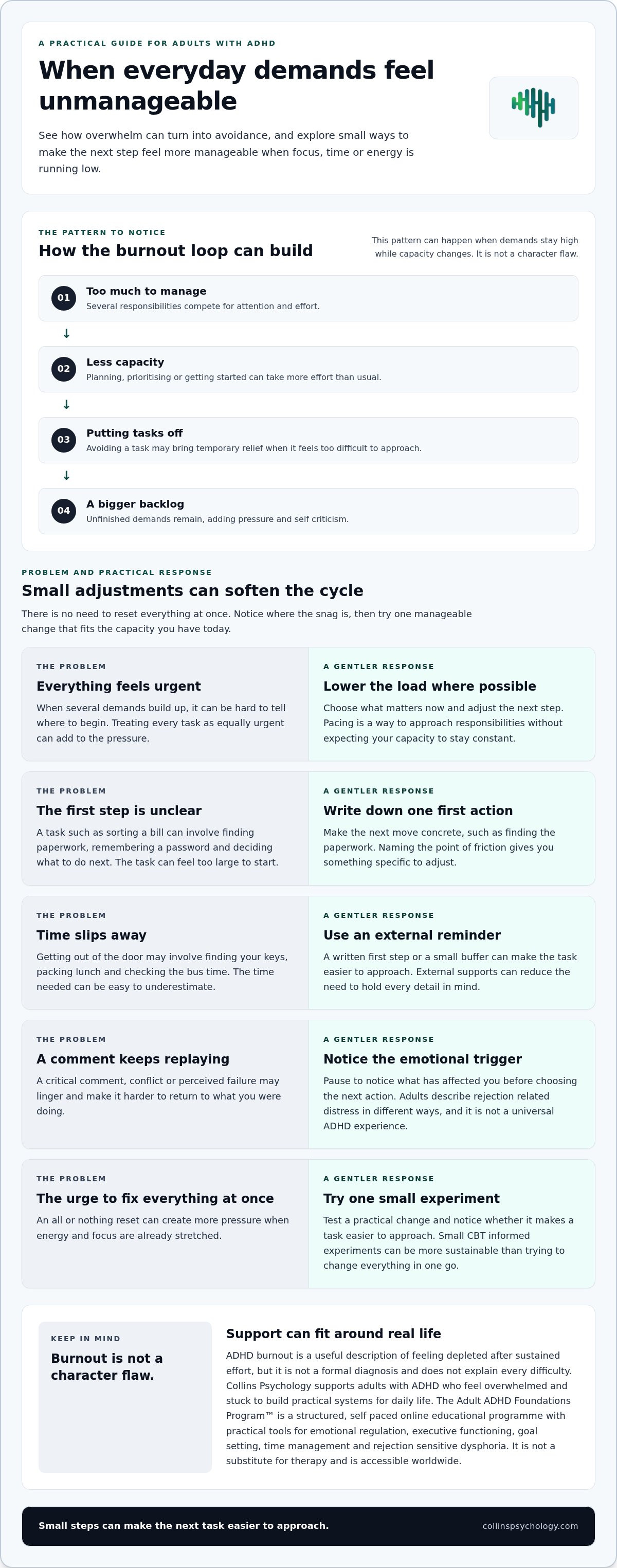
A practical CBT informed recovery plan for ADHD burnout
A useful plan should respond to the energy and responsibilities you have today, not demand that you follow a perfect routine. CBT can help you notice how thoughts, feelings and actions interact, then test a small practical change. How to recover from ADHD burnout can be approached as a flexible sequence: notice strain, choose one pressure point, reduce friction, take one small action and review what happened.
Use these steps as options, not a daily checklist you must complete in order. You might pause after any step, repeat one, or choose a different pressure point if your circumstances change.
Notice strain.
Name what feels difficult, such as a packed morning, an overdue task or a noisy workspace. Be specific without judging yourself.
Choose one pressure point.
Pick the issue that would make the next part of your day easier if it shifted.
Reduce friction.
Make the first step clearer, remove a distraction, prepare what you need or use body doubling.
Take one small action.
If task paralysis is stopping you writing a report, open the document and type the heading. If time blindness is making you late, set an alarm for leaving rather than only for the appointment.
Review.
Ask what helped, what got in the way and whether to adjust your next step. This supports follow-through without turning one missed plan into a personal verdict.
A brief thought record can make this review more compassionate. Write down the situation, the thought that showed up, and the facts you can observe. Then separate those facts from assumptions. For example, “I haven’t replied yet” is a fact; “I’ve ruined the relationship” is an assumption. End with one useful next action, such as drafting a short reply without sending it yet. The aim isn’t to force positive thinking. It’s to find a balanced view that helps you choose what to do.
Break task paralysis into a first visible action
“Finish the report” may feel too broad to start. Make the action observable and small: open the document, find the relevant email, or write a rough heading. You can then decide whether to continue or pause. This approach lowers the barrier to beginning without requiring you to finish the whole task in one sitting. A CBT approach to procrastination and ADHD can offer more ways to work with avoidance and task initiation.
Use external supports for time and follow through
Don’t rely on memory alone if a visible reminder or written next step would help. A calendar prompt can include the action, not just the appointment, such as “leave home” rather than only the meeting time. Allow realistic transition time for finding belongings, getting ready or switching tasks. For example, if you have a GP appointment in Cork or an online meeting from home, add the preparation and travel or log-in steps to the plan. If a plan slips, briefly review what made it hard and adjust the next attempt without turning the review into self-criticism.
For structured, online CBT tools that support daily functioning, explore the Adult ADHD Foundations Program™.
Explore The Adult ADHD Foundations Program™, a self-paced online programme with practical tools for daily life.
Build sustainable ADHD support with online CBT
Recovery is not about expecting yourself to manage every demand through willpower. Online support can make skills easier to access around work, parenting, study and everyday responsibilities, whether you are in Ireland or elsewhere. It can involve learning practical strategies and shaping routines around how your attention, energy and time work in real life.
The Adult ADHD Foundations Program™ is a psychologist-developed, structured, self-paced online programme available internationally. It includes five core modules, more than 13 hours of content and five comprehensive workbooks, with 12 months of access. It provides practical daily tools for emotional regulation, executive functioning, goal setting, time management and rejection sensitive dysphoria. It is an educational programme, not a substitute for therapy.
What structured online CBT support can offer
CBT-informed learning can help you notice patterns, test practical changes and build skills step by step. Relevant areas include emotional regulation, executive functioning, goal setting and time management. You might turn “get fit again” into “walk for ten minutes after lunch on Tuesday”, or turn “focus better” into “work for ten minutes with my phone in another room”. Specific, observable goals make it easier to see what happened and adjust rather than abandoning the plan (Diamond, 2013).
ADHD can look different across people and stages of life, so the challenges you want to work on may vary too. Learning can include fitness and focus, parenting challenges, making sense of a late diagnosis, or rebuilding routines after burnout. A parent might practise breaking the evening routine into visible steps, while someone adjusting after a late diagnosis might review old self-critical beliefs through a CBT thought record. You don’t need to address everything at once. Starting with one area can make it easier to put a new idea into practice and decide whether it fits your circumstances.
Choose a next step that feels manageable
Before beginning, identify one daily challenge you’d like to understand or address. It might be getting started on a routine task, keeping track of appointments or managing the emotional impact of an unexpected change. Write down what happens, what tends to get in the way and what a slightly easier version of the situation could look like. This gives you a specific place to begin rather than another broad goal to feel responsible for.
How to recover from ADHD burnout is a personal process, and support should leave room for your current capacity. You can explore the programme and consider whether its structured learning feels like a useful next step for you.
Our private services are not appropriate for acute incidents or urgent support. If you are in crisis, contact Samaritans 116 123, your GP, or dial 112 or 999. These contacts are external support resources.
Take one manageable step towards recovery
How to recover from ADHD burnout doesn’t need to be answered with a complete life overhaul. You can begin by noticing one place where a small change might make daily life easier, then build from what you learn. A missed step or difficult day isn’t proof that you’ve failed. It’s useful information about what may need adjusting.
If you’d like structured support as you work out your next steps, Collins Psychology’s psychologist developed adult ADHD CBT programmes offer practical learning for adults with or without a formal diagnosis. The learning is 100% online and self paced, so you can explore it around your real life. It provides tools for daily functioning, not a replacement for therapy.
You don’t have to solve everything today. Choose a next step that feels possible, and give yourself permission to adjust as you go. With practical support, you can build systems that work WITH your ADHD brain
Frequently Asked Questions
These questions reflect common concerns about ADHD burnout, task initiation, emotional regulation and online support. The answers are educational and focus on practical ways to understand patterns and reduce friction in daily life.
Can you recover from ADHD burnout while still managing everyday responsibilities?
Yes, recovery can happen alongside everyday responsibilities, although it may involve changing how you meet them. You might ask for a deadline extension, simplify a meal or focus on the task that matters most today. How to recover from ADHD burnout will look different for each person, and there is no guaranteed outcome. These educational strategies aren’t urgent support. If you need immediate help, use appropriate urgent support services.
How long does it take to recover from ADHD burnout?
There isn’t one reliable timetable for everyone. Ongoing demands, personal circumstances and available support all affect what recovery looks like. Instead of measuring progress against a deadline, notice small changes, such as finding it easier to return to a task after a pause or manage one part of your routine. If difficulties persist or feel unmanageable, consider seeking appropriate support. Avoid treating a slower week as proof that you’re making no progress.
Is ADHD burnout the same as being lazy?
No. Difficulty starting a task or keeping up with demands shouldn’t automatically be labelled laziness. Overwhelm or executive functioning challenges can make it harder to organise, begin or complete an activity, even when it matters to you. One difficult experience doesn’t establish ADHD or explain everything. Instead, get curious: is the instruction unclear, does the task have too many steps, or are you short on time? One adjustment may make it easier to begin.
Can you experience ADHD burnout without a formal ADHD diagnosis?
Yes, someone can feel depleted and overwhelmed without having a formal ADHD diagnosis, but that feeling alone can’t show whether they have ADHD. Collins Psychology’s Adult ADHD Foundations Program™ is designed for adults with or without a formal diagnosis and offers practical strategies for daily challenges. If you’re seeking diagnostic clarity, pursue an appropriate assessment outside the programme. You can still explore useful ways to manage planning, focus or task initiation in everyday life.
What is one small first step when ADHD task paralysis feels overwhelming?
Choose the smallest visible action that would move the task forward. If you need to deal with an email, you could open the message; if the kitchen feels daunting, you could place one cup by the sink. Starting isn’t the same as finishing. Pick an action that suits your available capacity, then decide whether to continue, pause or adjust. There’s no rule that you must build momentum or complete the whole task.
Medical and Mental Health Disclaimer
The information provided on this page, in the Adult ADHD Foundations Program™, individual Collins Psychology programs and the Adult ADHD Reflection Quiz is for general educational and informational purposes only and is not a substitute for individual medical, psychological or psychiatric assessment, diagnosis or treatment. These resources do not diagnose ADHD or any other condition and are not psychotherapy, counselling, crisis support or personalised treatment. Although the material is psychologist-developed and informed by psychological research and evidence-based approaches, individual outcomes will vary and no specific result can be guaranteed. If you are experiencing severe or worsening psychological symptoms, significant impairment, thoughts of harming yourself or another person, or concerns about your safety, seek support from an appropriately qualified health professional or contact the emergency or crisis service appropriate to your location.