.png)

If you live with ADHD, you are likely all too familiar with the cycle of procrastination. You know exactly what you need to do, you may even want to do it, but getting started feels impossible. This guide explores how Cognitive Behavioural Therapy (CBT) offers a structured, evidence-based system to break this cycle. We will move beyond generic productivity tips and delve into the core challenges of emotional regulation and executive functioning that drive ADHD-related procrastination, providing you with practical strategies to finally bridge the gap between intention and action.
Key Takeaways
• Procrastination in ADHD is not a character flaw but a challenge with emotional regulation and executive functioning.
• Standard productivity advice often fails because it does not address the underlying cognitive and emotional barriers common in the ADHD brain.
• Cognitive Behavioural Therapy (CBT) provides a structured framework for identifying and challenging the thought patterns and behaviours that fuel the procrastination cycle.
• Practical CBT strategies like task breakdown, time externalisation, and behavioural activation are essential for building momentum and reducing overwhelm.
• Collins Psychology offers self-paced, online CBT programmes designed as a system to help you manage procrastination without the pressure of traditional therapy appointments.
Table of Contents
• Understanding the Clinical Link Between Procrastination and ADHD
• How Cognitive Behavioural Therapy Targets Procrastination
• Practical CBT Strategies for Time Management and Focus
• The Role of Sleep, Fitness, and Emotional Regulation
• Building a Sustainable System with Self-Paced CBT
Understanding the Clinical Link Between Procrastination and ADHD
For many adults with ADHD, procrastination is more than just delaying a task; it is a chronic and often paralysing experience. It is crucial to understand this is not a sign of laziness or a character flaw, but a direct consequence of how the ADHD brain is wired. Procrastination is fundamentally a failure of self-regulation, driven by difficulties with executive functioning, a need for higher dopamine stimulation, and a distorted perception of time, often called "time blindness." At Collins Psychology, we provide structured online programmes that address these core issues, helping you build systems that work with your brain, not against it.
The Intention-Action Gap in Adult ADHD
Do you ever find yourself knowing exactly what to do but being completely unable to start? This is the "intention-action gap," a common and deeply frustrating experience for adults with ADHD. This gap occurs because the brain's executive functions, managed by the prefrontal cortex, struggle to translate plans into coordinated actions (Barkley, 2015). When a task feels too large, boring, or emotionally challenging, the brain defaults to avoidance, leaving you feeling stuck and overwhelmed by a sense of paralysis.
According to Adult attention deficit hyperactivity disorder, this is a well-documented area of ongoing research and practical application.
Why Traditional Productivity Advice Fails
Well-meaning advice like "just use a planner" or "get more disciplined" often feels shaming and ineffective for those with ADHD. These "top-down" strategies assume that the primary problem is a lack of organisation, when the real issue is often emotional and cognitive. The ADHD brain requires "bottom-up" strategies that first address the emotional blocks to starting a task, such as anxiety, boredom, or fear of failure. This is where Cognitive Behavioural Therapy provides an evidence-based standard for ADHD management, offering tools to manage the thoughts and feelings that get in the way of action.
How Cognitive Behavioural Therapy Targets Procrastination
Cognitive Behavioural Therapy (CBT) offers a powerful framework for understanding and breaking the procrastination loop. The core of the CBT model is the interconnectedness of our thoughts, feelings, and behaviours. For someone with ADHD, a thought like "This project is too big, I'll never finish it" (all-or-nothing thinking) can trigger feelings of overwhelm and anxiety, leading to the behaviour of avoiding the task. A structured, self-paced learning environment is ideal for developing the skills to interrupt this cycle and know what to do AND actually do it.
Challenging the Cognitive Distortions of Delay
Procrastination is often fuelled by unhelpful thought patterns, or cognitive distortions. Thoughts such as "I need to feel motivated to start" or "I'll feel more like doing this tomorrow" are cognitive traps that provide temporary relief but ultimately increase long-term stress. Using a CBT technique like the "Five-Minute Rule," you can conduct a behavioural experiment: commit to working on a task for just five minutes. This small step challenges the belief that you must feel ready to start and often builds enough momentum to continue, all while practising self-compassion to reduce the shame that fuels the cycle.
Research published by Cognitive Therapy for ADHD shows that this is a well-documented area of ongoing research and practical application.
Behavioural Activation and Task Initiation
Task initiation, the ability to begin a task without procrastinating, is a specific executive function challenge in ADHD. Behavioural activation is a core CBT strategy that focuses on increasing engagement in positive or meaningful activities, even when motivation is low. One effective technique is "anchoring," where you link a new, undesirable task to an existing, automatic habit. For example, you could decide to spend 15 minutes clearing your desk immediately after you finish your morning coffee, reducing the cognitive load required to get started. For a deeper dive into these skills, our CBT for ADHD Emotional Regulation course provides structured modules to build these foundational habits.
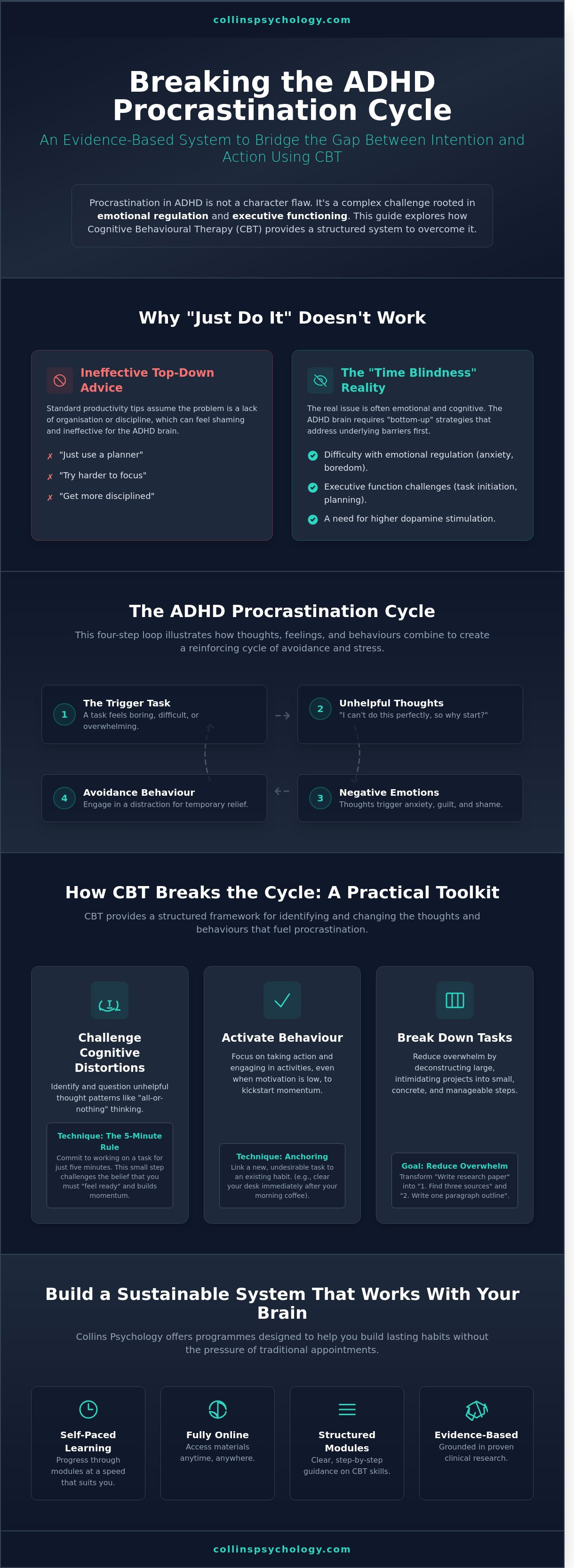
The ADHD Procrastination Cycle
Step 1: The Trigger Task.
You are faced with a task that feels boring, difficult, or overwhelming.
Step 2: Unhelpful Thoughts.
Your mind generates cognitive distortions like, "I can't do this perfectly, so I won't start," or "I'll do it later when I feel more motivated."
Step 3: Negative Emotions.
These thoughts trigger feelings of anxiety, guilt, shame, or frustration. To escape these uncomfortable emotions, you turn to a distraction.
Step 4: Avoidance Behaviour.
You engage in a different, more immediately rewarding activity (e.g., scrolling on your phone, cleaning something else). This provides temporary relief but reinforces the cycle, making the original task seem even more daunting.
Breaking the Cycle with CBT: CBT intervenes at Step 2 by teaching you to challenge unhelpful thoughts and at Step 4 by using behavioural strategies to start the task despite the discomfort.
Practical CBT Strategies for Time Management and Focus
CBT provides a toolkit of practical, structured strategies that are far more effective than willpower alone. These techniques are designed to externalise executive functions, making abstract concepts like time and planning more concrete and manageable. By implementing these systems, you can stop relying on motivation and build a reliable framework for getting things done.
Externalise time.
To combat "time blindness," use visual timers, analogue clocks, and phone alarms to make the passage of time tangible. This creates external cues that help with pacing and transitions.
Break tasks into "micro-steps".
A task like "clean the kitchen" is too vague. Break it down into concrete steps that take less than ten minutes each, such as "load the dishwasher," "wipe the counters," and "sweep the floor."
Implement "body doubling".
Work alongside another person, either physically or virtually. The quiet presence of someone else can significantly enhance focus and accountability.
Use "Implementation Intentions".
Create If/Then plans to automate your responses and reduce decision fatigue. For example: "If it is 3 PM, then I will spend 15 minutes answering emails."
Mastering Executive Functioning through Structure
A core concept in managing ADHD is creating an "External Brain." This means getting all tasks, reminders, and appointments out of your head and into a visible, trusted system. This could be a whiteboard, a digital app, or a simple notebook. To make your to-do list more effective, try categorising tasks by the amount of energy they require (low, medium, high) rather than just by deadline. This allows you to match your tasks to your current capacity, making it easier to start something, even on a low-energy day. Our CBT for ADHD Executive Function course provides practical tools to build your own external brain system.
Research published by Cognitive behavioral therapy for adults with ADHD shows that this is a well-documented area of ongoing research and practical application.
Goal Setting for the ADHD Brain
Traditional SMART (Specific, Measurable, Achievable, Relevant, Time-bound) goals can sometimes feel rigid and overwhelming for the ADHD brain. An ADHD-friendly approach often involves focusing on "process goals" instead of "outcome goals." For example, instead of a goal to "write a 5,000-word report" (outcome), set a goal to "write for 25 minutes every day" (process). This shifts the focus to consistent effort, which is within your control, and helps maintain motivation without being fixated on a distant, intimidating outcome. You can explore this approach further in our dedicated ADHD Goal Setting module.
The Role of Sleep, Fitness, and Emotional Regulation
Executive functions do not operate in a vacuum; they are profoundly affected by your physical and emotional state. Poor sleep, lack of physical activity, and unmanaged emotions can severely deplete the cognitive resources needed to fight procrastination. Research consistently shows that poor sleep hygiene exacerbates executive function deficits in adults with ADHD (Wajs & Wajs, 2020). Addressing these foundational areas is not an afterthought; it is a critical component of building a sustainable system for managing your ADHD. Emotional regulation is a core skill taught across all Collins Psychology programmes, helping you manage the anxiety, boredom, and frustration that form the "emotional wall" of procrastination.
Optimising Physical Health for Cognitive Control
Simple lifestyle adjustments can have a significant impact on your ability to initiate tasks. Establishing a consistent sleep routine, including a "digital sunset" an hour before bed, helps regulate your circadian rhythm. Similarly, incorporating regular physical activity, especially in the morning, can boost dopamine levels and increase the cognitive energy available for the day (Wajs & Wajs, 2020). Think of the "exercise-first" principle as a way to prime your brain for focus before you even sit down at your desk.
Managing the Anxiety of the Unfinished Task
The constant awareness of unfinished tasks can create a chronic state of low-grade anxiety or fight-or-flight. This mental "pile-up" makes it even harder to choose a task and begin. When you feel overwhelmed by your to-do list, use a simple grounding technique: take three slow, deep breaths and name one thing you can see, one thing you can hear, and one thing you can feel. This brief mindfulness practice can calm your nervous system enough to take the next small step. The self-paced nature of our online modules is designed to avoid the additional anxiety that can come with scheduling and attending traditional therapy appointments, allowing you to learn at your own pace.
Building a Sustainable System with Self-Paced CBT
For busy adults with ADHD, finding the time and energy for weekly appointments can be a barrier in itself. Online, self-paced programmes offer a flexible and accessible alternative. Collins Psychology provides a structured system, not therapy or coaching, that you can work through on your own schedule. This model allows you to start where you struggle most and build your ADHD support system over time. Our programmes include practical exercises, downloadable tools, and evidence-based modules designed to help you stop starting over every Monday and build lasting skills.
Why a Structured Programme Outperforms Random Tips
While social media can offer helpful tips, a "scattergun" approach often leads to confusion and inconsistent results. A cohesive clinical framework, like the one used in our online programmes, provides a systematic path forward. Our modules use a "learn-apply-review" cycle, ensuring you not only understand the concepts but also integrate them into your daily life. The programme design is aligned with the professional standards of bodies like the Psychological Society of Ireland (PSI), giving you a reliable and evidence-based foundation for change.
Taking the First Step Toward Change
We know that starting is the hardest part. Your "quick win" action today could be as simple as writing down one task that has been weighing on you and identifying the very first physical step required to begin. Instead of "do taxes," it becomes "find last year's tax folder." By making the first step ridiculously small, you lower the barrier to entry. If you are ready to build a comprehensive system for managing your ADHD, we invite you to explore the full collection of CBT for Adult ADHD programmes. Reclaiming your time and focus is possible with the right structure and support.
Frequently Asked Questions
Can CBT really help with ADHD-related procrastination?
Yes. CBT is one of the most well-researched approaches for adult ADHD. It works by targeting the specific cognitive distortions (e.g., "I must do this perfectly") and avoidance behaviours that drive procrastination, helping you build more effective coping strategies (Safren et al., 2005).
How is CBT for ADHD different from standard CBT for depression or anxiety?
While it uses the same core principles, CBT for ADHD is adapted to focus on the primary challenges of the condition: executive dysfunction, emotional regulation, and time management. It is highly practical, skills-based, and focused on building systems and structures in your daily life.
Do I need a formal diagnosis to start an online CBT programme for ADHD?
No, a formal diagnosis is not required to access and benefit from our self-paced programmes. If you recognise the challenges of procrastination, disorganisation, and emotional dysregulation in yourself, these skills-based modules can provide valuable tools and strategies.
How long does it take to see results from these CBT strategies?
Progress varies for each individual, but many people begin to notice small changes within a few weeks of consistently applying the strategies. The key is consistent practice, not perfection. The self-paced nature of the programmes allows you to move at a speed that works for you.
What if I procrastinate on starting the self-paced CBT course itself?
This is a very common and understandable concern. The programmes are designed with this in mind, broken into small, manageable modules. We recommend starting with the module that addresses your biggest pain point right now. One system, multiple entry points means you can begin where you need the most help.
Is one-to-one therapy better than an online self-paced programme for ADHD?
Neither is inherently "better"; they serve different needs. One-to-one therapy is ideal for complex mental health issues requiring direct therapist interaction. Our online programmes are designed as a structured system for learning and applying practical skills, offering flexibility and accessibility for adults who want to build functional life management tools independently.
How do these strategies help with "paralysis" when facing a big project?
CBT strategies directly address paralysis by breaking down the overwhelming project into tiny, concrete "micro-steps." By focusing only on the very next, non-intimidating action, you can bypass the brain's threat response and build momentum, which is often all that is needed to get moving. This is a core component of our guide on
Can these CBT tools help with ADHD symptoms like poor sleep or lack of focus?
Absolutely. The programmes include modules that specifically address the behavioural components of sleep hygiene, as well as strategies to improve focus and attention. By building a structured routine and managing the anxiety that often disrupts sleep, you can address these related symptoms effectively. For more on this, you can read our
References
Barkley, R. A. (2015). Attention-deficit hyperactivity disorder: A handbook for diagnosis and treatment (4th ed.). Guilford Press.
Safren, S. A., Otto, M. W., Sprich, S., Winett, C. L., Wilens, T. E., & Biederman, J. (2005). Cognitive-behavioral therapy for ADHD in medication-treated adults with continued symptoms. Behaviour Research and Therapy, 43(7), 831–842. https://doi.org/10.1016/j.brat.2004.07.001
Wajs, E., & Wajs, K. (2020). The role of physical activity in the management of ADHD. Psychiatria Polska, 54(5), 897–908. https://doi.org/10.12740/PP/OnlineFirst/110939
Disclaimer
Our programmes are designed to provide educational, evidence based CBT strategies to support adults with ADHD in everyday life. They are not a substitute for individual therapy or personalised care. If you are experiencing significant difficulties, we encourage you to seek support from a local qualified healthcare professional.