

If you care about a task but still cannot start, this guide will help you understand the ADHD intention-action gap and use practical CBT-informed tools for overwhelm, procrastination, emotional reactivity, focus and time management. You will learn why task initiation can be difficult, how to make action easier, and where online support can fit around real life.
Key takeaways
• The intention-action gap is an executive functioning challenge, not a character flaw.
• Care, pressure and fear of getting things wrong can make task initiation harder.
• Emotional regulation, time blindness and working memory all affect follow-through.
• CBT tools such as chunking, implementation intentions and environmental cues can make starting easier.
• Collins Psychology supports adults with ADHD who feel overwhelmed and stuck through practical, online, self-paced programmes.
When caring is not enough
The intention-action gap describes the frustrating space between knowing exactly what you need to do and actually starting the task. For many adults, this gap feels like a personal failure, but it's actually a core feature of executive dysfunction. You might find yourself asking, "why do i procrastinate even when i care," only to find that the more important a task becomes, the harder it is to initiate. This happens because high levels of care often translate into increased internal pressure, which spikes anxiety and triggers a defensive freeze response in the brain. Trying harder is rarely an effective strategy because it doesn't address the underlying neurological block that prevents you from moving from thought to action.
It is not laziness
Laziness is a choice to avoid work. However, the paralysis felt by those with ADHD is a biological struggle to engage the brain's ignition system. When you're stuck on the sofa unable to move toward a simple chore, your brain is often experiencing a genuine breakdown in task initiation. The psychology of procrastination suggests that this is less about time and more about the inability to bridge the gap between thought and movement. Constant reminders that you have so much potential only deepen the sense of shame, which acts as a heavy anchor rather than a motivator for future action. This internal paralysis is a physical sensation that can leave you feeling trapped in your own body while your to-do list grows.
When pressure backfires
High-stakes tasks often trigger a fear of failure that leads to perfectionism, causing you to avoid the work entirely to protect your self-esteem. This avoidance is frequently linked to Rejection Sensitive Dysphoria (RSD), where the perceived sting of a potential "bad job" feels physically painful. Because the ADHD brain is wired to prioritise immediate dopamine hits over long-term rewards, it'll often choose a low-stakes distraction over a high-value project. It isn't a lack of values; it's simply the brain's way of seeking safety from the overwhelming pressure of a task that feels too big to get right. When you feel overwhelmed and stuck, CBT for adult ADHD can help you build the practical systems needed to move forward without the weight of constant shame.
Why starting feels hard
The prefrontal cortex acts as the brain's command centre, managing everything from focus to impulse control. In the ADHD brain, this area often struggles with dopamine regulation, which makes it difficult to start or sustain effort on tasks that aren't immediately rewarding (American Psychiatric Association, 2022). Understanding this neurobiological foundation explains why do i procrastinate even when i care, as your brain's "ignition" system requires more than just a sense of importance to fire. Dopamine acts as the chemical messenger that signals reward and motivation, but when these levels are inconsistent, the transition from "thinking" to "doing" becomes physically difficult.
Unlike a neurotypical brain that responds to importance or consequences, the ADHD nervous system is often interest-based. This means that even if a task is vital for your career or health, your brain may not release the necessary dopamine to initiate the action unless the task is novel, challenging, or urgent. This creates a painful disconnect where your values and your actions are out of alignment, leaving you feeling stuck despite your best intentions. It isn't a lack of character, but a physiological reality of how your brain processes effort and reward in real time.
Working memory matters
Working memory is like a mental scratchpad that holds information while we work on a task. For many adults with ADHD, this scratchpad is smaller, meaning multi-step projects quickly become an overwhelming "wall" of data. When you can't hold all the steps in your head at once, the cognitive load becomes too heavy, and the brain's "start" button simply fails to engage. This helps explain why do i procrastinate even when i care, as the mental energy required to organise these steps can lead to immediate burnout before you've even started. To better manage these moments, focusing on ADHD executive functioning strategies can help break down that cognitive load into manageable pieces.
Making time visible
Time blindness is a common executive function challenge that makes it difficult to perceive the passage of time or estimate how long a task will take. This creates a binary world where everything is either "Now" or "Not Now," leading to a situation where tasks in the "Not Now" category are essentially invisible until they become urgent. This temporal myopia often leads to accidental procrastination, as the brain cannot feel the future consequences of a delay until it's almost too late. When a deadline isn't in the "Now" zone, your brain doesn't trigger the alertness needed to begin, leading to the familiar cycle of last-minute panic and exhaustion.
The emotional side of procrastination
Many people view procrastination as a failure of time management, but for those with ADHD, it's fundamentally an issue of emotional regulation. When you ask, "why do i procrastinate even when i care," the answer often lies in the emotional weight of the task itself. If a project feels overwhelming or boring, your brain perceives it as a threat, triggering a cycle of avoidance. You feel anxiety, you avoid the task to find immediate relief, and that relief reinforces the habit of avoidance for the future. Integrating ADHD emotional regulation techniques through Mindfulness Based Cognitive Therapy helps you notice these triggers before they lead to total paralysis.
The overwhelm spiral
When you face a complex task, your nervous system can misinterpret the challenge as a physical danger. This leads to a state of fight-or-flight, where your body feels physically unable to move toward the work. It isn't just about being "lazy"; it's a genuine struggle to down-regulate the stress response (Ramsay, 2020). For an ADHD brain, boredom is not just a minor annoyance but a painful state that the brain will do almost anything to escape. This is often the real reason why do i procrastinate even when i care, as the emotional threat overrides the logical value of the task.
Move beyond shame
The “shame spiral” is a common experience where you feel bad for procrastinating, which increases your stress and makes you more likely to avoid the task. Breaking this loop requires a shift from self-criticism to self-compassion. Pause and ask, “What is the specific emotion I am trying to avoid right now?” It might be fear of judgement, frustration with a difficult step or dread of boredom. Naming the emotion can make it easier to choose a small, deliberate action.
The gap at a glance
This quick visual summary shows how caring deeply can still lead to task paralysis, and how small, structured steps can help you begin. External cues are kinder to a busy working memory than good intentions alone. Use the sequence whenever a task feels foggy or too large.
| What happens | What can help |
|---|---|
| The task feels important and overwhelming. | Name the feeling and lower the first step. |
| Your brain cannot see where to begin. | Write one physical action, such as opening the document. |
| Time feels distant or unclear. | Use a visual timer, alarm or time anchor. |
| Starting still feels uncomfortable. | Try five minutes, body doubling or an if-then plan. |
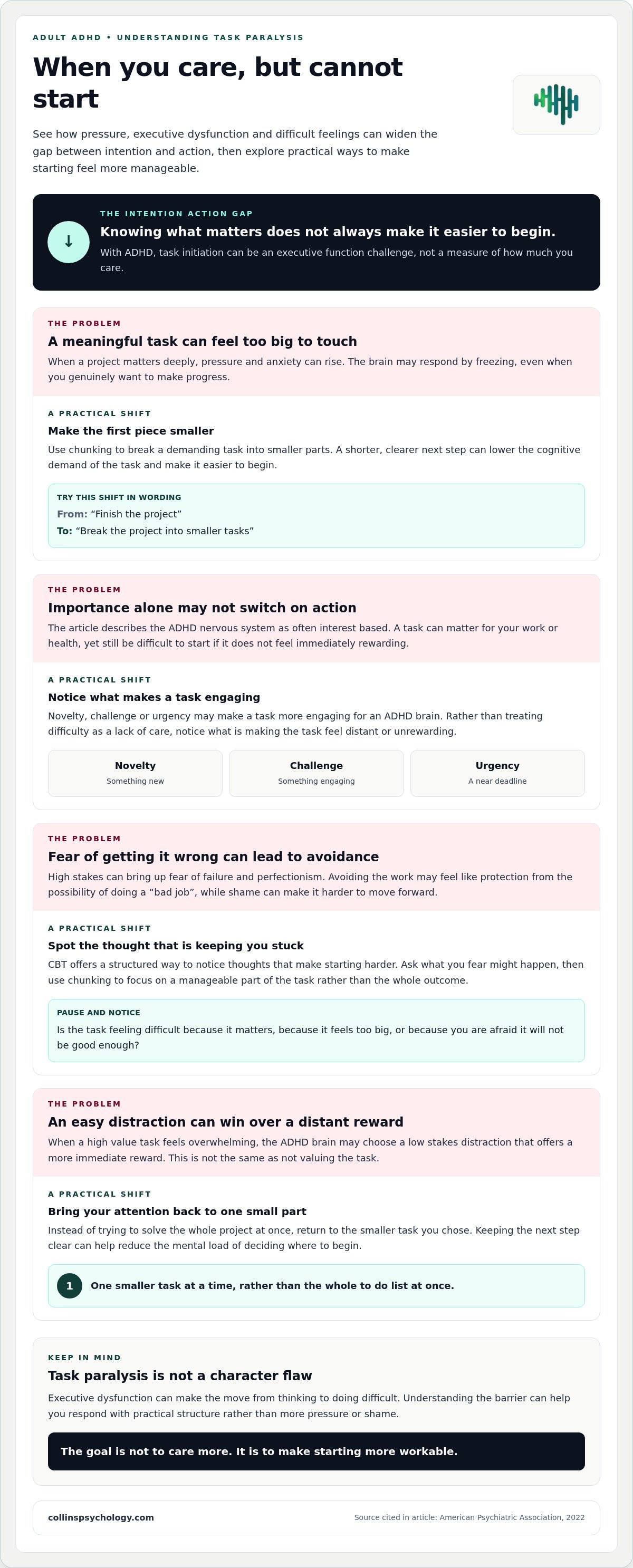
CBT tools that help
CBT is a logical next step for those who feel overwhelmed and stuck. It moves beyond generic advice and focuses on changing the relationship between your thoughts and your actions. One of the most effective tools is "chunking," which involves breaking a large project into the smallest possible units of work. This reduces the cognitive load on your working memory and makes starting feel less like climbing a mountain. Using Implementation Intentions, or "If-Then" plans, also helps by pre-deciding your actions so you don't have to rely on willpower. Externalising information by writing down every step is essential to support a weak working memory and keep your goals visible.
Design for focus
Body doubling is a practical strategy where you work alongside another person to maintain focus. This provides a gentle level of accountability that helps the ADHD brain stay anchored to the task. You should also focus on removing friction by setting up your workspace the night before. Visual cues, such as analogue clocks or brightly coloured reminders, act as external prompts that bypass your internal struggle with time blindness.
Loosen perfectionism
Many adults with ADHD struggle with all-or-nothing thinking, where a task is either done perfectly or not worth doing at all. Try setting “B-minus” goals to shift the objective from perfection to completion. The “five-minute rule” can also lower the barrier to entry: agree to work for only five minutes, then decide what comes next. These methods reduce the emotional and cognitive demand of beginning.
Systems that fit your brain
Adults with ADHD often spend years trying to “fix” themselves, when the real difficulty may be using systems that do not fit their needs. Collins Psychology supports adults with ADHD who feel overwhelmed and stuck through structured, online, self-paced programmes that focus on executive functioning, emotional regulation, goal setting, time management, rejection sensitivity, late diagnosis, parenting challenges, and fitness and focus. The Adult ADHD Foundations Program™ is designed to fit around real life, is accessible worldwide and offers practical tools for daily functioning. These programmes are not a substitute for therapy, but they provide a clear way to learn, practise and revisit skills at your own pace.
Support with structure
A structured programme can provide a clear roadmap for challenges such as rejection sensitivity, time blindness and task initiation. Collins Psychology’s online resources combine CBT-informed exercises with practical ADHD coaching, psychoeducation, mindfulness-based cognitive therapy and behavioural strategies. They are self-paced and designed to fit around work, parenting and everyday responsibilities, whether you are in Ireland or elsewhere in the world. They offer practical support, not a substitute for therapy, and can help you build systems without adding another demanding timetable.
Start small
We encourage you to pick just one small system to implement today, whether that is setting a visual timer or using a "chunking" technique for a difficult email. Remember that your struggle with why do i procrastinate even when i care is a biological challenge, not a moral failing. As you continue to build these practical systems, you'll find that the gap between caring and doing begins to shrink. If you're ready to take the next step toward managing your executive function and emotional regulation, you can explore our CBT for adult ADHD programmes. Taking action today is the first step toward a more empowered and focused future.
From insight to action
We have explored how the ADHD intention-action gap is a neurobiological challenge rather than a reflection of your character or values. By recognising that procrastination is often an emotional regulation strategy, you can stop asking, "why do i procrastinate even when i care" and start using tools that actually work. Shifting toward evidence-based strategies like chunking and environmental design allows you to manage executive dysfunction with more ease and less shame. It's about finding a rhythm that respects your energy and your needs.
Ready to move past the overwhelm? Explore our structured CBT programmes for adult ADHD which are designed specifically for the adult experience. These online, self-paced programmes focus on practical executive functioning and emotional regulation to help you regain control of your daily life. You'll find that progress becomes much more sustainable when you stop fighting your nature and start supporting it. You have the potential to thrive when you finally choose to work with your mind rather than against it.
We hope this has shown you that the gap between caring and doing is not a flaw in you. Our aim is always to help you build systems that work WITH your ADHD brain.
Frequently asked questions
Is procrastination part of ADHD?
Procrastination in ADHD is often a manifestation of executive dysfunction rather than a lack of willpower or a simple bad habit. It usually stems from significant difficulties with task initiation and emotional regulation. While anyone can develop poor habits, the ADHD brain struggles with the neurological processes required to bridge the gap between intention and action. This means you aren't being lazy; you're experiencing a biological hurdle that requires specific strategies.
Why do I wait until the last minute?
You likely wait until the last minute because the pressure of a looming deadline provides the dopamine hit your brain needs to engage. This often answers the question why do i procrastinate even when i care, as the emotional weight of the task makes the "stuck" feeling even more intense. Using urgency as a motor is a common but exhausting coping mechanism for those with executive functioning challenges. It creates a cycle of stress that can be broken with the right systems.
How can CBT help?
Cognitive Behavioural Therapy (CBT) helps by identifying the specific thought patterns and emotional triggers that lead to task avoidance. Our structured programmes teach you how to break down overwhelming projects into manageable steps while building tolerance for the discomfort of starting. It focuses on practical behavioural strategies and cognitive restructuring to help you manage your daily life more effectively. This approach empowers you to move past the shame often associated with ADHD struggles.
What is the difference between laziness and executive dysfunction?
Laziness is generally a choice to avoid effort, whereas executive dysfunction is an inability to act despite a strong desire to do so. If you feel distressed or guilty about your inactivity, it's likely a sign of executive dysfunction rather than a character flaw. Understanding this distinction is vital for moving away from shame and toward effective, structured solutions that support your brain's unique needs. This shift in perspective is the first step toward better management.
How can rejection sensitivity affect work?
Rejection sensitivity can lead to perfectionism or avoidance because the perceived risk of failure or criticism feels emotionally unbearable. You might find yourself unable to start a task because you're subconsciously protecting yourself from potential negative feedback. This emotional regulation challenge is a core part of many ADHD experiences and requires specific strategies to manage effectively. When you address the emotional root, the barrier to starting often begins to lower.
What helps with time blindness?
Managing time blindness involves using external cues to make the passage of time more visible and concrete. You can implement several practical tools to help stay on track throughout your day. These include visual timers, alarms with specific labels, and time anchoring to existing habits. These systems help reduce overwhelm and build a realistic understanding of task duration. By externalising time, you reduce the mental load required to track your progress.
Why do I feel stuck with a to-do list?
Feeling "stuck" often happens because a to-do list doesn't account for the mental energy required for task switching or the overwhelm of choice. Even with a list, your brain might struggle to prioritise or identify the very first physical movement needed to begin. Breaking items down into tiny, non-threatening micro-steps can help lower the barrier to entry and get your momentum started. This addresses why do i procrastinate even when i care by reducing initial friction.
If you are ready to move from feeling overwhelmed and stuck towards practical daily systems, explore Collins Psychology’s online CBT-informed support for adults with ADHD. The Adult ADHD Foundations Program™ is structured, self-paced and designed to fit around real life, with access worldwide. The aim is to help you build systems that work WITH your ADHD brain.
References
• American Psychiatric Association. (2022). Diagnostic and statistical manual of mental disorders (5th ed., text rev.). American Psychiatric Association Publishing.
Medical and Mental Health Disclaimer
The information provided on this page, in the Adult ADHD Foundations Program™, individual Collins Psychology programs and the Adult ADHD Reflection Quiz is for general educational and informational purposes only and is not a substitute for individual medical, psychological or psychiatric assessment, diagnosis or treatment. These resources do not diagnose ADHD or any other condition and are not psychotherapy, counselling, crisis support or personalised treatment. Although the material is psychologist-developed and informed by psychological research and evidence-based approaches, individual outcomes will vary and no specific result can be guaranteed. If you are experiencing severe or worsening psychological symptoms, significant impairment, thoughts of harming yourself or another person, or concerns about your safety, seek support from an appropriately qualified health professional or contact the emergency or crisis service appropriate to your location.