.png)

For many adults in Ireland, life can feel like a constant battle against procrastination, emotional overwhelm, and a persistent feeling of being behind. If you suspect these struggles are more than just character flaws, you may be wondering about the signs of Attention Deficit Hyperactivity Disorder (ADHD). The single most significant red flag for adult ADHD is not one specific behaviour but a chronic pattern of executive dysfunction: a persistent and often perplexing inconsistency in your ability to manage your life, focus, and regulate your emotions. This article explores the key indicators of adult ADHD through the practical lens of Cognitive Behavioural Therapy (CBT), offering clarity and actionable strategies for moving forward.
Identifying the Primary Red Flag of ADHD: A Pattern of Executive Dysfunction
The defining red flag of adult ADHD is a chronic inconsistency between your intentions and your actions, a pattern that persists despite your best efforts (Barker, 2020). While childhood ADHD is often associated with visible hyperactivity, adult symptoms are frequently more internalised. You might experience a constant inner restlessness, a mind that never seems to switch off, or a struggle to relax. This stems from challenges with executive function, which is essentially the brain’s management system responsible for planning, organising, and executing tasks. At Collins Psychology, we provide online, self-paced CBT programmes designed to help you build these skills. It is important to note that we do not offer one-to-one therapy; our programmes are created for flexible, independent learning.
The Inconsistency Gap: Why "Trying Harder" Does Not Work
A common frustration for adults with ADHD is the ability to hyperfocus on an engaging hobby for hours but struggle to start a simple work task. This is not a failure of willpower. The ADHD brain processes dopamine, a key neurotransmitter for motivation and reward, differently (Ramsay, 2020). Tasks that are novel, urgent, or personally interesting can trigger enough dopamine to fuel focus. Mundane or overwhelming tasks do not, creating an "inconsistency gap" that makes "just trying harder" an ineffective strategy. Recognising this as a neurological challenge, not a moral failing, is the first step toward effective management.
Executive Function Red Flags in Daily Adult Life
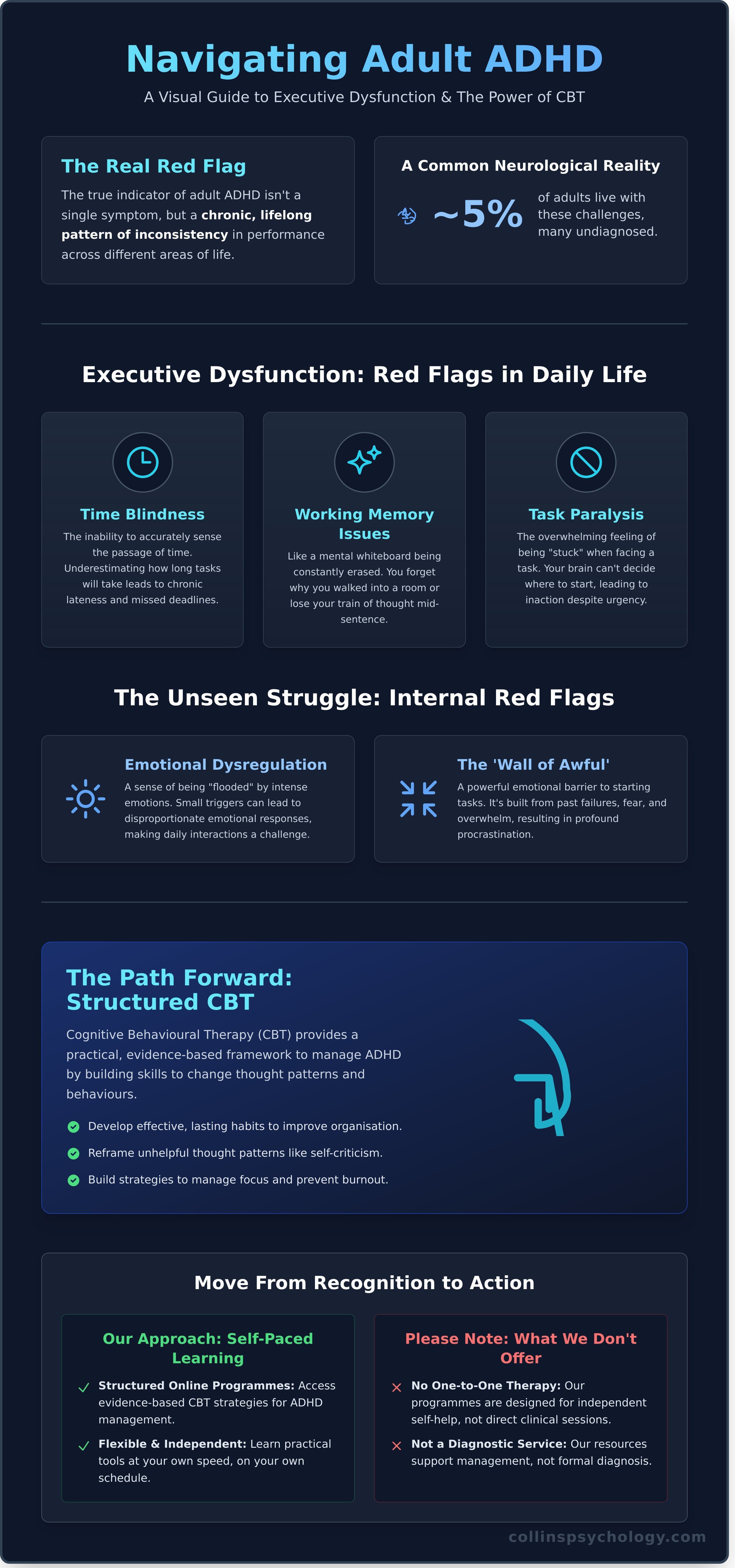
This neurological challenge manifests in tangible ways throughout your day. Key red flags related to executive function include:
Time Blindness
A consistent inability to accurately sense the passage of time. This can lead to chronic lateness, underestimating how long projects will take, and feeling like time moves either too fast or too slow.
Working Memory Issues
Difficulty holding and manipulating information in your mind. This might look like forgetting why you walked into a room, losing your train of thought mid-sentence, or needing to reread the same paragraph multiple times.
Task Paralysis
The overwhelming feeling of being unable to start a task, even if it is simple or urgent. This is not procrastination in the typical sense; it is a mental roadblock that can be incredibly frustrating. If you struggle with this, our guide to overcoming task paralysis provides practical strategies.
The Internal Red Flags: Emotional Regulation and Rejection Sensitivity
While executive dysfunction affects what you do, emotional dysregulation affects how you feel. This is a core, yet often overlooked, red flag of adult ADHD (Safren et al., 2017). Many adults experience "flooding", where emotions feel so intense and overwhelming that they are impossible to manage in the moment. This emotional volatility can place significant strain on relationships, friendships, and workplace dynamics. As an Irish psychology practice, our approach is aligned with the professional guidelines of the Psychological Society of Ireland (PSI), ensuring a responsible and evidence-based framework for our programmes.
Rejection Sensitive Dysphoria (RSD): The Hidden Red Flag
Rejection Sensitive Dysphoria, or RSD, is an extreme emotional sensitivity and pain triggered by the perception of being rejected, teased, or criticised. This is not a formal diagnosis, but it is a common experience for many with ADHD. This intense reaction can lead to two common coping mechanisms: becoming a people-pleaser to avoid disapproval at all costs or withdrawing from social situations to prevent the possibility of rejection. Learning to manage these intense feelings is crucial, which is why our programmes include dedicated emotional regulation strategies.
Mood Lability vs. Clinical Depression
The rapid, short-lived mood swings associated with ADHD are often mistaken for other conditions like depression or bipolar disorder. The key difference is duration and trigger. ADHD-related mood shifts are often a momentary, intense reaction to a specific event and can dissipate as quickly as they appear. Clinical depression, in contrast, involves a sustained period of low mood. CBT is highly effective in helping you identify your emotional triggers and develop thought patterns that reduce the intensity of these shifts.
Recognising ADHD Red Flags in the Workplace and Home
The patterns of executive dysfunction and emotional dysregulation create distinct challenges in professional and personal life. In the workplace, a common red flag is hitting "the wall of awful", an emotional barrier built of past failures and anxieties that makes it feel impossible to start an important project. At home, these challenges can impact everything from household management to parenting. Simple organisational tasks can feel monumental, and routines for sleep and fitness are often the first things to be compromised by inconsistent energy and focus.
The Cost of Procrastination and Chronic Lateness
The cycle of procrastination driven by ADHD is punishing: a task creates anxiety, you avoid it, the anxiety builds, and you are forced to complete it in a last-minute rush of adrenaline. This not only affects performance but also has a real-world cost. The "ADHD tax" refers to the financial consequences of executive dysfunction, such as late fees on bills, forgotten subscriptions, or impulse spending. CBT provides simple time management tools, like breaking tasks down and using external timers, to disrupt this cycle. For more on this topic, you can read our article on why adults with ADHD struggle with procrastination.
Parenting with ADHD: Managing the Chaos
Parenting requires a level of organisation and consistency that can feel impossible when you have ADHD. You may struggle to enforce the very routines your children need because you find them difficult to maintain yourself. This can lead to feelings of guilt and inadequacy. It is important to approach this with self-compassion. Our self-paced learning modules are designed with busy parents in mind, allowing you to learn practical management strategies at your own convenience, whenever you can find a quiet moment.
Why Structured CBT is the Gold Standard for Adult ADHD Management
Cognitive Behavioural Therapy (CBT) is an evidence-based, practical approach that is highly effective for managing adult ADHD. It is not about "curing" ADHD but about building the skills to work with your brain, not against it. CBT focuses on two key areas: changing unhelpful thought patterns (the "cognitive" part) and building better habits and systems (the "behavioural" part). Our self-paced learning tools are distinct from clinical therapy, offering structured education and strategies you can implement immediately in your daily life.
Building Executive Function through Cognitive Strategies
CBT provides a toolkit for managing the overwhelming nature of tasks. A core strategy is breaking large, intimidating projects into concrete "micro-steps". Instead of "clean the kitchen", the first step becomes "put one dish in the dishwasher". This lowers the barrier to entry and makes it easier to get started. Another key element is the use of external cues to support your internal management system. This includes using visual timers, structured planners, and phone reminders to compensate for challenges with working memory and time blindness. For daily tips, you can follow Elaine Collins on Instagram.
The Role of Habit Formation in Long-Term Success
Routines are essential for the ADHD brain because they reduce the number of decisions you have to make each day, conserving mental energy for more complex tasks (Solanto, 2011). CBT helps you build and maintain these routines. Integrating consistent sleep schedules, regular physical fitness, and balanced nutrition into your life provides the foundational stability your brain needs to function at its best. These practical, life-changing tools are available in our online CBT modules.
Moving Forward: From Recognition to Action
Recognising these red flags in your own life is a validating and powerful first step. It is the beginning of understanding that your struggles are not due to a lack of effort but are rooted in neurobiology. Acting on this recognition early can help prevent the burnout and low self-esteem that often accompany unmanaged ADHD. Collins Psychology offers flexible, self-paced online programmes to give you the tools you need. Learning at your own pace removes the pressure that can come with scheduled appointments and allows you to integrate new strategies into your life when you are ready.
Your Path to Better Focus and Emotional Balance
Getting started is straightforward. Our structured CBT for Adult ADHD programme guides you through the core areas of management. The self-paced modules are filled with practical resources, targeted exercises, and tools designed to help you build executive function skills and achieve better emotional balance. These programmes are developed in line with PSI professional guidelines to ensure a high standard of quality and care.
Connecting with a Community of Like-Minded Adults
One of the most powerful aspects of learning about ADHD is realising you are not alone. Understanding that millions of other adults share your experiences can lift a significant weight. We encourage you to take a proactive approach to your mental health and personal development. You have the capacity to manage these challenges and build a life that feels less chaotic and more fulfilling.
Frequently Asked Questions
What is the number one red flag of ADHD in adults?
The number one red flag is not a single behaviour but a chronic and pervasive pattern of executive dysfunction. This manifests as a persistent inconsistency in your ability to regulate your attention, emotions, and actions, causing significant challenges in daily life despite your best intentions.
Can I have ADHD if I was never hyperactive as a child?
Yes, absolutely. Many adults with ADHD, particularly women, never displayed classic childhood hyperactivity. Instead, their symptoms may have been primarily inattentive (e.g., daydreaming, disorganisation) or experienced as internal restlessness and an overactive mind, which are often overlooked.
How does ADHD affect my ability to manage my emotions?
ADHD can significantly impact emotional regulation. This can result in intense, quick-to-rise emotions that feel overwhelming (emotional flooding), extreme sensitivity to perceived criticism (Rejection Sensitive Dysphoria), and rapid mood swings in response to daily events.
Is chronic procrastination always a sign of ADHD?
While not everyone who procrastinates has ADHD, chronic, life-impairing procrastination is a major red flag. For adults with ADHD, it is often driven by executive function challenges like task paralysis, time blindness, and overwhelm, rather than simply laziness or poor time management.
What are the executive function red flags I should look for?
Key executive function red flags include "time blindness" (poor time estimation), weak working memory (forgetting information you just received), difficulty with organisation (at home and work), trouble starting tasks (task paralysis), and challenges with prioritising what is most important.
How do I distinguish between ADHD and general stress?
While stress can worsen ADHD symptoms, the key difference is duration and pervasiveness. Stress is typically a reaction to a specific situation and subsides when the stressor is gone. ADHD challenges are lifelong, present since childhood, and affect multiple areas of your life consistently, not just during stressful periods.
Can CBT help me if I do not want one-to-one therapy?
Yes. Our online programmes at Collins Psychology are specifically designed for this purpose. They are self-paced learning tools that teach you evidence-based CBT strategies and skills for managing ADHD without the need for traditional, one-to-one therapy sessions.
Why is time blindness considered a major red flag?
Time blindness is a major red flag because it fundamentally disrupts the ability to plan, meet deadlines, and structure one's life. It is a core executive function deficit that directly leads to common ADHD-related problems like chronic lateness, underestimating tasks, and feeling constantly rushed or behind schedule.
References
Barker, C. (2020). The adult ADHD guide: A practical and empowering resource for managing symptoms and thriving. Rockridge Press.
Ramsay, J. R. (2020). Cognitive-behavioral therapy for adult ADHD: An integrative psychosocial and medical approach (2nd ed.). Routledge.
Safren, S. A., Sprich, S. E., Perlman, C. A., & Otto, M. W. (2017). Mastering your adult ADHD: A cognitive-behavioral treatment program (2nd ed.). Oxford University Press.
Solanto, M. V. (2011). Cognitive-behavioral therapy for adult ADHD: Targeting executive dysfunction. The Guilford Press.