.png)

For adults with Attention-Deficit/Hyperactivity Disorder (ADHD), the pursuit of a balanced life can feel like a constant battle against overwhelm and inconsistency. The best lifestyle for ADHD is not found in sheer willpower or the latest productivity hack, but in creating a structured environment that supports your unique neurobiology. This article outlines a Cognitive Behavioural Therapy (CBT) approach to building this lifestyle. It moves beyond generic advice to provide a framework for developing sustainable systems for sleep, movement, organisation, and emotional regulation, helping you to finally bridge the gap between knowing what to do and being able to do it.
Key Takeaways
Shift from Willpower to Systems
An effective ADHD lifestyle minimises the reliance on executive functions like memory and motivation by creating external structures and routines. It’s about building systems that work with your brain, not against it.
CBT is the Framework
Cognitive Behavioural Therapy (CBT) provides the evidence-based tools to understand and change the thought patterns and behaviours that undermine consistency, helping you make new habits stick.
Prioritise Biological Foundations
Quality sleep and regular movement are non-negotiable for managing ADHD symptoms. They directly impact the brain’s chemistry, improving focus, mood, and emotional regulation.
Externalise Your Brain
Use environmental scaffolding, such as visual planners, dedicated zones for items, and external timers, to reduce cognitive load and create a calmer, more functional living space.
Emotional Regulation is a Skill
Emotional dysregulation is a core challenge of ADHD. CBT techniques can help you identify triggers, manage overwhelm, and develop self-compassion to break the cycle of shame and frustration.
Table of Contents
• Defining the ADHD Friendly Lifestyle: A Cognitive Behavioural Perspective
• Biological Foundations: Sleep, Movement, and Focus
• Environmental Scaffolding: Creating an External Brain
• Emotional Regulation and the Mental Lifestyle
• Implementing Change with the Collins Psychology CBT Programme
Defining the ADHD Friendly Lifestyle: A Cognitive Behavioural Perspective
An ADHD friendly lifestyle is one that systematically reduces the demand on executive functions. Instead of trying harder, you create an environment and routines that make desired behaviours easier to perform. For adults with ADHD, willpower is often an unreliable resource because challenges with executive functions are neurobiological, not a matter of character (Barkley, 2012). This is why so many people feel they are constantly starting over every Monday.
Cognitive Behavioural Therapy (CBT) offers a structured path forward. It helps you identify the unhelpful thought patterns (e.g., "I have to do this perfectly or not at all") and behaviours (e.g., procrastination) that sabotage your efforts. By applying CBT principles, you can build a lifestyle that provides the external support, or 'scaffolding', that your brain needs to thrive. This article provides a clinical framework to help you build that system for better focus and emotional regulation.
The ADHD Brain and Daily Life
The core struggle for many adults with ADHD is the gap between intention and action. You know you should tidy the kitchen, start the report, or go to bed on time, but initiating and sustaining the action feels impossible. This is a direct result of executive function challenges, which can manifest as:
• Chronic procrastination
• Difficulty with organisation and clutter
• Poor time management
• Trouble regulating emotional responses
Using evidence-based strategies is crucial to bridge this gap, allowing you to not only know what to do but also actually do it.
Moving Beyond Generic Productivity Advice
Generic advice like "just use a planner" or "be more organised" often fails because it does not address the underlying cognitive patterns. Without a system, a planner is just another item to lose. The concept of 'scaffolding' involves creating an external support system for your brain. This means using physical tools, environmental design, and structured routines to handle the tasks your executive functions find difficult. Our online CBT modules are designed to provide the structure needed to build these very systems.
Biological Foundations: Sleep, Movement, and Focus
Before tackling organisation or time management, it is essential to establish a solid biological foundation. The relationship between ADHD and sleep is bidirectional; poor sleep worsens ADHD symptoms, and ADHD symptoms often lead to poor sleep (Fargason & Kjeldgaard, 2021). Similarly, physical movement is a powerful tool for regulating the neurotransmitters, like dopamine and norepinephrine, that are implicated in ADHD. A low-friction approach to these basics is key, as aiming for perfection often leads to burnout. Meeting these fundamental needs has a profound positive impact on your ability to regulate emotions and maintain focus throughout the day.
Establishing an ADHD Friendly Sleep Routine
Many adults with ADHD struggle with sleep, often due to a racing mind, difficulty winding down, or 'revenge bedtime procrastination', where you sacrifice sleep for the personal time you lacked during the day. CBT-informed techniques can help:
Create a "wind-down" buffer zone
Dedicate the last 30-60 minutes before bed to screen-free, calming activities.
Externalise your bedtime
Set alarms not just for waking up, but also for starting your wind-down routine.
Reduce morning friction
Prepare clothes, work bags, and breakfast the night before to minimise decision-making when you are most groggy.
Movement for Cognitive Clarity
Physical movement can significantly improve cognitive clarity and reduce feelings of restlessness. The key is to find something you can do consistently without it feeling like another chore.
Strategic movement
Research shows that physical exercise can have positive effects on cognition and behaviour in adults with ADHD (den Heijer et al., 2017). Use short bursts of high-intensity activity (e.g., star jumps) to boost focus before a task, or mindful movement (e.g., walking or yoga) to calm a busy mind.
Integrate, don't schedule
Instead of blocking out an hour for the gym, try "exercise snacking." This could mean doing squats while the kettle boils, taking a brisk 10-minute walk at lunchtime, or cycling to the shops.
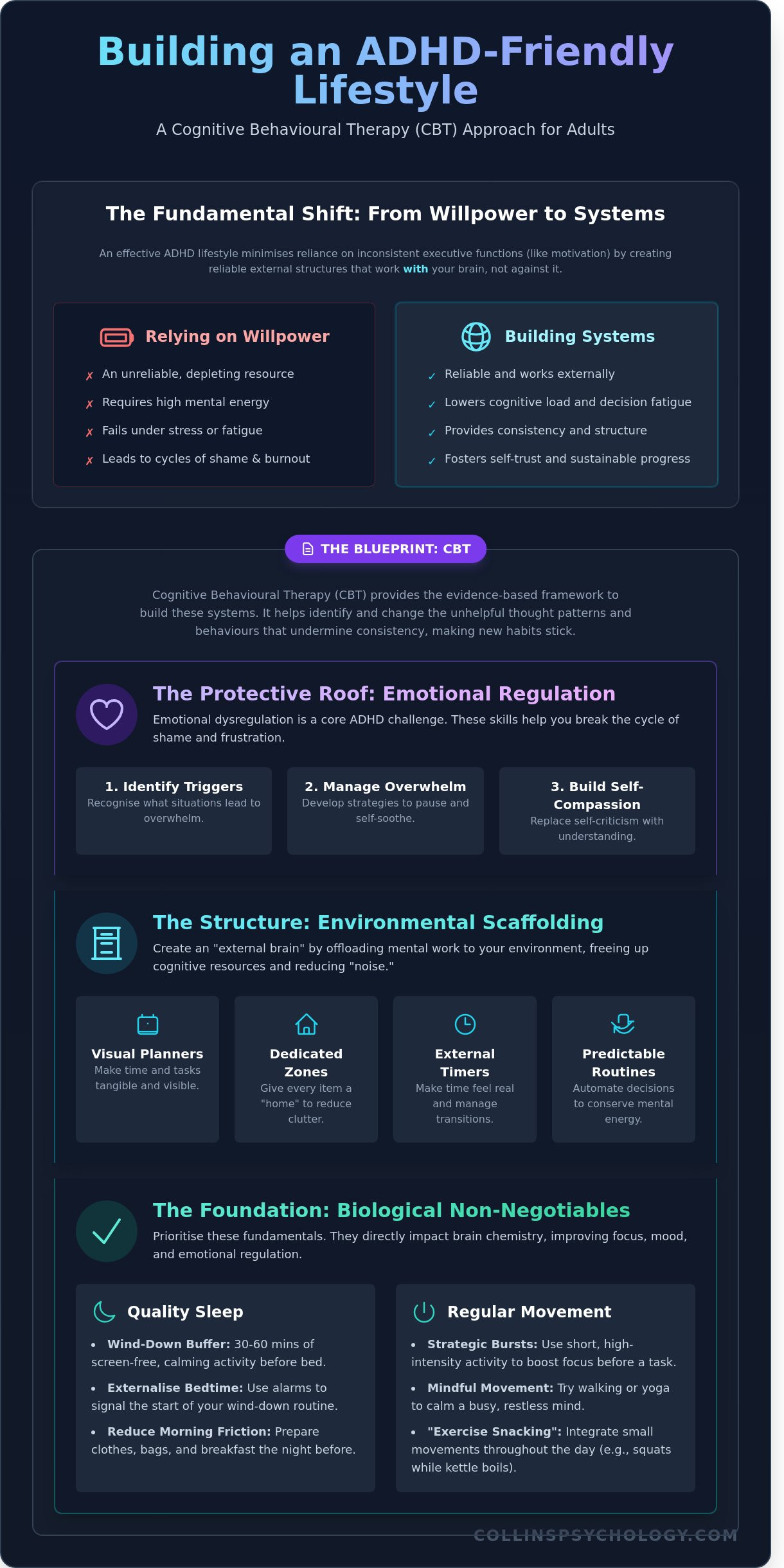
Infographic: The ADHD Lifestyle Scaffolding
(An infographic would be placed here visually representing the core concepts: Biological Foundations (Sleep, Movement) at the base, Environmental Scaffolding (Organisation, Timers) as the structure, and Emotional Regulation (Mindfulness, Self-Compassion) as the protective roof, with CBT as the blueprint holding it all together.)
Environmental Scaffolding: Creating an External Brain
The concept of 'environmental scaffolding' is about externalising your executive functions. By creating an organised physical and digital environment, you offload the mental work of remembering, planning, and organising, freeing up cognitive resources for more complex tasks. A structured environment reduces the visual and mental "noise" that can trigger distraction and overwhelm. For the ADHD mind, a predictable routine is not a restriction; it is a form of freedom that automates daily decisions and reduces anxiety.
Organisational Systems That Stick
To build systems that work with your brain, focus on function over perfection. The goal is to make it easier to find things and put them away.
Use visual cues
Clear storage boxes, labels, and colour-coding help you see what you have without needing to rely on memory.
The 'one-touch' rule
When you pick something up, deal with it immediately. Put it away, file it, or bin it. This prevents piles from forming.
Create functional zones
Designate specific, logical places for keys, wallets, post, and other essential items. This "home for everything" approach reduces frantic searching.
• If you struggle with getting started on these tasks, explore some helpful ADHD task initiation strategies.
Time Management and Decision Making
'Time blindness', or a distorted perception of time, is a common experience in ADHD (Barkley, 2015). Using external tools is essential for building temporal awareness.
Use external timers
Use visual timers (like a Time Timer) or phone alarms for tasks to make the passage of time tangible.
Break it down
Overwhelm often leads to a 'freeze' response. Break large projects into tiny, concrete micro-tasks (e.g., instead of "write report," start with "open document and write title").
• For a deeper dive into structuring your goals, our CBT for ADHD Goal Setting course provides a step-by-step system.
Emotional Regulation and the Mental Lifestyle
For many, the most challenging aspect of ADHD is not inattention but emotional dysregulation. Intense feelings of frustration, anger, or shame can appear suddenly and feel overwhelming, derailing your entire day (Shaw et al., 2014). A CBT approach focuses on developing the skills to manage these emotions proactively. This involves learning to identify your emotional triggers, implementing grounding techniques, and, most importantly, cultivating self-compassion to break the cycle of self-criticism that often accompanies ADHD.
Managing Overwhelm and Meltdown
When cognitive and emotional load becomes too high, having a plan is crucial.
Grounding techniques
Use your senses to pull yourself back to the present moment. Hold a piece of ice, notice five things you can see, or focus on the feeling of your feet on the floor.
Create a 'first aid kit'
Have a pre-prepared list of activities that help you calm down, such as a specific playlist, a walk in nature, or a conversation with a trusted friend.
• Our Emotional Regulation course offers guided exercises and a complete system for building these skills.
Parenting and Social Life with ADHD
The demands of parenting and maintaining a social life can put extra pressure on an already taxed system.
Set protective boundaries
Learn to say no to commitments that will drain your energy. It is okay to protect your time and capacity.
Communicate your needs
Explain to partners, family, or friends what you need to function well. For example, "I find it hard to focus on our conversation with the TV on. Could we turn it off?"
• Recognising how ADHD impacts your emotional responses, such as in Rejection Sensitive Dysphoria (RSD), can also be a powerful step in improving relationships.
Implementing Change with the Collins Psychology CBT Programme
Building a new lifestyle takes time and structure. For many adults with ADHD, the pressure of scheduled appointments can be another source of stress, which is why a self-paced learning format is often more effective. Our structured programmes provide the evidence-based exercises and tools you need to build a sustainable lifestyle at your own pace.
It is important to clarify that Collins Psychology provides online resources and programmes. It is not therapy and not coaching. It is a system designed to help you build your own ADHD support structure over time. You can start where you struggle most, whether that is with emotional regulation, executive function, or goal setting. It is one system with multiple entry points.
The Power of Self-Paced CBT
The CBT for Adult ADHD programme allows you to learn and implement strategies without the pressure of fixed sessions. The system includes a variety of tools, from executive function worksheets to emotional regulation videos, giving you a comprehensive toolkit. A structured, evidence-based approach is a reliable alternative to unverified online hacks that often lead to more frustration.
Your Next Steps Toward a Balanced Life
The key to lasting change is to start small. Choose one strategy from this article to implement today. Perhaps it is setting an alarm for your wind-down routine or laying out your clothes for tomorrow. Lasting change is built through small, consistent steps, not giant leaps.
• Follow Elaine Collins on Instagram for daily actionable tips.
Embrace the process of designing a lifestyle that is built for your brain. You have the capacity to create a life that feels calmer, more focused, and more in your control.
Frequently Asked Questions
What is the single most important lifestyle change for ADHD?
While it varies for everyone, establishing a consistent sleep schedule is often the most impactful first step. Quality sleep is foundational for improving focus, emotional regulation, and executive function.
Can a healthy lifestyle replace the need for other treatments?
A structured lifestyle is a powerful and essential component of managing adult ADHD. For many, it is a sufficient support, while for others, it works best in conjunction with other forms of support. This article does not discuss medication, focusing instead on the behavioural and cognitive systems you can build.
How do I make a routine stick when I have ADHD?
The key is to lower the barrier to entry and use external cues. Start incredibly small (a one-minute habit), link the new routine to an existing one (e.g., meditate for two minutes after your morning coffee), and use visual reminders and alarms. The CBT approach helps you challenge the "all-or-nothing" thinking that makes you quit after one missed day.
Is a specific diet required for an ADHD friendly lifestyle?
While balanced nutrition is important for overall brain health, there is no single "ADHD diet" that is conclusively proven to manage symptoms for all adults. The most effective approach is to focus on regular meals, adequate protein, and hydration to maintain stable energy and blood sugar levels.
How does CBT help with lifestyle management for ADHD?
CBT provides a framework for changing your relationship with your thoughts and habits. It helps you identify and modify the unhelpful thinking patterns that lead to procrastination and overwhelm, and it provides structured behavioural strategies (like breaking down tasks) to make it easier to follow through on your intentions.
What should I do if I feel too overwhelmed to start a new routine?
When you feel overwhelmed, the goal is to make the first step as small as humanly possible. Instead of "organise the kitchen," try "put one thing away." Celebrating that small win can build momentum. Grounding techniques can also help calm your nervous system enough to take that first tiny action.
How can I manage my ADHD lifestyle while working a full-time job?
Applying the principles of scaffolding to your work environment is key. Use digital calendars with reminders, block out focus time, use noise-cancelling headphones to minimise distractions, and take short, regular breaks for movement. Communicating your needs, such as requesting instructions in writing, can also be very helpful.
Are the Collins Psychology programmes suitable for those without a formal diagnosis?
Yes. The strategies and systems taught in our programmes are based on managing common challenges with executive functioning, emotional regulation, and focus. They are beneficial for anyone who experiences these difficulties, regardless of whether they have a formal diagnosis of ADHD.
References
Barkley, R. A. (2012). Executive functions: What they are, how they work, and why they evolved. The Guilford Press.
Barkley, R. A. (2015). Attention-deficit hyperactivity disorder: A handbook for diagnosis and treatment (4th ed.). The Guilford Press.
den Heijer, A. E., Groen, Y., Tucha, L., Tucha, O., Fuermaier, A. B., Koerts, J., & Lange, K. W. (2017). Sweat it out? The effects of physical exercise on cognition and behavior in children and adults with ADHD: a systematic literature review. Journal of Neural Transmission, 124(1), 3–26. https://doi.org/10.1007/s00702-016-1593-7
Fargason, R. E., & Kjeldgaard, M. M. (2021). The bidirectional relationship between sleep and attention-deficit/hyperactivity disorder: A literature review. Brain Sciences, 11(11), 1438. https://doi.org/10.3390/brainsci11111438
Shaw, P., Stringaris, A., Nigg, J., & Leibenluft, E. (2014). Emotional dysregulation and attention-deficit/hyperactivity disorder. American Journal of Psychiatry, 171(3), 276–293. https://doi.org/10.1176/appi.ajp.2013.13070966