.png)

The constant feeling of being overwhelmed by a never-ending to-do list can lead to task paralysis and burnout. The 80/20 rule, or Pareto Principle, offers more than just a productivity hack; it is a vital cognitive strategy for managing executive dysfunction. This approach helps you filter out the noise by focusing on the critical 20 percent of tasks that yield 80 percent of your results. By integrating this principle with evidence-based Cognitive Behavioural Therapy (CBT) techniques, you can learn to bypass perfectionism, reduce mental fatigue, and build a structured framework for prioritisation that works with, not against, your ADHD brain.
Understanding the Pareto Principle in the Context of Adult ADHD
The 80/20 rule, also known as the Pareto Principle, is the concept that for many outcomes, roughly 80 percent of the consequences come from 20 percent of the causes. Originating in economics, it has since been widely applied to behavioural psychology as a tool for improving efficiency and focus. For an adult with ADHD, this principle is not just about being more productive; it is about achieving a sense of "Cognitive Economy" by preserving finite mental energy for what truly matters.
While a neurotypical brain might more easily weigh and prioritise tasks based on long-term importance, the ADHD brain often operates on an interest-based nervous system. This can make it difficult to engage with tasks that are important but not immediately stimulating. The 80/20 rule provides an external, logical framework to counteract this internal chaos, acting as a filter to manage executive dysfunction.
The Science of the Pareto Principle
The principle is an observation of a common distribution pattern found in various aspects of life, from wealth distribution to software bugs. In human behaviour, it highlights that our efforts are not created equal. By identifying the high-impact activities in your day, you can strategically allocate your attention and energy. This approach aligns with professional guidelines from bodies which support the use of structured cognitive strategies to manage daily life challenges.
Why ADHD Brains Need a Different Approach to Priority
The ADHD nervous system is often driven by what is interesting, novel, or urgent, rather than what is genuinely important. This means a low-impact but engaging task can easily pull focus away from a high-impact but less stimulating one. The 80/20 rule provides a crucial external structure, helping you to consciously decide where to direct your focus. In essence, the rule becomes a practical filter for the challenges of executive dysfunction.
Why the ADHD Brain Struggles with Prioritisation and Impact
Difficulties with prioritisation are a core feature of ADHD, linked to differences in the prefrontal cortex, the brain region responsible for executive functions like planning and decision-making. This is compounded by "time blindness," a common ADHD trait where it is difficult to perceive time accurately, making all tasks on a list feel equally urgent and important.
Structured CBT programmes directly address these challenges by teaching skills to break down tasks, evaluate their importance, and manage the cognitive load that comes with decision-making (Safren et al., 2017). The 80/20 rule is a foundational tool within this framework.
The Trap of the Minor Task
Adults with ADHD often find themselves spending 80 percent of their time on the 20 percent of tasks that yield the least significant results. Why? These minor tasks—like organising a bookshelf instead of starting a major work project—provide a quick, easy dopamine hit. While it feels productive in the moment, this misallocated effort leads to significant mental fatigue and a lack of meaningful progress on key goals. This pattern is a common reason many people seek out guidance on understanding the ADHD burnout cycle.
Executive Function and the Pareto Principle
Executive function is the set of mental skills that include working memory, flexible thinking, and self-control. When these functions are strained, it can lead to "choice fatigue" or task paralysis, where the sheer number of options is so overwhelming that you do nothing at all. The 80/20 rule simplifies this process by drastically reducing the number of choices you need to consider. By focusing only on the vital few, you lower the cognitive demand and make it easier to take action.
For a deeper dive into building these skills, our Collins Psychology Executive Function course provides structured lessons and exercises.
Overcoming Perfectionism and the All or Nothing Mindset
One of the biggest objections to the 80/20 rule is the fear that ignoring 80 percent of tasks is irresponsible or lazy. This belief is often rooted in "All or Nothing" thinking, a cognitive distortion common in ADHD where tasks are seen as either perfect or a complete failure. This mindset is a significant barrier to progress, as the pressure to do everything perfectly often prevents you from starting anything at all.
The 80/20 rule is a practical exercise in "Effective Imperfection." It is not about neglecting your responsibilities; it is about giving yourself permission to prioritise the tasks that will move you forward, rather than staying stuck trying to do everything at once.
Reframing Success Through a CBT Lens
Cognitive Behavioural Therapy helps you challenge and reframe unhelpful thought patterns like perfectionism. A core CBT concept is the "Good Enough" principle, which encourages you to aim for completion over perfection. This shift in mindset is crucial for emotional regulation, as it reduces the anxiety and shame associated with not meeting impossibly high standards.
If you struggle with the emotional impact of perfectionism, our Emotional Regulation online module offers targeted strategies and support.
Breaking the Cycle of Task Paralysis
High expectations and perfectionism are directly linked to task paralysis. When a task feels too big or too important to get wrong, the brain's threat response can be activated, leading to avoidance. By focusing only on the "Critical 20 Percent," you give yourself a psychologically manageable entry point. It frames the goal not as "complete this entire project perfectly," but as "make meaningful progress on the most important part." Remember, 20 percent completion is infinitely better than 0 percent perfection.
Practical Ways to Apply the 80 20 Rule to Your Daily Routine
Applying the 80/20 rule is a skill that can be learned and integrated into your daily life, from your work tasks to home organisation and even self-care. The key is to consistently audit your activities to ensure your energy is aligned with your most important goals. This structured approach is fundamental to identifying the right 20 percent and making conscious choices about where to invest your focus.
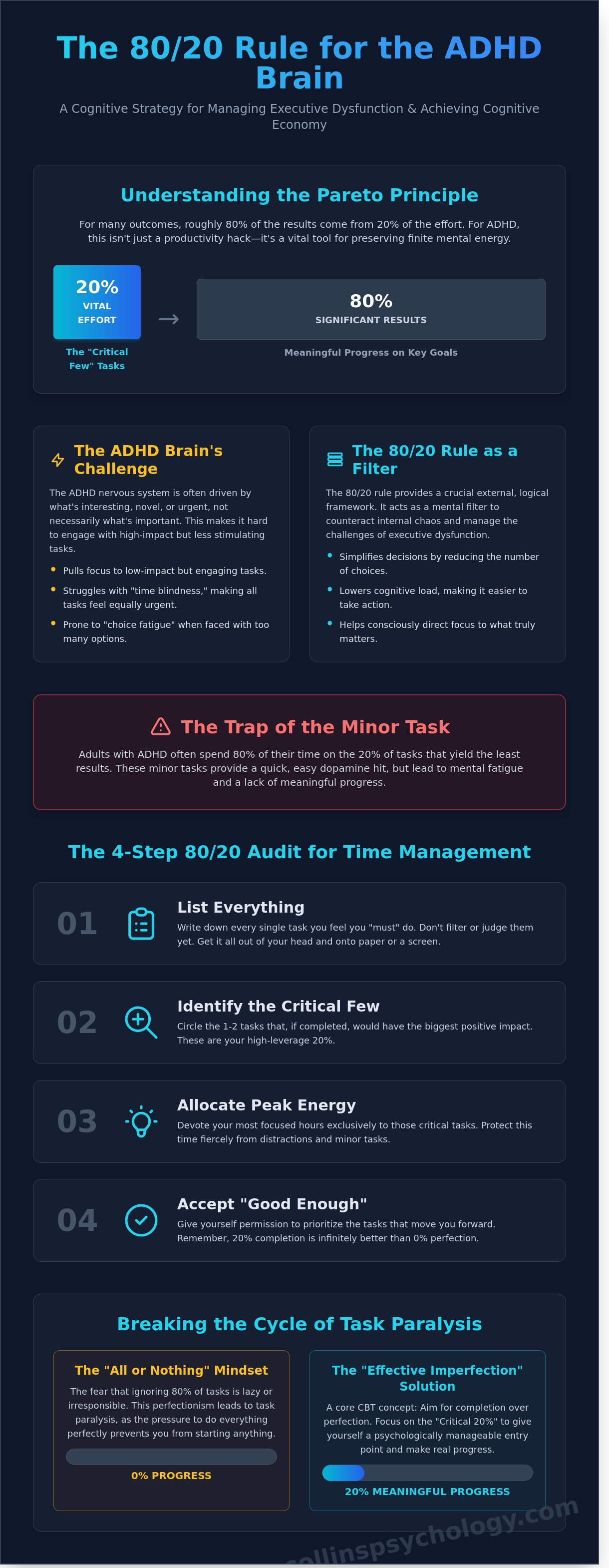
[INFOGRAPHIC: Visual representation of the 80/20 Audit for Time Management, showing the four steps in a clear, easy-to-follow flow chart.]
The 80/20 Audit for Time Management
Follow these steps to apply the rule to your daily to-do list:
•
Step 1: List Everything. Write down every single task you feel you "must" do today. Do not filter or judge them yet.
•
Step 2: Identify the Critical Few. Look at your list and circle the one or two tasks that, if completed, would have the biggest positive impact on your day, your week, or your goals. These are your 20 percent.
•
Step 3: Allocate Peak Energy. Devote your most focused hours—whenever they may be—exclusively to those critical tasks. Protect this time fiercely.
•
Step 4: Accept "Good Enough." Acknowledge that the remaining 80 percent of tasks may not get done today, or may only be done to a "good enough" standard. This is not failure; it is strategic prioritisation.
Applying the Rule to Self-Care and Fitness
The 80/20 rule is not just for work. It is incredibly effective for self-care, where overwhelm can prevent us from doing anything at all. Instead of trying to adopt a dozen new healthy habits, identify the one or two with the biggest impact. For many adults with ADHD, 20 percent of lifestyle changes like prioritising consistent sleep can drive 80 percent of the improvement in focus and emotional stability. Likewise, fitness should be viewed through the lens of high-impact movement—a short, intense workout is often more beneficial than an hour of half-focused exercise.
Building Sustainable Habits Through Structured CBT Programmes
While the 80/20 rule is a powerful tool on its own, it becomes truly transformative when integrated into a structured, evidence-based system like Cognitive Behavioural Therapy. At Collins Psychology, we provide online, self-paced programmes that teach you how to apply these principles consistently. It is important to note that our model focuses on providing these educational courses and does not include one-to-one therapy, giving you the flexibility to learn at your own pace in a way that fits your life in Ireland.
Why Structure Beats Willpower
The ADHD brain cannot rely on willpower or motivation alone, as these resources are often inconsistent. Lasting change comes from building reliable systems and structures that support your goals even on days when you feel unfocused or unmotivated. Our online courses provide the "scaffolding" needed for success, with clear lessons, practical exercises, and tools designed specifically for the challenges of adult ADHD.
Next Steps for Your ADHD Journey
Taking control of your focus and overcoming overwhelm is a journey of small, consistent steps. The 80/20 rule is an excellent first step. By learning to focus your energy where it counts, you can begin to build momentum and create lasting change.
Ready to master your focus? Explore our online CBT programs for Adult ADHD today. You can also browse our full collection of self-paced courses to find the right support for your needs.
Frequently Asked Questions
Is the 80/20 rule actually effective for ADHD brains?
Yes, it is particularly effective because it provides an external, logical system for prioritisation that helps counteract the ADHD brain's tendency to get distracted by less important but more stimulating tasks. It reduces overwhelm by simplifying choices.
How do I decide which 20 percent of my tasks are the most important?
Ask yourself: "If I could only do one or two things on this list today, which ones would make the biggest positive difference to my long-term goals, reduce the most stress, or prevent the biggest future problem?" Your answer is usually your 20 percent.
Can I apply the Pareto Principle to my parenting when I have ADHD?
Absolutely. In parenting, this could mean focusing 20 percent of your energy on high-impact activities like quality connection time or establishing a consistent bedtime routine, which can account for 80 percent of a positive family atmosphere, rather than stressing over a perfectly tidy house.
Does using the 80/20 rule mean I am being lazy or avoiding work?
No. It is the opposite of lazy. It is a strategic approach to ensure your limited energy and focus are used for maximum impact. It is about working smarter, not harder, and avoiding burnout from spending time on low-value activities.
What if my boss expects 100 percent effort on every single task?
This is a common concern. The key is to use the 80/20 rule to manage your own workflow and energy. By ensuring you deliver excellent results on the most critical 20 percent of your work (the projects your boss values most), you often create more leeway on the less critical 80 percent.
How does the 80/20 rule fit into a Cognitive Behavioural Therapy (CBT) plan?
In CBT, the 80/20 rule is a behavioural tool used to challenge cognitive distortions like "all-or-nothing" thinking and perfectionism. It is a practical strategy that helps you put CBT principles into action by making conscious, value-driven choices instead of reacting to overwhelming feelings.
Is there a specific way to use this rule for better sleep and focus?
Yes. Identify the 20 percent of actions that have the biggest impact on sleep quality, such as maintaining a consistent wake-up time and avoiding screens before bed. These two habits often contribute to 80 percent of sleep improvement, which in turn dramatically boosts focus.
Can this rule help with the emotional regulation issues common in ADHD?
Yes. By focusing on the 20 percent of activities that have the biggest positive impact on your emotional state (e.g., a short walk, five minutes of mindfulness), you can manage your energy more effectively and prevent the emotional burnout that comes from trying to do everything at once.
References
Safren, S. A., Sprich, S. E., Perlman, C. A., & Otto, M. W. (2017). Mastering your adult ADHD: A cognitive-behavioral treatment program, client workbook (2nd ed.). Oxford University Press.