.png)

For adults with ADHD, the constant battle with impulsivity can be exhausting, often leading to decisions we later regret. The 24 hour rule is a structured Cognitive Behavioural Therapy (CBT) technique designed to counteract this. It is not just about waiting; it is about creating a deliberate pause that allows your brain's executive functions to catch up with its emotional responses. This guide explains the clinical foundation of the 24 hour rule, how it retrains the ADHD brain to move from reactive choices to intentional actions, and provides a clear framework for implementing it in your daily life to manage impulsivity in finances, social interactions, and beyond.
Understanding the 24 Hour Rule for ADHD and Impulsivity
The 24 hour rule is a powerful tool for managing the impulsivity that often accompanies Adult ADHD. By creating a mandatory waiting period, you give your brain the time it needs to process information, regulate emotions, and make more considered decisions.
• The 24 hour rule is a structured intervention where an individual commits to waiting a full day before acting on a non-essential impulse.
• Impulsivity is a core challenge for the ADHD brain due to differences in the prefrontal cortex, the area responsible for self-regulation and executive control (Barkley, 1997).
• This strategy serves as a manual "pause button," allowing the initial emotional surge linked to an impulse to subside and giving the logical part of your brain a chance to engage.
• It is particularly effective for managing significant financial decisions and emotionally charged social responses that can have lasting consequences.
The link between ADHD and impulsive decision making
For many adults with ADHD, impulsive decisions are a frequent source of stress and regret. This is not a character flaw but a neurological reality. The ADHD brain often has lower levels of dopamine, a neurotransmitter associated with reward and motivation. This can lead to a constant search for activities that provide an immediate sense of gratification.
This drive for instant reward is compounded by a phenomenon known as "time blindness," where the perception of time is altered. This can make it difficult to properly weigh future consequences against immediate desires. You can learn more about this in our guide to ADHD and time blindness strategies. Common areas where impulsivity causes distress for adults include unplanned spending, abruptly quitting jobs, or making commitments without thinking them through.
Defining the 24 hour rule in a clinical context
From a clinical perspective, the 24 hour rule is more than just a simple "waiting period." It is a structured CBT tool that creates a cognitive buffer. This buffer is the mental space between an impulse and an action. Within a CBT framework, this pause allows you to challenge automatic thoughts and consider alternative responses.
A 24 hour window is often considered optimal because it is long enough for the initial, intense emotional reaction to fade, allowing you to return to a more stable emotional baseline. It gives you a full sleep cycle to process the decision, which can provide significant clarity. By consistently practising this rule, you are not just avoiding bad decisions; you are actively building a foundational skill for stronger executive functioning.
The Cognitive Behavioural Foundation of the 24 Hour Rule
Cognitive Behavioural Therapy (CBT) operates on the principle that our thoughts, feelings, and behaviours are interconnected (Beck, 2011). Impulsive actions in ADHD often stem from an automatic cycle where a trigger leads directly to a behaviour, with little to no conscious thought in between.
• CBT focuses on identifying and changing unhelpful patterns in the relationship between thoughts, feelings, and behaviours.
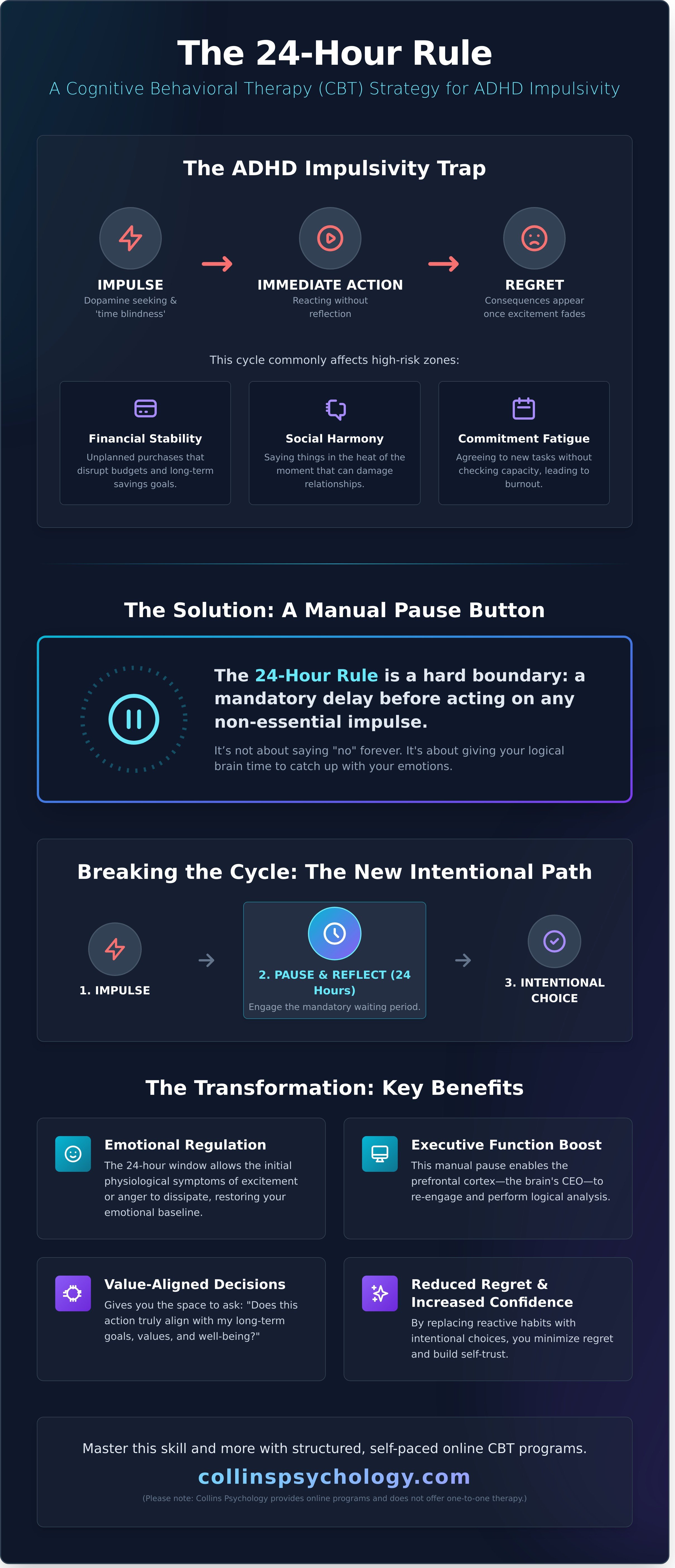
• The 24 hour rule directly interrupts the automatic cycle of "Impulse -> Action" by inserting a mandatory "Reflection" phase.
• Waiting allows the executive functioning centres of the brain (like the prefrontal cortex) to "catch up" with the more reactive, emotional centres (like the amygdala).
• Practising this deliberate delay helps strengthen the neural pathways associated with inhibitory control, making it easier to manage impulses over time.
How the rule strengthens executive functioning
Executive functioning can be thought of as the "CEO of the brain." It is a set of mental skills that includes working memory, flexible thinking, and self-control. These are the skills that help you plan, focus, and manage multiple tasks. ADHD presents challenges to these functions, but they can be strengthened with targeted strategies.
The 24 hour rule directly supports working memory by giving you time to hold a decision in your mind and compare it against your long-term goals and values. It forces you to move past the immediate "want" and consider the bigger picture. Consistent use of this rule builds long-term cognitive resilience, making you better equipped to handle future impulses. For a deeper dive into this area, explore our self-paced programme on CBT for ADHD executive function.
Building a cognitive buffer through deliberate delay
The "cognitive buffer" is the crucial space between a stimulus and your response. For many with ADHD, this space is almost non-existent. The 24 hour rule is a method for manually creating and expanding that buffer.
During moments of high emotion, such as a social conflict or a sudden urge to buy something, this delay can prevent an "amygdala hijack," where the emotional part of the brain takes over rational thought. The first step in using the rule effectively is self-observation: learning to recognise the physical and mental signs that a strong impulse has been triggered. Once you identify that feeling, you can activate the rule, giving yourself the time and space needed for a more measured response.
Practical Applications: Where the 24 Hour Rule Saves the Day
Knowing the theory is one thing, but applying the 24 hour rule in high-risk situations is where its true value lies. It acts as a safeguard against common ADHD pitfalls, transforming reactive patterns into intentional choices. The relief that comes from knowing you have a reliable system in place can significantly reduce anxiety and build self-trust. Remember, the rule is about empowering yourself with choice, not restricting yourself with limitations.
[Infographic: A visual guide to implementing the 24 hour rule for financial and social decisions, showing the cycle of Impulse -> Pause (24h) -> Reflect -> Intentional Action.]
Managing impulsive spending and financial health
Financial impulsivity is a major challenge for many adults with ADHD. The instant gratification of online shopping can be a powerful lure. The 24 hour rule provides a concrete defence.
The "Add to Cart" Rule
When shopping online, place any non-essential items in your cart but do not check out. Commit to leaving them there for a full 24 hours. When you return, the initial emotional urge will likely have faded, allowing you to assess if you truly need the item.
Reduce Financial Anxiety
This practice not only saves money but also reduces the financial anxiety and buyer's remorse that often follow impulsive purchases. It also helps prevent clutter from accumulating in your home.
Practical Tip
Go into the settings of your favourite shopping apps and disable "one-click" or "buy now" purchasing. Adding the small step of re-entering your payment details can be enough friction to remind you to pause.
Navigating social interactions and emotional regulation
Emotional reactivity can strain relationships and create professional difficulties. An impulsive email or text sent in anger can cause damage that is hard to undo. The 24 hour rule is an essential tool for emotional regulation.
Sleep on the Draft
When you receive a difficult email or a text message that triggers a strong emotional response, write your reply but do not send it. Save it as a draft and review it 24 hours later. You will almost always edit it to be more constructive and less reactive.
Respond to Perceived Slights Thoughtfully
Waiting 24 hours before responding to a perceived slight or criticism gives you time to consider the other person's perspective and avoid escalating a conflict unnecessarily.
• This strategy is a core component of building emotional resilience, a topic explored in detail in our emotional regulation module.
Implementing the Rule: 5 Steps to Success
Successfully using the 24 hour rule requires more than just remembering it in the moment; it requires creating a structured system to support your intention. Follow these five steps to integrate the rule into your life effectively.
Identify Your "Impulse Triggers"
Pay attention to the situations, emotions, or even times of day when you are most likely to be impulsive. Is it late-night online shopping? Responding to work emails when you feel criticised? Knowing your triggers is the first step to managing them.
Communicate the Rule
Let a trusted partner, friend, or family member know that you are implementing this rule. Saying, "I'm going to wait 24 hours before I decide on this," creates external accountability and can help you stick to your commitment.
Use External Tools
Do not rely on your memory alone. Use calendar reminders, phone alarms, or sticky notes to track your 24 hour window. For physical items, create a "waiting zone" in your home where potential new purchases must sit for a day before they are officially yours.
Review with a "Goal-Focus" Mindset
When the 24 hours are up, review the decision. Ask yourself: "Does this align with my long-term goals? Does this serve my values?" This shifts the focus from the immediate feeling to your larger life plan. This aligns with skills taught in our CBT for ADHD goal setting course.
Practise Self-Compassion
You will not be perfect. There will be times you forget or break the rule. When that happens, avoid self-criticism. Simply acknowledge it and recommit to using the rule for the next decision.
Setting up your environment for success
Your environment plays a huge role in your ability to follow through. The key is to reduce the friction for pausing and increase the friction for acting impulsively.
• Use digital reminders on your phone or computer that pop up at certain times of the day, reminding you of your 24 hour commitment.
• Place a visual cue, like a colourful sticky note, on your laptop or credit card that says "24 Hours?"
• Unsubscribe from marketing emails that create a false sense of urgency with "flash sales" and "limited-time offers."
Dealing with the urgency itch during the wait
The urge to act immediately can feel overwhelming, especially in the first few hours. This "urgency itch" is a normal part of the process. The goal is not to eliminate the feeling but to learn to sit with it without acting.
• Acknowledge that waiting is difficult. The discomfort you feel is a sign that the process is working.
• Use healthy distraction techniques. Go for a walk, listen to a podcast, do a few minutes of exercise, or talk to a friend about something completely unrelated.
• Try the "Write it Down" method. Get the impulse out of your head and onto paper. Write down what you want to do and why. This act of externalising the thought can reduce its power and give you a sense of control.
Moving Beyond Quick Fixes with Structured CBT Programmes
The 24 hour rule is an excellent tool, but it is most effective when it is part of a comprehensive CBT strategy for managing Adult ADHD. While individual techniques are helpful, lasting change comes from building a solid foundation of skills in all areas of life, from time management to emotional regulation.
At Collins Psychology, we provide online, self-paced CBT programmes designed specifically for adults with ADHD. It is important to note that we do not offer one-to-one therapy. Our model is built to provide a structured, flexible learning environment where you can develop practical skills at your own pace, creating lasting change in how you manage your ADHD.
Why self-paced learning works for the ADHD brain
The traditional therapy model does not work for everyone. A self-paced, online approach offers unique advantages for the ADHD brain.
• The flexibility of online modules allows you to engage with the material when your focus is at its peak, rather than being tied to a fixed appointment time.
• You can revisit resources, exercises, and lessons as many times as you need to, reinforcing your learning and adapting the strategies to your life.
• Our programmes are designed with the adult ADHD experience in mind, breaking down complex topics into manageable, actionable steps.
Integrating the 24 hour rule into a broader life strategy
View the 24 hour rule as one essential tool in a larger toolkit for building a better life with ADHD. When you combine it with stronger skills in goal setting, emotional regulation, and executive functioning, you create a powerful system for personal growth. Mastering impulsivity is a journey, and that journey benefits from structured support.
To learn more about how a comprehensive CBT approach can help you, we invite you to explore our CBT for Adult ADHD training materials.
Frequently Asked Questions
Does the 24 hour rule work for everyone with ADHD?
It is a highly effective strategy for many, but not a universal solution. Its success depends on consistent practice and combining it with other management techniques. It is most useful for non-urgent decisions where impulsivity is a known problem.
How do I remember to use the 24 hour rule when I am in a state of hyperfocus?
This is a common challenge. The key is preparation. Place physical reminders in your environment, such as a note on your computer screen or wallet. Using technology like a pop-up reminder on your phone can also help break through hyperfocus and trigger the "pause" response.
What if the decision is time-sensitive and I cannot wait a full 24 hours?
The rule is for non-essential, non-urgent decisions. If a decision is genuinely time-sensitive, the goal is still to create as much of a "pause" as possible. Even waiting 10 minutes to take a few deep breaths and consider the consequences is better than an instant reaction.
Can I use a shorter window, like a 1 hour rule, for smaller decisions?
Absolutely. The principle is scalable. For smaller, low-stakes decisions, a 1 hour or even a 10 minute pause can be sufficient to break the immediate impulse-action cycle. The key is to make the delay intentional and use that time for reflection.
Should I tell my friends and family that I am using the 24 hour rule?
This is a personal choice, but it can be very helpful. Informing your support network can build accountability. It also helps them understand why you might say, "Let me think about that and get back to you tomorrow," which can improve communication and reduce pressure.
What happens if I break the rule and make an impulsive decision anyway?
This will happen, and it is okay. The goal is progress, not perfection. Use it as a learning opportunity. Ask yourself what the trigger was and what made it difficult to pause. Avoid self-criticism and simply recommit to using the rule for the next decision.
Is the 24 hour rule scientifically proven to help with ADHD?
The 24 hour rule is a practical application of core principles from Cognitive Behavioural Therapy (CBT), which is an evidence-based approach for managing ADHD symptoms. The strategy directly targets well-documented ADHD challenges like poor impulse control (inhibitory control) and executive dysfunction.
Does using this rule mean I can never be spontaneous again?
Not at all. The rule is designed to protect you from regrettable impulsivity, not to eliminate healthy spontaneity. The goal is to help you distinguish between a joyful, spontaneous choice and a reactive, potentially harmful impulse. It puts you in control, allowing you to choose when to be spontaneous.
References
Barkley, R. A. (1997). Behavioral inhibition, sustained attention, and executive functions: Constructing a unifying theory of ADHD. Psychological Bulletin, 121(1), 65–94.
Beck, J. S. (2011). Cognitive behavior therapy: Basics and beyond (2nd ed.). Guilford Press.