.png)

For adults with ADHD, the to-do list can feel less like a helpful guide and more like a source of paralysis. Even the smallest tasks, like replying to an email or putting away a coat, can feel insurmountable. This is where the 2 minute rule comes in. It is not just another productivity hack; it is a cognitive behavioural strategy designed to lower the mental barrier to starting tasks. This guide will explain the psychology behind why this rule works for the neurodivergent brain, how to apply it using a structured Cognitive Behavioural Therapy (CBT) framework, and how to avoid common pitfalls like the dreaded "ADHD rabbit hole." Learn how to use this simple rule to bypass executive dysfunction, manage procrastination, and build momentum in your daily life.
Key Takeaways
The 2 Minute Rule Defined
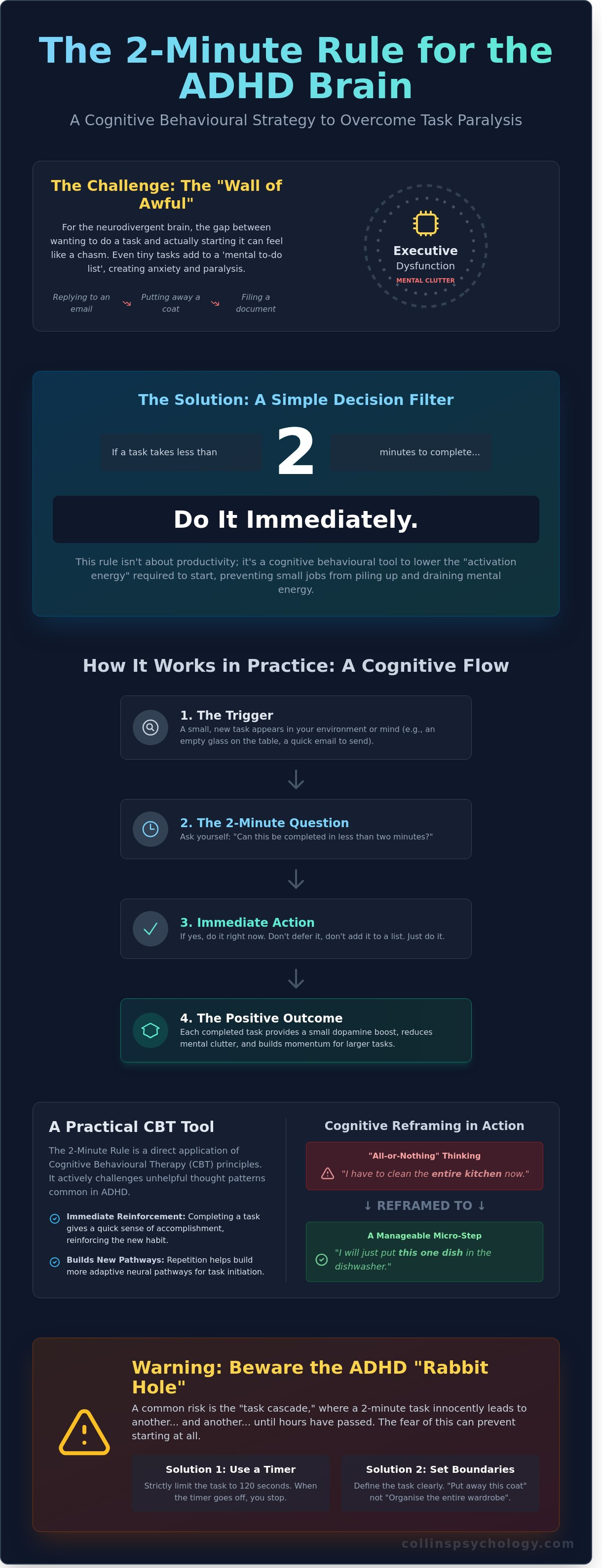
If a task takes less than two minutes to complete, do it immediately instead of deferring it. This reduces mental clutter and prevents small jobs from piling up.
A Tool for Executive Dysfunction
For ADHD brains, the rule acts as a cognitive bridge, lowering the "activation energy" needed to initiate a task and overcoming the initial resistance or "wall of awful."
Beware of Task Cascades
A common risk is when a 2 minute task turns into a multi-hour distraction. Setting clear boundaries, such as using a timer, is crucial to prevent this "rabbit hole" effect.
Grounded in CBT
The rule works by challenging "all or nothing" thinking and providing immediate reinforcement, which helps to build new, more effective habits. It is a practical application of cognitive reframing.
Part of a Larger System
While effective, the 2 minute rule is most powerful when integrated into a broader, structured system for managing ADHD. It is a starting point, not a complete solution.
Table of Contents
• Defining the 2 Minute Rule for Neurodivergent Adults
• The Psychology of Executive Dysfunction and Task Initiation
• Managing Task Cascades and the ADHD Rabbit Hole
• How to Apply the 2 Minute Rule using Cognitive Behavioural Strategies
• Developing Executive Function Skills through Online Learning
Defining the 2 Minute Rule for Neurodivergent Adults
The 2 minute rule is a simple but powerful principle: if a task or action takes less than two minutes to complete, you should do it immediately rather than postponing it. The concept was popularised by productivity consultant David Allen in his "Getting Things Done" methodology as a way to clear mental clutter and prevent small items from overwhelming a task management system (Allen, 2001). For adults with ADHD, however, the rule is more than just an organisational tool. It serves as a practical cognitive behavioural intervention to bypass the significant challenges with task initiation that are a hallmark of executive dysfunction. It helps to break the cycle of procrastination by making the first step feel almost effortless.
The Core Concept: Do It Now or Defer It
At its heart, the rule is a decision-making filter. Every small task that appears, from replying to a short text message to hanging up your coat or filing a single document, presents a choice: do it now or add it to a mental (or physical) to-do list. For the ADHD brain, that mental to-do list can quickly become a source of anxiety and paralysis. Each deferred task adds to your cognitive load, creating a background hum of unfinished business that drains mental energy. The goal of the 2 minute rule is to prevent this accumulation, clearing your mind to focus on more significant projects.
Why Traditional Productivity Advice Often Fails ADHD
Many productivity systems are built on the assumption of a linear, predictable relationship between intention and action. They presume that if you decide to do something, you simply do it. However, ADHD introduces a biological challenge in the brain's prefrontal cortex, which affects dopamine regulation and executive functions (Ramsay, 2020). This means that for a neurodivergent individual, the gap between wanting to do a task and actually starting it can feel like a chasm. The 2 minute rule must be adapted for this interest-based nervous system, not as a rigid command, but as a gentle nudge to get the dopamine flowing and build momentum.
The Psychology of Executive Dysfunction and Task Initiation
Executive functions are the high-level mental skills we use to manage time, pay attention, switch focus, and organise our actions. For many adults with ADHD, the primary hurdle is not the task itself but the act of starting it. This difficulty with ADHD task initiation is a core challenge linked to lower levels of dopamine, the neurotransmitter associated with motivation and reward. The 2 minute rule works by drastically reducing the perceived "cost" of starting. Committing to just 120 seconds feels negligible, which lowers the brain's resistance and makes it easier to begin. From a CBT perspective, this practice helps to reframe the anxiety that often surrounds the commencement of any task (Safren et al., 2005).
Understanding the Activation Energy Barrier
Think of your brain's motivation system like a car engine. It needs a spark to overcome inertia and get started. For a brain with ADHD, that initial spark can require a huge amount of mental energy. This is the "activation energy barrier." A large, undefined task like "clean the house" has a very high activation energy. A tiny, specific task like "put one dish in the dishwasher" has a very low one. The 2 minute rule is that spark. It breaks tasks down into manageable micro-steps, lowering the barrier to entry and making it easier to overcome the working memory deficits and emotional avoidance that fuel procrastination.
Cognitive Reframing of Small Tasks
A common cognitive distortion associated with ADHD is "all or nothing" thinking. This can make a 2 minute task feel like the start of a massive, draining project. For example, the thought "I should reply to that email" quickly morphs into "I have to open my inbox, deal with all the other emails, find the right information, and craft a perfect response." CBT helps you identify and challenge these unhelpful thoughts. By consciously applying the 2 minute rule, you challenge the belief that "I will do it later when I have more energy." Each time you successfully complete a small task immediately, you provide your brain with a small dose of reinforcement, which helps build new, more adaptive neural pathways.
Managing Task Cascades and the ADHD Rabbit Hole
While the 2 minute rule is a powerful tool, for the ADHD brain it can also be a potential trap. A "task cascade" occurs when one small, two-minute chore innocently leads to another, and then another, until you find you have spent three hours reorganising the kitchen when you were supposed to be working. This is the "rabbit hole" effect. For example, you decide to clean a single coffee mug. That leads to scrubbing the sink, which reveals a leaky tap, which sends you to find a wrench, which leads to you reorganising the entire toolbox. For some, the fear of this cascade is so strong that it prevents them from even starting the first 2 minute task. The key is to use the rule with intention and clear boundaries.
When to Ignore the 2 Minute Rule
The 2 minute rule is not absolute. It is a guideline, not a law. There are specific times when it is better to ignore it. The most important is when you are already in a state of "flow" or deep focus on a primary task. If you are writing a report and remember you need to send a quick email, interrupting your flow could cost you far more than two minutes to get back on track. In this case, jot the task down and return to it later. It is also important to recognise "hyperfocus traps," where a seemingly small task is a known gateway to a major distraction (like "just checking one thing on social media").
Strategies to Prevent Distraction
To use the rule safely, you need to build guardrails. These are simple strategies to keep your 2 minute tasks contained.
Use a Visual Timer
Set a timer for two minutes on your phone or a visual timer. When it goes off, you stop, regardless of whether you are finished. This contains the task and trains your brain to respect the time limit.
The "Post-it" Technique
If you are in the middle of a project and a 2 minute task pops into your head, write it on a Post-it note and stick it to the side of your monitor. This gets it out of your head without breaking your concentration.
Define the Task Precisely
Be very clear about what the 2 minute task is. It is not "tidy the desk"; it is "put three pens back in the pen pot." This clarity prevents the task from expanding.
These strategies are a core component of building better executive function skills as they help you manage focus and attention intentionally.
How to Apply the 2 Minute Rule using Cognitive Behavioural Strategies
Integrating the 2 minute rule into your daily life is a process of building a new habit. It requires mindful practice and a structured approach. The goal is to move from consciously deciding to use the rule to it becoming an automatic response to small, manageable tasks. This is how you stop relying on fleeting motivation and start building systems that work with your brain.
Step 1: The Triage Method for Tasks
As tasks and requests come in throughout the day, practise sorting them into three simple categories: "Now," "Later," or "Never." The "Now" category is exclusively for tasks that fit the 2 minute rule. Everything else goes into the "Later" category to be scheduled properly. This triage method helps you address the emotional discomfort that often comes with boring but necessary tasks and combats the time perception challenges that can make it hard to estimate how long a job will take. Learning to accurately assess and categorise tasks is a fundamental step in overcoming the cycle of procrastination that affects adults with ADHD.
Step 2: Building the Habit Loop
To make the 2 minute rule automatic, you need to build a habit loop, which consists of a cue, a routine, and a reward.
Cue
The trigger. This is the moment you see a small, undone task (e.g., your shoes by the door).
Routine
The action. This is applying the rule and immediately putting the shoes away.
Reward
The reinforcement. This is the feeling of satisfaction, the reduction in visual clutter, and the small mental release from not having to think about that task anymore.
You can strengthen this loop through "habit stacking," which involves pairing the new habit with an existing one. For example: "After I finish my morning coffee (existing habit), I will immediately rinse the mug and put it in the dishwasher (2 minute task)." This process is reinforced by clear goal setting and tracking your progress, which helps maintain momentum over time.
Developing Executive Function Skills through Online Learning
One-off tips like the 2 minute rule are most effective when they are part of a broader, structured system. Knowing what to do is one thing, but actually doing it consistently is the real challenge. If you are tired of starting over every Monday, it may be time to build systems that work with your brain, not against it.
Collins Psychology provides structured, CBT-based systems for adults with ADHD who are tired of knowing what to do but still struggling to do it. Our online, self-paced programmes are designed specifically for the neurodivergent brain, offering the flexibility to learn at your own pace with practical exercises and tools. It is important to note that Collins Psychology provides these educational programmes and does not offer one-to-one therapy.
The Benefits of a Structured CBT Approach
Moving beyond "hacks" to achieve deep-seated behavioural change requires a systematic approach. Our evidence-based modules focus on the core challenges of adult ADHD, including emotional regulation, time management, and focus. This is not therapy. This is not coaching. It is a system. You can build your ADHD support system over time, starting where you struggle most. We offer one system with multiple entry points.
Take the Next Step in Your ADHD Journey
If you are ready to build a personalised toolkit of strategies that go beyond single tips, we invite you to explore our self-paced CBT programmes for Adult ADHD. Learn to build systems that support your goals and finally bridge the gap between intention and action.
Frequently Asked Questions
Is the 2 minute rule effective for severe ADHD symptoms?
The rule can be helpful for anyone, but its effectiveness can vary. For those with more significant executive function challenges, it serves as a foundational tool for building momentum. It is most effective when used as part of a comprehensive, structured approach to managing ADHD.
How can I stop a 2-minute task from becoming a distraction?
The key is to set firm boundaries before you start. Use a timer and commit to stopping when it goes off. Also, be very specific about the task. Instead of "tidy the counter," define it as "put away the three items next to the sink." This prevents the task from expanding.
What if I have twenty 2-minute tasks at once?
This feeling of being overwhelmed is common. In this situation, do not try to do them all. Pick one. The goal is not to clear everything instantly but to break the paralysis of inaction. Completing just one task can provide the momentum needed to tackle the next.
Can the 2 minute rule help with emotional regulation?
Indirectly, yes. Procrastination and clutter often lead to feelings of shame, anxiety, and overwhelm. By consistently managing small tasks, you reduce these negative emotional triggers, creating a more stable and positive mental environment. This proactive approach can be a form of emotional regulation.
Does the 2 minute rule work for house chores or just work tasks?
It works for any task in any area of life. It is particularly effective for house chores, which often consist of many small, repeatable actions (e.g., wiping a counter, putting a book on a shelf, taking out the recycling).
What is the difference between the 2 minute rule and the 5 minute rule?
The 2 minute rule is for tasks you complete immediately. The 5 minute rule is a strategy for tasks you are dreading; you commit to working on the larger task for just five minutes. Both are designed to overcome task initiation, but they apply to different types of tasks.
How do I remember to use the rule when I am overwhelmed?
When you feel overwhelmed, your working memory is often overloaded. Try using a physical prompt, like a Post-it note on your computer screen or bathroom mirror that simply says "Less than 2 mins?" This can serve as an external reminder to use the tool when you need it most.
Is this rule part of standard Cognitive Behavioural Therapy?
While not a formal CBT protocol itself, the 2 minute rule is a perfect example of a CBT principle in action. It is a behavioural experiment that challenges unhelpful thoughts (e.g., "This is too big to start") and changes your behavioural patterns (avoidance) through small, manageable actions.
References
Allen, D. (2001). Getting things done: The art of stress-free productivity. Penguin Books.
Ramsay, J. R. (2020). Rethinking adult ADHD: Helping clients turn intentions into actions. American Psychological Association.
Safren, S. A., Otto, M. W., Sprich, S., Winett, C. L., Wilens, T. E., & Biederman, J. (2005). Cognitive-behavioral therapy for ADHD in medication-treated adults with continued symptoms. Behaviour Research and Therapy, 43(7), 831–842. https://doi.org/10.1016/j.brat.2004.07.001