.png)

For adults with ADHD, managing focus and ensuring a restful night's sleep can feel like a constant battle against a restless mind. The 10-3 rule offers a refreshingly simple yet powerful framework to bring structure to both your day and your night. This guide explores the two distinct applications of the 10-3 rule, one for productivity and one for sleep hygiene, grounding them in Cognitive Behavioural Therapy (CBT) principles. By breaking down daunting tasks and creating clear pre-sleep boundaries, this rule helps to bypass common ADHD challenges like time blindness and executive dysfunction, offering a practical path toward improved focus and deeper rest.
Key Takeaways
Two Rules, One Name
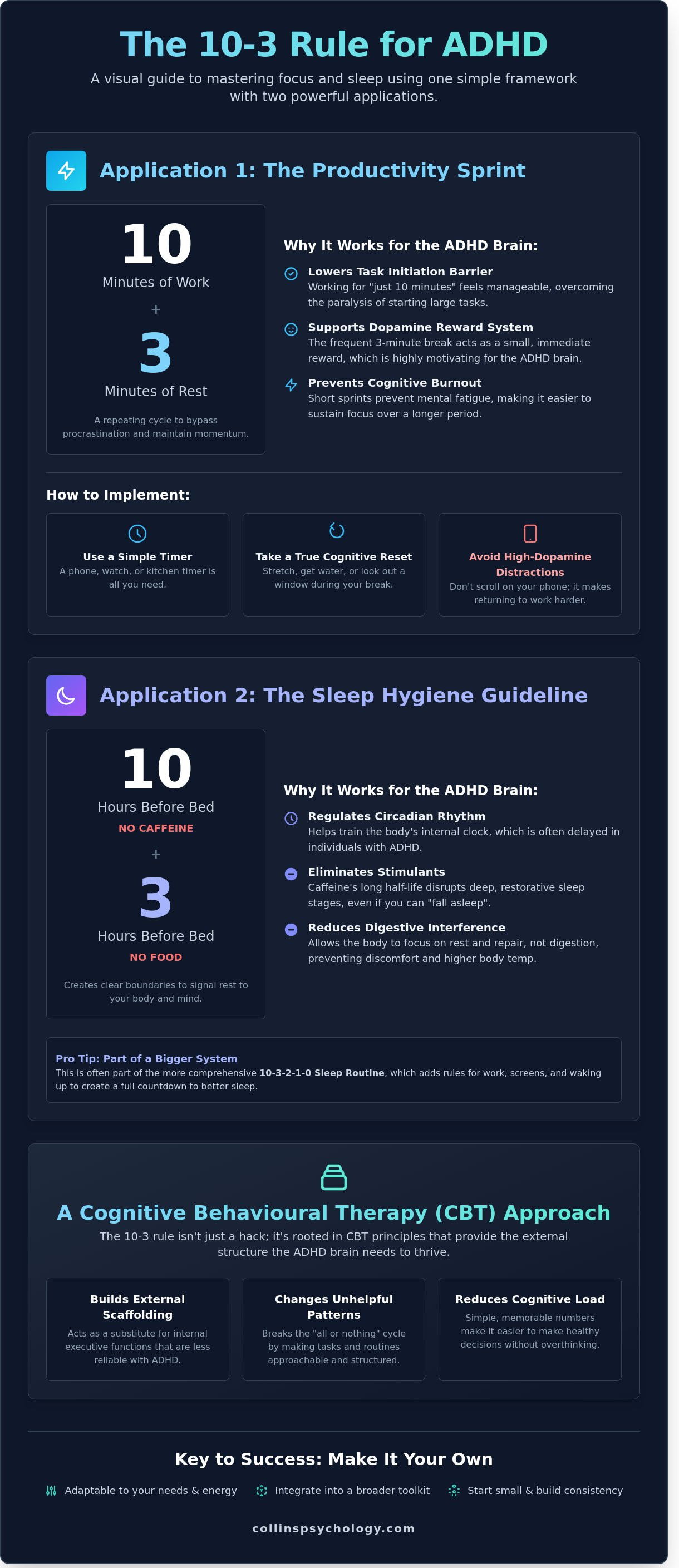
The "10-3 rule" refers to two separate strategies. The first is a productivity method (10 minutes of work, 3 minutes of rest). The second is a sleep hygiene guideline (no caffeine 10 hours before bed, no food 3 hours before bed).
CBT-Based Approach
This rule works by aligning with CBT principles. It provides external structure, creates manageable goals to increase dopamine, and reduces the cognitive load associated with starting tasks and winding down for sleep.
Bypasses Executive Dysfunction
For the ADHD brain, short, timed intervals make tasks less overwhelming and combat time blindness. The enforced breaks help regulate focus and prevent burnout.
Actionable and Adaptable
The rule is not rigid. You can start with one task or one evening and adjust the time intervals to suit your personal focus levels and needs.
Table of Contents
• Understanding the Challenges of ADHD Executive Functioning
• Defining the 10-3 Rule: Two Essential Strategies for ADHD
• Why the 10-3 Rule Works: A Cognitive Behavioural Perspective
• How to Implement the 10-3 Rule in Your Daily Routine
• Building Long-Term Habits with Self-Paced CBT Programmes
Understanding the Challenges of ADHD Executive Functioning
Adults with ADHD often navigate significant challenges with executive functioning, which are the set of mental skills that include working memory, flexible thinking, and self-control. This isn't a matter of willpower; it's a neurodevelopmental difference in how the brain organises and executes tasks.
Key difficulties include:
Time Blindness
An impaired ability to perceive the passage of time, making it difficult to estimate how long a task will take or to plan effectively.
Emotional Regulation
Difficulty managing frustration or boredom, which can lead to task avoidance and procrastination.
Task Initiation
The mental hurdle of simply starting a task, especially one that seems large, complex, or uninteresting.
Sustained Attention
While hyperfocus is possible on high-interest activities, maintaining focus on mundane but necessary tasks can be draining.
Because of these challenges, many popular productivity systems fail. They often require too much upfront planning or rely on an internal sense of timing that simply isn't available, leading to frustration and a cycle of trying and abandoning new methods.
The Impact of Executive Dysfunction on Daily Life
Executive dysfunction can manifest as a frustrating "all or nothing" approach. You might feel you need a large, uninterrupted block of time to be productive, but that time never seems to materialise. This leads to paralysis, where even small tasks feel monumental. The struggle to activate, or begin a task, is a core challenge. Structured, evidence-based strategies are therefore not just helpful; they are essential for creating forward momentum and building a sense of accomplishment (Ramsay & Rostain, 2016).
Why Structure is Essential for ADHD Management
The ADHD brain benefits immensely from external structure that acts as scaffolding for internal cognitive processes. Think of it as creating a clear, external roadmap when the internal GPS is unreliable. Cognitive Behavioural Therapy (CBT) provides this roadmap by teaching practical skills to manage thoughts, feelings, and behaviours. By implementing simple, consistent rules, you reduce the mental energy spent on deciding what to do and when, freeing up cognitive resources for the task itself. Building this structure is a key component of effective ADHD management, which can be developed through guided learning like a CBT for ADHD programme.
Defining the 10-3 Rule: Two Essential Strategies for ADHD
One of the main points of confusion online is that the "10-3 rule" is used to describe two completely different but equally valuable strategies for adults with ADHD. One targets focus and productivity during the day, while the other addresses sleep hygiene at night.
The Focus Rule
Work in a concentrated sprint for 10 minutes, then take a mandatory 3-minute rest break.
The Sleep Rule
Stop consuming caffeine 10 hours before your intended bedtime and stop eating 3 hours before bedtime.
Both rules succeed by simplifying complex physiological and psychological needs into clear, easy-to-remember numbers, reducing decision fatigue and creating predictable routines.
The 10-3 Productivity Sprint
This strategy tackles procrastination and task paralysis head-on. For a brain that finds it hard to get started, the thought of working for an hour is daunting, but almost anyone can convince themselves to do something for just 10 minutes.
The 10-Minute "Sweet Spot"
This short interval is just long enough to make meaningful progress but not so long that it triggers feelings of being overwhelmed. It lowers the barrier to entry for any task.
The 3-Minute Reset
The mandatory break is not a suggestion; it is part of the process. It allows your brain a moment to rest and reset, preventing the mental fatigue that often comes with trying to force sustained attention. This break helps you return to the next 10-minute sprint refreshed.
The 10-3 Sleep Hygiene Component
Many adults with ADHD have a delayed sleep phase, meaning their brains don't start producing melatonin until later at night. This rule creates firm boundaries to protect your natural sleep cycle.
The 10-Hour Caffeine Window
Caffeine has a long half-life and can significantly disrupt sleep architecture. A study in the Journal of Clinical Sleep Medicine found that consuming caffeine even six hours before bed had disruptive effects (Drake et al., 2013). The 10-hour rule provides a safe buffer to ensure it is fully metabolised.
The 3-Hour Food Window
Eating a large meal close to bedtime can interfere with sleep by causing indigestion or blood sugar fluctuations. Ending food intake three hours before bed allows your digestive system to settle, promoting more restful sleep. This rule is often part of the wider 10-3-2-1-0 sleep routine popular among adults with ADHD.
Why the 10-3 Rule Works: A Cognitive Behavioural Perspective
The effectiveness of the 10-3 rule is rooted in its ability to work with, not against, the neurobiology of the ADHD brain. It aligns perfectly with core CBT principles of behavioural activation and environmental structuring.
Dopamine and the ADHD Reward System
The ADHD brain is often described as having a dopamine-deficient reward system. Dopamine is a neurotransmitter linked to motivation and reward. For tasks that do not provide an immediate payoff, the ADHD brain struggles to stay engaged.
The 10-3 productivity sprint effectively "hacks" this system. The 3-minute break serves as an immediate, predictable reward for completing a 10-minute work block. This pattern of frequent, small rewards helps maintain motivation and engagement over time, a concept central to ADHD management models (Barkley, 2020). This approach helps in building stronger CBT skills for executive function.
Managing Emotional Regulation Through Breaks
Forcing yourself to work on a difficult or boring task for an extended period can lead to frustration, anxiety, and eventual burnout. The 3-minute break is a crucial tool for emotional regulation. It provides a scheduled opportunity to:
Step away before frustration builds
It prevents you from hitting a wall of mental exhaustion.
Check in with your body
Are you thirsty? Do you need to stretch? It’s a moment for mindful self-care.
Reset your focus
The break prevents hyperfocus on the wrong details and allows you to return to the task with a clearer perspective.
Effective breaks are key. Avoid scrolling on your phone, as it can be a difficult distraction to pull away from. Instead, try stretching, getting a glass of water, or simply looking out of a window.
How to Implement the 10-3 Rule in Your Daily Routine
Getting started is simple. The goal is to build momentum, not to achieve perfection on the first try.
Choose One Task
Pick a single task you have been avoiding. It could be answering emails, tidying a room, or starting a report.
Set a Physical Timer
Use a kitchen timer or a visual timer rather than your phone to minimise distractions. Set it for 10 minutes.
Work with Singular Focus
For those 10 minutes, commit to working only on the chosen task. If you get distracted, gently guide your attention back.
Stop and Rest
When the timer goes off, stop immediately. It is crucial to honour the break, even if you feel you are in a flow state. Set the timer for 3 minutes and truly rest.
Repeat
Aim to complete three cycles of 10-3. After the third cycle, take a longer, more rewarding break of 15-20 minutes.
Tools to Support Your 10-3 Practice
Visual Timers
These can be particularly helpful for those with ADHD and time blindness, as they show the passage of time in a concrete way.
Distraction Blockers
Use apps or browser extensions to block distracting websites during your 10-minute sprints.
Task Prioritisation
Before you start, be clear on what you will work on. Using simple goal setting resources can help you define a single, achievable objective for your work session.
Common Pitfalls and How to Avoid Them
Getting Distracted During the Sprint
It will happen. The goal is not perfect focus, but to notice the distraction and return to the task without judgement.
Skipping the Break
The urge to "just finish one more thing" can be strong. Resisting this urge and taking the break is what makes the system sustainable. It trains your brain that rest is part of the work process.
The Ratio Feels Wrong
If 10 minutes feels too long, start with 5 minutes of work and a 2-minute break. If it feels too short, try a 25-5 ratio (similar to the Pomodoro Technique). The principle matters more than the exact numbers.
Building Long-Term Habits with Self-Paced CBT Programmes
The 10-3 rule is an excellent entry point into a more structured approach to managing adult ADHD, but it is one tool in a much larger toolkit. Lasting change comes from understanding the underlying cognitive and behavioural patterns and developing a comprehensive set of skills to address them.
This is where structured learning can be transformative. Collins Psychology provides self-paced online programmes designed specifically for adults with ADHD. It is important to note that we do not offer one-to-one therapy. Instead, our model is designed to provide flexible, accessible education that fits into your life. These programmes use CBT principles to help you build a robust system for managing focus, emotional regulation, and executive functioning.
Flexible Learning for the ADHD Brain
Self-paced online modules offer a distinct advantage for the ADHD brain. You can engage with the material when you are most receptive, without the pressure of fixed appointment times. Our programmes use a variety of exercises, tools, and resources to help you bridge the gap between knowing what to do and actually doing it consistently. You can explore our full range of training materials to find support for your specific needs.
Taking the Next Step in Your ADHD Journey
We encourage you to start small by trying the 10-3 rule on a single task this week. Experience for yourself how a small amount of structure can create a significant sense of control and accomplishment.
When you are ready to build on that foundation and develop a more comprehensive set of skills, we invite you to explore our self-paced CBT programmes for Adult ADHD.
Frequently Asked Questions
Is the 10-3 rule better than the Pomodoro Technique for ADHD?
For some, yes. The Pomodoro Technique's 25-minute work interval can feel too long and intimidating for someone struggling with task initiation. The 10-minute sprint is a lower barrier to entry, making it easier to start. The best technique is the one you can stick with consistently.
Can I use the 10-3 rule for household chores as well as work?
Absolutely. It is highly effective for tasks like tidying, laundry, or meal preparation. Breaking down a messy kitchen into a few 10-minute sprints makes the entire process feel far more manageable.
What should I do during the 3-minute break to stay on track?
The best break activities are those that are easy to stop. Good options include stretching, getting water, looking out a window, or doing a few deep breaths. Avoid activities that are highly engaging and hard to pull away from, like scrolling social media or starting a new conversation.
Why does the 10-3 sleep rule recommend no caffeine 10 hours before bed?
Caffeine has an average half-life of about 5-6 hours, meaning half of it is still in your system that long after you consume it. A 10-hour window ensures that the vast majority of caffeine has been metabolised, preventing it from interfering with your ability to fall asleep and achieve deep, restorative sleep.
How long does it take to see results from using the 10-3 rule?
For the productivity rule, you can feel results like a sense of accomplishment and reduced overwhelm almost immediately. For the sleep rule, it may take several days to a week for your body to adjust and for you to notice a consistent improvement in your sleep quality.
Can the 10-3 rule help with ADHD-related burnout?
Yes, it can be a powerful tool for recovering from burnout. By enforcing regular breaks and making work feel less daunting, it helps regulate your energy and prevents the cycle of intense hyperfocus followed by exhaustion.
Does this rule work for children with ADHD or just adults?
The principles are effective for all ages, but the time intervals may need adjustment. For a child, you might try a 5-2 rule (5 minutes of homework, 2 minutes of play) to match their shorter attention spans.
What if I find 10 minutes is not enough time to get started on a task?
If a task has a high "activation energy," you can use the first 10-minute block just to prepare. For example, if you need to write a report, the first block could be opening the document, writing the title, and gathering your notes. The goal is to simply start and build momentum.
References
Barkley, R. A. (2020). Executive functions: What they are, how they work, and why they evolved. The Guilford Press.
Drake, C., Roehrs, T., Shambroom, J., & Roth, T. (2013). Caffeine effects on sleep taken 0, 3, or 6 hours before going to bed. Journal of Clinical Sleep Medicine, 9(11), 1195–1200. https://doi.org/10.5664/jcsm.3170
Ramsay, J. R., & Rostain, A. L. (2016). The adult ADHD tool kit: Using CBT to facilitate an accommodation model of treatment. Routledge.
Safren, S. A., Sprich, S. E., Perlman, C. A., & Otto, M. W. (2017). Mastering your adult ADHD: A cognitive-behavioral treatment program, therapist guide (2nd ed.). Oxford University Press.