.png)

Understand the often-misunderstood symptoms of inattentive ADHD in adults and discover effective, evidence-based strategies to manage its impact on your life. This guide offers a comprehensive overview of the condition, from its core diagnostic criteria and hidden challenges to the pathways for assessment and practical management techniques. We will explore how Cognitive Behavioural Therapy (CBT) provides a structured framework for developing skills to navigate the complexities of inattentive ADHD, helping you move from feeling overwhelmed to feeling empowered.
Understanding Inattentive ADHD: Beyond the 'Hyperactive' Stereotype
Attention-Deficit/Hyperactivity Disorder (ADHD) is a neurodevelopmental condition that affects how the brain manages attention, organisation, and impulse control. The most common image of ADHD is one of constant motion and hyperactivity, but this represents only one side of the condition. Many adults live with a form of ADHD that is far less visible: the Predominantly Inattentive Presentation (American Psychiatric Association, 2013).
This is what was historically, and often still is, referred to as Attention Deficit Disorder (ADD). However, current clinical language uses the term inattentive ADHD to clarify that it is one of three official presentations of ADHD. A common misconception is that if you are not physically hyperactive, you cannot have ADHD. This misunderstanding prevents many adults from seeking help, as they do not see their internal struggles reflected in the public perception of the disorder. It is crucial to understand that inattentive ADHD is a real, brain-based condition, not a personal failing or a lack of willpower.
The Internal Experience vs. External Perception
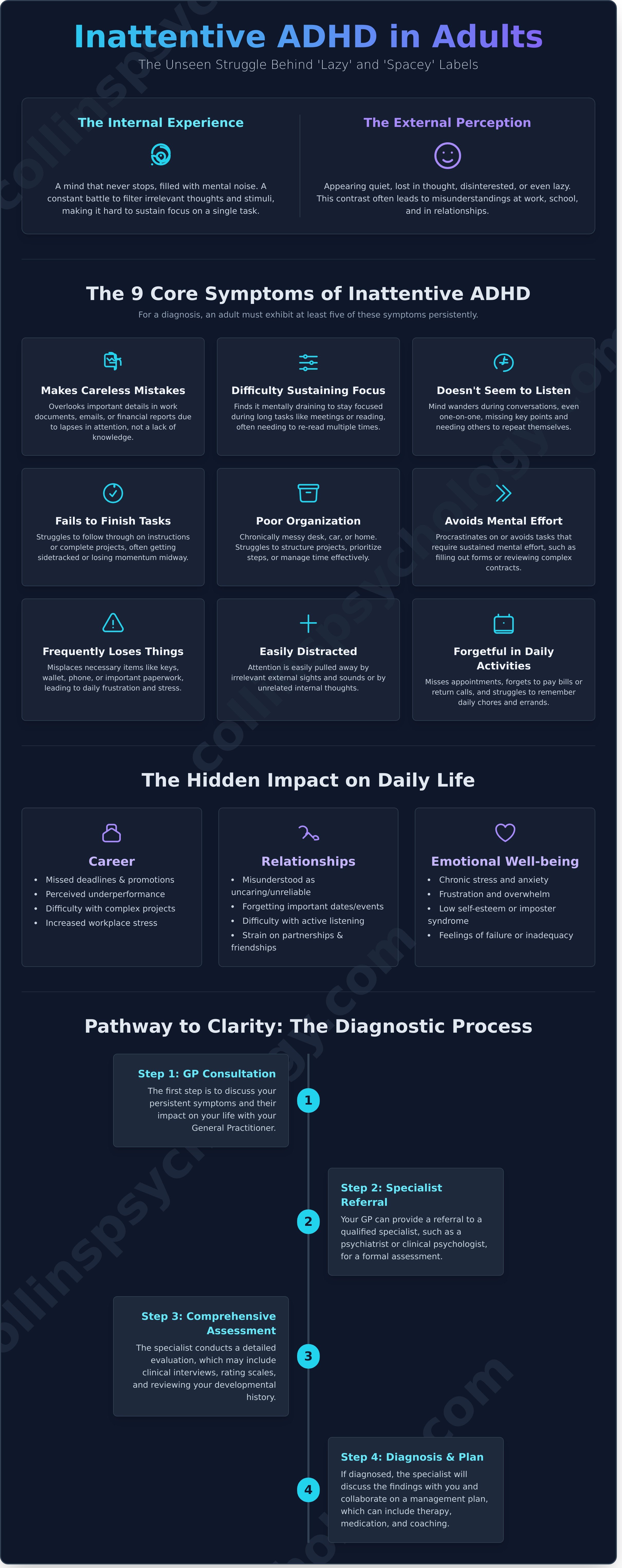
For an adult with inattentive ADHD, the internal world can feel like a constant storm of thoughts, ideas, and external stimuli with no effective filter. Your mind may jump from a work task to a forgotten errand to a random memory, all within a few seconds. This internal busyness is often exhausting, yet it is completely invisible to others.
Externally, this internal struggle can be perceived very differently. An individual with inattentive ADHD might appear:
Quiet or shy
They may be lost in thought rather than engaging in conversation.
A daydreamer
Their mind wanders during meetings or social gatherings.
Disinterested or aloof
They may miss social cues or parts of a conversation, making them seem uncaring.
'Lazy' or unmotivated
Procrastination on mentally demanding tasks is seen as a choice, not a symptom of executive dysfunction.
This gap between internal reality and external perception can lead to significant challenges in relationships and professional settings, often resulting in feelings of being profoundly misunderstood.
Why Is It Often Missed, Especially in Adults and Women?
Inattentive ADHD frequently goes undiagnosed until adulthood, particularly in women. Unlike hyperactive-impulsive symptoms, which are often disruptive in a classroom setting, inattentive symptoms are quiet and internalised. A child who daydreams is far less likely to be referred for an assessment than a child who cannot stay in their seat (Quinn, 2005).
Many adults, especially women, also develop sophisticated coping mechanisms over the years to mask their symptoms. They may work twice as hard to meet deadlines, rely on complex systems of reminders, or avoid situations where their difficulties might become apparent. While these strategies can be effective, they are mentally draining and can contribute to chronic stress, anxiety, and burnout, which may be the very issues that finally lead them to seek help.
The 9 Core Symptoms of Inattentive ADHD in Adults
The clinical diagnosis of inattentive ADHD is based on criteria outlined in the Diagnostic and Statistical Manual of Mental Disorders (DSM-5). An adult must consistently display at least five of the following nine symptoms for a period of six months or more, to a degree that is inconsistent with their developmental level and negatively impacts their life (American Psychiatric Association, 2013).
Here, we translate these clinical criteria into real-world examples common in adulthood.
Difficulties with Sustained Focus and Detail
Often fails to give close attention to details or makes careless mistakes.
This can manifest as sending an email with typos, overlooking key information in a report, or making simple errors in calculations.
Often has difficulty sustaining attention in tasks or play activities.
You might find it hard to get through a long meeting without your mind wandering, struggle to finish a book, or lose focus halfway through a project.
Often does not seem to listen when spoken to directly.
During a conversation, your thoughts may drift, causing you to miss what was said and have to ask people to repeat themselves. This can be misinterpreted as rudeness or a lack of interest.
Challenges with Organisation and Task Management
- Often does not follow through on instructions and fails to finish schoolwork, chores, or duties in the workplace. You might start a task with enthusiasm but get sidetracked and leave it unfinished.
- Often has difficulty organising tasks and activities. This can look like a persistently messy desk or home, trouble prioritising tasks, or struggling to plan a project with multiple steps. These are core challenges related to executive functioning (Barkley, 2015).
- Often avoids, dislikes, or is reluctant to engage in tasks that require sustained mental effort. You may procrastinate on filling out forms, preparing reports, or reviewing dense documents because the mental effort feels overwhelming.
- Often loses things necessary for tasks or activities. This includes frequently misplacing keys, wallets, phones, documents, or tools needed to get a job done.
Issues with Distractibility and Memory
- Is often easily distracted by extraneous stimuli. A phone notification, a nearby conversation, or even a passing thought can be enough to completely derail your focus from the task at hand.
- Is often forgetful in daily activities. This can range from forgetting appointments and deadlines to not remembering to pay a bill or return a phone call.
The Hidden Impact of Inattentive ADHD on Daily Life
The DSM-5 criteria describe behaviours, but they do not fully capture the profound and often painful impact these symptoms have on an adult’s life. Living with undiagnosed or unmanaged inattentive ADHD can take a significant emotional, professional, and personal toll.
Emotional Dysregulation and Rejection Sensitivity
While not a core diagnostic criterion, emotional dysregulation is a common and challenging aspect of adult ADHD (Shaw et al., 2014). This can involve:
Low frustration tolerance
Small setbacks can feel catastrophic and trigger intense emotional reactions.
Overwhelm
The constant effort of managing daily life can lead to feelings of being completely overwhelmed and shutting down.
Low self-esteem
A lifetime of being told you are 'not trying hard enough' or are 'lazy' can lead to deep-seated feelings of inadequacy.
Many adults with ADHD also experience what is sometimes called Rejection Sensitive Dysphoria (RSD). This is an extreme emotional sensitivity and pain triggered by the perception of being rejected, criticised, or falling short of expectations. This can make navigating relationships and workplace feedback incredibly difficult.
Professional and Financial Consequences
In the workplace, the challenges of inattentive ADHD can lead to underperformance, missed promotions, or frequent job changes. You may be highly intelligent and creative but struggle to execute your ideas consistently.
Financially, this can result in what is known as the 'ADHD tax'. This refers to the extra costs incurred due to symptoms, such as:
• Late fees from forgotten bills.
• Wasted money on unused subscriptions.
• Impulse spending to get a quick dopamine hit.
• The cost of replacing lost items.
Relationship Strain and Social Difficulties
The symptoms of inattentive ADHD can cause significant friction in personal relationships. A partner may feel ignored or unloved when you forget important dates or 'zone out' during conversations. The unequal distribution of household chores, often stemming from difficulties with organisation and task initiation, can be a major source of conflict. Friendships can also suffer when you struggle to reply to messages or follow through on plans.
Pathways to Clarity: The Diagnostic Process for Adults
If you recognise yourself in the descriptions above, seeking a formal assessment can be a validating and empowering first step. It is important to note that Collins Psychology provides therapeutic programmes to manage ADHD symptoms but does not offer formal diagnostic services.
Who Can Diagnose Adult ADHD?
In Ireland and much of Europe, the diagnostic process for adult ADHD typically involves a referral from your General Practitioner (GP). Your GP can refer you to a professional with training in diagnosing adult neurodevelopmental conditions, such as:
A Psychiatrist
A medical doctor who can conduct a full assessment, provide a diagnosis, and is able to prescribe medication if it is deemed an appropriate part of the treatment plan.
A Clinical Psychologist
A professional who can conduct a comprehensive psychological assessment, provide a diagnosis, and offer therapeutic interventions like CBT.
What to Expect During an Assessment
A thorough ADHD assessment is not a quick checklist. It is a comprehensive process designed to build a complete picture of your life and rule out other conditions that can present with similar symptoms, like anxiety, depression, or thyroid issues. You can typically expect:
A detailed clinical interview
Discussing your current struggles, as well as your history from childhood to the present.
Rating scales and questionnaires
For you and sometimes for a partner or family member to complete.
A review of past records
Such as old school reports, if available, which can provide evidence of symptoms in childhood.
A diagnosis can provide immense relief. It reframes a lifetime of struggles not as character flaws, but as the symptoms of a treatable condition.
Managing Inattentive ADHD: Evidence-Based Strategies That Work
A diagnosis is the start, not the end, of the journey. Managing inattentive ADHD effectively often involves a multi-modal approach that includes education, lifestyle adjustments, and skills-based therapy. Cognitive Behavioural Therapy (CBT) is a highly effective, non-pharmacological approach that helps adults with ADHD build practical strategies to manage their symptoms.
The Role of Cognitive Behavioural Therapy (CBT)
CBT is a structured, goal-oriented therapy that has been adapted specifically for the challenges of adult ADHD (Safren et al., 2005). It works by helping you understand the interplay between your thoughts, feelings, and actions. For inattentive ADHD, CBT focuses on:
Challenging negative thought patterns
It helps you reframe unhelpful beliefs like "I am lazy" or "I will never be organised" into more realistic and compassionate ones.
Building practical skills
CBT provides concrete techniques for improving organisation, planning, and time management. It is about doing, not just talking.
Improving emotional regulation
It teaches you to recognise emotional triggers and develop healthier coping strategies for frustration, overwhelm, and rejection sensitivity.
Practical Strategies for Executive Functioning
CBT helps you implement systems to support your brain's executive functions. These are not about 'trying harder', but about working smarter. Examples include:
Using external aids
Leveraging planners, calendars, apps, and reminders to offload the burden from your working memory.
Breaking down tasks
Learning to dissect large, overwhelming projects into small, specific, and manageable steps.
Time management techniques
Implementing strategies like time blocking or the Pomodoro Technique to sustain focus and prevent burnout.
Building a Supportive Environment
Effective management also involves creating a life that works with your brain, not against it. This includes:
Prioritising sleep, nutrition, and exercise
These are fundamental for optimal brain function and can significantly impact ADHD symptoms.
Communicating your needs
Learning how to explain your challenges and needs to partners, employers, and friends in a constructive way.
Our structured online programmes are designed to guide you through this process. They offer a clear, self-paced path to learning and implementing these evidence-based CBT strategies, helping you build a life where you are in control.
Learn about our evidence-based CBT programmes for Adult ADHD.
Frequently Asked Questions
Is inattentive ADHD the same as ADD?
Yes, essentially. Attention Deficit Disorder (ADD) is an older term that was used before the different presentations of ADHD were clinically defined. Today, the correct clinical term for this condition is ADHD, Predominantly Inattentive Presentation.
Can you develop inattentive ADHD as an adult?
ADHD is a neurodevelopmental condition, which means it originates in childhood. You cannot develop it as an adult. However, it is very common for the symptoms to be missed or misinterpreted during childhood, leading to a diagnosis for the first time in adulthood when life's demands increase.
How do I know if it's inattentive ADHD or just anxiety or depression?
There is significant symptom overlap between these conditions. For example, difficulty concentrating can be a symptom of all three. This is why a comprehensive assessment from a qualified professional is essential to distinguish between them and identify any co-occurring conditions.
Can you have inattentive ADHD and still be successful or intelligent?
Absolutely. Many highly intelligent, creative, and successful people have inattentive ADHD. The condition does not determine intelligence or potential. The challenges are not in ability, but in the consistent application of that ability.
What are the first steps to take if I suspect I have inattentive ADHD?
A good first step is to speak with your GP. They can discuss your symptoms with you, rule out other potential medical causes, and provide a referral to a psychiatrist or clinical psychologist for a formal assessment if appropriate.
Does inattentive ADHD get worse with age?
The core ADHD symptoms do not necessarily worsen with age. However, the challenges can become more pronounced as life responsibilities increase, such as managing a career, household, and family. Furthermore, hormonal changes, particularly for women during perimenopause and menopause, can exacerbate ADHD symptoms.
References
American Psychiatric Association. (2013). Diagnostic and statistical manual of mental disorders (5th ed.).
Barkley, R. A. (2015). Attention-deficit hyperactivity disorder: A handbook for diagnosis and treatment (4th ed.). The Guilford Press.
Quinn, P. O. (2005). Treating adolescent girls and women with ADHD: gender-specific issues. Journal of Clinical Psychology, 61(5), 579-587.
Safren, S. A., Otto, M. W., Sprich, S., Winett, C. L., Wilens, T. E., & Biederman, J. (2005). Cognitive-behavioral therapy for ADHD in medication-treated adults with continued symptoms. Behaviour Research and Therapy, 43(7), 831–842.
Shaw, P., Stringaris, A., Nigg, J., & Leibenluft, E. (2014). Emotion dysregulation in attention deficit hyperactivity disorder. American Journal of Psychiatry, 171(3), 276-293.