.png)

Do you ever feel trapped in a cycle of negative thinking, where worry or self-doubt are on a constant loop? Perhaps you’ve considered therapy but worry it will be directionless, or you've felt that past sessions were more about talking than taking action. If you're seeking a structured, evidence-based approach to create real change, Cognitive Behavioural Therapy (CBT) offers a clear path forward.
Unlike therapies that can feel open-ended, CBT is a goal-oriented process designed to equip you with practical skills. In this guide, we will demystify this powerful therapeutic model. You will learn its core principles, understand the proven connection between your thoughts, feelings, and actions, and discover what to expect from a typical session. Our goal is to provide you with a clear understanding of how CBT works, so you can feel hopeful and empowered to improve your mental well-being.
Key Takeaways
- Understand how CBT provides a structured, goal-oriented approach to therapy, focusing on present-day challenges rather than solely on the past.
- Discover the practical techniques used in cbt to identify, challenge, and reframe unhelpful thought patterns and behaviours.
- Learn which mental health conditions CBT is an evidence-based and highly effective treatment for, including anxiety and depression.
- Get a clear picture of what happens in a typical session, from setting an agenda to developing actionable strategies for the week ahead.
- Recognise the key qualifications to look for when seeking a qualified CBT therapist in Ireland to ensure you receive specialised care.
What is CBT? The Core Principles Explained Simply
Cognitive Behavioral Therapy, or CBT, is a structured, goal-oriented form of psychotherapy that empowers you to manage challenges in your life. Unlike some therapies that delve deep into your past, CBT focuses primarily on the 'here and now'-your current thoughts, feelings, and behaviours. It operates on a simple yet powerful principle: these three elements are deeply interconnected and influence one another. For a complete academic overview, you can read more about Cognitive Behavioral Therapy on Wikipedia, but the core concept is straightforward. Think of it like trying on different pairs of glasses; changing your thought patterns (the lenses) can completely change how you see and react to a situation.
The Cognitive Model: How Thoughts Shape Your Reality
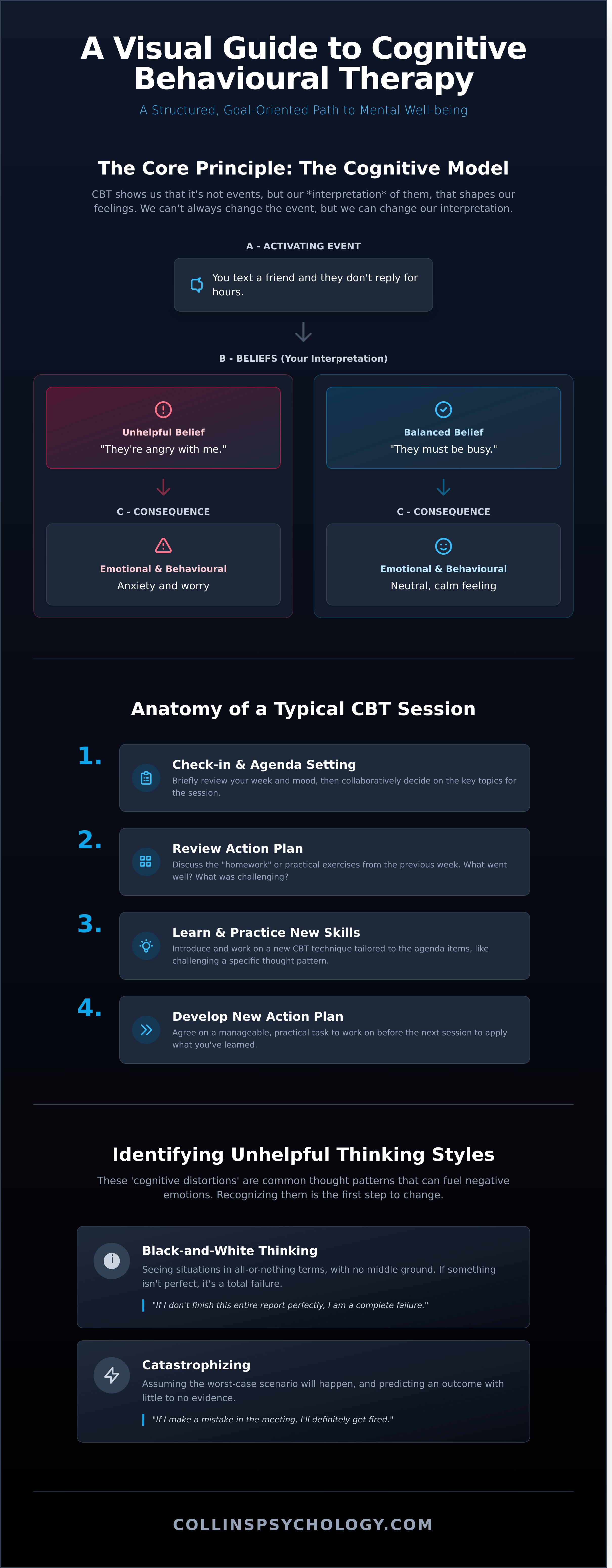
CBT uses a framework called the Cognitive Model to understand our experiences. It’s often broken down into the A-B-C model:
- A - Activating Event: Something happens. (e.g., You send a text message to a friend, and they don't reply for hours.)
- B - Beliefs: Your interpretation or thoughts about the event. (e.g., Path 1: "They're angry with me." vs. Path 2: "They must be busy.")
- C - Consequences: Your emotional and behavioural reaction. (Path 1 leads to anxiety and worry. Path 2 leads to a neutral, calm feeling.)
The key insight is that we cannot change the event (A), but we have the power to challenge and change our beliefs (B), which directly alters the emotional outcome (C).
The Collaborative Nature of CBT
Your relationship with your therapist is a partnership. Think of it as a team working towards a common goal. Your therapist acts as a guide, providing the map and tools based on evidence-based strategies. However, you are always the expert on your own life. Your active participation is crucial-from setting meaningful goals to providing feedback on what works for you. This collaborative approach ensures the therapy is tailored specifically to your needs and circumstances.
Why CBT is Skills-Based and Action-Oriented
While gaining insight is valuable, CBT is fundamentally about action. It goes beyond just talking about problems and focuses on building a practical toolkit of lifelong skills. Between sessions, you will often work on 'action plans'-specific tasks designed to help you practice new strategies in your daily life. The goal of cbt is not to keep you in therapy forever, but to equip you with the durable skills needed to become your own therapist and effectively manage challenges long after your sessions have ended.
How Does a Typical CBT Session Work?
Unlike less structured forms of therapy, a Cognitive Behavioural Therapy (CBT) session is a collaborative, goal-oriented meeting. Each session is designed to be a productive workshop where you and your therapist work together on practical strategies. While flexible enough to address immediate concerns, every meeting follows a predictable and effective format to maximise your progress.
A standard session typically unfolds in four clear stages:
- Check-in and Agenda Setting: A brief review of your week and mood, followed by collaboratively setting the goals for the session.
- Review: Discussing your experience with the strategies you practiced since the last session (your "homework").
- Learning and Practicing: Introducing a new concept or skill tailored to your specific challenges.
- Action Plan: Agreeing on a new, manageable task to practice before your next meeting.
Setting a Clear Agenda
For an adult with ADHD, a clear structure is essential. Setting an agenda at the start of each session ensures the time is used effectively to address your most pressing concerns. This collaborative process empowers you to take an active role in your own therapy. Agenda items are specific and action-focused, such as, "develop a strategy to manage procrastination on work projects" or "practice challenging anxious thoughts about social events."
Identifying and Challenging Negative Thought Patterns
A core component of cbt involves learning to recognise and reframe unhelpful thinking styles, often called 'cognitive distortions'. These are common, automatic thought patterns that can fuel anxiety, low mood, and inaction. As the American Psychological Association on CBT explains, identifying these thoughts is the first step toward changing your behavioural response. Your therapist will help you spot them in your own thinking. Common examples include:
- Black-and-White Thinking: Seeing situations as all-or-nothing, with no middle ground. For example, "If I don't finish this entire report perfectly, I am a complete failure."
- Catastrophizing: Assuming the worst-case scenario will happen. For instance, "If I make a mistake in the meeting, I'll definitely get fired."
- Personalisation: Believing you are responsible for events that are entirely outside of your control.
Developing New Skills and Strategies
Each session builds on the last, systematically adding new tools to your mental toolkit. The focus is always on practical application-how you can use these strategies to manage ADHD symptoms and improve your daily life. The ultimate goal is for you to become your own therapist, equipped with the knowledge and confidence to navigate challenges long after therapy has concluded. Our structured CBT programs are designed to build these skills systematically, providing a clear path toward greater control and well-being.
What Conditions and Challenges Can CBT Help With?
Cognitive Behavioural Therapy is one of the most extensively researched and evidence-based forms of psychotherapy available today. Its effectiveness is recognised for a wide range of mental health conditions. While it is a gold-standard treatment for anxiety disorders (including GAD, panic, and phobias), depression, and PTSD, its structured, practical approach extends far beyond formal diagnoses to address everyday life challenges.
Managing Anxiety and Depression
For those struggling with anxiety, this therapy provides effective strategies to break the debilitating cycle of worry and avoidance. It teaches you to identify, challenge, and reframe anxious thoughts. In cases of depression, the focus is on modifying the negative core beliefs that fuel low mood. A key technique, known as behavioural activation, encourages engaging in positive, rewarding activities to systematically improve mood and restore a sense of accomplishment.
A Structured Approach for Adult ADHD
While not a "cure" for ADHD, cbt is expertly adapted to target its most challenging aspects, particularly those related to executive functioning. This specialised approach provides a structured framework for building practical skills in areas like time management, organisation, and overcoming procrastination. It also directly addresses the emotional regulation difficulties-such as frustration and impulsivity-that frequently accompany ADHD, helping you develop better coping mechanisms. Learn more about our specialized CBT for Adult ADHD program.
Improving Other Areas of Life
The principles of this therapeutic approach are highly adaptable, making it a powerful tool for improving overall well-being. Its applications are diverse and include proven methods for managing:
- Insomnia: A specific protocol, CBT-I, is the leading non-pharmacological treatment for chronic insomnia.
- Chronic Pain and Stress: It helps individuals change their relationship to physical discomfort and develop more effective stress management techniques.
- Self-Esteem and Anger: The therapy provides tools to challenge self-critical thoughts and manage anger by understanding its triggers and developing healthier responses.
The broad applicability of this therapy is why it is so widely recommended. In other regions, for instance, major organisations like the Australian Psychological Society provide resources to help people Find a CBT therapist in Australia for these very issues.
Core CBT Techniques You Will Learn
Cognitive Behavioural Therapy is not just about talking; it's about doing. In your sessions, you will acquire a toolkit of practical, evidence-based strategies designed to manage the challenges of ADHD. These are not quick fixes, but skills that, with practice, you can master and apply throughout your life to improve focus, regulate emotions, and achieve your goals. Below is a preview of some foundational techniques you'll learn.
Cognitive Restructuring and Thought Records
A core component of cbt involves learning to identify and challenge the unhelpful automatic thoughts that often fuel anxiety and procrastination. The Thought Record is a structured tool that helps you do this systematically. Your therapist will guide you through its columns:
- Situation: What event triggered the thought? (e.g., Receiving critical feedback at work)
- Automatic Thought: What was the first thing that went through your mind? (e.g., "I'm a failure and can't do anything right.")
- Emotion: How did that thought make you feel? (e.g., Ashamed, anxious)
- Evidence For/Against: Objectively examine the evidence. What facts support this thought? What facts contradict it?
- New, Balanced Thought: Based on the evidence, what is a more realistic way to view the situation? (e.g., "The feedback was tough, but it was about one task, not my entire worth. I can learn from this.")
This process creates critical distance, allowing you to respond to situations thoughtfully rather than react emotionally.
Behavioral Experiments
Sometimes, the most powerful way to challenge a belief is to test it in the real world. A behavioral experiment is a planned activity to see if your fears or predictions come true. For example, if you have social anxiety and believe, "If I speak up in a meeting, everyone will think my idea is stupid," we might design an experiment where you share one well-prepared thought. By observing the actual outcome-which is often neutral or even positive-you gather powerful, first-hand evidence that directly counters your unhelpful belief.
Activity Scheduling and Behavioral Activation
ADHD can often co-occur with low motivation and mood, creating a cycle of inactivity and feeling worse. Behavioral Activation flips this on its head with a simple but profound principle: action comes before motivation. Instead of waiting to feel good to do things, you will learn to strategically schedule small, manageable activities that are either pleasurable or provide a sense of accomplishment. This builds momentum and lifts your mood. Our course on CBT for Goal Setting & Motivation dives deep into these methods.
Finding a Qualified CBT Therapist in Ireland
Embarking on therapy is a significant and positive step towards managing adult ADHD. The success of this journey often depends on finding the right professional partner. While many therapists incorporate elements of Cognitive Behavioural Therapy into their practice, it is crucial to find a practitioner with specific, in-depth training in this structured, evidence-based approach to ensure you receive the most effective care.
What to Look For in a Therapist's Profile
When reviewing potential therapists, look for specific keywords that signal expertise. Their profile or website should mention terms like "CBT," "evidence-based practice," and, ideally, a specialisation in "adult ADHD." In Ireland, verify that they are accredited with a recognised professional body relevant to their discipline (e.g., psychology, psychotherapy, counselling). This accreditation ensures they meet stringent professional and ethical standards specific to the Irish context.
Questions to Ask a Potential CBT Therapist
An initial consultation is an opportunity for you to interview the therapist and determine if their approach aligns with your needs. Feeling empowered to ask direct questions is key to finding the right fit. Consider asking:
- What is your specific training and experience in using cbt with adults who have ADHD?
- How do you structure your therapy sessions, and what can I expect during a typical meeting?
- How will we collaborate to set clear, measurable goals and track my progress?
Taking the Next Step
Finding a therapist you connect with is fundamental to the therapeutic process. Do not be discouraged if the first person you speak with isn't the right match. This search is an investment in your long-term well-being. A strong therapeutic alliance is built on trust and a shared understanding of your goals, providing the foundation for meaningful change.
If you believe a structured, evidence-based approach is right for you and are considering specialised online support, contact the team at Collins Psychology to learn more about our programmes for adult ADHD.
Your Path Forward with Cognitive Behavioural Therapy
Ultimately, Cognitive Behavioural Therapy offers a structured and empowering path toward managing your mental health. By understanding the direct link between your thoughts, feelings, and actions, you gain a set of practical, lifelong skills to reframe unhelpful patterns and respond to challenges more effectively.
Putting these principles into practice is the most important step. At Collins Psychology, we specialise in structured, evidence-based cbt programs, with a distinct focus on supporting adults with ADHD. Our clinical expertise is trusted not only by our clients but also by fellow professionals who attend our clinical training programs across Ireland.
If you are ready to build greater control and clarity in your life, we are here to guide you. Explore our evidence-based CBT programs for adults and take a definitive step towards a more manageable future.
Frequently Asked Questions About CBT
What is the difference between CBT and other types of therapy?
Cognitive Behavioral Therapy (CBT) is a structured, goal-oriented approach focused on your current challenges. Unlike therapies that may delve deeply into your past, CBT concentrates on identifying and changing unhelpful thinking patterns and behaviours in the present. It is highly practical, teaching you specific skills to manage symptoms and improve daily functioning. The focus is on developing concrete strategies you can use right away to better cope with the impacts of ADHD.
How long does Cognitive Behavioral Therapy usually take?
Cognitive Behavioral Therapy is designed to be a short-term treatment. While the exact duration depends on your individual needs and goals, a typical course of CBT for adult ADHD involves between 12 and 20 weekly sessions. The aim is to equip you with a durable toolkit of strategies for managing executive functioning challenges, emotional regulation, and focus, empowering you to maintain progress independently long after therapy concludes.
Is CBT effective? What does the research say?
Yes, CBT is a highly effective, evidence-based therapy. Extensive scientific research has demonstrated its success in treating a range of conditions, including the core challenges associated with adult ADHD. Studies show that a specialised CBT approach can significantly improve executive functioning skills, such as organisation and time management, and help individuals develop better strategies for emotional regulation. It is considered a first-line treatment due to its strong empirical support.
Do I have to talk about my childhood in CBT?
Generally, you do not have to talk extensively about your childhood in CBT. The primary focus is on the "here and now"-your current thoughts, emotions, and behaviours. While your therapist will acknowledge how past experiences have shaped you, the sessions are geared towards solving present-day problems and building skills for the future. The goal is to address current obstacles rather than analysing the past in depth.
Can CBT be done online or via telehealth?
Absolutely. Online CBT is a well-established and effective method of delivering therapy that offers the same structured, evidence-based support as in-person sessions. Telehealth provides a convenient and accessible way to engage in therapy from the comfort of your own home, eliminating travel time and fitting more easily into a busy schedule. Research confirms that the outcomes for online cbt are comparable to face-to-face treatment for many conditions.
Is CBT suitable for complex trauma?
While standard CBT can address some symptoms associated with trauma, such as anxiety or depression, it is not typically the recommended primary treatment for complex trauma. More specialised, trauma-informed approaches are better suited for addressing the deep-seated effects of prolonged traumatic experiences. Therapies like Trauma-Focused CBT (TF-CBT), EMDR, or phased-based treatments are specifically designed to handle the complexities of trauma in a safe and effective manner.