.png)

Do you ever feel trapped in a cycle of negative thoughts, wishing you had a practical way to break free? The world of therapy can feel overwhelming, and it’s understandable to worry about finding an approach that offers clear, structured solutions rather than just endless talking. If you're looking for an effective, goal-oriented path forward, cognitive behavioral therapy (CBT) provides a scientifically-backed framework for creating meaningful, lasting change in your life.
This practical guide is designed to demystify CBT and empower you with knowledge. We will explore its core principles, breaking down exactly how your thoughts, feelings, and behaviours are connected. You will learn about specific, evidence-based techniques to challenge unhelpful patterns and develop healthier coping strategies. Our goal is to provide you with the clarity and confidence to understand how this powerful therapy works and to decide if it’s the right step for you on your journey to better mental health.
Key Takeaways
- Discover the powerful connection between your thoughts, feelings, and actions, and how you can learn to reshape unhelpful patterns.
- Understand how structured, collaborative sessions are central to cognitive behavioral therapy, an evidence-based approach for a wide range of mental health conditions.
- Explore the practical 'toolkit' of CBT, which provides actionable strategies you can use for the rest of your life to manage emotional challenges.
- Learn what makes a person a good candidate for CBT and why being an active participant in your therapy is key to achieving your goals.
The Core Principles of CBT: How Thoughts, Feelings, and Actions Connect
Before we can apply specific time management strategies, it is essential to understand the psychological framework that makes them effective. Cognitive Behavioral Therapy (CBT) is a structured, evidence-based form of psychotherapy that focuses on the present. Unlike therapies that delve deep into your past, CBT provides practical tools to manage current challenges by examining the powerful connection between what you think, how you feel, and what you do.
The fundamental idea is that it’s not external events-like a looming deadline or a critical comment-that directly cause our emotional distress, but rather our interpretation of those events. For a comprehensive overview of CBT, it's helpful to understand its core principle: our thoughts shape our reality. Imagine wearing a pair of glasses; if the lenses are tinted grey, the whole world looks bleak. CBT helps us recognise the tint of our "lenses" and learn how to see situations with more clarity and balance.
The Cognitive Triangle Explained
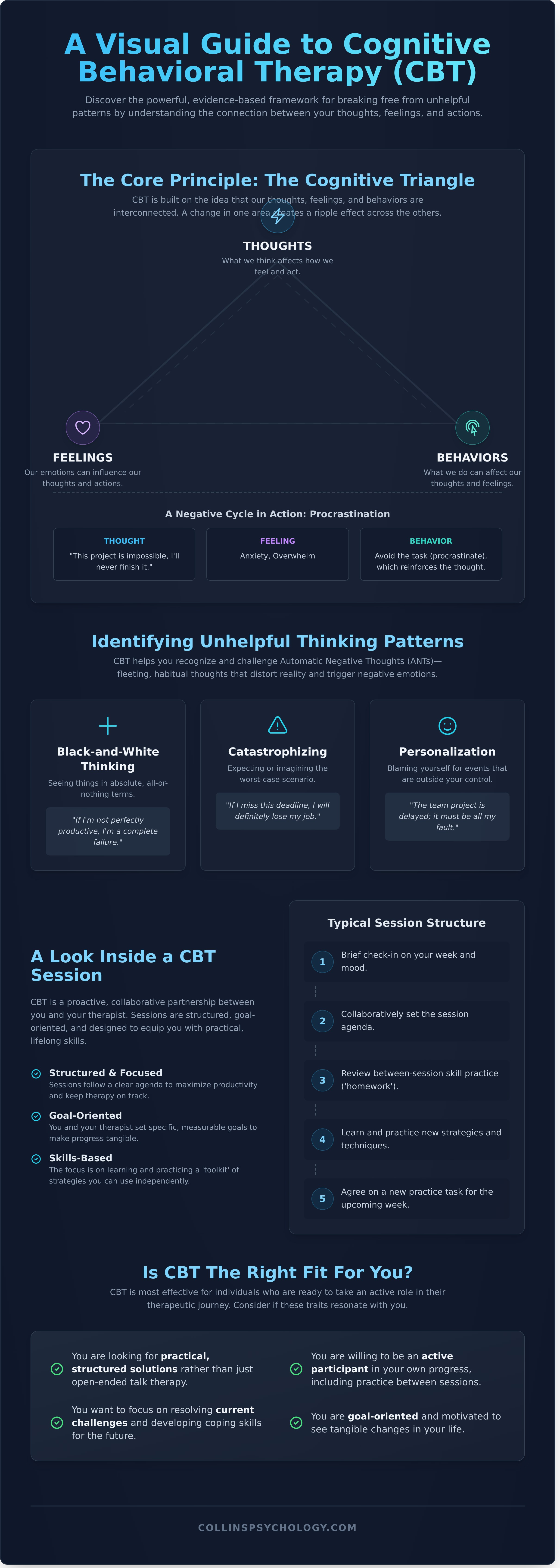
The central model in cognitive behavioral therapy is the Cognitive Triangle, which illustrates how our thoughts, feelings, and actions are interconnected. A change in one corner directly influences the other two, creating a cycle that can either be helpful or unhelpful. The three points are:
- Thoughts: What we think about a situation.
- Feelings: The emotions and physical sensations we experience.
- Actions: Our resulting behaviours.
For example, facing a large project (situation), you might have the thought, "This is impossible; I'll never finish it." This thought can lead to feelings of anxiety and being overwhelmed, which in turn leads to the action of procrastinating. This avoidance then reinforces the initial thought that the task is impossible, trapping you in a negative loop.
Identifying Automatic Negative Thoughts (ANTs)
A crucial first step in CBT is learning to identify Automatic Negative Thoughts (ANTs). These are fleeting, habitual thoughts that pop into our minds without conscious effort and often shape our emotional responses. Becoming aware of these unhelpful thinking patterns, or "cognitive distortions," is the key to breaking the cycle. Common examples include:
- Black-and-White Thinking: Seeing things in absolute terms. "If I'm not perfectly productive, I'm a complete failure."
- Catastrophizing: Expecting the worst-case scenario. "If I miss this deadline, I’ll lose my job."
- Personalization: Blaming yourself for things you can't control. "The team project is delayed; it must be my fault."
Simply noticing these thoughts without judgment is a powerful act. It creates the space needed to challenge and reframe them-a skill we will explore throughout this article.
How CBT Works in Practice: A Look Inside the Therapy Room
Cognitive behavioral therapy is not about endlessly analysing your past. Instead, it’s a proactive, collaborative partnership between you and your therapist focused on the "here and now." Sessions are structured, goal-oriented, and typically short-term, designed to equip you with practical skills to manage current challenges. You are an active participant in your own progress, working as a team to identify and change unhelpful patterns.
The Structure of a Typical Session
To ensure every moment is productive, CBT sessions follow a clear, predictable structure. This methodical approach helps maintain focus, which is particularly beneficial for the ADHD brain. A typical session includes:
- A brief check-in on your week and mood.
- Setting a clear agenda for the session together.
- Reviewing your between-session skill practice ('homework').
- Learning and actively practicing new strategies and techniques.
- Agreeing on a new practice task to apply before the next session.
The Importance of Goal Setting
Effective therapy begins with a clear destination. You and your therapist will work together to set specific, measurable, and achievable goals. Instead of a vague aim like "be less stressed," a CBT goal might be "to reduce procrastination on work projects by using a specific time management technique three times a week." This makes progress tangible and keeps therapy focused. While our focus here is on ADHD, the American Psychological Association provides a useful overview of what CBT can treat, from anxiety to sleep issues. Structured programs often build on these principles, focusing on specific skills like goal setting and time management to create lasting change.
The Role of 'Homework' in Making Real Change
The most significant progress in therapy happens between sessions. We refer to 'homework' as skill practice or behavioral experiments, as it’s your opportunity to apply what you’ve learned in the real world. This could involve using a thought record to challenge negative self-talk, scheduling specific tasks to overcome avoidance, or practicing a new relaxation technique. This is not about passing a test; it's about building new habits and proving to yourself that change is possible.
What Can Cognitive Behavioral Therapy Treat?
Cognitive Behavioral Therapy (CBT) is one of the most extensively researched and evidence-based forms of psychotherapy available today. Its structured, goal-oriented approach has been proven effective across a wide spectrum of psychological and emotional challenges. This practical therapy focuses on identifying the connections between your thoughts, feelings, and actions. To understand in more detail how CBT works, it is helpful to see it as a toolkit for changing unhelpful patterns.
Its efficacy is well-documented for numerous conditions, including:
- Depression
- Anxiety disorders (such as panic disorder, OCD, and phobias)
- Post-Traumatic Stress Disorder (PTSD)
- Eating disorders
Beyond these specific diagnoses, CBT also provides powerful strategies for managing common life challenges like chronic stress, anger management, and low self-esteem.
CBT for Mood and Anxiety Disorders
For anxiety, CBT helps individuals break the cycle of worry by teaching them to identify, question, and reframe anxious thoughts. In the context of depression, it provides tools to challenge the persistent negative self-beliefs that fuel low moods. For those recovering from trauma, it offers a safe, structured way to process difficult memories and overcome the patterns of avoidance that can keep PTSD active.
CBT for Adult ADHD: Managing Executive Function Challenges
For adults with ADHD, cognitive behavioral therapy is specifically adapted to address the core difficulties associated with executive functioning. It provides practical, real-world coping strategies to manage the daily impact of ADHD. The focus is less on the past and more on building skills for the present and future, targeting key areas such as:
- Procrastination and task initiation
- Time management and planning
- Organisation and reducing clutter
- Emotional regulation and managing overwhelm
It’s important to note that CBT does not 'cure' ADHD. Instead, it empowers you with effective, evidence-based tools to navigate its challenges, improve productivity, and build a more confident, structured life. Learn more about our specialized CBT for Adult ADHD program.
Key Techniques Used in Cognitive Behavioral Therapy
Think of cognitive behavioral therapy as a practical toolkit for managing ADHD. It isn't about endless talk; it's about learning effective, evidence-based skills that you can use for the rest of your life. A therapist acts as your guide, helping you build a flexible set of coping strategies to navigate challenges with executive functioning and emotional dysregulation. These techniques are typically categorised into two main groups: cognitive (related to your thoughts) and behavioral (related to your actions).
Cognitive Techniques: Changing Your Mind
This approach is founded on the principle that your thoughts directly influence your feelings and behaviours. The core technique here is Cognitive Restructuring. You will learn to identify, challenge, and reframe the negative, automatic thoughts that often accompany ADHD, such as "I'm a failure for procrastinating again." Using tools like thought records, you can systematically examine the evidence for these thoughts and develop more balanced, helpful alternatives. Your therapist will use methods like Socratic questioning to guide you in this discovery process, empowering you to become your own thought detective.
Behavioral Techniques: Changing Your Actions
While changing your thinking is crucial, changing your actions is where progress becomes tangible. Key behavioral techniques include:
- Behavioral Activation: A powerful strategy to combat inertia and low mood. It involves intentionally scheduling positive, rewarding, or meaningful activities into your day, even when you don't feel motivated. This helps break the cycle of avoidance and builds momentum.
- Exposure Therapy: If anxiety or specific phobias (like a fear of starting complex projects) contribute to your time management issues, your therapist may use exposure techniques. This is a safe, gradual process of facing feared situations to reduce their power over you.
- Skills Training: This can involve learning practical skills like structured problem-solving, time-blocking, or relaxation techniques to manage stress.
Skills for Emotional Regulation and Resilience
A significant benefit of cognitive behavioral therapy is learning to manage the intense emotions that can derail your focus and productivity. By combining cognitive and behavioral skills, you learn to identify emotional triggers and develop healthier responses. Techniques like mindfulness help you stay grounded in the present moment, while distress tolerance skills provide strategies for navigating crises without making them worse. This ultimately helps you learn to respond to situations thoughtfully rather than react impulsively. Our online modules can help you build specific skills like emotional regulation.
Is CBT Right For You and How to Get Started
Throughout this article, we have explored practical strategies for managing time with ADHD. For many, integrating these skills is most effective within a structured, supportive framework. Cognitive behavioral therapy (CBT) is a highly effective, evidence-based approach that equips you with the tools to change unhelpful thought patterns and behaviours that impact time management.
However, CBT is not a passive process. Its success depends on your active participation. It is a collaborative journey where you and your therapist work together to set clear goals and you commit to practising new skills between sessions. If you are ready to take an active role in developing lasting strategies, CBT could be an excellent fit.
Signs That CBT Could Be a Good Fit
This therapeutic approach is particularly beneficial if you identify with the following:
- You prefer a practical, goal-oriented approach focused on solving current challenges.
- You are prepared to engage in "homework," such as trying new organisational techniques or tracking your time.
- You want to understand the connection between your thoughts, feelings, and actions related to procrastination and productivity.
- You are seeking a structured, evidence-based treatment with a clear beginning, middle, and end.
Finding a Qualified CBT Therapist in Brisbane
Finding the right therapist is a crucial first step. In Brisbane, look for a registered psychologist or an accredited psychotherapist with specific training and experience in cognitive behavioral therapy, particularly for adults with ADHD. Professional bodies like the Australian Psychological Society (APS) or the Psychotherapy and Counselling Federation of Australia (PACFA) maintain directories of qualified members.
Beyond qualifications, the therapeutic relationship is key. It is vital to find a professional you feel comfortable with. Most therapists offer an initial consultation, which is an excellent opportunity to ask questions and see if their approach feels right for you. Consider asking:
- What is your experience working with adults with ADHD?
- How do you adapt CBT to address challenges like time blindness and executive dysfunction?
- What would a typical session look like?
- What are your session fees and cancellation policy?
Taking the step to begin therapy is an investment in your well-being. If you have questions about our structured programs for ADHD management, please contact us.
Harnessing CBT for Lasting Change
As we've explored, the power of CBT lies in its practical, collaborative approach. By illuminating the critical link between your thoughts, feelings, and behaviours, it provides a structured framework for enacting meaningful change. Ultimately, cognitive behavioral therapy is not just a treatment but a set of lifelong skills, empowering you to become your own therapist and navigate future challenges with confidence and resilience.
If you are ready to take the next step, Collins Psychology offers a clear path forward. We provide structured, evidence-based programs with a specialisation in CBT for Adult ADHD, alongside professional training for practitioners across Ireland. Find the support or training that is right for you.
Explore our evidence-based CBT programs and training courses to learn more. Your journey toward greater well-being and professional development starts here.
Frequently Asked Questions About Cognitive Behavioral Therapy
Is CBT just positive thinking?
Cognitive Behavioral Therapy is a structured, skills-based approach, not simply positive thinking. While it encourages a more balanced perspective, its core focus is on identifying and changing unhelpful thought patterns and behaviours. You will learn practical strategies to challenge negative assumptions and develop more effective coping mechanisms, rather than just forcing yourself to think positively. This evidence-based method provides tangible tools for real-world challenges.
How long does Cognitive Behavioral Therapy usually take?
CBT is a short-term, goal-oriented therapy. A typical course of treatment ranges from 12 to 20 sessions, though the exact duration depends on your individual needs and goals. We will collaborate on a structured treatment plan with a clear timeline from the outset. The focus is on making measurable progress in an efficient manner, equipping you with skills that provide lasting benefits long after therapy has concluded.
What is the difference between CBT and other therapies like psychodynamic therapy?
The primary difference lies in their focus and structure. CBT is present-focused and action-oriented, targeting current thoughts and behaviours to solve specific problems. In contrast, psychodynamic therapy often explores past experiences and unconscious influences to foster insight. While both approaches have value, our structured CBT programmes are designed to provide you with practical strategies for immediate application, which is highly effective for managing ADHD-related challenges.
Can I do CBT online or does it have to be in person?
Yes, CBT is delivered effectively both online and in person. Online therapy provides significant flexibility, allowing you to attend sessions from a location that is convenient for you. At Collins Psychology, we offer structured online appointments that uphold the same high standards of professional care as our in-person services. This ensures you can access expert, evidence-based support from anywhere in Ireland, fitting therapy into your schedule without compromise.
Is CBT effective for children and teenagers as well as adults?
Yes, Cognitive Behavioral Therapy is a highly effective and evidence-based treatment for children and adolescents. The techniques are adapted to be age-appropriate, often using more creative and engaging methods to teach core skills. It helps younger individuals manage challenges like anxiety, low mood, and the executive functioning difficulties associated with ADHD. The focus remains on building practical coping strategies they can use at school, at home, and with peers.
What is the evidence that CBT actually works?
The efficacy of CBT is supported by extensive scientific research. Hundreds of clinical trials have demonstrated its effectiveness for a wide range of conditions, including anxiety, depression, and managing the core symptoms of ADHD. It is recognised as a gold-standard treatment by major health organisations. Our practice is committed to using these evidence-based approaches, ensuring you receive a therapy that has been scientifically validated to produce positive, lasting outcomes.