.png)
%20for%20Adult%20ADHD%20online%20support%20psychologist.jpg)
For adults with ADHD, life can often feel like a constant battle against overwhelm, self-criticism, and a revolving door of strategies that do not stick. A structured approach is often necessary to navigate the complexities of executive function and emotional regulation. The 5 C’s framework, originally developed by Dr. Sharon Saline for children and parents, provides a powerful and adaptable roadmap for adults. By integrating this model with evidence-based Cognitive Behavioural Therapy (CBT) techniques, you can move from a cycle of shame to a place of self-compassion and effective self-management. This guide will translate the 5 C’s into a practical toolkit specifically for the adult ADHD experience, helping you build skills in self-control, compassion, collaboration, consistency, and celebration.
What are the 5 C’s of ADHD for Adults?
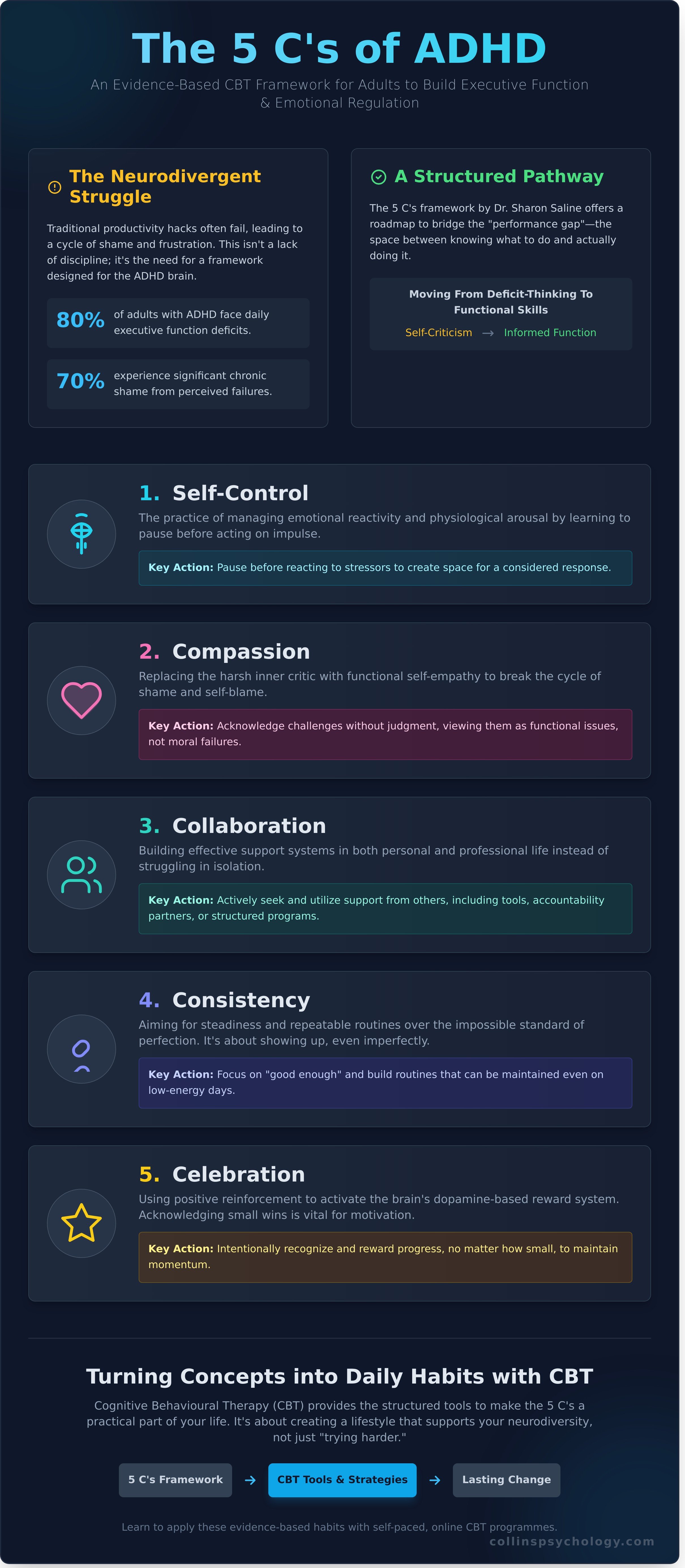
The 5 C’s of ADHD is a framework designed to build resilience and improve management of ADHD-related challenges. While initially conceptualised for a family context (Saline, 2018), its core principles are highly effective for adults seeking to understand and support their own neurodiversity. The five pillars are Self-Control, Compassion, Collaboration, Consistency, and Celebration. For the adult ADHD brain, which often struggles with internal structure and motivation, these pillars provide an essential external scaffold. Cognitive Behavioural Therapy (CBT) serves as the clinical engine that powers this framework, offering the practical tools needed to turn these concepts into tangible daily habits.
Defining the 5 Cs in a Clinical Context
Applying a clinical lens, we can adapt the 5 C’s for adult self-management:
Self-Control
This involves developing the ability to manage emotional reactivity and physiological arousal. It is about creating a pause between a trigger and your response, a core skill in CBT.
Compassion
This is the practice of replacing the harsh "inner critic," a common feature for many adults with ADHD, with functional self-empathy. It is about understanding your challenges without judgment.
Collaboration
For adults, this means strategically building support systems. This includes collaborating with tools (like apps and planners), colleagues at work, and partners or friends in your personal life.
Consistency
This pillar focuses on aiming for "good enough" steadiness rather than perfection. It acknowledges the ADHD brain's variability and prioritises sustainable routines over rigid, all-or-nothing approaches.
Celebration
This is the conscious use of positive reinforcement to fuel the dopamine-deficient ADHD brain. It involves acknowledging effort and small wins to maintain motivation and momentum.
The ADHD Shame Cycle and the Need for Structure
Many adults with a late diagnosis of ADHD have a long history of internalising their struggles as character flaws, leading to a pervasive cycle of shame and self-blame. This can manifest as anxiety, depression, and chronic low self-esteem. Evidence-based frameworks like the 5 C’s, applied through CBT, are crucial for breaking this cycle. They provide a non-judgmental, skills-based approach that externalises the problem from the person. This aligns with the professional standards of bodies like the Psychological Society of Ireland (PSI), which emphasise the use of structured, empirically supported interventions.
Managing Emotional Regulation through Self-Control and Compassion
Emotional dysregulation is a frequent and distressing aspect of adult ADHD. It is not a matter of willpower but a biological difference in how the brain processes and responds to emotions (Shaw et al., 2014). This can lead to intense feelings of frustration, anger, or sadness that seem to appear without warning. The first two C’s, Self-Control and Compassion, work together to address this. Practical CBT techniques help you create the mental space to pause before reacting, while self-compassion allows you to navigate intense feelings without self-criticism. This combination is key to meeting yourself where you are, rather than where you feel you "should" be.
Strategies for Self-Control in High-Stress Moments
Self-control is not about suppressing emotion, but about managing your response to it.
Identify physiological triggers
Notice the physical signs of rising stress, such as a faster heart rate, shallow breathing, or tense muscles. This awareness is your first signal to intervene.
Use the "Stop, Breathe, Reflect" technique
When you feel triggered, consciously Stop what you are doing. Take a few slow, deep Breathes to calm your nervous system. Then, Reflect on the situation and choose a more measured response.
Manage sensory overload
In busy environments, sensory inputs can be overwhelming. Using noise-cancelling headphones or stepping away for a few minutes are valid forms of self-control that reduce cognitive load.
Developing Functional Self-Compassion
Self-compassion is the antidote to the shame that often accompanies ADHD.
Differentiate between excuses and acknowledgment
Acknowledging that a task is difficult due to your neurodiversity is not an excuse. It is a factual starting point from which you can find appropriate strategies.
Use CBT to reframe negative self-talk
When you catch yourself thinking, "I always mess this up," reframe it to, "This is a challenging task for me, and it is okay to find it difficult. What is one small step I can take?"
• Our online programmes provide structured exercises to build these skills. You can learn more in our module on Emotional Regulation.
Boosting Executive Function with Collaboration and Consistency
Executive functions—the brain’s management system responsible for planning, organisation, and task initiation—are a core area of difficulty in ADHD. Instead of trying to force your brain to work in a neurotypical way, the C’s of Collaboration and Consistency encourage you to build a supportive system around yourself.
Step 1: Identify your executive function "bottlenecks."
Are you constantly losing track of time? Do you struggle to start large projects? Pinpoint your one or two biggest challenges.
Step 2: Collaborate with tools and people.
Do not struggle alone. Use digital calendars, project management apps, or a visual timer. Ask a colleague for a 5-minute check-in to create accountability.
Step 3: Define "minimum viable consistency."
What is the smallest version of a habit you can stick with even on a bad day? For example, instead of a one-hour workout, aim for a 10-minute walk.
Step 4: Use external cues to maintain steadiness.
Set alarms, use sticky notes, or place your gym clothes by the door. These external reminders reduce the reliance on your brain's working memory.
Step 5: Review and adjust without self-judgment.
If a system is not working, it is not a personal failure. It is a data point. Review what went wrong and adjust the system accordingly.
Collaboration Beyond the Parenting Model
For adults, collaboration takes on a professional and personal dimension.
Collaborate with workplace managers
This can involve asking for reasonable adjustments, such as receiving instructions in writing or having a quieter workspace.
Use body doubling and digital tools
Working alongside someone else (in person or virtually) can dramatically improve focus. Tools like Asana or Trello act as a collaborative partner for organising projects.
Communicate clearly in adult relationships
Explain to your partner or friends how your ADHD affects you and what kind of support is helpful (e.g., "A gentle reminder about our plans tomorrow would be really helpful").
Consistency Over Perfection
The "all or nothing" mindset is a common trap that can lead to burnout and abandonment of goals.
Embrace "good enough"
The goal is progress, not perfection. Submitting a "good enough" report on time is better than submitting a "perfect" one late.
Build habits that stick
By aiming for 80% consistency, you allow for the natural fluctuations in energy and focus that come with ADHD. This approach is far more sustainable. If you find yourself stuck, explore our guide on overcoming procrastination with ADHD.
• For more detailed strategies, our Executive Function Course offers in-depth guidance.
Celebration: Overcoming the ADHD Shame Cycle
Celebration is arguably the most overlooked yet critical "C" for adults with ADHD. The ADHD brain has a different dopamine reward system, meaning it needs more frequent and immediate positive reinforcement to stay motivated. What may seem like "small wins" to others are significant milestones that require immense cognitive effort. Creating a "Celebration Habit" reframes your relationship with success and directly counteracts the negativity bias that fuels the shame cycle.
The Power of Positive Reinforcement
Use behavioural activation
Acknowledging your progress, no matter how small, releases dopamine and makes you more likely to repeat the behaviour.
Acknowledge cognitive effort
Celebrate the act of starting a difficult task, not just finishing it. Recognise the energy it took to make that phone call or organise that first paragraph.
Create a "done list"
At the end of the day, write down everything you accomplished, including things not on your to-do list. This provides a visual record of your efforts.
Goal Setting for the ADHD Brain
Break large projects into dopaminergic micro-goals
A "micro-goal" is a task so small it is easy to complete, providing a quick hit of satisfaction. Instead of "write report," the first goal might be "open document and write title."
Avoid moving the goalposts
Once you achieve a goal, take a moment to genuinely celebrate it before immediately moving on to the next challenge.
• Our Goal Setting Course teaches you how to structure goals in a way that works with your brain, not against it.
Applying the 5 Cs with Online CBT Learning
For many adults with ADHD, the structure of traditional weekly therapy can be difficult to maintain. Self-paced online learning offers a flexible and effective alternative. It allows you to engage with materials when your focus is at its peak and to revisit concepts as needed. At Collins Psychology, we provide structured, evidence-based CBT programmes designed specifically for the adult ADHD experience. It is important to note that we do not offer one-to-one therapy sessions. Our model is built to empower you with tools and strategies you can learn and apply independently.
The Structure of Our CBT Programmes
Our online modules contain practical exercises, video lessons, and downloadable resources that guide you through applying concepts like the 5 C’s to your own life. You can learn at your own pace, fitting the programme around your work and life commitments. The curriculum covers core areas of difficulty for adults with ADHD, including emotional regulation, executive function, sleep, and time management.
Getting Started with Collins Psychology
Building autonomy and self-management skills is a journey. Our self-paced learning model is designed to support you in developing long-term strategies for a more balanced and fulfilling life. You can choose the module that best addresses your current needs and begin building a personalised toolkit today.
Ready to apply a structured CBT approach to your ADHD? Explore our online, self-paced CBT programs for Adult ADHD.
Frequently Asked Questions
What are the 5 Cs of ADHD parenting, and can they work for adults?
The 5 Cs were originally developed by Dr. Sharon Saline for parents of children with ADHD. The principles—Self-Control, Compassion, Collaboration, Consistency, and Celebration—are designed to create a supportive family environment. However, these concepts are fundamentally about self-regulation and building effective systems, making them perfectly adaptable for adults to apply to their own lives for self-management.
How does self-control differ from self-suppression in ADHD?
Self-control is a mindful, skill-based process of pausing to choose your response to a feeling or situation. It is about emotional regulation. Self-suppression, or masking, is the act of hiding your symptoms or bottling up emotions to fit in. Suppression is exhausting, unsustainable, and can lead to burnout, whereas self-control is an empowering strategy for navigating challenges.
Why is consistency so difficult for adults with ADHD?
Consistency is challenging due to core executive function difficulties, particularly with task initiation, working memory, and sustained attention. The ADHD brain is also wired to seek novelty and can struggle with routine tasks that do not provide an immediate dopamine reward. The key is to aim for "good enough" consistency rather than perfection, using external tools and reminders to support your efforts.
Can CBT help with the emotional regulation pillar of the 5 Cs?
Yes, absolutely. Cognitive Behavioural Therapy (CBT) is highly effective for emotional regulation. It provides concrete tools to help you identify emotional triggers, challenge the unhelpful thought patterns that intensify your feelings, and develop behavioural strategies (like the "Stop, Breathe, Reflect" technique) to respond more calmly and effectively.
What does collaboration look like for an adult with ADHD in the workplace?
Workplace collaboration can include asking for reasonable adjustments like written instructions or a quiet workspace, using shared project management software to track tasks, scheduling regular check-ins with your manager for accountability, or using "body doubling" (working quietly alongside a colleague) to improve focus on demanding tasks.
Is celebration really necessary for managing ADHD symptoms?
Yes, it is a crucial neurological tool. The ADHD brain has a different dopamine reward system, which impacts motivation. Celebration is not just about feeling good; it is a way to manually trigger a dopamine release after completing a task. This reinforces the behaviour, making it easier to initiate similar tasks in the future and helping to counteract the brain's natural negativity bias.
Do I need a formal diagnosis to start a CBT program for ADHD?
No, a formal diagnosis is not required to benefit from our programmes. The CBT strategies for executive function, emotional regulation, and focus are valuable for anyone who experiences these challenges, regardless of their diagnostic status. Our self-paced courses are designed to be educational tools for skill-building.
How long does it take to see results from applying the 5 Cs?
This varies for each individual. Applying the 5 Cs is a process of building new habits and thought patterns, not a quick fix. Some people notice small improvements in self-awareness and emotional control within a few weeks of consistent practice. Significant, lasting change in areas like executive function and consistency can take several months of dedicated effort. The self-paced nature of our programmes allows you to move at a speed that works for you.
References
Saline, S. (2018). What your ADHD child wishes you knew: Working together to empower kids for success in school and life. TarcherPerigee.
Shaw, P., Stringaris, A., Nigg, J., & Leibenluft, E. (2014). Emotion dysregulation in attention deficit hyperactivity disorder. American Journal of Psychiatry, 171(3), 276–293. https://doi.org/10.1176/appi.ajp.2013.13070966