.png)

For adults with Attention Deficit Hyperactivity Disorder (ADHD), the experience of rejection can be profoundly painful, often feeling like a sudden, overwhelming physical blow. This intense reaction, known as Rejection Sensitive Dysphoria (RSD), can significantly impact self-esteem, relationships, and professional growth. This article unpacks the connection between the ADHD brain and this heightened sensitivity. It offers a clear path forward, not through simple reassurance, but through structured, evidence-based Cognitive Behavioural Therapy (CBT) strategies designed to help you regulate these powerful emotions, challenge negative core beliefs, and systematically rebuild your self-worth.
Key Takeaways
• Rejection Sensitive Dysphoria (RSD) is an extreme emotional sensitivity and pain triggered by the perception of being rejected, criticised, or failing. It is a common, though not formally diagnosed, experience for many adults with ADHD.
• The ADHD brain's challenges with emotional regulation mean that minor setbacks can be processed as catastrophic events, leading to intense feelings of shame, anger, or despair.
• Low self-esteem in adults with ADHD is often a direct result of a lifetime of challenges with executive functions, leading to internalised beliefs of being "not good enough" or "broken".
• Structured Cognitive Behavioural Therapy (CBT) provides practical tools to identify and challenge the cognitive distortions that fuel RSD, such as "mind reading" and "catastrophising".
• You can improve your self-esteem and manage RSD through self-paced, evidence-based learning programmes that build resilience, without the need for traditional weekly therapy appointments.
Table of Contents
• Understanding Rejection Sensitive Dysphoria and Its Impact on Adult Life
• The Connection Between ADHD Brain Chemistry and Low Self-Esteem
• Rejection Sensitivity vs Social Anxiety: Identifying Your Patterns
• Practical CBT Strategies to Build Resilience and Self-Esteem
• Enhancing Your Wellbeing with Self-Paced CBT Programmes
Understanding Rejection Sensitive Dysphoria and Its Impact on Adult Life
Rejection Sensitive Dysphoria (RSD) is a term used to describe an intense and painful emotional response to perceived or actual rejection, criticism, or failure. While it is not a formal diagnosis listed in the Diagnostic and Statistical Manual of Mental Disorders (DSM-5), it is a widely recognised and validated experience within the ADHD community. The sensation is often described not just as an emotion, but as a physical one, a sudden "stab in the chest" or an overwhelming wave of shame that can be momentarily debilitating. This phenomenon is frequently observed in individuals with ADHD, a connection highlighted by clinicians working with neurodivergent populations (Dodson, 2016).
The Emotional Intensity of the ADHD Brain
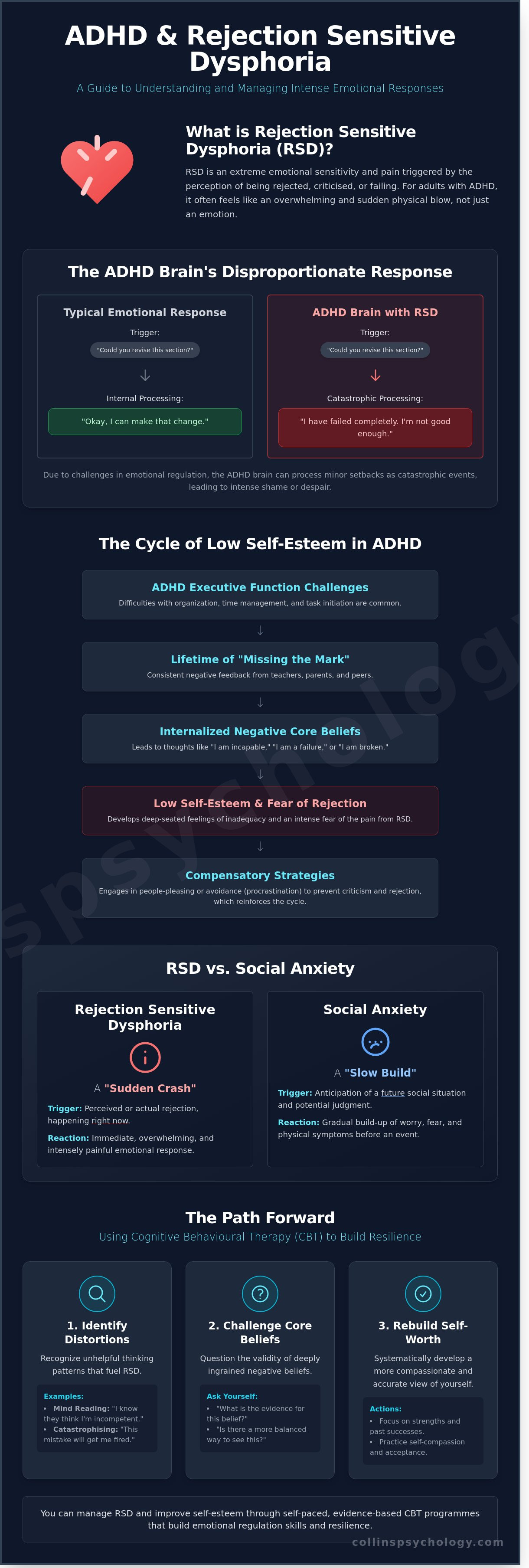
The neurological underpinnings of ADHD involve differences in the brain's self-regulatory systems, which extend beyond attention to include emotions. The ADHD nervous system can struggle to regulate the intensity of incoming emotional information, a concept known as emotional dysregulation (Shaw et al., 2014). This means that a piece of neutral feedback from a manager at work, such as "Could you revise this section?", might not be processed as a simple request. Instead, it can be instantly interpreted as "You have failed completely," triggering a disproportionate emotional response. This is not a matter of being "too sensitive", it is a reflection of a brain wired to react with greater intensity.
Common Signs You Are Experiencing RSD
• Sudden and intense shifts in mood, such as rage or extreme sadness, following a perceived slight or criticism.
• A tendency towards social withdrawal or "ghosting" friends and colleagues as a protective measure to avoid potential rejection.
• Setting impossibly high standards for oneself, leading to a chronic sense of failure and harsh self-criticism when those standards are not met.
The Connection Between ADHD Brain Chemistry and Low Self-Esteem
For many adults with ADHD, low self-esteem is a deeply ingrained part of their identity. This often stems from a lifetime of navigating a world not built for their brain, where challenges with executive functions like organisation, time management, and task initiation are common. Consistently "missing the mark" on social or professional expectations can lead to the formation of a core belief of being fundamentally inadequate. The prefrontal cortex, which is responsible for filtering emotional responses and managing executive functions, develops differently in those with ADHD, making this emotional and practical regulation more difficult (Shaw et al., 2014). For more information on this, you can explore our structured CBT approach to improving self-esteem.
The Cycle of People-Pleasing and Avoidance
To cope with the anticipated pain of RSD, many adults with ADHD develop compensatory strategies. One of the most common is people-pleasing, an attempt to control external variables to mitigate any chance of criticism or rejection. This can lead to burnout and a loss of personal identity. Another related behaviour is avoidance. Procrastination, often mistaken for laziness, can be a symptom of RSD. The fear of not performing a task perfectly, and the criticism that might follow, can be so overwhelming that it feels safer not to start at all. For instance, a talented professional might avoid applying for a promotion, fearing the increased scrutiny and potential for failure in a more senior role.
Core Beliefs and the ADHD Identity
Cognitive Behavioural Therapy (CBT) introduces the concept of "core beliefs", which are fundamental assumptions we hold about ourselves, others, and the world (Beck, 1979). For a child with undiagnosed or unsupported ADHD, frequent negative feedback from teachers, parents, and peers can create powerful core beliefs like "I am incapable," "I am a failure," or "I am unlovable." These are not objective facts, but deeply internalised thoughts that shape one's identity. The foundation of CBT intervention is the understanding that these beliefs, while powerful, can be examined, challenged, and ultimately changed.
Rejection Sensitivity vs Social Anxiety: Identifying Your Patterns
While RSD and social anxiety can feel similar, their emotional mechanics are distinct. Social anxiety often involves a "slow build" of worry and fear about future social situations and potential judgment. RSD, in contrast, is typically a "sudden crash", an immediate and overwhelming reaction to a perceived judgment that is happening right now. Because of this difference, traditional anxiety treatments may not fully address the acute, intense nature of an RSD episode. A targeted approach is often more effective, such as the tools found in our ADHD emotional regulation programme.
| Feature | Rejection Sensitive Dysphoria (RSD) | Social Anxiety |
|---|---|---|
| Trigger | Perceived or actual rejection, criticism, or failure. | Anticipation of social situations and negative judgment. |
| Onset | Sudden, immediate, and often surprising in its intensity. | Gradual build-up of worry, often hours or days before an event. |
| Primary Emotion | Intense shame, rage, hurt, or despair. | Fear, worry, and apprehension. |
| Focus | Internal. "I have been found lacking". | External. "They will think I am awkward". |
When Anxiety and RSD Overlap
It is important to acknowledge that many adults with ADHD experience both social anxiety and RSD, and the two can create a challenging cycle. The fear of triggering an RSD episode can fuel social anxiety, leading to avoidance of social situations. Conversely, the constant worry from social anxiety can make a person hypervigilant to signs of rejection, making RSD episodes more likely. Observing your "recovery time" can be a useful clue. Recovery from an RSD episode can sometimes be as swift as the onset, especially with reassurance, while the unease of social anxiety may linger. For a deeper look at this connection, our guide on social anxiety in adults with ADHD may be helpful.
The Role of Cognitive Distortions
RSD is often fuelled by cognitive distortions, which are unhelpful thinking patterns that our brains default to. Two that are particularly relevant are "Mind Reading" (assuming you know what others are thinking, usually negatively) and "Catastrophising" (imagining the worst possible outcome). For example, if a friend doesn't reply to a text message, your mind might jump to "They are angry with me" (Mind Reading) and then to "Our friendship is over" (Catastrophising). A simple CBT exercise is to "catch" these thoughts and ask, "What is the evidence for this thought? What are some alternative explanations?". Structured CBT helps you develop this skill to interrupt the spiral before it takes hold (Burns, 1980).
Practical CBT Strategies to Build Resilience and Self-Esteem
The core of managing RSD is not to stop feeling emotions, but to reduce their intensity and your belief in the catastrophic thoughts they produce. Evidence-based CBT offers a toolkit for this process (Safren et al., 2017).
The "Pause and Appraise" Method
When you feel that sudden emotional spike, consciously create a pause before you react. Take a deep breath and ask yourself: "What just happened? What was the trigger? What is the story I am telling myself about this trigger?" This pause separates the event from your interpretation of it.
Objective Fact Checking
Actively look for evidence that contradicts your negative thought. If you believe a colleague's brief email means they are unhappy with your work, re-read the email and look for objective facts. Is there another explanation? Perhaps they were just busy.
Self-Compassion
The shame cycle is a powerful component of RSD. Self-compassion involves treating yourself with the same kindness you would offer a friend. Instead of self-criticism ("I always mess things up"), try a more compassionate framing ("This is a painful moment. It is okay to feel this way").
Create an "Evidence Journal"
Dedicate a notebook to challenging your negative core beliefs. On one side of the page, write the negative belief (e.g., "I am incompetent"). On the other side, actively log every piece of evidence, big or small, that contradicts it (e.g., "I completed that report on time," "My manager praised my idea in the meeting"). Over time, this builds a powerful, factual case against the negative belief.
Time Management and Goal Setting as Self-Esteem Boosters
A significant source of RSD triggers is the feeling of "failing" at daily tasks. By improving executive functioning skills, you reduce the frequency of these triggers. Mastering time management and learning to set achievable goals creates a consistent stream of "wins" that directly counteracts feelings of inadequacy. Using "micro-goals" (e.g., "spend 15 minutes on this task" instead of "finish the entire project") can build momentum and a sense of accomplishment. Our goal setting resource is a foundational tool for this process.
Physical Wellbeing and Focus
Your brain's ability to regulate emotions is directly linked to your physical state. Poor sleep, inadequate nutrition, and a lack of physical activity can leave your nervous system in a state of high alert, making you more susceptible to RSD triggers (Wajszilber et al., 2018). A dysregulated body leads to a dysregulated mind. Implementing a simple, "low-arousal" evening routine, such as dimming the lights, avoiding screens, and engaging in a calming activity an hour before bed, can significantly improve sleep quality and your emotional resilience the following day.
Enhancing Your Wellbeing with Self-Paced CBT Programmes
At Collins Psychology, we understand that traditional therapy is not always a practical fit for busy adults. Our model is built around providing structured, evidence-based learning through online, self-paced programmes. It is important to note that these programmes are designed for independent learning and do not involve one-to-one therapy sessions. This approach offers the flexibility to learn proven CBT strategies at your own pace, from your own home, empowering you with tools you can apply immediately to your daily life.
What to Expect from our Online Modules
Our online modules are carefully designed to translate clinical principles into practical, actionable steps. When you enrol in our CBT for ADHD collection, you will find a blend of educational resources, practical exercises, and downloadable tools. The content is structured logically, following professional guidelines from organisations like the Psychological Society of Ireland (PSI), and is specifically adapted to address the common challenges of the adult ADHD mind, such as maintaining focus and motivation.
Starting Your Journey to Better Self-Esteem
Feeling overwhelmed by Rejection Sensitive Dysphoria and living with low self-esteem does not have to be your permanent reality. These are manageable challenges, and with the right framework, you can build the skills to navigate them effectively. Taking the first step to understand how your brain works is an act of empowerment. We invite you to explore our training materials and begin your journey towards greater emotional regulation and confidence.
Ready to build resilience and improve your self-worth? Access our structured CBT programmes for Adult ADHD here.
Frequently Asked Questions
Is Rejection Sensitive Dysphoria a formal medical diagnosis?
No, RSD is not currently a formal diagnosis in the DSM-5. It is a term used to describe a specific set of symptoms commonly experienced by individuals with ADHD, and it is widely recognised by clinicians who work with this population.
How does CBT specifically help with RSD if it is related to ADHD?
CBT helps by teaching you to identify, challenge, and change the unhelpful thought patterns (cognitive distortions) that turn a perception of rejection into a catastrophic emotional event. It gives you the tools to pause, evaluate the situation more objectively, and respond in a less emotionally overwhelming way.
Can I improve my self-esteem without attending weekly therapy sessions?
Yes. Self-paced programmes, like the ones we offer, provide the same evidence-based CBT principles and structured exercises you would learn in therapy. For many people who are self-motivated and prefer a flexible learning style, this can be a very effective way to build skills and improve self-esteem.
Why do I feel physical pain when I think someone is cross with me?
Research shows that the brain pathways that process emotional pain and physical pain are closely linked. For individuals with heightened emotional sensitivity, like those with RSD, the brain can interpret intense emotional hurt so powerfully that it manifests as a genuine physical sensation.
What is the difference between being "sensitive" and having RSD?
While general sensitivity is a personality trait, RSD is characterised by the sheer extremity and severity of the emotional response. The pain is overwhelming, all-consuming, and can cause an abrupt and dramatic shift in mood that is far beyond what would be considered a typical sensitive reaction.
Are these self-paced programmes suitable for someone who struggles with focus?
Our programmes are designed with the ADHD brain in mind. The content is broken down into manageable modules with clear, practical exercises. The self-paced nature means you can work in short bursts when your focus is at its best, without the pressure of a fixed appointment time.
How long does it take to see results from a CBT programme for ADHD?
The timeline for seeing results varies for each individual. However, many people begin to notice small but significant changes in their thinking and emotional responses within a few weeks of consistently applying the CBT strategies and completing the exercises.
Do I need a formal ADHD diagnosis to start your online modules?
No, a formal diagnosis is not required. If you identify with the challenges described, such as emotional dysregulation, executive function difficulties, and low self-esteem, you will find the strategies and tools in our programmes beneficial.
References
Beck, A. T. (1979). Cognitive therapy and the emotional disorders. Penguin.
Burns, D. D. (1980). Feeling good: The new mood therapy. William Morrow.
Dodson, W. (2016). ‘New insights into rejection sensitive dysphoria’. ADDitude Magazine. Retrieved from https://www.additudemag.com/rejection-sensitive-dysphoria-and-adhd/
Safren, S. A., Sprich, S. E., Perlman, C. A., & Otto, M. W. (2017). Mastering your adult ADHD: A cognitive-behavioral treatment program, therapist guide (2nd ed.). Oxford University Press.
Shaw, P., Stringaris, A., Nigg, J., & Leibenluft, E. (2014). Emotion dysregulation in attention deficit hyperactivity disorder. American Journal of Psychiatry, 171(3), 276-293. https://doi.org/10.1176/appi.ajp.2013.13070966
Wajszilber, D., Santiseban, J. A., & Gruber, R. (2018). Sleep and athletic performance in youth with and without ADHD. Sleep Medicine Clinics, 13(3), 357-367. https://doi.org/10.1016/j.jsmc.2018.06.002