.png)

Do you feel powered by an internal motor that never switches off, even when you're exhausted? This constant restlessness, coupled with a tendency to interrupt conversations or make impulsive choices, can create significant challenges at work and in your personal life. If you've ever wondered if these struggles are a personal failing, the answer is likely no. These experiences are often the core symptoms of adult hyperactive attention deficit, a condition that is frequently misunderstood.
This guide is designed to provide clarity and validation. We will move beyond stereotypes to offer an evidence-based explanation for the hyperactive and impulsive aspects of adult ADHD. Our goal is to help you understand the neurological reasons behind your need for motion and stimulation. More importantly, we will provide structured, effective strategies you can use to manage these symptoms, helping you to build greater focus and find a sense of calm in your daily life.
Key Takeaways
- Reframe ADHD as a manageable neurodevelopmental condition, not a personal failing, to build a foundation for effective change.
- Recognise how the core traits of hyperactive attention deficit affect daily adult life, from professional performance to personal relationships.
- Discover evidence-based strategies that go beyond medication to help you manage impulsivity and channel restless energy productively.
- Learn to build supportive structures and systems in your environment to significantly reduce daily cognitive load and improve focus.
Decoding the Term: What is Hyperactive-Impulsive ADHD?
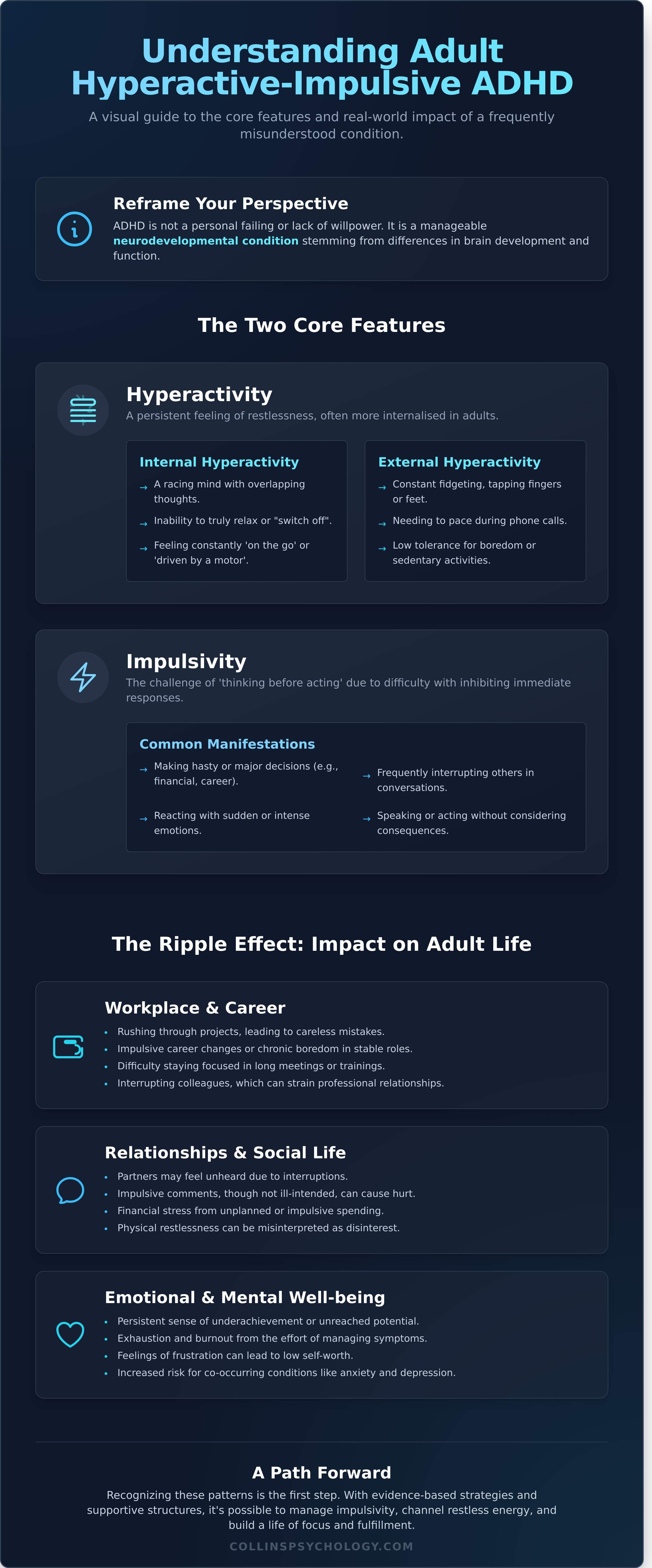
While many people search for terms like hyperactive attention deficit, the modern clinical diagnosis is Attention-Deficit/Hyperactivity Disorder (ADHD). It is crucial to understand that ADHD is not a personal failing or a lack of willpower; it is a neurodevelopmental condition stemming from differences in brain development and function. This condition presents unique challenges with self-regulation, impacting how individuals manage their energy, attention, and impulses. For a foundational adult ADHD overview, recognizing its neurobiological roots is the first step toward effective management.
ADHD manifests in three primary ways, known as presentations: Predominantly Inattentive, Predominantly Hyperactive-Impulsive, and Combined. This article focuses specifically on the Hyperactive-Impulsive presentation, which is characterised by two core features that significantly affect daily life.
Hyperactivity in Adults: Not Just Bouncing Off the Walls
The stereotype of a child constantly running and climbing doesn't accurately capture adult hyperactivity. In adults, this symptom often becomes more internalised and subtle. It is a persistent feeling of restlessness that can manifest as:
- External Hyperactivity: Constant fidgeting, tapping fingers or feet, bouncing a leg, or needing to pace during phone calls.
- Internal Hyperactivity: A racing mind with overlapping thoughts, an inability to truly relax, or feeling constantly 'on the go' or 'driven by a motor'.
This internal and external drive creates a constant need for stimulation and a very low tolerance for boredom, making quiet, sedentary activities particularly challenging.
Impulsivity: The Challenge of 'Thinking Before Acting'
Impulsivity in ADHD is a difficulty with inhibiting immediate responses-a core challenge related to the brain's executive functions. It's the struggle to pause and consider consequences before speaking or acting. In adults, this can surface in various ways, such as making hasty financial decisions, frequently interrupting others in conversation, or reacting with sudden emotional intensity. Understanding that this trait is a key feature of the condition, not a choice, is the essential first step toward developing effective strategies to manage its impact on your daily life.
Real-World Impact: How Hyperactivity and Impulsivity Affect Adult Life
The clinical diagnosis of hyperactive-impulsive ADHD provides a name for the challenges, but it doesn't fully capture the day-to-day reality. For many adults, life feels like a constant effort to manage an internal motor that won't switch off. This isn't just about feeling fidgety; it's a cumulative pattern of behaviour that can profoundly affect success and fulfilment. Many individuals with hyperactive attention deficit report a persistent sense of underachievement, feeling that their true potential is just out of reach. The constant mental energy required to 'keep a lid on it' in professional and social settings often leads to exhaustion and burnout.
Challenges in the Workplace and Career
In a professional environment, hyperactivity and impulsivity can create significant hurdles. The modern Australian workplace, often built around long meetings and sedentary desk work, can feel restrictive and frustrating. This can manifest in several ways:
- Rushing through projects, which can lead to careless mistakes and a need for rework.
- Impulsive career changes, frequent job-hopping, or chronic boredom in a stable role.
- Difficulty remaining seated and focused during important meetings or training sessions.
- Interrupting colleagues or speaking out of turn, which can strain professional relationships.
Strain on Relationships and Social Interactions
The impact extends far beyond the office. In personal relationships, the traits of impulsivity and hyperactivity can be misinterpreted as a lack of care or interest. Partners and friends may feel unheard when conversations are interrupted, or that you are not present due to physical restlessness. Impulsive comments, spoken without ill intent, can inadvertently cause hurt. Furthermore, challenges with impulse control can lead to financial stress from unplanned spending. Even simple downtime, like watching a film with a loved one, can become a challenge when the need for stimulation is high.
Emotional and Mental Well-being
Living with the constant internal and external pressures of ADHD takes a significant toll. The chronic stress of managing symptoms, coupled with the frustration of not meeting personal or societal expectations, can lead to low self-worth. This experience aligns with many of the core symptoms of adult ADHD, which can increase the risk for co-occurring conditions like anxiety and depression. For some, the need for stimulation may lead to risky behaviours. Learning to manage these intense emotional responses is a critical step towards well-being, and the challenge of emotional regulation is a core part of our CBT program.
Evidence-Based Management: Beyond Medication
While medication can be a valuable tool, it is only one component of a comprehensive plan for managing hyperactive and impulsive ADHD. The most sustainable success comes from building a personal toolbox of skills and strategies. The goal is not to 'cure' ADHD but to develop robust coping mechanisms that empower you to navigate daily challenges with greater control and confidence. This approach, which focuses on therapeutic skills and lifestyle adjustments, is a cornerstone of modern evidence-based ADHD management, creating a supportive framework for the ADHD brain to thrive.
The Role of Cognitive Behavioral Therapy (CBT)
Cognitive Behavioral Therapy (CBT) is a highly effective, structured approach for addressing the core challenges of ADHD. It provides a framework to identify and reframe the unhelpful thought patterns that often fuel impulsivity. Through CBT, you learn to create a crucial pause between an impulse and an action, allowing you to challenge automatic reactions and make more considered choices. It also equips you with practical skills for planning and organisation, reducing the sense of chaos that can accompany hyperactive attention deficit. Our structured CBT for Adult ADHD program is specifically designed to build these essential skills.
Practical Strategies for Hyperactivity
Managing physical restlessness means channelling that energy constructively rather than trying to suppress it. Learning to work with your need for movement can make a significant difference in your day-to-day life.
- Channel Energy with Exercise: Regular, high-intensity workouts can significantly help regulate energy levels and improve overall focus.
- Use Fidget Tools Discreetly: Fidget tools can provide a quiet, non-disruptive outlet for physical energy during meetings or at your desk.
- Incorporate Movement Breaks: Build short, frequent breaks into your workday to stand, stretch, or walk around, preventing restlessness from building up.
- Practice Mindfulness: Even a few minutes of mindfulness or meditation can help calm a racing mind and reduce feelings of internal agitation.
Techniques to Improve Impulse Control
Strengthening impulse control is a skill that can be developed over time with consistent practice. The following techniques create a buffer between an urge and an action, giving your rational brain time to engage. Improving these skills is fundamental to mastering executive function with CBT.
- Implement a '24-Hour Rule': For any non-essential purchase, commit to waiting a full day before buying. This simple delay often dissipates the initial impulse.
- Practice Active Listening: In conversations, make a conscious effort to let the other person finish their thought completely before you respond, which helps reduce interruptions.
- Use Visual Timers: When you feel a strong impulse, set a timer for 5-10 minutes. Use that time to consider the consequences before you act.
Building a Supportive Structure for Success
Effectively managing ADHD is not about forcing your brain to work differently; it is an ongoing process of creating personalised systems that work with your brain. A structured environment significantly reduces cognitive load, freeing up mental resources that would otherwise be spent on organising, planning, and remembering. This involves consciously optimising your physical space, daily routines, and the tools you use to navigate your day. By externalising executive functions through technology and consistent habits, you build a reliable framework for success.
Creating ADHD-Friendly Routines
Consistency is a powerful tool for managing the challenges of hyperactive attention deficit. Routines act as an anchor, reducing decision fatigue and creating predictable patterns that help regulate energy and focus. Consider implementing the following strategies:
- A consistent sleep-wake cycle: Aim to go to bed and wake up around the same time each day, even on weekends, to improve mood and concentration.
- ‘Bookending’ your day: Establish simple, predictable morning and evening routines to start and end your day with a sense of control.
- Time-blocking: Allocate specific blocks of time for specific tasks. This creates clear boundaries and helps sustain focus on one priority at a time.
- Scheduled downtime: Intentionally schedule breaks, hobbies, and rest into your week to replenish your energy and prevent burnout.
Workplace Accommodations and Strategies
In a professional setting, advocating for your needs is a key component of sustainable performance. Many effective strategies involve minor adjustments to your environment and workflow. Communicating your requirements clearly and professionally allows you to collaborate with your employer to create a more productive setup.
Practical workplace strategies include:
- Requesting a quieter workspace or using high-quality noise-cancelling headphones to minimise distractions.
- Asking for meeting agendas in advance to help you prepare your thoughts and stay on track during discussions.
- Using task management apps (like Asana or Trello) to break down large projects into smaller, more manageable steps.
- Clearly communicating your work style and needs to your manager, focusing on solutions that support both your productivity and team goals.
Building these supportive structures is a proactive and empowering step. If you are seeking guidance on developing personalised strategies, the evidence-based therapy programs at Collins Psychology can provide the structured support you need to thrive.
Building a Structured Path to Managing Adult ADHD
Understanding the nuances of hyperactive attention deficit is the first critical step toward effective management. As we've explored, its impact on daily life-from career challenges to personal relationships-can be significant, but it is manageable. Crucially, effective strategies extend beyond medication, incorporating supportive structures and behavioural skills that empower you to take control.
If you are ready to build these skills, you don't have to navigate this path alone. The evidence-based programs at Collins Psychology are designed by specialist psychologists to provide practical, real-world skills for adults. Through our structured modules, you will learn to implement effective strategies with clarity and confidence. Explore our structured CBT programs for Adult ADHD to learn effective management strategies.
A more focused and fulfilling life is not just a possibility-it's an achievable goal.
Frequently Asked Questions About Hyperactive-Impulsive ADHD
Can you have hyperactive ADHD as an adult if you weren't diagnosed as a child?
Yes, it is very common for adults to be diagnosed with ADHD for the first time. Many individuals, particularly women, develop effective coping mechanisms that can mask symptoms during childhood. Symptoms may also have been misattributed to personality traits or other conditions like anxiety. A late diagnosis is valid and serves as the crucial first step toward understanding your challenges and developing effective strategies to manage them in your adult life.
How is hyperactive-impulsive ADHD different in women compared to men?
While men often exhibit more externally obvious hyperactivity, women may experience it more internally. This can manifest as racing thoughts, an inner feeling of restlessness, or being excessively talkative. Impulsivity in women might present as compulsive shopping or making abrupt relationship decisions rather than physical risk-taking. These differences from the "classic" male presentation contribute to why many women with ADHD are historically underdiagnosed or misdiagnosed.
Does hyperactivity ever go away or lessen with age?
The overt, physical signs of hyperactivity often decrease or change form with age. A child who was constantly running may become an adult who fidgets, talks excessively, or feels an intense internal restlessness. While the outward expression may become more subtle, the underlying neurological need for stimulation and movement typically persists. Management strategies for adults therefore focus on channelling this energy productively and managing the internal sense of being constantly "on the go."
Is it possible to have just hyperactivity without the inattention?
Yes. According to clinical guidelines, this is referred to as ADHD, Predominantly Hyperactive-Impulsive Presentation. While less common than the combined type, it is a recognised diagnosis. An individual with this form of hyperactive attention deficit may not have significant issues with organisation or sustained focus but will experience core challenges with restlessness, an inability to be still, and acting on impulse. These symptoms can still have a major impact on work, relationships, and self-esteem.
What is the first step I should take if I recognise these symptoms in myself?
The most important first step is to seek a professional assessment. In Ireland, this typically begins with a visit to your GP, who can discuss your concerns and provide a referral to a specialist, such as a psychiatrist or a clinical psychologist with expertise in adult ADHD. A formal diagnosis is essential to rule out other conditions and to create a structured, evidence-based treatment plan that is tailored specifically to your needs and goals.
Can therapy like CBT really help with something that feels so physical like hyperactivity?
Absolutely. While Cognitive Behavioural Therapy (CBT) does not change the core neurology of ADHD, it is a highly effective, evidence-based approach for managing its impact. CBT provides practical strategies to help you recognise the triggers for your restlessness, develop skills to pause before acting impulsively, and find constructive ways to channel your physical energy. It empowers you with the tools to work with your brain's unique wiring, not against it.