.png)

Discover how to build an effective support network and use structured Cognitive Behavioural Therapy (CBT) strategies to manage adult ADHD challenges with the help of those around you. This guide shifts the focus from simple emotional support to creating practical, external scaffolding. It provides actionable steps for both adults with ADHD and their partners, friends, or family to collaborate effectively, build systems that work with the ADHD brain, and enhance daily functioning without fostering dependence.
Key Takeaways
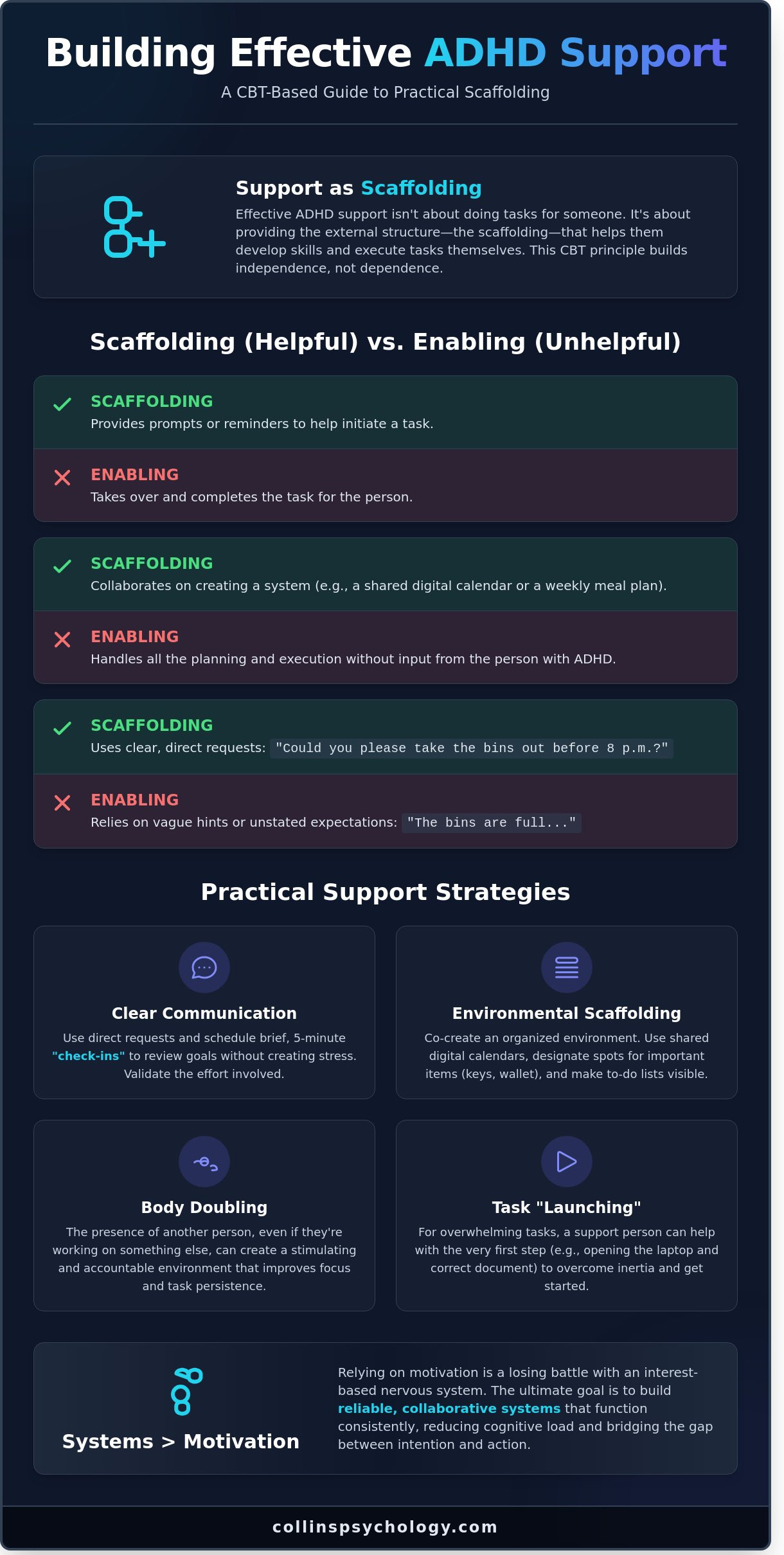
Support as Scaffolding
Effective help for ADHD is not about doing tasks for someone, but providing the external structure (scaffolding) that helps them execute tasks themselves, which is a core principle of CBT.
Executive Function Focus
Support should target specific executive function challenges like time management, task initiation, and organisation, rather than relying on generic advice that often fails the ADHD brain.
Clear Communication is Crucial
Vague hints and unstated expectations lead to frustration. Direct, non-judgmental communication and scheduled check-ins are essential for a successful support partnership.
Accountability Drives Action
A designated accountability partner using a structured framework, like adapted SMART goals, can bridge the gap between intention and action for mundane but necessary tasks.
Systems Over Motivation
Relying on motivation is a losing battle. The goal is to build reliable systems with your support network that function consistently, allowing you to know what to do and actually do it.
Table of Contents
• The Role of Support Systems in Managing Adult ADHD
• Practical Ways Others Can Support Executive Functioning
• Scaffolding vs Enabling: Finding the Right Balance
• Goal Setting and Accountability with a Support Partner
• Structured Self-Paced Learning with Collins Psychology
The Role of Support Systems in Managing Adult ADHD
For adults with ADHD, a support system is more than a circle of friends; it is a fundamental component of a successful management strategy. Within the context of neurodiversity, these systems act as external aids for internal regulation challenges. Clinical approaches to ADHD consistently highlight the importance of involving significant others in the process, as external support is a pillar of successful outcomes (Safren et al., 2017). The psychological difference between feeling isolated with your struggles and having a well-informed network is profound. It is crucial, however, to distinguish between general emotional support and the practical assistance required to bolster executive functions.
Why We Need Help from Others
The ADHD nervous system is often described as "interest-based," meaning it is primarily engaged by tasks that are novel, urgent, or personally compelling (Barkley, 2015). This leaves a significant gap when it comes to managing mundane but essential life admin. This is where others can help.
External Cues
A support person can provide the external prompts or reminders that the ADHD brain does not always generate internally.
Social Accountability
Simply knowing that someone will be checking in can provide the necessary activation energy to start a difficult or boring task.
Body Doubling
The presence of another person, even if they are working on something else, can improve focus and persistence. This technique, known as "body doubling," creates a subtly stimulating and accountable environment.
The Limitations of Traditional Support
Well-intentioned advice often misses the mark. Phrases like "just try harder" or "you just need a planner" can be invalidating because they fail to acknowledge the neurological basis of ADHD challenges. This mismatch in understanding can lead to frustration and conflict in relationships. The key is to move away from these unhelpful patterns and towards a collaborative, CBT-informed approach where both parties understand the goal is to build systems, not to "fix" the person with ADHD.
Practical Ways Others Can Support Executive Functioning
Practical support is about co-creating an environment that reduces the cognitive load on the person with ADHD. It is about externalising internal processes that are challenging, such as time perception and working memory.
Externalising Information
Help create a "visible" environment where reminders, lists, and schedules are out in the open rather than stored in memory.
Assisting with Time Perception
The ADHD brain often operates in two time zones: "now" and "not now" (Barkley, 2015). A support person can help by breaking down future tasks and connecting them to the present, for example, by saying, "We need to leave in 15 minutes, so it is time to find your keys now."
Non-Judgmental Reminders
Gentle, pre-agreed-upon reminders for daily routines can be invaluable. The key is that these are seen as helpful cues, not nagging.
Facilitating Health Habits
Support with foundational habits like sleep and fitness, which are crucial for ADHD management, can make a significant difference. This could involve joining them for a walk or helping to establish a consistent wind-down routine in the evening.
Environmental Scaffolding
This involves structuring the physical and digital environment to make success easier.
Shared Digital Calendars
Using a shared calendar for appointments and deadlines reduces the burden of remembering and prevents things from slipping through the cracks.
Collaborative Organisation
Work together to create logical, organised physical spaces (e.g., a designated spot for keys and wallets) to minimise distraction and time spent searching for items.
Task "Launching"
For overwhelming tasks, a support person can help with the very first step, such as opening the laptop and the correct document, which can be enough to overcome the initial inertia.
Communication Strategies
How you communicate is just as important as what you do.
Use Clear, Direct Requests
Replace vague hints with specific, actionable requests. Instead of "The bins are full," try "Could you please take the bins out before 8 p.m.?"
The "Check-In" Method
Schedule brief, five-minute check-ins to review progress on a shared goal. This keeps things on track without turning into a lengthy, stressful conversation.
Validate the Effort
Acknowledging the genuine difficulty of executive tasks is incredibly powerful. Statements like, "I know this is a really tough task for you, and I appreciate you working on it," can transform the dynamic of a relationship (Ramsay, 2020).
Scaffolding vs Enabling: Finding the Right Balance
One of the most critical distinctions for any support person to understand is the difference between scaffolding and enabling. Scaffolding provides temporary support to help someone develop their own skills, while enabling removes the opportunity for skill development altogether. The principles of CBT focus on building self-efficacy and independence, making this distinction vital for long-term success.
Scaffolding (Helpful)Enabling (Unhelpful)Provides prompts or reminders to initiate a task.Takes over and completes the task for the person.Collaborates on creating a system (e.g., a weekly meal plan).Handles all the planning and execution without input.Allows natural consequences to occur (e.g., a late fee)."Rescues" the person from the consequences of their actions.Encourages the use of tools and strategies.Creates workarounds that foster dependence.Focuses on building long-term skills and confidence.Aims to avoid short-term conflict or discomfort.
Identifying Enabling Behaviours
Enabling often comes from a place of love or a desire to avoid conflict, but it ultimately undermines the person's autonomy. It can manifest as repeatedly doing tasks for them, making excuses on their behalf, or shielding them from the natural outcomes of forgetting an appointment or missing a deadline. Over time, this can create a cycle of resentment and reduce the person's belief in their own ability to manage their life.
Building Effective Scaffolding
Effective scaffolding involves being a supportive collaborator, not a manager. It means providing prompts instead of taking over, working together on the "how" of a task without dictating the "when," and consistently encouraging the use of tools designed to strengthen executive function. The goal is always to provide just enough support to allow the person to succeed on their own.
Goal Setting and Accountability with a Support Partner
An accountability partnership is one of the most powerful forms of scaffolding. It formalises the process of checking in and provides the external structure needed to pursue goals.
Adapt the SMART Framework
Traditional SMART (Specific, Measurable, Achievable, Relevant, Time-bound) goals need a slight adjustment for the ADHD brain. Make goals highly specific, break them down into "micro-goals," and keep the "Time-bound" element very short, often within 24-48 hours.
Choose the Right Partner
An ideal accountability partner is non-judgmental, reliable, and understands the goal is support, not criticism.
Set a Check-In Routine
A formal but conversational check-in (e.g., a five-minute call every morning or a text at the end of the day) creates a consistent and predictable routine.
Celebrate Small Wins
The ADHD brain is highly motivated by positive reinforcement. Acknowledging and celebrating the completion of small steps is essential for maintaining momentum.
The Accountability Partnership
Before starting, define the rules. The partner's job is to ask about progress and listen, not to judge, lecture, or solve the problem. The "five-minute check-in" should be brief and focused on the pre-agreed goal. If there are setbacks, the focus should be on problem-solving for the next attempt, free from shame or blame. For those looking to implement this, our structured goal-setting resources can provide a clear framework.
Structured Self-Paced Learning with Collins Psychology
While a support system is invaluable, it works best when paired with a structured approach to skill-building. At Collins Psychology, we provide exactly that. Not therapy. Not coaching. A system. Our online CBT programmes are designed for adults with ADHD in Ireland who are ready to build systems that work with their brain. We provide the tools and frameworks to help you stop relying on motivation and stop starting over every Monday. You can finally know what to do AND actually do it.
The Online Programme Advantage
Our model is built for the ADHD lifestyle. There are no rigid appointments to miss or schedules to manage.
Flexibility
Learn when your focus is at its peak, whether that is early in the morning or late at night.
Practical Tools
Gain access to a library of evidence-based exercises, downloadable worksheets, and practical strategies you can implement immediately.
Empowerment
Our programmes provide a clear path for you and your support system to follow, giving you a shared language and toolkit to improve communication and collaboration. Learn more about how to build a lifestyle that supports your ADHD.
Getting Started with CBT for ADHD
We offer a suite of programmes covering the core challenges of adult ADHD, including emotional regulation, focus, and time management. You can start where you struggle most. It is one system with multiple entry points, designed to help you build your ADHD support system over time. These programmes are designed to be integrated into your daily life, providing the structure needed to turn knowledge into consistent action.
Begin your journey with our structured CBT for Adult ADHD programmes today.
Frequently Asked Questions
How can I explain my ADHD struggles to my partner without sounding like I am making excuses?
Focus on explaining the "how" and "why" from a neurological perspective. Use analogies, like explaining that executive functions are like the conductor of an orchestra, and for you, the conductor is often distracted. Frame the conversation around finding collaborative solutions rather than just describing problems.
What is the best way for a friend to help me with my time management?
Ask them to be an external timekeeper. For instance, if you need to leave at 10:00, ask them to give you a verbal 15-minute, 5-minute, and "time to go now" reminder. This externalises the process of tracking time, which can be a significant challenge.
Can a support person help me with my emotional regulation?
Yes, but indirectly. A support person cannot regulate your emotions for you, but they can help create a stable environment that reduces emotional triggers. They can also learn to recognise signs of emotional dysregulation and, as pre-agreed, prompt you to use a CBT strategy you have been working on, such as taking a break or doing a breathing exercise.
Is it better to have one person for all my support needs or a wider network?
A wider network is often more sustainable. Relying on one person, such as a partner, for all support needs can lead to burnout and strain the relationship. You might have one friend as an accountability partner for work, and your partner might help with household systems.
How do I know if the help I am getting is actually enabling my symptoms?
Ask yourself: "Is this support helping me build a skill, or is it removing the need for me to use that skill?" If someone is constantly completing tasks for you that you are capable of doing, it may be enabling. If they are helping you set up a system so you can complete the task yourself, that is scaffolding.
What should I do if my support person becomes frustrated with my progress?
Have an open conversation outside of a moment of conflict. Acknowledge their frustration and validate their feelings. Revisit your shared goals and strategies. Sometimes, the system itself needs to be adjusted. It is a process of trial and error for both of you.
Can I use these support strategies if I am doing a self-paced CBT programme?
Absolutely. These strategies are a perfect complement to a self-paced programme. You can share what you are learning with your support person and ask them to help you implement the specific tools and exercises from the programme, making them an active part of your learning system.
How does social accountability help with ADHD focus?
Social accountability provides external motivation and structure. The ADHD brain often struggles to self-activate for low-interest tasks. Knowing that another person is aware of your goal and will be checking in creates a sense of mild, positive pressure that can be enough to initiate and sustain focus on that task.
References
Barkley, R. A. (2015). Attention-deficit hyperactivity disorder: A handbook for diagnosis and treatment (4th ed.). The Guilford Press.
Ramsay, J. R. (2020). Rethinking adult ADHD: Helping clients turn intentions into actions. American Psychological Association.
Safren, S. A., Sprich, S. E., Perlman, C. A., & Otto, M. W. (2017). Mastering your adult ADHD: A cognitive-behavioral treatment program, therapist guide (2nd ed.). Oxford University Press.