.png)
If you live with Attention Deficit Hyperactivity Disorder (ADHD), you may find that the pang of a loved one leaving feels more intense, even overwhelming, than it seems to for others. This experience, known as adult separation anxiety, is more than just missing someone; it is a profound distress that can strain relationships and impact your wellbeing. This article explores the connection between ADHD and separation anxiety in adults, explaining how core ADHD traits like emotional dysregulation and rejection sensitivity can amplify these feelings. We will provide evidence-based, Cognitive Behavioural Therapy (CBT) informed strategies to help you understand and manage your emotions, build self-reliance, and foster more secure connections.
What is Adult Separation Anxiety Disorder (ASAD)?
Adult Separation Anxiety Disorder (ASAD) is a recognised anxiety condition that extends beyond the more commonly known childhood version. It involves significant and excessive fear or anxiety concerning separation from those to whom an individual is deeply attached, often a partner, close friend, or family member (Bögels et al., 2013). This is not the same as codependency or general worry in a relationship. ASAD is characterised by a persistent, intense fear that harm will come to your attachment figure or that you will be permanently separated from them. In accessible terms, key criteria include recurrent and excessive distress when anticipating or experiencing separation, persistent worry about losing attachment figures, and a reluctance to be alone for fear of this separation.
Symptoms of ASAD in Adults
While symptoms can vary, many adults with ASAD report common patterns of thought and behaviour. These can include:
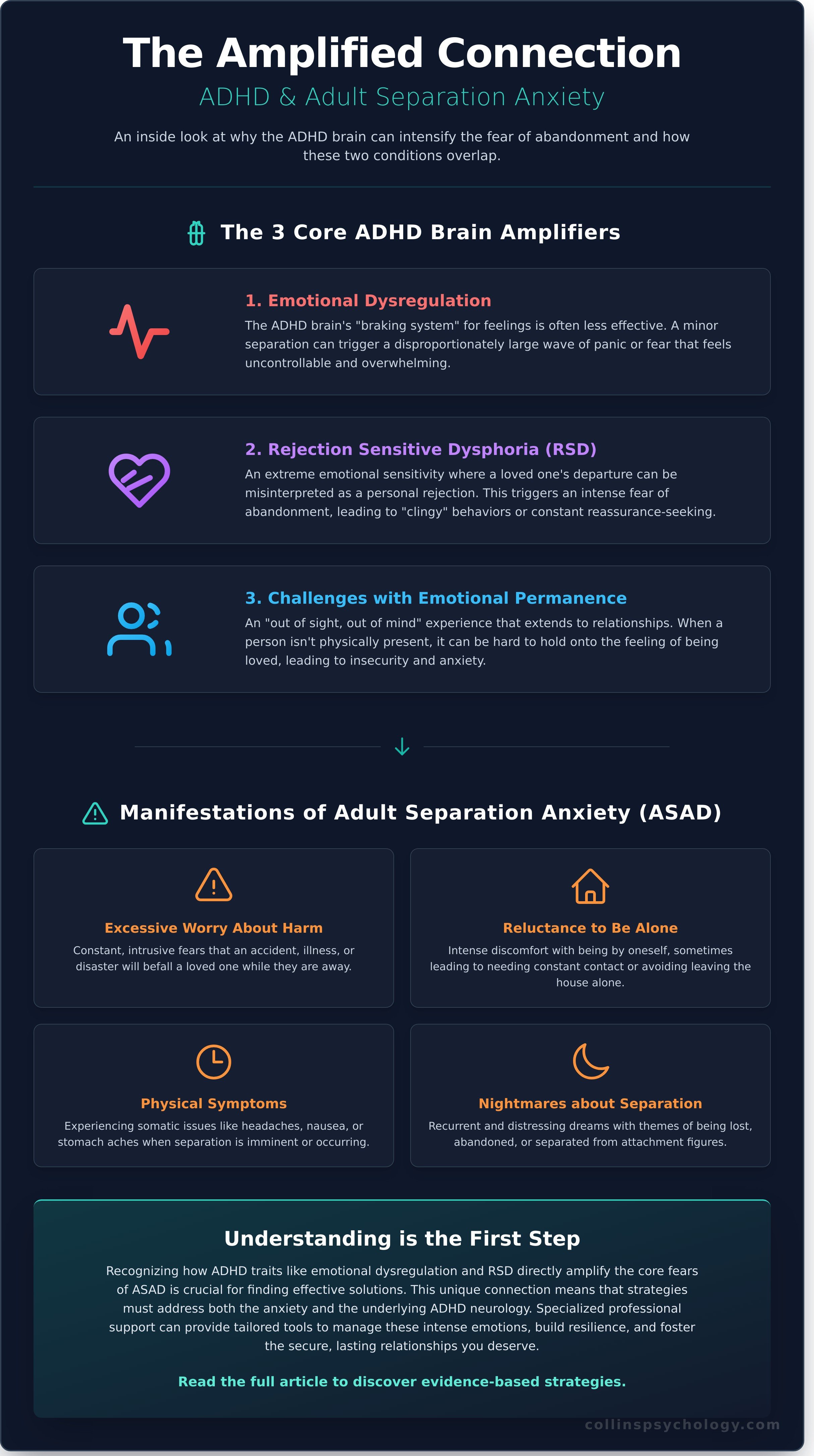
• Excessive and persistent worry about potential harm, such as an illness or accident, befalling loved ones when they are away.
• A strong reluctance or refusal to be alone, often arranging your schedule to avoid it.
• Physical symptoms that arise when separation is imminent or occurring, such as headaches, stomach aches, or nausea.
• Recurrent nightmares with themes of being abandoned or separated from key people in your life (Manicavasagar et al., 2009).
Moving Beyond the Childhood Diagnosis
Many adults with separation anxiety are never diagnosed because the condition is so strongly associated with childhood. However, the nature of our attachments simply changes as we grow older. In adulthood, an attachment figure is more likely to be a romantic partner, a sibling, or even one’s own child, rather than a parent. The symptoms also manifest differently. An adult may not refuse to go to work, for example, but they might experience debilitating panic when their partner does not answer the phone or is late home from a trip. This can lead to feelings of shame or a belief that one is simply being ‘dramatic’, causing many to suffer in silence without seeking support.
The ADHD Connection: Why Your Brain Amplifies Separation Anxiety
It is well established that anxiety disorders frequently co-occur with ADHD (Fayyad et al., 2017). ADHD is not just a condition of inattention or hyperactivity; at its core, it involves challenges with regulation, particularly emotional regulation. The neurological wiring of the ADHD brain can create fertile ground for anxiety to develop and intensify. This section explains the ‘why’ behind the powerful feelings of panic and fear that separation can trigger when you have ADHD.
Emotional Dysregulation and Fear of Abandonment
Emotional dysregulation is a central feature of ADHD for many adults. It means that emotions are experienced with greater intensity and that the brain has more difficulty modulating or ‘turning down the volume’ on these feelings (Shaw et al., 2014). When a loved one leaves, a neurotypical brain might register a feeling of sadness or loneliness, which it can manage. For an ADHD brain, that same departure can trigger a flood of panic or despair that feels like a five-alarm fire. This difficulty in down-regulating fear can turn a minor, temporary separation into a perceived emotional crisis, leaving you feeling overwhelmed and confused by the strength of your own reaction.
Rejection Sensitive Dysphoria (RSD)
Rejection Sensitive Dysphoria (RSD) describes an extreme emotional sensitivity and pain triggered by the perception of being rejected, teased, or criticised. Although not a formal diagnosis, it is a concept that resonates deeply with many people with ADHD. A partner leaving for a work trip or a friend being unavailable can be misinterpreted by the ADHD brain not as a normal life event, but as a form of rejection or abandonment. This perceived rejection can trigger intense emotional pain, leading to behaviours like seeking constant reassurance or becoming withdrawn to avoid the possibility of future ‘rejection’.
Challenges with Object & Emotional Permanence
Object permanence is the understanding that things continue to exist even when you cannot see them. While adults with ADHD do not struggle with literal object permanence, many experience a related challenge with emotional permanence. This is the difficulty in holding onto the feeling of being loved, connected, and secure when an attachment figure is not physically present. This ‘out of sight, out of mind’ phenomenon can apply to positive emotions, creating an internal void and a desperate need for constant contact, like texts or calls, just to feel that the connection is still real and stable. Furthermore, ADHD ‘time blindness’, or a distorted sense of time, can make a two-hour separation feel like an entire day, stretching the anxiety out interminably.
Recognising the Overlap: What It Looks and Feels Like
Understanding how ADHD and ASAD symptoms intertwine in daily life is the first step toward managing them. Below are some real-world scenarios that illustrate how these conditions can merge, influencing both your actions and your inner emotional state.
Behavioural and Emotional Patterns to Watch For
Constant Checking
Repeatedly texting or calling a partner to check where they are, not out of distrust, but out of a need to soothe your own anxiety.
Panic When Unresponsive
Experiencing a surge of panic, or even a full panic attack, when your partner is late or does not reply to a message as quickly as you expected.
Avoiding Solitude
Actively avoiding being alone, such as declining opportunities for solo travel or feeling unable to relax at home until your partner returns.
Dependent Procrastination
Putting off important tasks or chores until an attachment figure is present to provide a sense of safety and support.
Internal Experiences: The Inner Monologue
Racing Thoughts
Your mind immediately jumps to worst-case scenarios: ‘What if they have been in an accident? What if something terrible has happened?’
Catastrophising
A short separation is interpreted as a permanent one: ‘They are not answering, they must have decided to leave me for good.’
Negative Self-Talk
The anxiety turns inward, leading to thoughts like: ‘I am too needy. No one would want to put up with this. They are going to leave me because I am too much.’
A Physical Void
Experiencing a tangible, empty feeling in your chest or stomach when the person you are attached to is gone.
Evidence-Based Strategies for Managing Separation Anxiety with ADHD
Feeling overwhelmed by these emotions does not mean you are powerless. Managing separation anxiety is a skill that can be developed with practical, structured techniques. The strategies below are informed by Cognitive Behavioural Therapy (CBT), an approach that is highly effective for both anxiety and ADHD. They are tools to help you build self-regulation and empowerment.
Cognitive Techniques (CBT-Informed)
Challenge Catastrophic Thoughts
When your mind jumps to the worst-case scenario, pause and challenge it. Ask yourself: What is a more likely explanation? What is the evidence for my fear? Writing these thoughts down can make them easier to analyse objectively.
Create Soothing Routines
Establish predictable routines or use ‘transitional objects’ (like a partner’s jumper or a shared photo) to create a sense of connection and safety when you are alone.
Develop Mindfulness Skills
Mindfulness helps anchor you in the present moment, rather than getting swept away by future-oriented worries. Simple breathing exercises can calm your nervous system when you feel panic rising. For structured guidance on these skills, our CBT programme for emotional regulation provides a clear framework.
Behavioural Strategies
Practice Graduated Exposure
Intentionally plan short, manageable separations and gradually increase their duration. Start with a 30-minute solo walk and build up from there. This teaches your brain that you can handle being alone and that your loved one will return.
Schedule Engaging Solo Activities
Fill your alone time with activities you genuinely enjoy. This shifts the focus from what you are missing to what you are gaining: a sense of independence, competence, and self-reliance.
Establish Clear Communication Plans
Before a separation, agree on a communication plan with your partner. For example, agree to a goodnight text each evening during a trip. This predictability can significantly reduce anxiety.
ADHD-Specific Support
Use Visual Reminders of Connection
Keep photos, saved messages, or mementos in plain sight to serve as a concrete reminder of the relationship’s stability when your emotional permanence falters.
Manage Time Blindness
Set timers or alarms to break down long periods of separation into smaller, more manageable chunks. This can make the time feel less daunting and more finite.
Focus on Executive Function Skills
Anxiety about managing life alone is often rooted in executive function challenges. Strengthening skills like planning, organising, and problem-solving can build your confidence in your ability to cope independently. Our CBT programme for executive function offers practical tools for this.
Seeking Professional Support for ADHD and Separation Anxiety
While self-help strategies are powerful, the dual challenge of ADHD and ASAD often requires a structured approach to achieve lasting change. Finding support from a professional who understands the complex interplay between ADHD and anxiety is a crucial step toward building resilience.
The Role of Cognitive Behavioural Therapy (CBT)
Cognitive Behavioural Therapy (CBT) is an evidence-based psychological therapy that helps you identify and change the unhelpful thought patterns and behaviours that fuel anxiety (Hofmann et al., 2012). Its structured, skills-based framework is particularly effective for the ADHD brain, providing a clear and logical path forward. Through CBT, you can build tangible skills in emotional regulation, distress tolerance, and cognitive restructuring.
Finding the Right Support
It is important to find psychological support that is well-versed in the nuances of adult ADHD. A structured programme can provide the consistency and step-by-step guidance needed to make meaningful progress. At Collins Psychology, we provide online, self-paced CBT programmes designed for adults with ADHD. It is important to note that we do not offer one-to-one therapy. Our programmes are created to be flexible, allowing you to learn practical skills at your own pace with a wealth of resources, exercises, and tools. Our comprehensive CBT for Adult ADHD programme is designed to address these core challenges.
How to Talk to Your Partner and Loved Ones
Communicating your needs is vital for building a secure relationship. Open and honest conversation can help your partner understand what you are experiencing without feeling blamed or overwhelmed.
Educate Them
Share resources, like this article, to give them context for your emotional reactions.
Use ‘I Feel’ Statements
Express your anxiety by saying, “When you are late and I do not hear from you, I feel scared,” instead of, “You make me anxious when you are late.”
Work Together on Routines
Collaboratively create routines and communication plans that help you feel secure while respecting their independence. This makes them a partner in the solution.
Frequently Asked Questions
How do I know if it's ASAD or just a normal part of my ADHD?
While emotional dysregulation is common in ADHD, ASAD involves a specific and persistent fear centred on separation from attachment figures. If your anxiety is almost exclusively triggered by separation and leads to significant distress and avoidance, it may indicate ASAD. A formal assessment with a qualified mental health professional is the best way to get clarity.
Can separation anxiety in adults with ADHD be cured?
While ‘cure’ may not be the right term, the symptoms can be very effectively managed to the point where they no longer dominate your life. With consistent use of CBT strategies and a better understanding of your ADHD, you can learn to regulate your emotions, build independence, and significantly reduce the distress caused by separation.
How do I explain these intense feelings to my partner without scaring them away?
Focus on explaining the ‘why’ behind your feelings, linking them to ADHD traits like emotional intensity and RSD. Frame it as a challenge you are actively working on and invite them to be part of the solution by co-creating strategies that build security for you both.
Is separation anxiety linked to past trauma?
Yes, there can be a strong link. Experiences of abandonment, loss, or inconsistent caregiving in childhood can create insecure attachment styles that make a person more vulnerable to separation anxiety in adulthood (Bowlby, 1973). ADHD can then amplify the emotional response to these underlying vulnerabilities.
What's the difference between separation anxiety and borderline personality disorder (BPD)?
While both can involve an intense fear of abandonment, they are distinct conditions. The fear in ASAD is typically focused on harm befalling the attachment figure or a catastrophic separation event. In BPD, the fear of abandonment is part of a broader pattern of instability in relationships, self-image, and mood. A thorough diagnostic assessment by a clinical psychologist or psychiatrist is necessary to differentiate between them.
References
Bögels, S. M., Knappe, S., & Clark, L. A. (2013). Adult separation anxiety disorder in DSM-5. Clinical Psychology Review, 33(5), 663–674. https://doi.org/10.1016/j.cpr.2013.03.006
Bowlby, J. (1973). Attachment and loss, Vol. 2: Separation: Anxiety and anger. Attachment and Loss. New York: Basic Books.
Fayyad, J., Sampson, N. A., Hwang, I., Adamowski, T., Aguilar-Gaxiola, S., Al-Hamzawi, A., ... & Kessler, R. C. (2017). The descriptive epidemiology of DSM-IV adult ADHD in the World Health Organization World Mental Health Surveys. ADHD Attention Deficit and Hyperactivity Disorders, 9(1), 47-65. https://doi.org/10.1007/s12402-016-0208-3
Hofmann, S. G., Asnaani, A., Vonk, I. J., Sawyer, A.T., & Fang, A. (2012). The efficacy of cognitive behavioral therapy: A review of meta-analyses. Cognitive Therapy and Research, 36(5), 427–440. https://doi.org/10.1007/s10608-012-9476-1
Manicavasagar, V., Silove, D., Wagner, R., & Drobny, J. (2009). A survey of the clinical correlates of adult separation anxiety disorder in an anxiety clinic. Comprehensive Psychiatry, 50(3), 232-238. https://doi.org/10.1016/j.comppsych.2008.08.001
Shaw, P., Stringaris, A., Nigg, J., & Leibenluft, E. (2014). Emotional dysregulation and attention-deficit/hyperactivity disorder. The American Journal of Psychiatry, 171(3), 276–293. https://doi.org/10.1176/appi.ajp.2013.13070966