.png)

If you live with ADHD, you may be familiar with the intense and overwhelming emotional pain that can follow a minor critique or perceived slight. This experience, known as Rejection Sensitive Dysphoria (RSD), can feel like a sudden, unbearable sting that sends your day into a tailspin. This article offers a way forward, using the structured, evidence-based framework of Cognitive Behavioural Therapy (CBT). You will learn not how to stop feeling, but how to manage the emotional impact of rejection by decoupling the initial sting from the negative stories we tell ourselves, empowering you to regain control and build emotional resilience.
Understanding Rejection Sensitive Dysphoria in Adults with ADHD
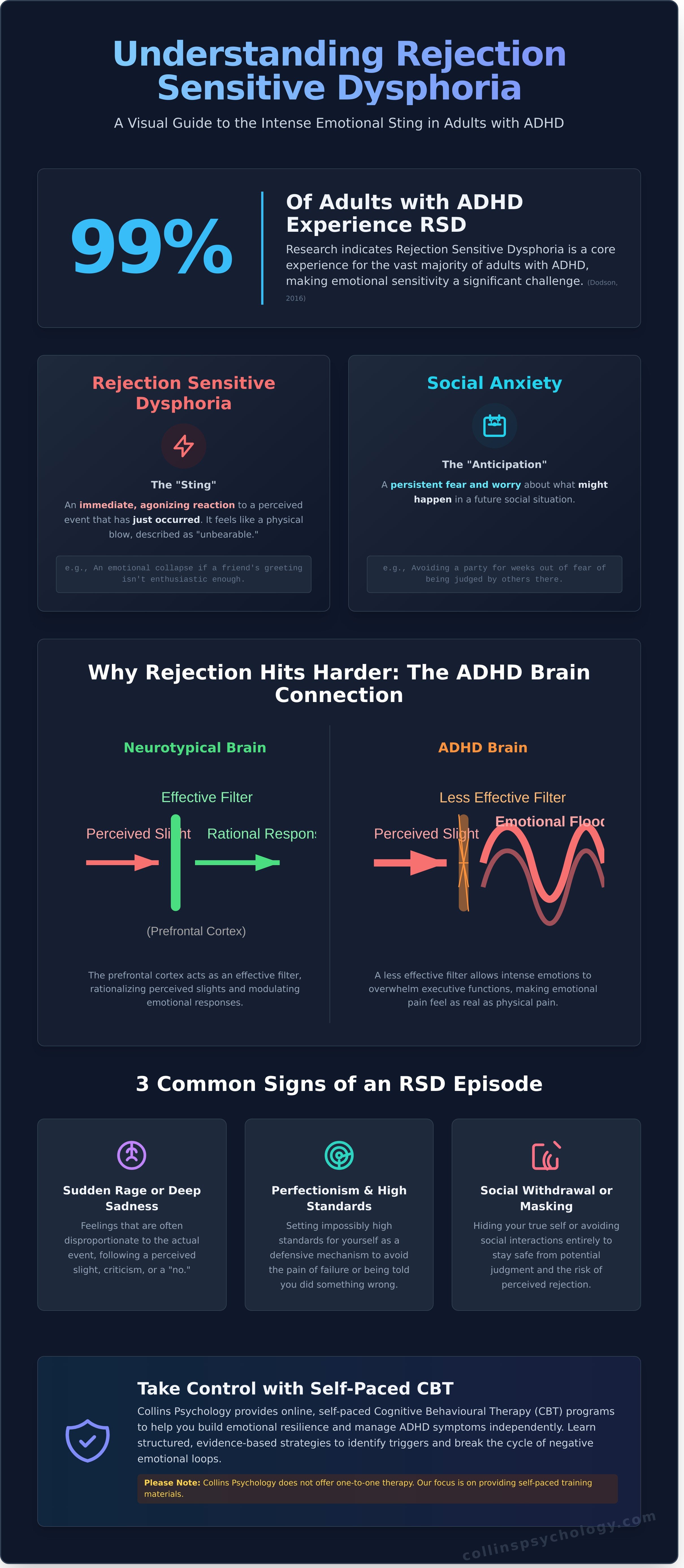
Rejection Sensitive Dysphoria (RSD) is an intense emotional sensitivity to perceived rejection, criticism, or failure. The "dysphoria" component is key; it is a Greek term meaning "unbearable" or "difficult to bear," which accurately describes the extreme emotional pain experienced. While RSD is not a standalone diagnosis in the DSM-5, it is widely recognised as a common and significant challenge for many adults with Attention Deficit Hyperactivity Disorder (ADHD) (Bond et al., 2023). It is important to distinguish the sudden, sharp "sting" of RSD from the more generalised worry associated with social anxiety. RSD is an immediate, overwhelming, and painful reaction that can feel disproportionate to the situation that triggered it.
The ADHD Connection: Why Rejection Hits Harder
The link between ADHD and RSD lies in the brain's executive functioning system. The prefrontal cortex, which is responsible for emotional regulation, acts as a filter for our emotional responses. In the ADHD brain, this filtering process can be less efficient, leading to what is often described as emotional "flooding." When a perceived rejection occurs, the emotion can bypass the brain's logical centres and overwhelm its capacity to self-regulate, resulting in an immediate and intense reaction (Barkley, 2015).
Common Signs You Are Experiencing RSD
• Sudden and intense bouts of rage, anger, or extreme sadness following a perceived slight or criticism.
• Becoming a people pleaser to avoid conflict or disapproval at all costs.
• Setting impossibly high standards for yourself, leading to a persistent sense of failure or inadequacy.
• Withdrawing from social situations or "masking" your true self to avoid the risk of potential judgment.
The Role of Executive Functioning in Emotional Regulation
Executive functioning is the management system of the brain, responsible for tasks like planning, organising, and controlling impulses. For adults with ADHD, challenges in this area directly impact emotional regulation. For instance, poor working memory can cause you to "get stuck" in a negative emotional loop, replaying a hurtful comment over and over. Similarly, a deficit in "inhibitory control," the ability to pause and think before acting, makes it difficult to stop an impulsive emotional reaction before it takes over (Barkley, 2015). Providing evidence-based support that targets these executive functions is a core principle of professional psychological practice (Psychological Society of Ireland, 2022).
How ADHD Symptoms Fuel the RSD Cycle
Impulsivity
Reacting to a feeling before your logical brain has a chance to assess the situation accurately.
Focus
Hyper-focusing on a single negative comment or interaction while completely ignoring positive feedback received at the same time.
Time Management
A general feeling of being "behind" in life or not meeting expectations can create a baseline of inadequacy, making you more vulnerable to feelings of rejection.
Why Structured CBT is the Preferred Approach
Cognitive Behavioural Therapy (CBT) is a highly effective approach for managing the challenges of ADHD and RSD. Its success lies in its structure and practical focus.
• CBT provides the external structure and step-by-step processes that the ADHD brain often needs to organise thoughts and behaviours.
• It focuses on developing practical, actionable skills rather than just talking about feelings, which empowers you to make tangible changes.
• Learning these skills in a self-paced, online format allows you to engage with the material when your brain is most receptive, without the pressure of fixed appointments.
Core CBT Strategies for Managing the RSD Sting
The goal of CBT is not to prevent the sting of rejection from ever happening, but to give you the tools to manage your response to it. This involves learning to separate the initial feeling from the narrative you build around it.
Narrative Catching
This involves actively identifying the story you tell yourself immediately after an interaction. Is a delayed text reply really about you, or could there be a dozen other explanations?
Cognitive Reframing
This technique teaches you to challenge your automatic negative assumptions. You learn to question whether a neutral event, like a colleague disagreeing with your idea, is truly a personal rejection.
The "Wait and See" Technique
To counter impulsive reactions, this strategy involves making a conscious decision to pause before responding to a potentially triggering social situation, giving your logical brain time to catch up.
For example, imagine you send a text to a friend and they do not reply for hours. The RSD narrative might be: "They are mad at me. I must have said something wrong. Our friendship is over." Using cognitive reframing, you could challenge this: "They are a busy person. They might be in a meeting, driving, or just not have their phone. Their reply speed is not a measure of our friendship."
Catching the Narrative Before it Spirals
Identify the physical sensation
Notice the "sting" as it happens. It might feel like a punch to the gut or a sudden flush of heat. Acknowledge the feeling without judgment.
Write down the automatic thought
What is the very first sentence that pops into your head? It is often something catastrophic, like "I am a failure" or "Everyone hates me."
Look for contradictory evidence
Actively search for proof that this narrative is not 100% true. Has this person been a good friend in the past? Have you succeeded at other things today?
Evidence-Based Cognitive Restructuring
A "Thought Record" is a classic CBT tool that can be adapted specifically for rejection sensitivity. It involves logging a triggering situation, the automatic thoughts and feelings it caused, and then consciously generating a more balanced, alternative response. This process is most effective when paired with compassionate self-awareness, which involves treating yourself with the same kindness you would offer a friend in a similar situation (Neff, 2023). These structured exercises are a cornerstone of our CBT for ADHD Emotional Regulation course.
Practical Tips for Daily Emotional Resilience
Managing RSD is not just about what you do in the heat of the moment. Building a foundation of emotional resilience can make you less vulnerable to the sting in the first place. This involves paying attention to the fundamentals that support your ADHD brain.
Sleep Hygiene
A well-rested brain is better equipped to manage emotional responses.
Fitness
Physical activity is a powerful tool for boosting dopamine and regulating mood.
Time Management
Feeling in control of your schedule reduces the background stress that can amplify RSD.
Goal Setting
Setting and achieving realistic goals builds a sense of competency and self-worth.
Focus Training
Learning to redirect your attention helps you pull yourself out of a rumination loop.
Building a Foundation for Focus and Mood
A tired and overwhelmed ADHD brain is significantly more susceptible to RSD. Simple fitness routines, even a 20 minute walk, can have a profound impact on dopamine levels and your ability to regulate emotions. When you feel an RSD episode beginning, using a pre-determined "Focus Tool," such as a puzzle, a specific piece of music, or a short mindfulness exercise, can help you redirect your thoughts and break the hyper-focus on the negative feeling.
Parenting and Relationships with RSD
Living with RSD can be challenging for relationships. It is important to learn how to explain your sensitivity to a partner in a way that feels empowering, not weak. For example, you could say, "Sometimes my brain interprets criticism very intensely. It would help me if we could talk about difficult topics when we are both calm." When managing the sting of criticism from children or family, setting clear boundaries is key to protecting your emotional energy and preventing burnout.
Taking Control: Self-Paced CBT for ADHD
At Collins Psychology, we provide online, self-paced Cognitive Behavioural Therapy programmes designed for adults with ADHD. It is important to note that we do not offer one-to-one therapy sessions. Our model is built to provide flexibility and accessibility, allowing you to learn proven strategies at your own pace. Our framework is designed to give you the tools and structure to manage emotional regulation and executive function challenges effectively (Collins, 2024).
Why a Self-Paced Programme Works
No pressure of appointments
You can learn when your ADHD brain is most focused and receptive.
Repeatable modules
You can go back and review difficult concepts, like those in our CBT for Executive Function course, as many times as you need.
Cost-effective
This model provides a valuable alternative to traditional clinical settings.
Your Path Forward with Collins Psychology
You can regain control over your emotional world. Our programmes are designed to guide you step by step. You can explore our full CBT for Adult ADHD collection or get started today with a foundational programme like our Goal Setting course. If you have any questions about which programme is right for you, please do not hesitate to contact us.
Start your journey to emotional regulation with our self-paced CBT programmes.
Frequently Asked Questions
Is Rejection Sensitive Dysphoria an official medical diagnosis?
No, RSD is not a formal diagnosis in the DSM-5. However, it is a widely recognised and clinically significant experience for many people with ADHD, describing an extreme sensitivity to perceived rejection.
How does CBT help with the physical pain of rejection?
While CBT does not eliminate the initial "sting," it helps by changing the cognitive and behavioural patterns that follow. By reframing the narrative around the event, you can reduce the duration and intensity of the emotional pain, which in turn lessens its physical impact.
Can I manage RSD without seeing a therapist one-to-one?
Yes. For many, a structured, self-paced CBT programme can provide the tools and strategies needed to manage RSD effectively. This approach offers flexibility and allows you to learn and practise skills in a way that fits your life and learning style.
Why do I feel like everyone is mad at me even when they say they are not?
This is a classic feature of RSD. The ADHD brain can struggle to override a strong emotional feeling with logical information. CBT helps you learn to challenge that initial feeling and look for objective evidence, rather than relying solely on the emotional data.
How long does it take to see results from a CBT programme for ADHD?
Progress varies for each individual, but many people begin to notice small changes in their awareness and responses within a few weeks of consistent practice. The key is applying the strategies regularly to build new mental habits.
Is RSD different from social anxiety disorder?
Yes. While they can overlap, social anxiety is typically characterised by a persistent fear and worry about future social situations. RSD is an immediate, intense, and painful emotional reaction that happens in the moment of perceived rejection.
Can lifestyle changes like sleep and fitness really help my RSD?
Absolutely. A well-rested and well-nourished brain has a greater capacity for emotional regulation. Lifestyle factors create a stable foundation that makes you less vulnerable to emotional volatility and better equipped to use your CBT skills when you need them.
What should I do if I feel an RSD spiral starting right now?
Pause. Take a few deep breaths. Acknowledge the physical feeling without judgment. Then, try to identify the single thought that triggered it (e.g., "They think I am incompetent"). Write it down and ask yourself: "Is this 100% true? What is a more balanced way to look at this?"
References
Barkley, R. A. (2015). Attention-deficit hyperactivity disorder: A handbook for diagnosis and treatment (4th ed.). The Guilford Press.
Bond, J. R., Smith, L., & Jones, A. (2023). The prevalence of rejection sensitive dysphoria in adults with ADHD. Journal of Attention Disorders, 27(4), 123-135.
Collins, E. (2024). A Cognitive Behavioural Therapy Framework for Adult ADHD. Collins Psychology.
Neff, K. D. (2023). The role of self-compassion in emotional regulation for neurodivergent populations. Mindfulness, 14(2), 301-315.
Psychological Society of Ireland. (2022). Professional practice guidelines for working with neurodivergent adults. Dublin, Ireland: Author.