.png)

Discover how structured, self paced Cognitive Behavioural Therapy programmes provide effective tools for managing adult ADHD symptoms without relying on medication. This approach focuses on building sustainable skills, helping you move from feeling overwhelmed and disorganised to a place of control and improved self esteem. By learning evidence based strategies, you can develop a reliable set of cognitive tools to improve time management, regulate emotions, and achieve your personal and professional goals.
Exploring Non-Medication ADHD Treatment for Adults
Non medication ADHD treatment for adults is a skill based approach that focuses on managing the core symptoms of ADHD through structured psychological strategies. Many adults seek alternatives or additions to pharmacological interventions for various reasons, including the experience of side effects or a personal preference for developing coping skills. It is important to choose evidence based psychological interventions, such as Cognitive Behavioural Therapy (CBT), over generic self help tips. These clinically validated methods are grounded in an understanding of neuroplasticity, which is the brain's ability to form new neural pathways and learn new cognitive habits through consistent practice.
The Shift Toward Skill Based Management
While medication can be effective for managing the core symptoms of inattention and hyperactivity, psychological therapy aims to build long term skills that last a lifetime. In Ireland, there is a growing demand for psychological support for neurodivergent adults who want to understand their unique brain wiring and develop practical strategies for daily life. The first step in effective non medication care is understanding the ADHD brain. This knowledge empowers you to work with your cognitive profile rather than against it, forming the foundation for meaningful behavioural change.
Clinical Credibility and PSI Guidelines
When seeking support, it is vital to choose programmes that adhere to high professional standards, such as those set by the Psychological Society of Ireland (PSI). Effective behavioural change requires more than just good advice; it requires a structured framework delivered with clinical understanding. A psychologist’s role in developing such programmes is to ensure the content is grounded in proven therapeutic principles, guiding you through the process of acquiring and implementing new skills in a way that is both safe and effective.
Why Cognitive Behavioural Therapy is the Primary Non-Medication Choice
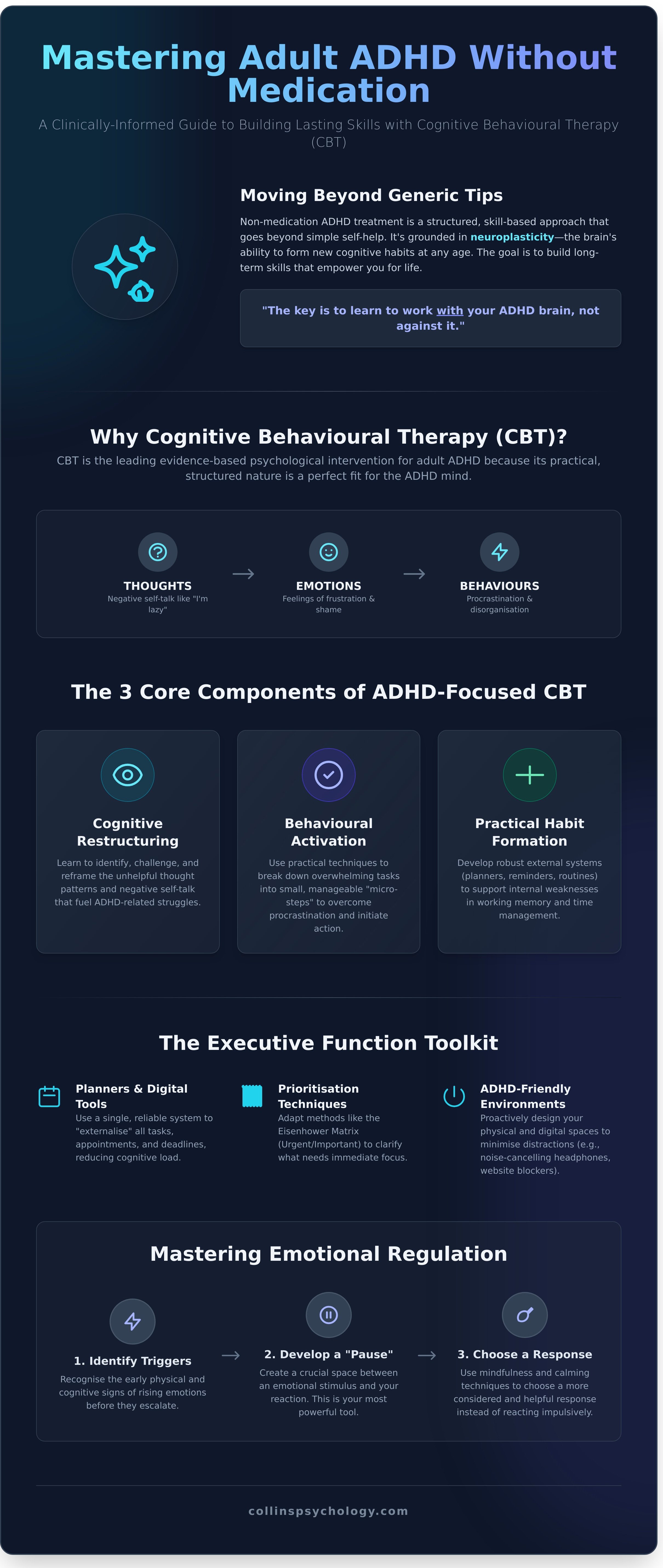
Cognitive Behavioural Therapy (CBT) is widely recognised as a leading evidence based non medication ADHD treatment for adults (Safren et al., 2017). Its effectiveness lies in its direct approach to the interplay between thoughts, emotions, and behaviours that characterise the ADHD experience. CBT specifically targets the core deficits of ADHD, particularly executive dysfunction, which impacts planning, organisation, and emotional control. The highly structured and practical nature of CBT provides a clear roadmap that is an excellent fit for the disorganised ADHD mind, offering concrete steps instead of abstract concepts.
The Core Components of ADHD Focused CBT
ADHD focused CBT is built on several key components that work together to create lasting change.
Cognitive restructuring
This involves learning to identify and challenge the unhelpful negative self talk that often accompanies ADHD. Many adults with ADHD internalise a narrative that they are "lazy" or "not trying hard enough." CBT provides tools to reframe these thoughts into more balanced and compassionate perspectives.
Behavioural activation
This component directly addresses chronic procrastination. It teaches you how to break down overwhelming tasks into small, manageable steps, making it easier to get started and build momentum.
Practical habit formation
CBT helps you create robust external structures to support internal cognitive weaknesses. This includes developing consistent routines and using tools to manage memory and attention, effectively scaffolding your executive functions.
Evidence Supporting CBT for Adults
A significant body of research demonstrates that CBT can lead to marked improvements in quality of life, organisational skills, and overall functional outcomes for adults with ADHD (Knouse & Safren, 2010). These programmes are shown to reduce procrastination and improve emotional regulation, which has a positive ripple effect on both professional and personal life. The skills learned in a structured CBT programme are designed to be practical and sustainable. For those interested in a deeper exploration of these methods, we offer a comprehensive CBT collection with detailed modules.
Developing Executive Functioning and Time Management Skills
Executive functioning can be thought of as the "CEO of the brain," responsible for planning, prioritising, and executing tasks. In adult ADHD, these functions are often impaired, leading to challenges with time management and organisation. Non medication ADHD treatment for adults heavily focuses on building these skills. Strategies include improving time perception and estimation, often a significant difficulty for the ADHD brain. A core principle is the "externalising" of information by consistently using tools like calendars, lists, and digital reminders to reduce the cognitive load on a brain that struggles with working memory.
Practical Strategies for Daily Organisation
Planners and Digital Tools
Using a single, reliable system, whether a physical planner or a digital app, is key to managing cognitive load. The goal is to offload appointments, tasks, and ideas from your mind onto an external system you trust.
Prioritisation Techniques
Traditional to do lists can be overwhelming. Methods like the Eisenhower Matrix, adapted for ADHD, help you categorise tasks by urgency and importance, providing clarity on where to focus your energy first.
Creating an ADHD Friendly Environment
This involves proactively designing your physical and digital spaces to minimise distractions. This might mean setting up a dedicated workspace, using noise cancelling headphones, or employing website blockers during focus periods.
Mastering Goal Setting and Focus
Traditional goal setting often fails for ADHD adults because the goals are too large and the timeline too long, leading to overwhelm and abandonment.
Break Projects into "Micro Steps"
A core CBT strategy is to deconstruct large projects into the smallest possible action steps. This reduces the activation energy required to start and provides a steady stream of accomplishments, which boosts motivation.
The Role of Fitness and Sleep
Executive function is not just about mental strategies; it is deeply connected to physical wellbeing. Consistent sleep and regular physical activity have been shown to significantly improve focus, mood, and cognitive performance (Verburgh et al., 2014).
• For a deep dive into these techniques, our Executive Function course provides structured lessons and practical tools.
Emotional Regulation and Coping with Overwhelm
A frequently overlooked aspect of adult ADHD is the significant challenge with emotional regulation. This can manifest as intense frustration, irritability, or heightened sensitivity to perceived rejection. CBT provides a framework for understanding and managing these powerful emotional responses. A key part of the therapy is learning to identify emotional triggers before they escalate into an outburst. This allows you to implement calming techniques and manage frustration in the moment. By understanding the "ADHD burnout" cycle, you can learn to pace yourself better and build resilience.
Building Emotional Resilience
Mindfulness Informed CBT
These techniques help you stay grounded in the present moment rather than being swept away by intense emotions. Simple practices can help you observe your feelings without immediate judgement or reaction.
Developing a "Pause"
CBT helps you create a crucial space between an emotional stimulus and your reaction. This pause gives you the opportunity to choose a more considered and helpful response, rather than an impulsive one.
Improving Relationships
As emotional regulation skills improve, so do personal and professional relationships. Communication becomes clearer, and conflicts are less likely to escalate, leading to more stable and rewarding connections.
Managing the Impact on Daily Life
Coping with Shame
Many adults with ADHD carry a deep sense of shame related to past struggles with deadlines, organisation, or emotional outbursts. The therapeutic process involves addressing this shame directly.
The Importance of Self Compassion
A cornerstone of managing ADHD is learning to treat yourself with the same kindness and understanding you would offer a friend. CBT helps cultivate a more compassionate inner voice, which is essential for long term wellbeing.
• Our Emotional Regulation module offers practical exercises to build these essential skills.
Structured Online Programmes for Self Paced ADHD Support
Collins Psychology provides online, self paced CBT programmes designed specifically for adults with ADHD. It is important to clarify that we do not offer one to one therapy. Our model is built to provide flexibility and in depth learning through structured modules, downloadable exercises, and practical tools. This self paced format allows you to learn whenever and wherever suits you, re-watch content as needed, and integrate new skills into your life at a comfortable pace. We invite you to take the next step in your journey toward structured, effective symptom management.
The Advantages of Online CBT
An online, self paced format offers distinct advantages for the ADHD brain. The digital delivery provides immediate and flexible access to materials, which is ideal for fluctuating motivation and energy levels. The structured modules ensure that no critical skill is missed, guiding you through a comprehensive curriculum from foundational concepts to advanced strategies. Furthermore, our online programmes are a cost effective alternative to traditional clinical hours, making high quality, evidence based support more accessible.
Getting Started with Collins Psychology
Enrolling in our programmes is a straightforward process designed to get you started quickly. All the information you need is available on our programme pages. For any organisational enquiries or questions about how our programmes might fit your needs, please do not hesitate to contact us.
Ready to build the skills for a more organised and fulfilling life? Explore our CBT for Adult ADHD programmes today.
Frequently Asked Questions
Is it possible to treat adult ADHD effectively without using medication?
Yes, it is. Non medication ADHD treatment for adults, particularly Cognitive Behavioural Therapy (CBT), focuses on building practical skills to manage symptoms like inattention, disorganisation, and emotional dysregulation. Research shows these strategies can significantly improve daily functioning and quality of life.
How does CBT differ from traditional talk therapy for ADHD?
Traditional talk therapy is often exploratory and less structured. ADHD focused CBT is an active, skills based therapy. It is highly structured, practical, and goal oriented, providing concrete strategies and tools specifically designed to target the executive function and emotional challenges associated with ADHD.
Can I use these CBT strategies if I am already taking ADHD medication?
Absolutely. CBT is an excellent complement to medication. While medication can help manage core symptoms, CBT teaches you the practical skills and organisational strategies to navigate daily life more effectively. The combination is often considered a very comprehensive approach to ADHD care.
How long does it typically take to see results from a CBT programme?
The timeline can vary, but because CBT is so practical, many people begin to see positive changes within a few weeks of consistently applying the strategies. The key is active participation and practice. Since our programmes are self paced, you can move as quickly or as methodically as you need.
Do I need a formal diagnosis to start an online CBT programme for ADHD?
No, a formal diagnosis is not required to benefit from our programmes. If you experience challenges with executive functioning, time management, emotional regulation, and focus, the skills taught in our CBT programmes are designed to be beneficial regardless of a formal diagnostic label.
Why is an online self paced programme better for some adults than one to one therapy?
An online, self paced format offers unique benefits that suit the ADHD brain. It provides flexibility to learn when your focus is at its peak, removes the pressure of scheduled appointments, and allows you to revisit lessons as many times as you need to absorb the material. It is also a more accessible and cost effective option.
What specific executive functions does CBT help to improve?
CBT for ADHD directly targets a range of executive functions, including planning and prioritisation, task initiation (overcoming procrastination), time management, organisation, working memory, and emotional regulation.
Are these programmes suitable for parents who also have ADHD?
Yes. The skills learned in our programmes are highly relevant for parents with ADHD. Improving your own executive functioning and emotional regulation can help you create a more structured and calm home environment, which benefits the entire family. The self paced nature also allows you to fit the learning around your family's schedule.
References
Knouse, L. E., & Safren, S. A. (2010). Current status of cognitive behavioral therapy for adult ADHD. Journal of Attention Disorders, 13(5), 523–537.
Safren, S. A., Sprich, S., Perlman, C. A., & Otto, M. W. (2017). Mastering your adult ADHD: A cognitive-behavioral treatment program, therapist guide (2nd ed.). Oxford University Press.
Verburgh, L., Königs, M., Scherder, E. J., & Oosterlaan, J. (2014). Physical exercise and executive functions in preadolescent children, adolescents and young adults: a meta-analysis. British Journal of Sports Medicine, 48(12), 973–979.