.png)

When you have ADHD, the experience of grief can feel confusing and isolating. The typical roadmap for mourning may not apply, leaving you to question if you are grieving "correctly." This article explains why the ADHD brain processes loss differently, from intense emotional floods to moments of forgetting the loss entirely. We will explore the intersection of emotional dysregulation, executive dysfunction, and grief, moving beyond validation to provide a structured Cognitive Behavioural Therapy (CBT) framework. You will learn practical, evidence-based strategies to manage the administrative and emotional weight of bereavement, helping you to build systems that work with your brain, not against it.
Key Takeaways
• Grief with ADHD is a non-linear process, characterised by intense emotional bursts rather than a steady state of sadness. This is due to core traits like emotional dysregulation.
• Executive function challenges, such as poor working memory and object permanence issues, can lead to cycles of "forgetting" the loss, followed by overwhelming waves of grief when reminded.
• Societal expectations of how grief "should" look often clash with the ADHD experience, leading to unnecessary guilt and shame. Reframing distraction as a biological need for the ADHD brain is crucial.
• Structured CBT strategies, like "grief appointments" and breaking down administrative tasks into micro-steps, provide the external support needed to navigate the practical and emotional sides of loss.
• Collins Psychology offers self-paced, online CBT programmes designed to help adults with ADHD build these systems. It is not one-to-one therapy but a structured learning system to manage emotional and executive challenges.
Table of Contents
• Understanding the Unique Intersection of ADHD and Grief
• How Executive Function Challenges Impact the Grieving Process
• Overcoming the Guilt of Neurodivergent Grief Patterns
• Practical CBT Strategies for Managing Loss with ADHD
• Building Resilience through Structured Online Learning
Understanding the Unique Intersection of ADHD and Grief
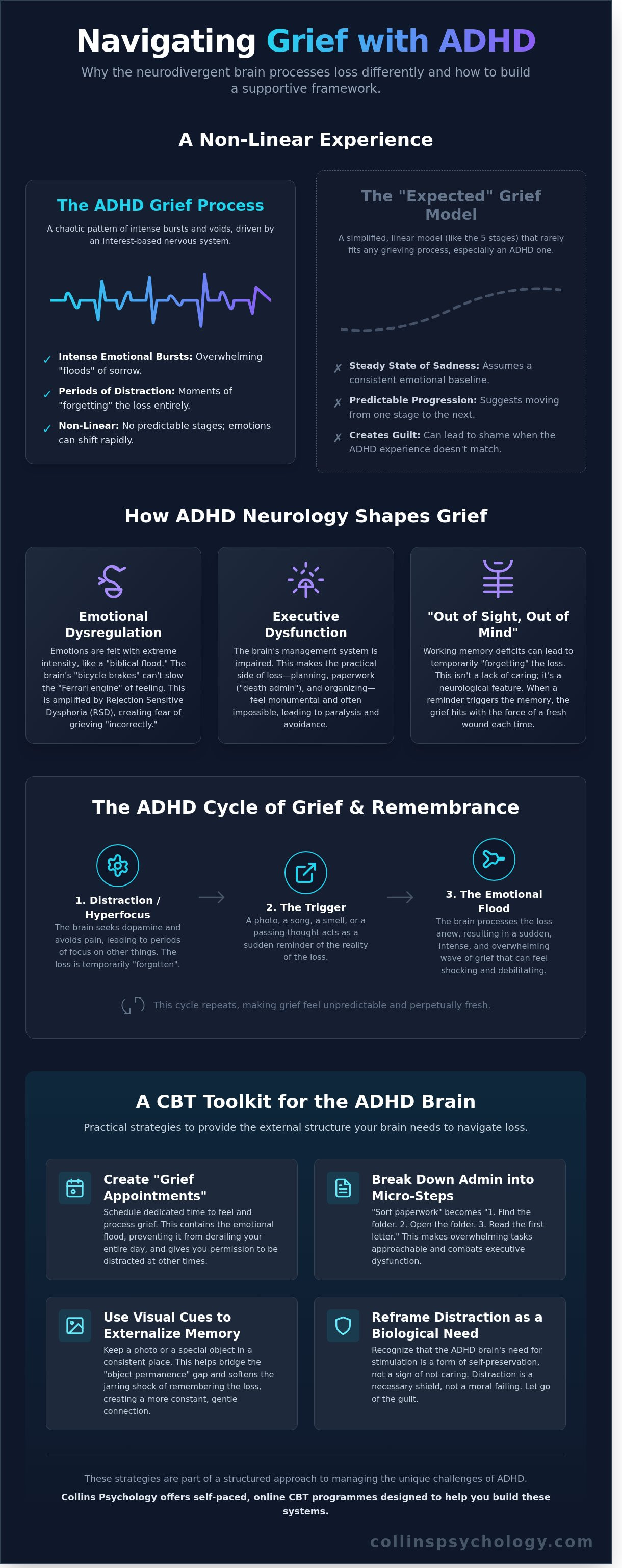
For an adult with ADHD, grief is not a linear progression through predictable stages. It is a process profoundly shaped by the underlying neurobiology of the condition. The ADHD brain can be described as having a "Ferrari engine with bicycle brakes," a metaphor that becomes particularly relevant during a crisis like bereavement (Ratey & Hallowell, 2011). The intense emotional engine revs high, while the systems needed to regulate it are less effective.
This experience is influenced by several core ADHD traits:
Emotional Dysregulation
This is a key feature of adult ADHD, leading to emotions that are felt more intensely and can shift more rapidly than in neurotypical individuals (Shaw et al., 2014). Sorrow can feel like a biblical flood, completely overwhelming your capacity to function.
Dopamine Seeking
The ADHD brain is constantly seeking dopamine, its primary reward and motivation neurotransmitter. During grief, this can manifest as an unconscious drive to find stimulation to mask the profound pain of loss, leading to behaviours that might seem inappropriate to others.
Non-linear Processing
The ADHD grieving process is often one of bursts and voids. You may feel intensely connected to your grief one moment and completely distracted the next, which is a natural function of an interest-based nervous system.
The Role of Emotional Dysregulation
Adults with ADHD do not just feel emotions; they can become completely engulfed by them. This is not a matter of willpower but of neurology. The brain structures responsible for emotional control and moderation are impacted by ADHD, making it harder to apply the "brakes" once an emotion is triggered (Barkley, 2015).
Furthermore, many adults with ADHD experience Rejection Sensitive Dysphoria (RSD), an extreme emotional sensitivity and pain triggered by the perception of being rejected or criticised. During bereavement, RSD can amplify feelings of guilt or the fear that you are not meeting the expectations of grieving family members, making an already painful time even more difficult. Understanding this is a critical first step in unpacking RSD and its impact on self-esteem.
Why Traditional Grief Models May Not Fit
The classic "Five Stages of Grief" (denial, anger, bargaining, depression, acceptance) proposed by Kübler-Ross (1969) offers a simple framework, but it was never intended as a rigid, linear path. For the ADHD brain, this model is particularly ill-fitting. The grieving process is more likely to be a chaotic pattern of intense emotional "bursts" interspersed with periods of distraction or even numbness.
Attempting to force your experience into a linear model can lead to feelings of failure. A more helpful approach, and one central to modern grief work, is to see grief as a process of meaning-making and adaptation rather than a series of stages to be completed (Neimeyer, 2000). A trauma-informed CBT approach acknowledges this individual variability and provides tools to manage the distress as it appears, without judgement.
How Executive Function Challenges Impact the Grieving Process
Beyond the emotional intensity, it is the impact on executive functions that makes grieving with ADHD a unique challenge. Executive functions are the management systems of the brain, responsible for planning, organising, prioritising, and regulating focus. When these functions are impaired by ADHD, the practical demands of loss become monumental.
Key challenges include:
"Forgetting" the Loss
Due to working memory deficits, you might go for hours without thinking about your loved one, only to be hit by the reality of their absence with crushing force.
"Death-Related Admin"
The mountain of paperwork, phone calls, and logistical planning following a death is a nightmare for a brain that struggles with organisation and task initiation.
Hyperfocus as Avoidance
The ADHD brain may latch onto a task or hobby as a coping mechanism, using hyperfocus to create a temporary shield from the pain. While this can provide a necessary break, it can also lead to delayed emotional processing.
The Object Permanence Factor
In psychology, object permanence is the understanding that things continue to exist even when they cannot be seen or heard. While typically discussed in child development, a version of this challenge affects adults with ADHD. "Out of sight, out of mind" can apply to tasks, objects, and even the emotional reality of loss.
Without constant reminders, the ADHD brain can momentarily "forget" the new reality. This is not a reflection of how much you cared; it is a neurological feature. This phenomenon is why the grief can feel so sudden and shocking each time it resurfaces. A photograph, a song, or a shared memory can trigger an abrupt and overwhelming "flood" of emotion, as the brain is forced to process the loss anew. Using visual cues, such as a dedicated memorial space or a photograph, can help create a more consistent connection to the reality of the loss, softening these jarring realisations.
Executive Dysfunction and Funeral Logistics
Planning a funeral, notifying relatives, and dealing with financial paperwork requires a high level of executive functioning that is simply not available during acute grief, especially for someone with ADHD. Time blindness can make scheduling feel impossible, and the inability to prioritise can lead to paralysis when faced with a long list of urgent tasks.
This is where external systems become essential. Breaking down a task like "plan the funeral" into tiny, concrete "micro-steps" can make it manageable. For a deeper dive into building these essential skills, our CBT-based programme on Executive Function provides a structured system to follow.
Overcoming the Guilt of Neurodivergent Grief Patterns
The most common and painful question from adults grieving with ADHD is: "Am I a bad person for not feeling sad all the time?" Society has a powerful, unwritten script for how mourning should look: constant, visible sadness. When your ADHD brain distracts you with a new project or you find yourself laughing at a joke, it is easy to feel a profound sense of guilt.
This guilt stems from a misunderstanding of the ADHD nervous system. Your brain is not choosing distraction over sadness; it is biologically driven to seek engagement and stimulation to regulate itself. These moments are not a betrayal of your loved one; they are necessary breaks that allow your nervous system to cope with an otherwise unsustainable level of emotional pain.
The Guilt of Distraction
The ADHD brain operates on an "interest-based" nervous system, not an "importance-based" one. It directs its attention towards what is novel, challenging, or engaging. Even in tragedy, this fundamental operating principle does not change. Your brain will latch onto a "dopamine hit," whether from a new hobby, a work project, or a compelling conversation.
It is vital to reframe this. Distraction is not avoidance; it is a form of self-preservation. It is your brain's way of titrating the dose of grief, giving you moments of respite so you have the strength to face the pain when it returns. Feeling shame for returning to a hobby "too soon" is a burden you do not need to carry.
Validating Your Individual Process
CBT principles encourage us to challenge unhelpful thoughts, including the thought that "I am grieving incorrectly." Self-compassion is key. Acknowledge that your grief is authentic to you and your neurotype.
It can also be helpful to communicate your process to neurotypical family members. You might say, "My brain processes things in bursts. If you see me focused on something else, it is not because I do not care. It is how I cope. I will have other moments where I really need your support." This aligns with professional guidelines from bodies like the Psychological Society of Ireland (PSI), which emphasise the importance of recognising individual differences in psychological responses to trauma and loss.
Practical CBT Strategies for Managing Loss with ADHD
CBT provides a structured, practical toolkit to help you manage the dual challenges of emotional pain and executive dysfunction during bereavement. The goal is not to eliminate grief but to build a container for it, allowing you to honour your loss without it completely derailing your life.
Here are some evidence-based strategies:
Structured "Grief Appointments"
Instead of waiting for grief to ambush you, schedule time to engage with it. Set aside 15-30 minutes each day to look at photos, listen to music, or write about your loved one. This gives your grief a predictable outlet, reducing its tendency to erupt at unexpected times.
Externalised Reminders
Use visual cues like a memorial candle, a dedicated photo frame, or a special object on your desk. This helps bridge the "out of sight, out of mind" gap and allows for a more consistent, gentle processing of the loss.
Sensory Grounding
When an emotional flood hits, engage your senses to bring you back to the present moment. Hold an ice cube, notice five things you can see, or press your feet firmly into the floor. This technique helps regulate the nervous system when it feels overwhelmed.
"Check the Facts"
A core CBT technique for emotional regulation. When you feel a wave of guilt, ask yourself: What is the evidence that I am a "bad person" for not crying right now? Is there another, more compassionate way to view this?
Structuring Your Grief
The key to managing grief with ADHD is to create external structure where internal structure is lacking. Use time-blocking in your calendar to schedule not only your grief appointments but also essential self-care routines. Maintaining your "fitness and focus" routines, even in a modified form, provides a critical anchor during a time of emotional turmoil. Our programme on Emotional Regulation offers a complete system for building these routines.
Managing the Administrative Burden
To tackle the "death-related admin," you must break large, vague tasks into concrete "micro-steps." For example, "Sort out the estate" becomes:
• Find the phone number for the solicitor.
• Call the solicitor to book an appointment.
• Locate the will.
• Put the will in a folder to take to the appointment.
Using a "body double" (a friend or family member who sits with you, either in person or on video call, while you do the task) can provide the external accountability needed to get started. Setting realistic goals is paramount, and the frameworks within our Goal Setting module are designed specifically for the ADHD brain.
Building Resilience through Structured Online Learning
Navigating grief is one of the most difficult human experiences, and doing so with ADHD adds a layer of complexity that requires a different kind of support. You need more than motivation; you need a system that works with your brain.
At Collins Psychology, we provide structured, self-paced CBT programmes. This is not therapy. It is not coaching. It is a system. Our online modules are designed for adults with ADHD who are tired of knowing what to do but still struggling to do it. The flexibility of online learning allows you to engage with the material when your brain is ready, without the pressure of fixed appointments. You can start where you struggle most and build your ADHD support system over time.
The Collins Psychology Business Model
We want to be clear about how we can help. Collins Psychology provides self-paced educational programmes based on evidence-based CBT principles. These programmes are designed for busy adults who need practical tools they can apply to daily life, including during difficult times like bereavement. We do not offer one-to-one therapy or crisis support. Our model is built to empower you with skills and systems so you can stop starting over every Monday and finally know what to do AND actually do it.
Next Steps for Your Healing Journey
Your grieving process is your own, and there is no right or wrong way to do it. The goal is to find a way to honour your deceased loved one without being perpetually overwhelmed. Building a system to support your emotional regulation and executive functioning is a powerful step in that journey.
If you are ready to build systems that work with your brain, you can browse our full collection of courses or begin with our foundational CBT for Adult ADHD programme.
Frequently Asked Questions
Why does ADHD make grief feel so different from others?
ADHD impacts emotional regulation and executive functioning. This means you may experience emotions with greater intensity (emotional floods) and struggle with the practical tasks of bereavement. The non-linear "burst" pattern of grief is also common, contrasting with the more sustained sadness often expected by society.
Is it normal to "forget" that a loved one has died when I have ADHD?
Yes, this is a common and distressing experience related to working memory and object permanence challenges in ADHD. Your brain is not dismissing the loss; it is a neurological feature that can cause you to momentarily forget, leading to a painful rediscovery of the reality.
How can CBT help me manage the emotional floods of grief?
Cognitive Behavioural Therapy (CBT) offers practical techniques like "Check the Facts" to challenge guilt-inducing thoughts, and sensory grounding exercises to regulate your nervous system during overwhelming moments. It also helps you create structures, like "grief appointments," to process emotions in a contained way.
Does Collins Psychology offer one-to-one therapy for bereavement?
No, Collins Psychology does not provide one-to-one therapy. We offer self-paced, online CBT programmes that teach you the skills and systems to manage the emotional and executive function challenges of adult ADHD, which are highly applicable during periods of grief.
What is the "out of sight, out of mind" effect in the context of loss?
This refers to the ADHD brain's tendency to lose awareness of things that are not in its immediate environment. In grief, this can mean that without a direct reminder, the reality of the loss can fade into the background, only to return with shocking intensity when triggered.
Can hyperfocus be a symptom of grieving with ADHD?
Yes. Hyperfocus can serve as a powerful coping mechanism, allowing the brain to take a break from intense emotional pain by immersing itself in an engaging activity. While it can be a useful short-term tool, it is important to also create space to process the grief.
How do I handle the paperwork and logistics of a death with executive dysfunction?
The key is to use external supports. Break every large task into the smallest possible steps. Use visual aids like checklists. Employ strategies like body doubling, where another person's presence provides accountability to help you start and finish tasks.
References
Barkley, R. A. (2015). Attention-deficit hyperactivity disorder: A handbook for diagnosis and treatment (4th ed.). The Guilford Press.
Hallowell, E. M., & Ratey, J. J. (2011). Driven to distraction: Recognizing and coping with Attention Deficit Disorder from childhood through adulthood. Anchor Books.
Kübler-Ross, E. (1969). On death and dying. Macmillan.
Neimeyer, R. A. (2000). Searching for the meaning of meaning: Grief therapy and the process of reconstruction. Death Studies, 24(6), 541-558. https://doi.org/10.1080/07481180050121480
Psychological Society of Ireland. (n.d.). Code of Professional Ethics. Retrieved from https://www.psychologicalsociety.ie/footer/Code-of-Ethics
Shaw, P., Stringaris, A., Nigg, J., & Leibenluft, E. (2014). Emotional dysregulation and attention-deficit/hyperactivity disorder. American Journal of Psychiatry, 171(3), 276–293. https://doi.org/10.1176/appi.ajp.2013.13070966