.png)

Grief is a profoundly challenging journey for anyone, but for an adult with Attention Deficit Hyperactivity Disorder (ADHD), the process can feel chaotic and overwhelming in unique ways. This guide is designed to help you understand why grief feels so different when you have ADHD and to provide a structured, evidence-based framework for navigating your loss. By connecting core ADHD traits to the grieving process, we will explore practical, Cognitive Behavioural Therapy (CBT) based strategies that work with your brain, not against it. Our aim is to validate your experience and offer actionable steps to help you process your emotions, rebuild your routines, and find a path forward.
Why Grief Feels Different: The Intersection of ADHD and Loss
Grief is a universal human experience, but the neurology of ADHD can amplify its challenges, making the process feel unmanageable. It is not that you feel more or less than others; it is that your brain processes the experience differently. Understanding the neurological reasons behind your feelings can be a powerful first step towards self-compassion and healing. This section will validate your experience by explaining the ‘why’ and connecting core ADHD traits directly to the grieving process.
Emotional Dysregulation and Intense Feelings
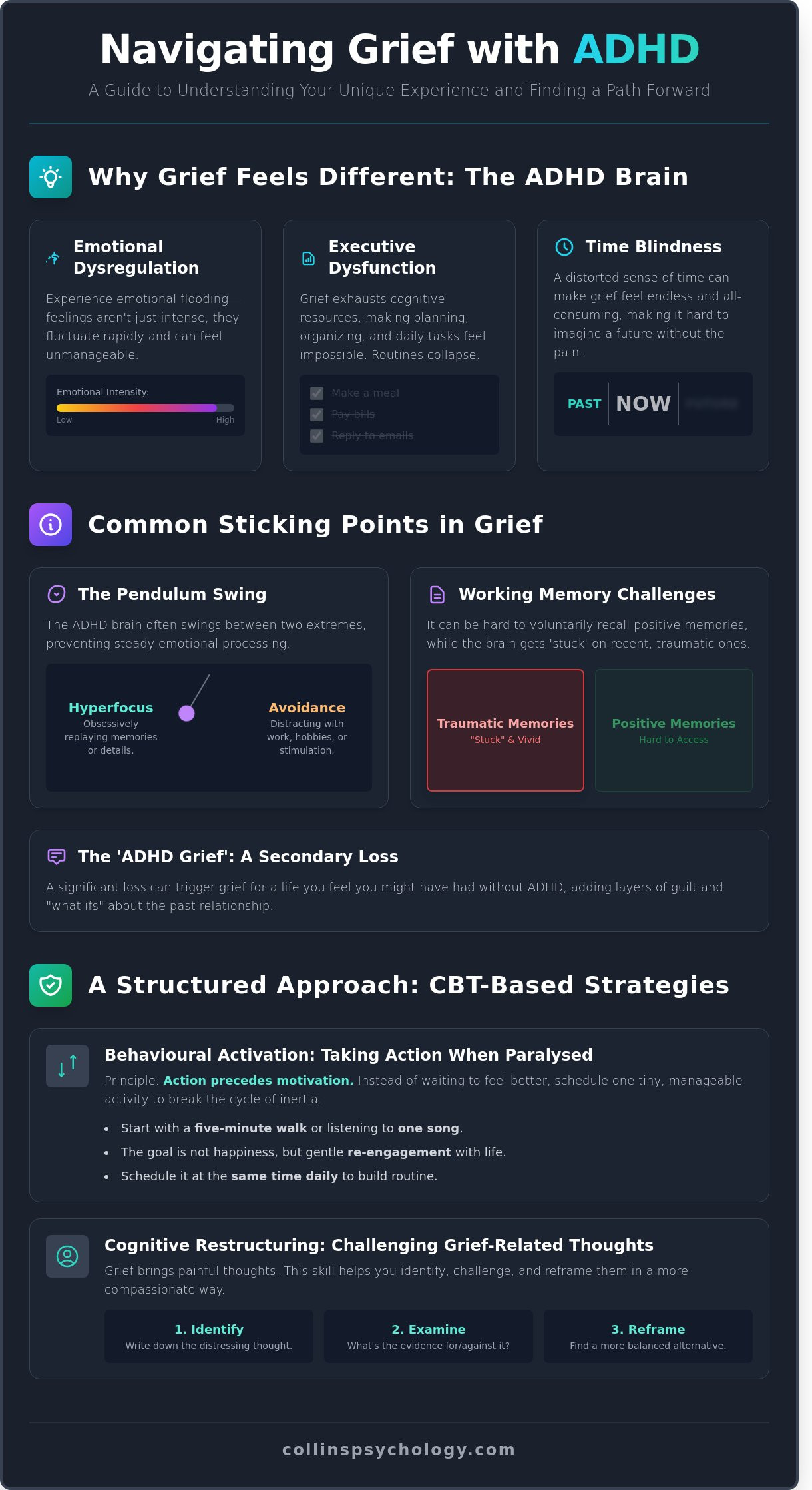
A key feature of adult ADHD is difficulty with emotional regulation, which is the ability to manage and respond to emotional experiences (Shaw et al., 2014). When grieving, this can manifest as emotional flooding, where you are swamped by feelings that are not just intense but also fluctuate rapidly. One moment you might feel a profound, bottomless sadness, and the next you could be experiencing intense anger or irritability. This is not a character flaw; it is a reflection of how your brain is wired. The experience of loss can also heighten emotional reactivity to perceived rejection or abandonment, a concept sometimes referred to as rejection sensitivity, making the pain of separation feel particularly acute (Skirrow & Asherson, 2013).
Executive Dysfunction and the Collapse of Routine
Grief is mentally and physically exhausting for everyone, placing a significant tax on our cognitive resources. For someone with ADHD, this exhaustion directly impacts executive functions: the mental skills needed for planning, organising, initiating tasks, and self-monitoring (Barkley, 2015). During bereavement, even simple daily activities like making a meal, paying a bill, or responding to emails can feel impossible. The external structures and routines that are often vital for managing ADHD can fall apart, leading to a sense of chaos and feeling completely adrift.
Time Blindness and Getting 'Stuck' in Grief
Many adults with ADHD experience ‘time blindness’, or a distorted perception of time (Noreika et al., 2013). When you are grieving, this can make the pain feel endless and all-consuming. It can be incredibly difficult to imagine a future where you will not feel this way, creating a sense of hopelessness. This altered sense of time can also lead to a pattern of avoiding the processing of difficult emotions, as the task feels too monumental to begin. The past can feel intensely immediate, while the future seems abstract and unreachable.
Common Sticking Points: Unique Ways Grief Manifests with ADHD
ADHD does not just change how grief feels; it changes how it shows up in your thoughts and behaviours. Recognising these common patterns is the first step toward developing effective coping strategies. These manifestations can range from emotional volatility to memory issues, and may also include a secondary form of grief related to the ADHD diagnosis itself.
The Pendulum Swing: Hyperfocus vs. Avoidance
The ADHD brain often operates in extremes, and this is especially true during grief. You may find yourself on a pendulum, swinging between two poles. On one end is hyperfocus, where you become completely absorbed by the loss. This can look like obsessively replaying final moments, researching details surrounding the death, or ruminating on what you could have done differently. On the other end is avoidance, where you do everything possible to distract yourself from the pain through work, new hobbies, or other stimulating activities. While both are natural responses, an extreme swing between them can prevent the steady, gentle processing that is necessary for healing.
Working Memory Challenges and Remembering the Good
Working memory, the ability to hold and manipulate information in your mind, is often a challenge for adults with ADHD (Barkley, 2015). During grief, this can make it difficult to voluntarily recall positive, comforting memories of the person you have lost. Instead, your brain may get ‘stuck’ on the most recent and often traumatic memories, such as their final days or the moment you heard the news. This is not a reflection of your relationship; it is a neurological quirk that can inadvertently focus your grieving mind on pain rather than on the full, cherished history you shared.
The 'ADHD Grief': Mourning Lost Time and Potential
A significant loss can act as a catalyst, triggering a secondary wave of grief that is unique to the experience of living with ADHD. This is the grief for a life you feel you might have had without the challenges of ADHD. You might mourn missed opportunities or conversations, or feel regret about times when your symptoms impacted your relationship with the person you lost. This ‘ADHD grief’ can complicate the primary grieving process, adding layers of guilt and ‘what ifs’ that need to be acknowledged and processed with compassion.
A Structured Approach: CBT-Based Strategies for Grieving with ADHD
Standard advice on grief, such as ‘just let yourself feel it’, can be unhelpful for an ADHD brain that craves structure. Cognitive Behavioural Therapy (CBT) offers a practical, skills-based framework for managing the overwhelming thoughts, feelings, and behaviours that accompany grief (Safren et al., 2017). These strategies are designed to provide the scaffolding your brain needs, allowing you to engage with your grief in a way that feels contained and manageable.
Behavioural Activation: Taking Action When You Feel Paralysed
Grief naturally leads to withdrawal and inertia, which can be particularly pronounced when executive dysfunction is at play. Behavioural Activation is a powerful CBT technique that acts as an antidote (Dimidjian et al., 2006). The principle is simple: action precedes motivation. Instead of waiting to feel better to do something, you schedule a small, manageable action to break the cycle.
• Start with one tiny, planned activity each day, such as a five-minute walk, listening to one song, or tidying one surface.
• The goal is not to feel happy instantly, but to gently re-engage with life and break the powerful grip of inertia.
• Schedule the activity at the same time each day to help build a routine.
Cognitive Restructuring: Challenging Grief-Related Thoughts
Grief often brings with it a host of painful and unhelpful thoughts, such as ‘I will never be happy again’ or ‘It was my fault’. Cognitive Restructuring is a core CBT skill that involves identifying, challenging, and reframing these thought patterns.
Identify
Write down the distressing thought when you notice it.
Examine
Ask yourself, ‘What is the evidence for and against this thought? Is there a more compassionate way of looking at this?’
Reframe
Develop a more balanced and realistic alternative thought, such as, ‘It is possible to feel happiness again, even while I am still grieving’ or ‘I did the best I could with the information I had at the time’.
Structured Emotional Processing: Making Space for Feelings
For the ADHD brain, emotions can feel like a flood that threatens to take over everything. A structured approach can make processing these feelings less daunting. This involves creating a deliberate, time-limited container for your grief.
• Set a timer for 10 to 15 minutes each day for ‘structured grieving time’.
• During this time, give yourself full permission to feel whatever comes up. You can journal, cry, look at photos, or simply sit with your sadness without judgment.
• When the timer goes off, consciously transition to a different, pre-planned activity, even something small like making a cup of tea. This helps contain the grief, assuring your brain that it will not consume your entire day.
Rebuilding Scaffolding: How to Restore Routine and Self-Care
ADHD management often relies on external structures, or scaffolding, to support executive functions. Grief can dismantle this scaffolding overnight. Rebuilding these supports is a critical part of the healing process and is essential for restoring a sense of stability and function. The focus should always be on compassion and consistency over perfection.
Start with the 'Big Three': Sleep, Nutrition, Movement
Grief disrupts our most basic biological functions, and this disruption has a significant negative effect on ADHD symptoms (Stroebe et al., 2007). Prioritising these three areas provides a foundation for everything else.
Sleep
Aim for a consistent wind-down routine, even if it is just for 15 minutes before bed. This could involve reading, listening to calm music, or gentle stretching. Avoid screens.
Nutrition
Your brain is using a huge amount of energy. Plan for simple, low-effort meals and snacks. Keep healthy options visible and easy to grab.
Movement
Link a short period of movement to an existing habit. For example, walk around the block immediately after finishing lunch. The goal is gentle consistency, not intense exercise.
Externalise Everything: Use Tools to Support Your Brain
Your brain is at full capacity dealing with grief. Do not ask it to also remember appointments or multi-step tasks. Offload as much of this cognitive burden as possible onto external systems.
• Use calendars, phone alarms, and visual reminders for absolutely everything.
• Write checklists for tasks that feel overwhelming, like getting ready in the morning or completing a work assignment.
• Use a whiteboard or sticky notes in a prominent place to keep track of your top three priorities for the day.
Lean on Your Support System Strategically
People often want to help but do not know how. Vague requests for ‘help’ can be hard for them to act on and for you to manage. Be specific and strategic in your requests.
• Ask for concrete help: ‘Could you please call me at 5 pm to check in?’ is more effective than ‘I am having a hard day’.
• Assign specific roles. You might have one friend who is your ‘body double’ for running errands and another you call when you need to talk things through.
• Communicate your needs clearly. It is okay to say, ‘I would love to see you, but I do not have the energy to talk much. Could we just watch a film together?’
When to Seek Professional Support
Navigating grief is hard. Navigating it with ADHD can be incredibly complex, and you do not have to do it alone. If your grief feels persistently unmanageable, seeking help from a mental health professional is a sign of strength and self-awareness. A therapist with experience in adult ADHD can provide guidance tailored to your unique needs.
Signs You Might Need More Support
It is important to recognise the signs that your grief may be developing into something more serious, such as complicated grief or depression. Consider seeking professional help if you experience:
• A prolonged inability to perform basic daily functions at work or home.
• Persistent feelings of worthlessness, hopelessness, or thoughts of self-harm.
• Intense grief that does not seem to lessen in intensity over many months, preventing you from re-engaging with your life.
Finding the Right Support for ADHD and Grief
When looking for support, it is helpful to find a professional who understands the interplay between adult ADHD and the grieving process. Therapies that use a structured, skills-based approach, like CBT, are often very effective. Our online programmes at Collins Psychology are designed to provide this kind of structured support. We offer self-paced CBT courses that teach practical strategies for managing emotional regulation and executive functioning challenges. It is important to note that we provide educational programmes and do not offer one-to-one therapy, allowing you to learn valuable skills at your own pace.
Frequently Asked Questions
Does grief make ADHD symptoms worse?
Yes, grief can significantly worsen ADHD symptoms. The emotional and cognitive load of bereavement depletes executive function resources, making challenges with focus, organisation, emotional regulation, and memory more pronounced.
Why do I feel numb instead of sad after a loss?
Numbness is a common and valid part of grief. For an ADHD brain prone to emotional flooding, numbness can be a self-protective mechanism to prevent the system from becoming completely overwhelmed. It is often a temporary state before other feelings begin to surface.
How can I support a partner or friend with ADHD who is grieving?
Offer practical, structured support. Instead of saying ‘Let me know if you need anything’, offer to do specific tasks like cooking a meal, helping with paperwork, or being a ‘body double’ for an errand. Help them maintain or rebuild simple routines, and offer compassion without judgment for their emotional fluctuations.
Is there a 'right' way to grieve when you have ADHD?
No, there is no ‘right’ way to grieve for anyone, with or without ADHD. Your process is your own. The key is to find strategies that honour your neurological wiring, offer self-compassion, and provide the structure you need to feel stable amidst the pain.
How is complicated grief different for someone with ADHD?
Complicated grief, or Prolonged Grief Disorder, is when acute grief remains intense and debilitating for an extended period. For someone with ADHD, executive dysfunction and emotional dysregulation can make it harder to adapt to the loss, potentially increasing the risk of getting ‘stuck’ in this state.
Can medication for ADHD help with the grieving process?
This is a question to discuss with your prescribing doctor. For some, continuing their ADHD medication can provide a necessary baseline of executive function to engage in daily tasks and therapeutic work. For others, adjustments may be needed. Professional medical advice is essential.
Our structured CBT programmes are designed to help adults with ADHD build the skills needed to manage life’s challenges. Learn more about our structured CBT Programmes for Adult ADHD.
• Evidence-based therapy programmes
• Guidance for adults with ADHD
• Delivered by experienced clinical psychologists
References
Barkley, R. A. (2015). Attention-deficit hyperactivity disorder: A handbook for diagnosis and treatment (4th ed.). The Guilford Press.
Dimidjian, S., Hollon, S. D., Dobson, K. S., Schmaling, K. B., Kohlenberg, R. J., Addis, M. E., ... & Jacobson, N. S. (2006). Randomized trial of behavioral activation, cognitive therapy, and antidepressant medication in the acute treatment of adults with major depression. Journal of Consulting and Clinical Psychology, 74(4), 658–670. https://doi.org/10.1037/0022-006X.74.4.658
Noreika, V., Falter-Wagner, C. M., & Rubia, K. (2013). Timing deficits in ADHD: evidence from a review. Neuropsychology Review, 23(3), 265–288. https://doi.org/10.1007/s11065-013-9235-3
Safren, S. A., Sprich, S. E., Perlman, C. A., & Otto, M. W. (2017). Mastering your adult ADHD: A cognitive-behavioral treatment program, therapist guide (2nd ed.). Oxford University Press.
Shaw, P., Stringaris, A., Nigg, J., & Leibenluft, E. (2014). Emotion dysregulation in attention deficit hyperactivity disorder. American Journal of Psychiatry, 171(3), 276–293. https://doi.org/10.1176/appi.ajp.2013.13070966
Skirrow, C., & Asherson, P. (2013). Emotional lability, comorbidity and impairment in adults with attention-deficit hyperactivity disorder. Journal of Affective Disorders, 147(1-3), 80–86. https://doi.org/10.1016/j.jad.2012.10.011
Stroebe, M., Schut, H., & Stroebe, W. (2007). Health outcomes of bereavement. The Lancet, 370(9603), 1960–1973. https://doi.org/10.1016/S0140-6736(07)61816-9