.png)

For many adults with ADHD, the idea of mindfulness can feel like a contradiction. The instruction to “clear your mind” often clashes with a brain that is constantly buzzing with ideas, distractions, and emotions. This article explores Mindfulness Based Cognitive Therapy (MBCT), a structured approach that does not ask you to empty your mind, but rather to build a new, more intentional relationship with your thoughts. We will look at how MBCT provides a practical framework for adults with ADHD to improve focus, manage emotional reactivity, and strengthen executive function, helping you move from knowing what to do to actually doing it.
Key Takeaways
•
MBCT is a structured, evidence based programme that combines mindfulness practices with cognitive behavioural strategies to address core ADHD challenges like inattention and emotional dysregulation.
•
Unlike traditional meditation that may feel frustrating, MBCT for ADHD focuses on noticing distraction and gently redirecting attention, which strengthens attentional networks in the brain over time.
•
This approach provides practical tools, such as the "Three Minute Breathing Space," to create a pause between impulse and action, which is particularly helpful for managing emotional reactivity and Rejection Sensitive Dysphoria (RSD).
•
MBCT can be learned through self paced online modules, offering the flexibility needed for the ADHD brain to engage with the material without the pressure of fixed appointments.
Table of Contents
•
•
The Science of Mindfulness and the ADHD Brain
•
MBCT vs Traditional Cognitive Behavioural Therapy
•
Practical Mindfulness Strategies for Executive Function
•
Accessing Structured Support with Collins Psychology
What is MBCT for ADHD Adults?
Mindfulness Based Cognitive Therapy (MBCT) is an integrated programme that brings together the tools of Cognitive Behavioural Therapy (CBT) with the practice of mindful awareness. Originally developed to prevent depressive relapse, its principles have been adapted to address the core challenges of adult ADHD, such as distractibility, impulsivity, and emotional dysregulation. Unlike vague spiritual practices, MBCT is a highly structured, skills based approach grounded in the foundational work of psychologists like Segal, Williams, and Teasdale (2013). The goal is not to stop thoughts but to change your relationship with them, observing them without getting carried away.
The Core Components of the Programme
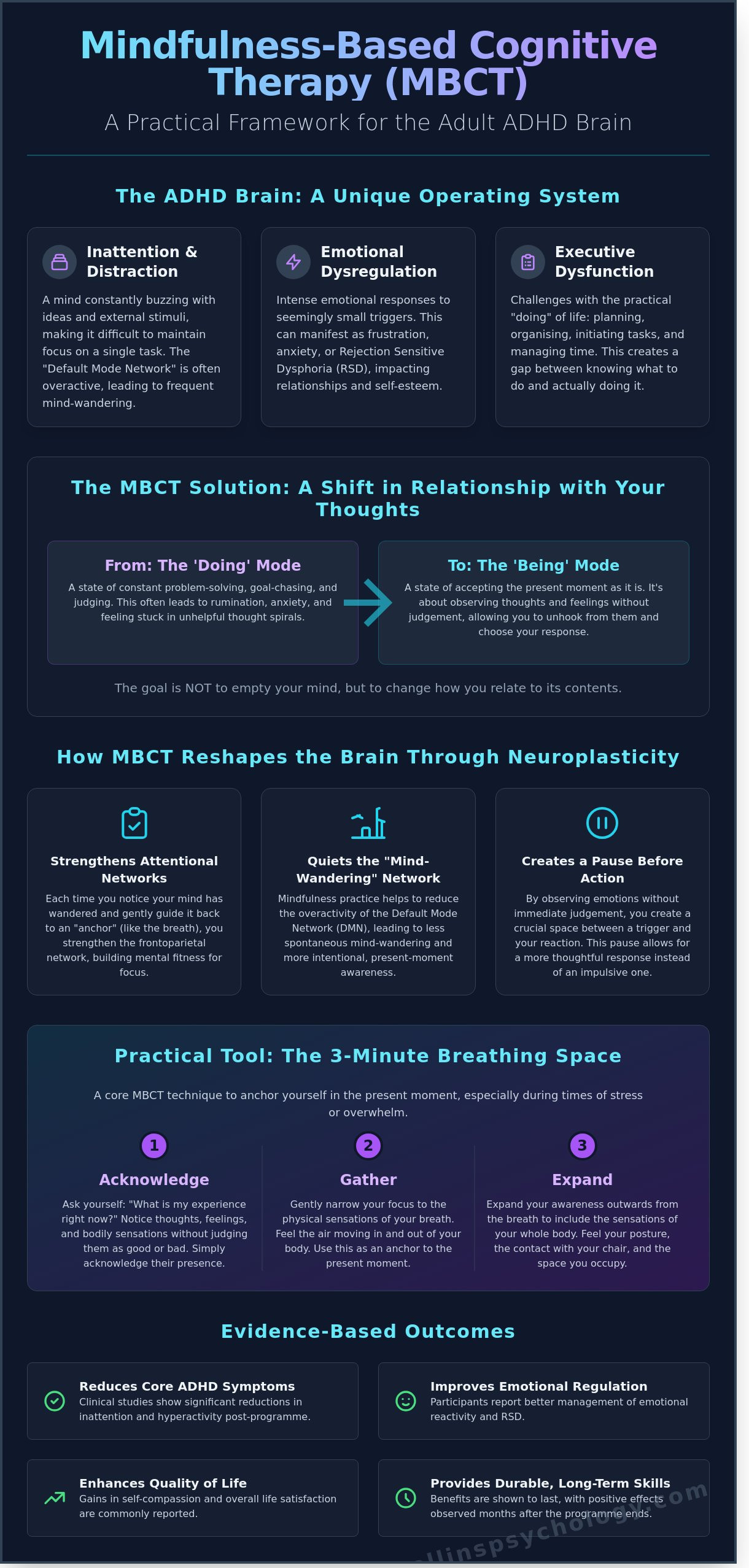
A central concept in MBCT is the shift from a "doing" mode of mind to a "being" mode. The "doing" mode is goal oriented and constantly trying to fix problems, which can lead to rumination and anxiety for the ADHD brain. In contrast, the "being" mode focuses on accepting the present moment as it is, which helps in decentering from intrusive or distracting thoughts. Through cognitive exercises, you learn to identify and unhook from unhelpful thought patterns before they spiral, giving you greater control over your focus and mood.
According to Mindfulness-Based Cognitive Therapy, this is a well-documented area of ongoing research and practical application.
Evidence for MBCT in Adult ADHD Management
Research increasingly supports the effectiveness of MBCT for adults with ADHD. Studies have demonstrated significant reductions in core ADHD symptoms, including inattention and hyperactivity, following an MBCT programme (Speckens et al., 2017). Beyond symptom reduction, participants often report meaningful improvements in their overall quality of life, self compassion, and emotional regulation. These benefits have been shown to be durable, with positive effects observed in clinical trials up to six months after the programme concludes, highlighting its value as a long term management strategy.
The Science of Mindfulness and the ADHD Brain
The ADHD brain is not broken; it simply works differently, and mindfulness practices can leverage the brain's own ability to change, a concept known as neuroplasticity. Consistent practice helps strengthen the attentional circuits that are often weaker in adults with ADHD. Research suggests that mindfulness impacts the Default Mode Network (DMN), a brain network associated with mind wandering, which is typically overactive in ADHD (Bachmann et al., 2016). By training the brain to return to a point of focus, MBCT helps quieten the DMN, allowing for more intentional thought and action.
Strengthening the Attentional Network
The core of mindfulness is not about maintaining unbroken focus but about the act of returning your focus again and again. Simple "anchoring" exercises, like paying attention to the breath or the sensations in your feet, build the mental muscle required to notice when your mind has wandered and gently guide it back. This repeated action strengthens the frontoparietal network, which is crucial for executive functions like planning and attention. Over time, this practice builds what can be described as "mental fitness," enhancing your ability to stay present and engaged in your daily life.
Research published by The Neuropsychology of MBCT for ADHD shows that this is a well-documented area of ongoing research and practical application.
Managing Emotional Dysregulation
Emotional dysregulation is a significant challenge for many adults with ADHD, often manifesting as intense emotional reactions or Rejection Sensitive Dysphoria (RSD). MBCT offers powerful tools for this by teaching you to create a "pause" between an emotional trigger and your reaction. Techniques like non judgemental awareness help you observe feelings of frustration, anxiety, or shame without immediately acting on them. This space allows you to respond more thoughtfully rather than impulsively, reducing the negative impact of emotional dysregulation on your work and relationships.
How MBCT Works for the ADHD Brain
Common ADHD Challenges
•
Constant Distraction: The mind wanders easily, making it difficult to stay on task.
•
Emotional Reactivity: Small triggers lead to intense emotional responses.
•
Executive Dysfunction: Difficulty with planning, organising, and starting tasks.
MBCT Solutions & Skills
•
Anchoring Attention: Training the brain to notice distraction and gently return to the present moment.
•
Creating a Pause: Using the breath to create space between a feeling and an impulsive reaction.
•
Mindful Awareness: Observing thoughts and tasks without judgement to reduce overwhelm and shame.
MBCT vs Traditional Cognitive Behavioural Therapy
While both MBCT and traditional Cognitive Behavioural Therapy (CBT) are effective for ADHD, they approach challenges from different angles. Traditional CBT is often goal oriented, focusing on identifying and changing specific unhelpful thought patterns and behaviours. MBCT, on the other hand, is more awareness focused, teaching you to observe your thoughts and feelings from a distance without necessarily needing to change them. For many adults with ADHD, these approaches are highly complementary, and research shows that combined modalities can be particularly effective (Mitchell et al., 2015).
When to Choose a Combined Approach
A combined approach is beneficial when you need both practical, structured strategies and a way to manage the underlying mental chatter and emotional overwhelm. While cognitive restructuring from CBT is excellent for challenging beliefs like "I always procrastinate," mindful awareness from MBCT helps you sit with the uncomfortable feelings that drive procrastination in the first place. For those who find the rigid homework of standard CBT difficult to maintain, the gentle, acceptance based nature of mindfulness can feel more accessible and sustainable, providing a foundation upon which to build other cognitive skills.
The Role of Structure in Therapy
A methodical, step by step approach is vital for the ADHD mind, which thrives on clarity and predictability. Collins Psychology provides structured, CBT based systems for adults with ADHD who are tired of knowing what to do but still struggling to do it. Our self paced learning programmes remove the pressure and scheduling difficulties of traditional clinical settings, allowing you to engage with the material when your brain is most receptive. This is not therapy or coaching; it is a system designed to help you stop relying on motivation and instead build systems that work with your brain.
Practical Mindfulness Strategies for Executive Function
One of the biggest objections to mindfulness for ADHD is the idea of sitting still for long periods. The good news is that MBCT is not about lengthy, formal meditation sessions. It is about integrating short, intentional moments of awareness into your busy day to support your executive function. A cornerstone of this practice is the "Three Minute Breathing Space," a brief, structured exercise used during transition periods to reset your focus and ground yourself before moving to the next task.
Mindful Approaches to Time Management
Time blindness, or the difficulty in accurately perceiving the passage of time, is a common ADHD challenge. You can combat this with "mindful check ins," where you pause for a moment to notice what you are doing, how much time has passed, and what you need to do next. This practice helps you stay present with your current capacity, allowing you to set more realistic goals for your day. For example, before starting a work task, take one minute to mindfully notice your energy levels and focus, then adjust your expectations for the task accordingly, rather than pushing through and risking burnout.
Improving Sleep and Focus
A racing mind at night is a frequent complaint for adults with ADHD, severely impacting sleep quality and next day focus. A mindful body scan can be a powerful tool to break this cycle. Instead of trying to force your mind to be quiet, you gently guide your attention through different parts of your body, noticing sensations without judgement. This practice anchors your mind in the present physical moment, making it harder for racing thoughts to take over and promoting a state of relaxation conducive to sleep. For more on this, explore our structured CBT approach to sleep issues.
Mindfulness for Fitness and Parenting
Mindfulness can be integrated into almost any activity, including fitness and parenting. Mindful movement involves paying full attention to the physical sensations of your body during exercise, which can enhance its mental health benefits and improve your connection with your body. For parents with ADHD, the "STOP" acronym (Stop, Take a breath, Observe, Proceed) is an invaluable tool for managing stressful moments. By taking a brief pause to observe your internal state before reacting to a child's behaviour, you can respond with more patience and intention, fostering better regulation for both yourself and your household.
Accessing Structured Support with Collins Psychology
Collins Psychology provides online, self paced programmes designed specifically for adults with ADHD. Our business model is built on providing flexible, self directed learning systems that empower you with practical skills. It is important to state clearly that Collins Psychology does not provide one to one therapy sessions; our focus is on delivering structured, evidence based educational content that you can access anytime, anywhere. This approach allows you to build your ADHD support system over time, starting where you struggle most.
The Benefits of Self Paced Online Modules
Our online courses offer a system with multiple entry points, allowing you to focus on your most pressing challenges first. For example, the executive function course provides specific tools and frameworks to help you know what to do AND actually do it. A key benefit of self paced learning is the ability to revisit materials whenever your focus wavers or you need a refresher, which is essential for the ADHD learning style. Each module includes practical exercises, tools, and downloadable resources to help you integrate the strategies into your daily life.
Getting Started with Your Training
You can begin building a system that works with your brain today. We invite you to explore our full collection of structured CBT programmes for adult ADHD to find the right starting point for your journey. The enrolment process is simple, allowing you to gain immediate access to our modules on emotional regulation, goal setting, time management, and more. If you have questions about which programme is the best fit for you, please do not hesitate to contact Collins Psychology for more information.
Frequently Asked Questions
Is MBCT effective for adults with ADHD?
Yes, a growing body of evidence shows that MBCT is effective for reducing core ADHD symptoms like inattention and emotional dysregulation, while also improving overall quality of life and self compassion.
How does MBCT differ from standard mindfulness meditation?
While both involve mindfulness, MBCT is a structured, therapeutic programme that integrates cognitive behavioural techniques. It specifically focuses on changing your relationship with your thoughts and is adapted for clinical challenges, rather than being a purely spiritual or relaxation practice.
Can I learn MBCT techniques through an online course?
Absolutely. Online, self paced courses are an excellent way to learn MBCT skills, offering the flexibility to learn at a pace that suits the ADHD brain and revisit materials as needed.
How long does it take to see results from MBCT for ADHD?
While experiences vary, many people begin to notice small shifts in their awareness and emotional reactivity within a few weeks of consistent practice. Significant, lasting changes in executive function and focus typically develop over several months.
Do I need a formal diagnosis to start an MBCT based programme?
No, a formal diagnosis is not required to benefit from our programmes. The skills taught are valuable for anyone struggling with challenges related to executive function, focus, and emotional regulation, regardless of their diagnostic status.
Is MBCT suitable for people who struggle with sitting still?
Yes. MBCT for ADHD acknowledges this challenge and incorporates many practices that do not require long periods of stillness, such as mindful walking, body scans, and brief, informal moments of awareness integrated into daily activities.
What are the main executive function benefits of mindfulness?
The main benefits include improved attentional control (the ability to direct and sustain focus), better working memory (holding information in mind to complete a task), and enhanced cognitive flexibility (the ability to shift between tasks more smoothly).
References
Bachmann, K., Lam, A. P., Suto, M., & Wiggs, K. K. (2016). Mindfulness-based cognitive therapy for medication-treated adults with ADHD: a qualitative study of participants' experiences. SAGE Open, 6(4). https://doi.org/10.1177/2158244016671850
Mitchell, J. T., McIntyre, E. M., English, J. S., Dennis-Tiwary, T. A., & Beckham, J. C. (2015). A pilot trial of mindfulness meditation training for ADHD in adulthood: impact on core symptoms, executive functioning, and emotion dysregulation. Journal of Attention Disorders, 21(13), 1105–1120.
Segal, Z. V., Williams, J. M. G., & Teasdale, J. D. (2013). Mindfulness-based cognitive therapy for depression: A new approach to preventing relapse. Guilford Press.
Speckens, A., van der Sluis, M., van Stralen, J., & Spijkerman, R. (2017). Mindfulness-based cognitive therapy for adults with ADHD: a proof of concept study. Journal of Attention Disorders, 21(13), 1083–1093.
Zylowska, L. (2012). The mindfulness prescription for adult ADHD: An 8-step program to focusing your mind, managing your emotions, and achieving your goals. Trumpeter.
Disclaimer
Our programmes are designed to provide educational, evidence based CBT strategies to support adults with ADHD in everyday life. They are not a substitute for individual therapy or personalised care. If you are experiencing significant difficulties, we encourage you to seek support from a local qualified healthcare professional.