.png)

This guide demystifies why concentration is so hard with ADHD and provides structured, evidence-based strategies to help you regain control of your focus. For many adults with Attention Deficit Hyperactivity Disorder (ADHD), the persistent struggle to maintain focus is not a matter of willpower but a genuine neurological challenge. This article explores the brain-based reasons behind these concentration challenges, offers a framework for managing both internal and external distractions, and presents practical techniques grounded in psychological principles to help you build sustainable focus.
Why Is Concentration So Difficult with Adult ADHD? The Brain-Based Reasons
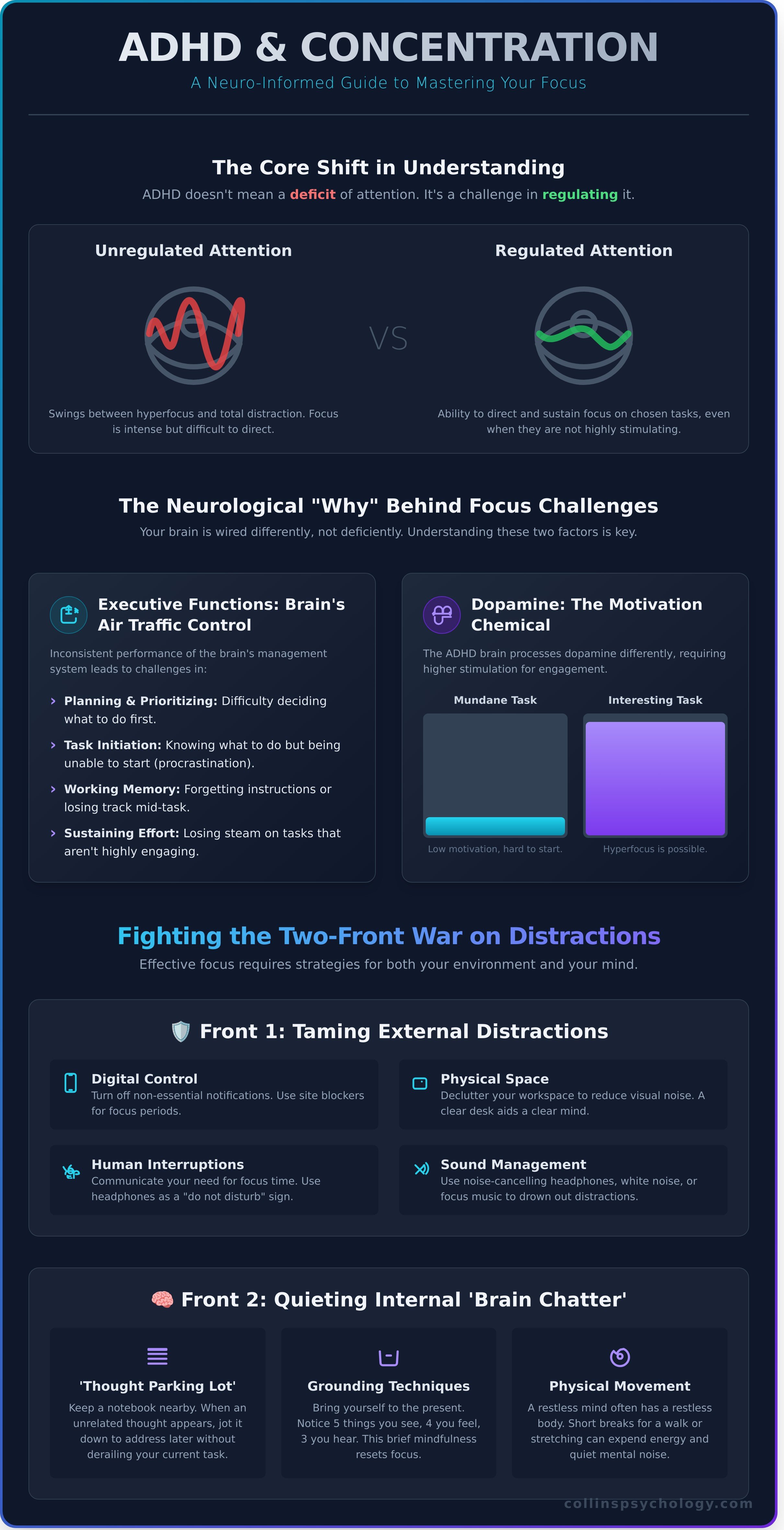
To effectively manage concentration challenges, we must first understand their origins. The experience of ADHD is not a simple lack of attention; it is more accurately described as a difficulty in regulating attention (Barkley, 2015). This means you might hyperfocus intensely on something that interests you, yet find it nearly impossible to engage with tasks you perceive as mundane. This struggle is rooted in the unique wiring of the ADHD brain, and understanding the science behind it can be a powerful first step in removing self-blame and building effective strategies.
Executive Functions: Your Brain's Air Traffic Control
Executive functions are a set of high-level mental processes that act as the management system of the brain. They help you plan, organise, prioritise, initiate tasks, and manage your time (Brown, 2005). In adults with ADHD, these functions can be less efficient, leading to common frustrations like procrastination and feeling overwhelmed. You may know exactly what you need to do but feel a profound inability to start. This is not a moral failing; it is a direct consequence of challenges with executive skills, including working memory and the ability to sustain effort on non-preferred tasks.
The Role of Dopamine: The 'Interest and Motivation' Chemical
Dopamine is a neurotransmitter in the brain that plays a critical role in motivation, reward, and the ability to feel interested in an activity. Research suggests that the dopamine reward pathway functions differently in individuals with ADHD, which can lead to a constant, underlying search for stimulation (Volkow et al., 2009). This explains why a novel or highly engaging project can capture your complete attention, while a routine, low-stimulation task feels painfully difficult to focus on. This is not a conscious choice to ignore the 'boring' thing; it is a neurobiological drive towards activities that provide a greater dopamine response.
The Two-Front War: Managing Internal vs. External Distractions
Improving focus requires fighting a war on two fronts. External distractions are the tangible interruptions from the world around you, while internal distractions are the constant 'brain chatter' within your own mind. For many adults with ADHD, the internal battle is often the more challenging one. By categorising these focus-killers, we can apply specific strategies to each, making the task of improving concentration feel more manageable.
Taming External Distractions: Creating a Focus-Friendly Environment
Your physical and digital environments can either support or sabotage your concentration. Taking deliberate control of these spaces is a foundational step.
Manage Digital Distractions
Turn off non-essential notifications on your phone and computer. Use website blockers or apps to limit access to social media during work periods. Close unnecessary browser tabs to reduce visual clutter.
Optimise Your Physical Space
Reduce clutter on your desk to minimise visual noise. If possible, position your workspace away from high-traffic areas.
Use Auditory Tools
Noise-cancelling headphones can be invaluable for blocking out ambient sound. Many people find 'focus music', such as binaural beats or instrumental playlists, helps to create a consistent auditory environment that encourages concentration.
Handle Interruptions
Politely communicate your need for uninterrupted time to colleagues or family. A sign on your door or a status message on a work-based chat app can set clear boundaries.
Quieting Internal Distractions: The Challenge of 'Brain Chatter'
Internal distractions include racing thoughts, daydreams, worries, and the sudden urge to switch tasks. These can be more difficult to manage but are crucial to address.
Create a 'Thought Parking Lot'
Keep a notepad or digital document open. When an unrelated thought, idea, or worry pops into your head, quickly write it down to address later. This acknowledges the thought without letting it derail you.
Practise Mindfulness
Mindfulness is not about emptying your mind, but about gently returning your attention to the present moment when it wanders. Even a few minutes of mindful breathing can help calm a racing mind (Mitchell et al., 2015).
Use Grounding Techniques
When you feel your mind drifting, bring your attention to your physical senses. Notice the feeling of your feet on the floor or the temperature of the air. This can pull you back from internal chatter to the task at hand.
Incorporate Movement
A restless mind often accompanies a restless body. Short breaks for physical activity, like stretching or a quick walk, can help discharge excess energy and reset your focus.
Building Your Focus Toolkit: Practical, Evidence-Based Strategies
Understanding your ADHD is important, but the next step is to build a toolkit of practical strategies. The most effective techniques are those that work with the tendencies of the ADHD brain, not against them. These strategies are grounded in behavioural principles and can help you structure your work and environment for success.
Structuring Your Tasks for Success
The Pomodoro Technique
Work in focused, timed intervals (e.g., 25 minutes), separated by short breaks. This method leverages the ADHD brain's preference for sprints over marathons and makes starting a task feel less daunting.
Task-Batching
Group similar small tasks together. For example, answer all your emails in one block rather than responding to them as they arrive. This reduces the mental effort of switching between different types of tasks.
Break Down Large Projects
A large, vague project can trigger overwhelm and procrastination. Break it down into the smallest possible, concrete steps. Focus on completing just one small step at a time.
The '2-Minute Rule'
If a task takes less than two minutes to complete, do it immediately. This helps build momentum and prevents small items from piling up on your to-do list.
Leveraging Tools and Technology
Use External Brains
Use digital calendars, task managers, and reminder apps to offload the mental burden of remembering everything. Schedule not just appointments, but also blocks of time for specific tasks.
Try 'Body Doubling'
This involves working, either physically or virtually, alongside another person. Their quiet presence can provide a sense of accountability and help you stay on task.
Gamify Your Tasks
Turn boring tasks into a game to increase dopamine. Challenge yourself to beat a timer, create a point system for completed tasks, or find an app that adds game-like elements to your to-do list.
Make Time Tangible
Use visual timers that show the passage of time. This can help with time blindness, a common challenge where you have difficulty sensing how much time has passed.
Strengthening Your Core Executive Skills
While individual tips are helpful, long-term improvement in focus often comes from strengthening the underlying executive skills. This involves consistent practice in areas like planning, prioritising, and time management. Structured approaches, such as those taught in Cognitive Behavioural Therapy (CBT), provide a framework for systematically building these cognitive skills.
Beyond Tips: The Critical Role of Emotional Regulation in Focus
A frequently overlooked aspect of concentration is the powerful influence of emotions. For adults with ADHD, strong feelings like frustration, anxiety, boredom, or shame can completely hijack attention (Shaw et al., 2014). This emotional dysregulation is a core component of the ADHD experience and is a primary saboteur of focus.
How Emotional Dysregulation Hijacks Your Attention
The parts of the brain responsible for emotional response and executive function are closely linked. When you experience an intense emotion, a phenomenon known as 'emotional flooding' can occur. This effectively short-circuits your brain's 'thinking' centres, making it almost impossible to concentrate, plan, or solve problems. For example, a small mistake at work can trigger intense frustration, leading you to abandon the task altogether. Similarly, anxiety about a project can lead to avoidance and procrastination. Recognising this connection is vital for developing effective focus strategies.
Strategies for Building Emotional Resilience
'Name It to Tame It'
Simply pausing to identify and label the emotion you are feeling can reduce its intensity. Acknowledging "I am feeling overwhelmed" or "I am feeling frustrated" creates a small amount of mental space between you and the emotion.
Mindful Breathing
When you feel an emotion escalating, take a few slow, deep breaths. This simple act can activate your body's relaxation response and calm your nervous system, allowing your executive functions to come back online.
Cognitive Reframing
This CBT technique involves identifying and challenging the unhelpful thoughts that often accompany strong emotions. For instance, instead of thinking "I'll never get this done," you might reframe it as "This is challenging, but I can start with the first small step."
Creating Sustainable Focus: Systems, Routines, and Professional Support
Individual tips and tricks can provide temporary relief, but they often fail without a supportive structure. The ultimate goal is to move from relying on momentary motivation to building reliable, long-term systems that support your focus. This involves creating routines, managing lifestyle factors, and knowing when to seek professional guidance.
The Power of Routines and Habit Stacking
Routines are powerful because they reduce cognitive load. When a sequence of actions becomes a habit, you no longer have to spend precious mental energy deciding what to do next.
Establish 'Anchor' Routines
Create a consistent 'work start-up' routine to ease into your day and a 'wind-down' routine to signal to your brain that it is time to switch off.
Use Habit Stacking
Link a new habit you want to build to an existing one. For example, "After I finish my morning coffee (existing habit), I will spend 15 minutes planning my top three priorities for the day (new habit)."
When to Seek Professional Help
Self-help strategies are a powerful starting point. However, if your concentration challenges are significantly impacting your work, relationships, or overall wellbeing, it may be time to seek further support. A structured therapeutic approach can help you build the underlying skills that make all other strategies more effective.
How CBT for Adult ADHD Creates Lasting Change
Cognitive Behavioural Therapy (CBT) is an evidence-based, practical approach that is highly effective for adult ADHD (Ramsay & Rostain, 2015; Solanto et al., 2010). Unlike traditional talk therapy, CBT is skills-based and solution-focused. It provides a structured framework for changing the unhelpful thought patterns and behaviours that undermine focus, planning, and emotional regulation.
At Collins Psychology, we provide online, self-paced CBT programmes designed for adults with ADHD. It is important to note that we do not offer one-to-one therapy. Our programmes are designed to be flexible, allowing you to learn and implement these evidence-based skills at your own pace through a variety of resources, exercises, and tools. This approach empowers you to build reliable systems for managing your ADHD and creating lasting change in your ability to focus.
Take the next step. Explore our evidence-based CBT for Adult ADHD programme.
Frequently Asked Questions
How is ADHD-related lack of focus different from just being lazy or unmotivated?
The difference is neurobiological. Laziness is a choice to not exert effort, whereas ADHD-related focus challenges stem from difficulties with executive functions and dopamine regulation. An adult with ADHD often wants to focus and may exert immense mental effort, but their brain's wiring makes it difficult to sustain attention, particularly on low-stimulation tasks.
Can medication alone fix my concentration challenges with ADHD?
Medication can be very effective in reducing the core symptoms of ADHD, including inattention. However, it does not teach skills. Many adults find that a combination of medication and skill-based therapy like CBT provides the best outcome. Therapy helps you build the practical strategies, systems, and coping mechanisms needed to manage life's complexities.
What is 'hyperfocus' and is it a good or bad thing for concentration?
Hyperfocus is an intense state of concentration on a task that is highly interesting or stimulating. It can be a "superpower," allowing for incredible productivity. However, it can also be a challenge, as it makes it difficult to switch attention to other important tasks, notice the passage of time, or even remember to eat or rest. It is a prime example of the attention dysregulation aspect of ADHD.
Do diet, exercise, and sleep really make a big difference in ADHD focus?
Yes, absolutely. These lifestyle factors are foundational for brain health. Regular exercise has been shown to improve executive function and increase dopamine levels. A balanced diet helps stabilise blood sugar and energy. Crucially, poor sleep significantly worsens ADHD symptoms, making it much harder to focus, manage emotions, and make decisions.
I'm successful in some areas of my life. Can I still have ADHD concentration issues?
Yes. Many adults with ADHD are very successful, often in fields that are fast-paced, novel, or align with their passions. They may have developed sophisticated coping mechanisms or built a life that plays to their strengths. However, they may still struggle significantly with concentration in other areas, such as administration, household chores, or tasks they find uninteresting.
Why do simple strategies like 'making a to-do list' often fail for adults with ADHD?
A standard to-do list can be overwhelming. It often presents a wall of tasks without context or priority. For an ADHD brain, this can trigger avoidance. Effective systems for ADHD often involve breaking lists into very small, concrete steps, prioritising only 1-3 items for the day, and pairing the list with tools like timers or visual planners to overcome challenges with task initiation and time management.
References
Barkley, R. A. (2015). Attention-deficit hyperactivity disorder: A handbook for diagnosis and treatment (4th ed.). Guilford Press.
Brown, T. E. (2005). Attention deficit disorder: The unfocused mind in children and adults. Yale University Press.
Mitchell, J. T., Zylowska, L., & Kollins, S. H. (2015). Mindfulness meditation training for attention-deficit/hyperactivity disorder in adulthood: Current empirical evidence, clinical implications, and future directions. Cognitive and Behavioral Practice, 22(2), 172-191.
Ramsay, J. R., & Rostain, A. L. (2015). Cognitive-behavioral therapy for adult ADHD: An integrative psychosocial and medical approach (2nd ed.). Routledge.
Shaw, P., Stringaris, A., Nigg, J., & Leibenluft, E. (2014). Emotional dysregulation and attention-deficit/hyperactivity disorder. American Journal of Psychiatry, 171(3), 276–293.
Solanto, M. V., Marks, D. J., Wasserstein, J., & Mitchell, K. (2010). Efficacy of meta-cognitive therapy for adult ADHD. American Journal of Psychiatry, 167(8), 958–968.
Volkow, N. D., Wang, G. J., Kollins, S. H., Wigal, T. L., Newcorn, J. H., Telang, F., Fowler, J. S., Zhu, W., Logan, J., Ma, Y., Pradhan, K., Inverardi, L., & Swanson, J. M. (2009). Evaluating dopamine reward pathway in ADHD: clinical implications. JAMA, 302(10), 1084–1091.