.png)

Key Takeaways
• Persistent low mood and anxiety in adults are frequently linked to underlying and unmanaged Attention-Deficit/Hyperactivity Disorder (ADHD), particularly difficulties with executive function.
• Standard mental health advice like "try harder" or "just get organised" often fails because it does not address the neurobiological differences in the ADHD brain.
• Cognitive Behavioural Therapy (CBT) provides a structured, evidence-based framework for managing the emotional and practical challenges of ADHD, focusing on building systems rather than relying on motivation.
• Our online programmes offer a flexible, self-paced system to learn these CBT skills, allowing you to build your ADHD support system over time without the pressure of traditional therapy appointments.
Table of Contents
• Understanding Why Adults Are Often with Low Mood or Anxiety
• The Link Between ADHD and Being Often with Low Mood or Anxiety
• Why Standard Mental Health Advice May Not Be Enough
• Practical CBT Strategies for Emotional Regulation and Focus
• Starting Your Journey with Collins Psychology Online Programmes
Understanding Why Adults Are Often with Low Mood or Anxiety
If you find yourself often with low mood or anxiety, you are not alone. These feelings are common across modern adult life in Ireland, but when they become persistent, they can feel overwhelming and isolating. This article explores why these emotional states are so frequently connected to adult ADHD, moving beyond generic advice to offer practical, evidence-based Cognitive Behavioural Therapy (CBT) strategies. We will define the difference between sadness and a more concerning low mood, examine how neurodiversity shapes your emotional world, and provide actionable systems to help you regain a sense of control. The goal is to help you understand the "why" behind your feelings and build systems that work with your brain, not against it.
The Difference Between Temporary Sadness and Persistent Low Mood
Everyone experiences sadness; it is a natural human response to difficult events like workplace stress, relationship changes, or loss. However, a persistent low mood that lingers for weeks is different and warrants closer attention. Clinical guidelines often suggest that if feelings of sadness, emptiness, or a loss of interest in activities continue for more than two weeks, it is time to consider seeking support (American Psychiatric Association, 2013). Anxiety can accompany this, often manifesting as a constant physical restlessness, a racing heart, or a sense of dread that is difficult to shake.
How Neurodiversity Influences Emotional States
For many adults, what appears on the surface to be a primary anxiety or mood disorder is actually a secondary symptom of unmanaged neurodivergent traits. ADHD, in particular, can be misunderstood as a mood disorder because the daily struggles with executive functions like planning, starting tasks, and emotional regulation can lead to chronic stress and low self-esteem. This can result in a state of ADHD burnout, which shares many features with clinical depression but has its roots in the specific challenges of the neurotype. Recognising this connection is the first step toward finding strategies that truly work.
The Link Between ADHD and Being Often with Low Mood or Anxiety
The connection between ADHD and being often with low mood or anxiety is well-established in clinical research (Katzman et al., 2017). This link is not coincidental; it stems directly from the core challenges of ADHD, particularly executive dysfunction. Executive functions are the management system of the brain, responsible for planning, organising, regulating emotions, and sustaining focus. When these functions are impaired, it creates a cascade effect that directly impacts your emotional wellbeing and can lead to a state of chronic worry or "analysis paralysis."
Emotional Dysregulation: The Overlooked ADHD Symptom
Emotional dysregulation is a key, though often overlooked, feature of adult ADHD. This means individuals with ADHD tend to experience emotions more intensely and have greater difficulty returning to a calm baseline after an emotional event. This is compounded by Rejection Sensitive Dysphoria (RSD), an extreme emotional sensitivity to perceived criticism or rejection, which can trigger an immediate and painful drop in mood. In daily Irish life, this might look like feeling deeply hurt by a casual comment from a colleague or experiencing intense frustration over a minor setback like missing a bus.
Executive Function and the "To-Do List" Anxiety
The daily demands of life rely heavily on executive functions, and for adults with ADHD, a simple to-do list can become a major source of anxiety. Poor time management can lead to constantly feeling behind, while difficulties with working memory can cause you to forget appointments or promises, leading to social anxiety and guilt. This creates a painful cycle: you know what to do, but your brain struggles to execute the plan, which in turn fuels feelings of inadequacy and low mood. Learning to manage these cognitive functioning issues in ADHD adults is essential for breaking this cycle.
Why Standard Mental Health Advice May Not Be Enough
Many adults with ADHD who are often with low mood or anxiety report that standard mental health advice has been ineffective for them. Suggestions like "just use a planner," "break tasks down," or "try to focus more" can feel invalidating because they overlook the underlying neurological reasons for the struggle. General talk therapy may provide a space to explore feelings, but without a structured, skills-based approach, it often fails to provide the practical tools needed to manage executive function deficits. At Collins Psychology, we focus on structured, evidence-based CBT programmes because they are designed to build tangible skills. It is important to clarify that our model is based on self-paced learning; we do not offer one-to-one therapy.
The Problem with "Try Harder" Mentalities
The societal pressure in Ireland to "just get on with it" can be particularly damaging for adults with ADHD. The "try harder" approach implies that the difficulty is a matter of willpower or character, rather than a genuine difference in brain function. The biological basis for focus and motivation difficulties in ADHD is linked to the brain's dopamine pathways, which affects reward and reinforcement (Volkow et al., 2009). ADHD-specific behavioural interventions acknowledge this reality and work with your brain's wiring by creating external structures and reward systems, a far more effective approach than simply demanding more effort.
Moving from Awareness to Actionable Strategies
Understanding that you have ADHD is a critical first step, but awareness alone does not change daily struggles. The key is to move from awareness to action by implementing structured strategies that support your executive functions. Our self-paced modules are designed for this purpose, allowing you to learn and apply CBT techniques without the pressure of fixed appointments, which can be a significant barrier for those with ADHD. You can build your ADHD support system over time, starting where you struggle most. This is not therapy or coaching; it is a system designed to help you know what to do and actually do it.
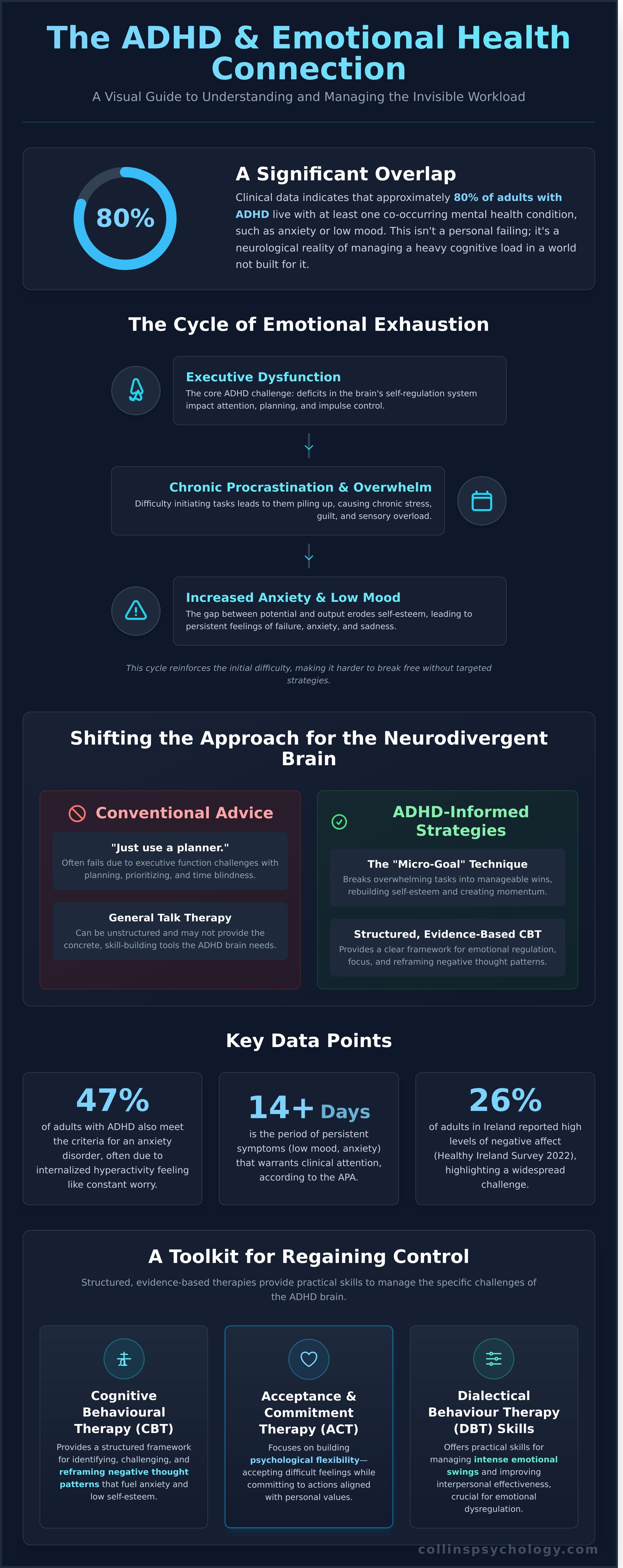
The ADHD, Anxiety, and Low Mood Cycle
• You struggle to start a task, remember an appointment, or manage your time.
2. Negative Outcome
• You miss a deadline, forget a social plan, or your home becomes cluttered and overwhelming.
3. Negative Self-Talk and Low Mood
• Internal thoughts like "I'm lazy," "I'm a failure," or "I always let people down" lead to feelings of guilt, shame, and a persistent low mood.
4. Increased Anxiety
• You worry about future failures, avoid tasks that trigger these feelings, and experience "analysis paralysis," which makes it even harder to start.
5. Cycle Repeats
• The heightened anxiety and low mood further impair executive function, making it even more difficult to manage daily tasks, and the cycle continues.
Practical CBT Strategies for Emotional Regulation and Focus
Cognitive Behavioural Therapy (CBT) is widely recognised as a highly effective approach for managing the core symptoms of adult ADHD and their impact on mood. It works by helping you identify and change unhelpful thought patterns and behaviours, replacing them with structured, adaptive systems. For example, instead of viewing a large project as an overwhelming mountain, CBT teaches you to break it down into manageable "micro-goals," which reduces anxiety and makes it easier to start. This practical, skills-based approach extends to all areas of life, including improving sleep hygiene to support dopamine regulation and using grounding techniques to manage moments of acute anxiety.
Goal Setting and Time Management Techniques
Effective goal setting and time management are crucial for adults with ADHD. Techniques like the "Pomodoro" method, which involves working in focused 25-minute intervals with short breaks, are effective because they create structure and a sense of urgency that works well for the ADHD brain. Another powerful concept is "Eat the Frog," which encourages you to tackle your most dreaded task first thing in the morning, preventing it from draining your mental energy all day. These are not just productivity hacks; they are cognitive tools that reduce overwhelm and build momentum. You can learn more in our dedicated CBT for ADHD Goal Setting module.
Managing the Physical Symptoms of Anxiety
Anxiety is not just a mental experience; it has powerful physical symptoms that can be very distressing. A cornerstone of managing this is regulating the nervous system through consistent lifestyle habits. Regular physical activity is a powerful tool for stabilising mood and burning off restless energy, while a balanced diet can prevent the blood sugar crashes that often exacerbate anxiety. Simple, structured breathing exercises, such as the 4-7-8 technique (breathe in for 4 seconds, hold for 7, exhale for 8), can also provide immediate relief when you feel overwhelmed by activating the body's relaxation response.
Starting Your Journey with Collins Psychology Online Programmes
Collins Psychology provides structured, CBT-based systems for adults with ADHD who are tired of knowing what to do but still struggling to do it. Our online, self-paced model is designed specifically to support the inconsistent energy and focus levels that often come with ADHD, allowing you to learn when it works for you. You can stop relying on motivation and stop starting over every Monday by building systems that work with your brain. Our programmes include a range of resources, exercises, and practical tools to help you build skills in emotional regulation, executive functioning, and focus.
What to Expect from Our Self-Paced Modules
When you enrol in our programmes, you gain access to a library of structured modules that you can work through at your own pace. The content focuses on practical, everyday strategies that you can implement immediately, rather than dense academic theory. It is a system with multiple entry points, so you can start with the area you struggle with the most. Please note that our programmes are educational and skills-based; they are not a form of one-to-one therapy and no clinical advice is provided.
Taking the First Step Toward Better Focus
Managing ADHD is a skill that can be learned, not a personality flaw that needs to be fixed. Taking the first step involves committing to building a system that supports your unique brain. We invite you to follow our work on Instagram for daily tips and insights into managing adult ADHD. When you are ready to move from awareness to action and build a life with better focus and a more stable mood, we encourage you to explore our programmes.
Access our CBT for Adult ADHD programmes today.
Frequently Asked Questions
Is it common for adults with ADHD to be often with low mood or anxiety?
Yes, it is very common. Research shows a high rate of comorbidity between ADHD and mood and anxiety disorders. This is often due to the chronic stress, low self-esteem, and frustration that result from unmanaged ADHD symptoms like executive dysfunction and emotional dysregulation.
How does CBT help with emotional regulation in adults?
CBT helps by teaching you to recognise the triggers for your emotional responses and to challenge the unhelpful thought patterns that intensify them. It provides practical tools like grounding techniques, behavioural strategies, and problem-solving skills to help you manage your emotions more effectively rather than being overwhelmed by them.
Can I complete these programmes while working a full-time job?
Absolutely. Our programmes are designed to be self-paced and flexible precisely for this reason. You can access the materials whenever and wherever suits you, allowing you to integrate learning into your existing schedule without the pressure of fixed appointments.
Do I need a formal diagnosis to start a self-paced CBT programme?
No, a formal diagnosis is not required to benefit from our programmes. If you experience challenges with focus, organisation, emotional regulation, and time management, the strategies and systems taught in our CBT-based modules can provide valuable support, regardless of your diagnostic status.
What is the difference between these modules and one-to-one therapy?
Our online modules are an educational, skills-based system designed to teach you practical CBT strategies for managing ADHD. It is not therapy. One-to-one therapy involves a direct therapeutic relationship with a clinician for personalised assessment, diagnosis, and treatment, which we do not provide.
How long does it typically take to see improvements in focus and mood?
This varies for each individual, as progress depends on consistency and application of the strategies. However, many people report feeling a greater sense of control and experiencing small improvements within a few weeks of consistently applying the CBT techniques from the programmes.
Are these programmes suitable for parents with ADHD?
Yes. The skills taught in our programmes, such as improved time management, emotional regulation, and organisation, are highly beneficial for parents with ADHD. By building better systems for yourself, you can reduce household stress and model effective coping strategies for your children.
What if I find it hard to stay motivated with online learning?
This is a common concern for adults with ADHD. Our programmes are broken down into short, digestible lessons to prevent overwhelm. The system is designed so you can start where you struggle most, providing an immediate and relevant entry point, which can help maintain engagement.
References
American Psychiatric Association. (2013). Diagnostic and statistical manual of mental disorders (5th ed.).
Barkley, R. A. (2012). Executive functions: What they are, how they work, and why they evolved. Guilford Press.
Katzman, M. A., Bilkey, T. S., Chokka, P. R., Fallu, A., & Klassen, L. J. (2017). Adult ADHD and comorbid disorders: clinical implications of a dimensional approach. BMC Psychiatry, 17(1), 335. https://doi.org/10.1186/s12888-017-1493-3
Volkow, N. D., Wang, G. J., Kollins, S. H., Wigal, T. L., Newcorn, J. H., Telang, F., Fowler, J. S., Zhu, W., Logan, J., Ma, Y., Pradhan, K., Felix, C., & Swanson, J. M. (2009). Evaluating dopamine reward pathway in ADHD: clinical implications. JAMA, 302(10), 1084–1091. https://doi.org/10.1001/jama.2009.1308