.png)

In Ireland, receiving an ADHD diagnosis as an adult can bring both relief and a wave of new questions about your rights and the support available. Understanding the legal landscape is the first step, but true progress comes from developing practical skills to navigate daily challenges. This guide clarifies the legal standing of ADHD as a disability in Ireland under key legislation like the Disability Act 2005 and the Employment Equality Acts. It also provides a roadmap for moving beyond a label, using evidence-based Cognitive Behavioural Therapy (CBT) strategies to manage symptoms, improve executive functioning, and build a more structured, fulfilling life.
Understanding the Legal Classification of ADHD in Ireland
The question, "Is ADHD classed as a disability in Ireland?" is a common and important one for many adults. The short answer is yes, it can be. However, the legal recognition depends on how the condition affects your day-to-day life. Under Irish law, a disability is not defined by a specific diagnosis, but by the impact that condition has on a person's ability to carry out everyday activities. A formal diagnosis is the crucial first step, as it provides the necessary evidence to access legal protections and supports.
Defining Disability
The Disability Act 2005 defines disability as a substantial restriction in the capacity of a person to carry on a profession, business or occupation, or to participate in social or cultural life.
Meeting the Criteria
For ADHD to be considered a disability, you must demonstrate that its symptoms, such as difficulties with concentration, organisation, or emotional regulation, create a "substantial restriction" in one or more of these major life activities.
The Role of IHREC
The Irish Human Rights and Equality Commission (IHREC) provides information and promotes equality, working to protect the rights of people with disabilities, including those with neurodevelopmental conditions like ADHD.
The Gateway to Protection
A formal clinical diagnosis from a qualified practitioner is the gateway to accessing legal protections in the workplace, education, and other areas of public life.
The Disability Act 2005 and Your Rights
The Disability Act 2005 is a cornerstone of disability rights in Ireland. Its definition is broad, focusing on the functional impact of a condition rather than the condition itself. For an adult with ADHD, this means the law looks at how your symptoms affect your ability to work, study, or engage with the community (Government of Ireland, 2005).
The Act's emphasis on "substantial restriction" is key. For example, if challenges with executive function significantly hinder your ability to manage tasks at work or if difficulties with communication impact your social interactions, your condition would likely meet the Act's criteria. A primary function of this legislation is to ensure that public bodies make their services and buildings more accessible for people with disabilities, which includes considerations for neurodivergent adults.
The Psychological Society of Ireland Guidelines
Within the Irish clinical community, practitioners are guided by principles that align with The Psychological Society of Ireland (PSI). The perspective on ADHD is increasingly one of neuro-affirming care, which acknowledges it as a natural variation in brain wiring rather than a personal failing.
ADHD is understood as a neurodevelopmental condition characterised by a persistent pattern of inattention and/or hyperactivity-impulsivity that interferes with functioning or development (American Psychiatric Association, 2013). This clinical framework is essential, as it validates the biological basis of the challenges faced by adults with ADHD and informs the evidence-based approaches, like Cognitive Behavioural Therapy, used to manage its symptoms effectively.
Navigating Employment Equality and Workplace Accommodations
For many adults with ADHD, the workplace presents the most significant challenges. Thankfully, the Employment Equality Acts 1998 to 2015 provide a strong legal framework to protect you from discrimination and ensure you receive the support you need to thrive professionally.
Under these Acts, employers have a legal obligation to provide "reasonable accommodation" for employees with disabilities, unless doing so would impose a "disproportionate burden" on the business (IHREC, n.d.). This means your employer must take appropriate measures to enable you to do your job, participate in training, and pursue promotion opportunities on an equal footing with your colleagues. It is illegal for an employer to discriminate against you because of your ADHD, from the hiring process through to the end of your employment. Disclosing your diagnosis can feel daunting, but it is the necessary step to activate these legal protections.
Examples of Reasonable Accommodations
Reasonable accommodations are adjustments to the work environment or the way work is usually done. They are often simple, low-cost changes that can make a significant difference. Examples include:
Flexible Working Hours
Adjusting start and finish times to align with periods of peak focus or to accommodate appointments.
A Quieter Workspace
Providing noise-cancelling headphones or access to a quiet area to minimise distractions.
Assistive Technology
Supplying software for time management, task organisation, or text-to-speech to support executive functioning.
Your Rights During the Recruitment Process
Your rights begin before you even get a job. During the recruitment process, you are not legally required to disclose your ADHD diagnosis unless it is directly relevant to your ability to perform the core duties of the role.
You have the right to request reasonable accommodations for interviews or any assessment tests. For example, you could ask for extra time for a written test or request that interview questions be provided in writing. If you believe you have been treated unfairly during recruitment or at any point in your employment due to your ADHD, you can seek advice from the Workplace Relations Commission (WRC).
Accessing Educational Supports and Financial Assistance
Beyond the workplace, there are systems in place to support adults with ADHD in further education and provide financial assistance if the condition significantly impacts their ability to work.
For students entering third-level education, the Disability Access Route to Education (DARE) scheme is a key pathway. It offers reduced points places to school leavers whose disabilities have had a significant impact on their second-level education. For those already in college, the Fund for Students with Disabilities can provide grants for assistive technology, academic support, or other necessary services. In terms of social welfare, adults whose ADHD severely limits their capacity to work may be eligible for the Disability Allowance, provided they meet the specific criteria.
Higher Education Supports (DARE and HEAR)
The DARE scheme is designed to increase the number of students with disabilities attending third-level education. To apply, you will need to provide evidence of your disability, typically in the form of a report from a qualified psychologist or medical practitioner that details the impact of your ADHD on your educational experience. Developing structured goal-setting techniques can be particularly beneficial for students navigating the demands of higher education.
Financial Grants and Allowances
The Disability Allowance is a weekly payment for individuals whose disability is expected to last for at least one year and substantially restricts their ability to work. When applying, it is vital to provide comprehensive medical evidence showing how your ADHD symptoms directly impact your earning capacity. Other potential supports, depending on your circumstances and work history, could include the Invalidity Pension or Illness Benefit, though the eligibility criteria for these are distinct and should be reviewed carefully.
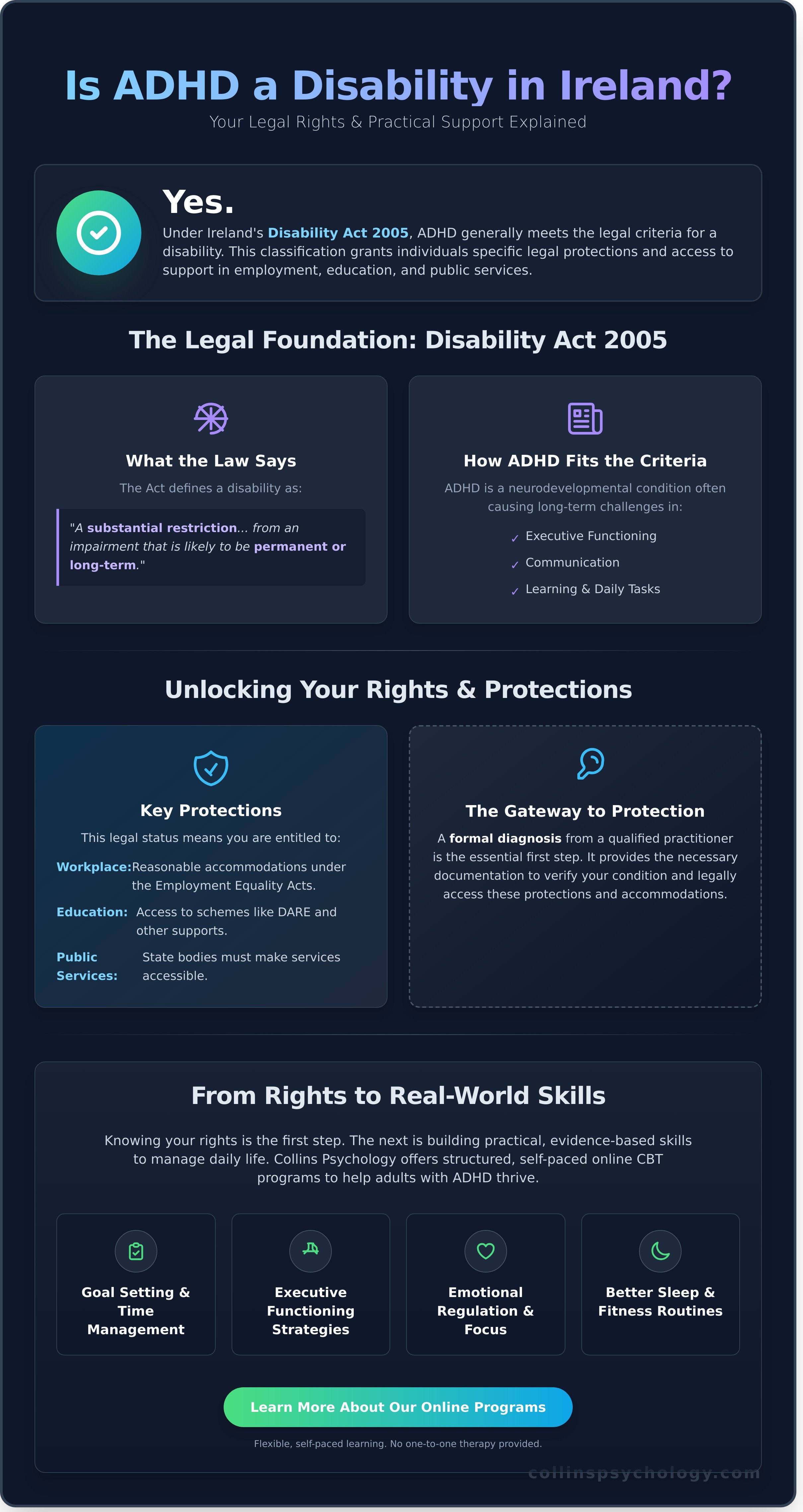
[Infographic: A visual guide to ADHD Rights and Supports in Ireland, summarising key legal acts, accommodation examples, and educational/financial aids.]
Moving Beyond the Label with Cognitive Behavioural Strategies
While understanding your legal rights is an essential foundation, it is only one part of the journey. The "disability" label provides a framework for protection, but it does not provide the tools to manage the daily realities of ADHD. This is where evidence-based psychological support becomes invaluable.
Cognitive Behavioural Therapy (CBT) is a highly effective, practical approach for adults with ADHD. It focuses on identifying and changing unhelpful thought patterns and behaviours. Instead of just coping with symptoms, CBT empowers you to build new skills for managing emotional regulation, overcoming rejection sensitivity, and strengthening your executive functions. It shifts the focus from deficit to skill-building, giving you a tangible way to improve your daily life.
Emotional Regulation and Focus
Many adults with ADHD struggle with intense emotions and find it difficult to maintain focus. CBT provides a structured framework for understanding the connection between your thoughts, feelings, and actions. It helps you identify the specific triggers that lead to emotional overwhelm or distraction. Through practical exercises, you can learn grounding techniques to calm your nervous system and strategies to redirect your attention, helping you manage periods of hyperfocus and improve overall concentration. Our programme on Emotional Regulation for ADHD offers targeted strategies to help you develop these skills.
Executive Functioning in Daily Life
Executive functions are the mental processes that enable us to plan, focus attention, remember instructions, and juggle multiple tasks. ADHD commonly impacts these skills, leading to challenges with organisation, time management, and task initiation, often referred to as the "ADHD tax." CBT offers concrete strategies for improving your executive functioning. It teaches you how to break down large projects into manageable steps, use external aids like planners and apps effectively, and develop routines that work with, not against, your neurodivergent brain. Learning these techniques can be crucial for overcoming task paralysis and achieving your personal and professional goals.
Building Skills with Self-Paced CBT Programs for Adults
For many adults in Ireland, accessing consistent psychological support can be difficult due to waitlists, cost, and a busy schedule. Online, self-paced learning models offer a modern, flexible solution that is particularly well-suited to the ADHD brain.
At Collins Psychology, we provide structured, self-paced CBT programs designed specifically for adults with ADHD. This model allows you to learn and apply new skills on your own schedule, without the pressure of fixed appointments. You can work through the material at a pace that feels comfortable, integrating powerful CBT exercises into your daily life when it suits you. This approach empowers you to take control of your ADHD management journey.
Why Self-Paced Learning Works
The flexibility of a self-paced program directly supports the executive functioning challenges associated with ADHD.
Reduced Pressure
Eliminates the stress of scheduling and attending regular appointments.
Revisit Complex Topics
Allows you to go over modules on challenging topics like emotional regulation or time management as many times as you need.
Supports Executive Functioning
The ability to start, stop, and resume learning accommodates natural fluctuations in energy and focus.
Getting Started with Collins Psychology
Our online platform offers a series of comprehensive CBT modules covering the core challenges of adult ADHD. It is important to note that we provide educational programs and do not offer one-to-one therapy. Our goal is to equip you with the knowledge and tools you need to build lasting skills for a more organised and emotionally balanced life. You can take the first step today without a long wait.
Enrol in our self-paced CBT programs for ADHD
Frequently Asked Questions (FAQs)
Is ADHD considered a disability for social welfare in Ireland?
Yes, ADHD can be considered a disability for social welfare purposes, such as the Disability Allowance, if it is shown to cause a substantial restriction in your capacity to work. Eligibility is determined by a medical assessment and a means test.
What legal protections do I have at work with an ADHD diagnosis?
Under the Employment Equality Acts 1998 to 2015, you are protected from discrimination. Your employer has a legal duty to provide reasonable accommodations to help you perform your job, unless it causes a disproportionate burden.
Can I get a tax credit for ADHD in Ireland?
Generally, tax credits for disabilities are reserved for conditions that cause severe and permanent incapacitation. While possible, it is less common for ADHD to meet the high threshold for credits like the Incapacitated Child Credit or Dependant Relative Tax Credit.
Do I have to tell my employer that I have ADHD?
No, you are not legally obligated to disclose your ADHD diagnosis to your employer. However, to receive legal protection and reasonable accommodations under the Employment Equality Acts, you must inform your employer about your condition and its impact on your work.
Is ADHD a lifelong disability according to Irish law?
Irish law, particularly the Disability Act 2005, defines disability based on the presence of a "substantial restriction" that is long-term, which is generally considered to be lasting for at least one year. As ADHD is a lifelong neurodevelopmental condition, it meets this duration criterion.
What financial supports are available for adults with ADHD in Ireland?
Potential supports include the Disability Allowance if you are unable to work, the Fund for Students with Disabilities if you are in third-level education, and various employment support schemes administered by the Department of Social Protection.
How does the Disability Act 2005 protect people with ADHD?
The Act protects people with ADHD by requiring public bodies to make their services accessible. It also provides a legal basis for an assessment of need for health and educational services, ensuring that your requirements are formally recognised and addressed.
Can I access DARE with an adult ADHD diagnosis?
The DARE scheme is for school-leavers under the age of 23. If you received your diagnosis as an adult but are still a school-leaver applying for college, you can apply. However, mature students (over 23) apply directly to higher education institutions, which have their own disability support services and admission routes.
References
American Psychiatric Association. (2013). Diagnostic and statistical manual of mental disorders (5th ed.).
Government of Ireland. (2005). Disability Act 2005. Irish Statute Book. Retrieved from https://www.irishstatutebook.ie/eli/2005/act/14/enacted/en/html
Irish Human Rights and Equality Commission. (n.d.). Disability and the duty to provide reasonable accommodation. Retrieved from https://www.ihrec.ie/your-rights/disability-and-the-duty-to-provide-reasonable-accommodation/