.png)
For adults with ADHD, the night can feel like a battleground. You are exhausted from the day, yet your mind refuses to switch off, caught in a loop of racing thoughts, last-minute creative ideas, and the endless scroll of a phone screen. If you have tried standard sleep advice like avoiding caffeine or drinking herbal tea and found it ineffective, you are not alone. This guide moves beyond generic tips to explore the unique insomnia challenges for ADHD adults, framing sleep not as a simple matter of discipline but as a complex issue of executive functioning and emotional regulation. Discover why the ADHD brain struggles with sleep and learn evidence-based Cognitive Behavioural Therapy (CBT) strategies to build a system that finally breaks the cycle of insomnia.
Key Takeaways
ADHD Insomnia is Different
Sleep problems in adults with ADHD are often linked to executive function challenges like task switching and emotional regulation, not a simple lack of discipline.
Standard Advice Fails
Generic "sleep hygiene" tips often do not work for the ADHD brain because they fail to address the underlying biological and psychological factors, such as a delayed melatonin release and the need for dopamine.
Revenge Bedtime Procrastination is a Coping Mechanism
Delaying sleep to reclaim personal time is a common response to a day spent masking or feeling overstimulated. It is a bid for autonomy, not a moral failing.
CBT Offers a Structured Solution
Cognitive Behavioural Therapy provides practical, evidence-based tools to manage racing thoughts, create effective transition periods, and build systems that work with, not against, the ADHD brain.
Systems Beat Motivation
Lasting change comes from creating a structured, flexible approach to winding down, rather than relying on willpower, which can be a finite resource for those with ADHD.
Table of Contents
• Understanding the Link Between ADHD and Insomnia
• Executive Functioning and the Difficulty of Winding Down
• Breaking the Cycle of Revenge Bedtime Procrastination
• Evidence-Based CBT Strategies for ADHD Sleep Management
• Implementing a Structured Approach with Online CBT Programmes
Understanding the Link Between ADHD and Insomnia
For many adults with ADHD, the primary sleep issue is not staying asleep but initiating it. This is known as sleep onset insomnia, a persistent difficulty in falling asleep at a desired time. The prevalence of sleep disturbances in the ADHD population is significant, with studies suggesting that a high percentage of adults with the condition experience chronic sleep problems (Faraone et al., 2015). This is often compounded by a biological tendency towards being a "night owl," a condition known as delayed sleep phase syndrome, where the body’s internal clock is shifted later than the norm. It is crucial to recognise that ADHD symptoms do not simply disappear at sunset; in fact, the lack of external structure in the evening can make them feel more pronounced.
The Biological Reality of the ADHD Brain
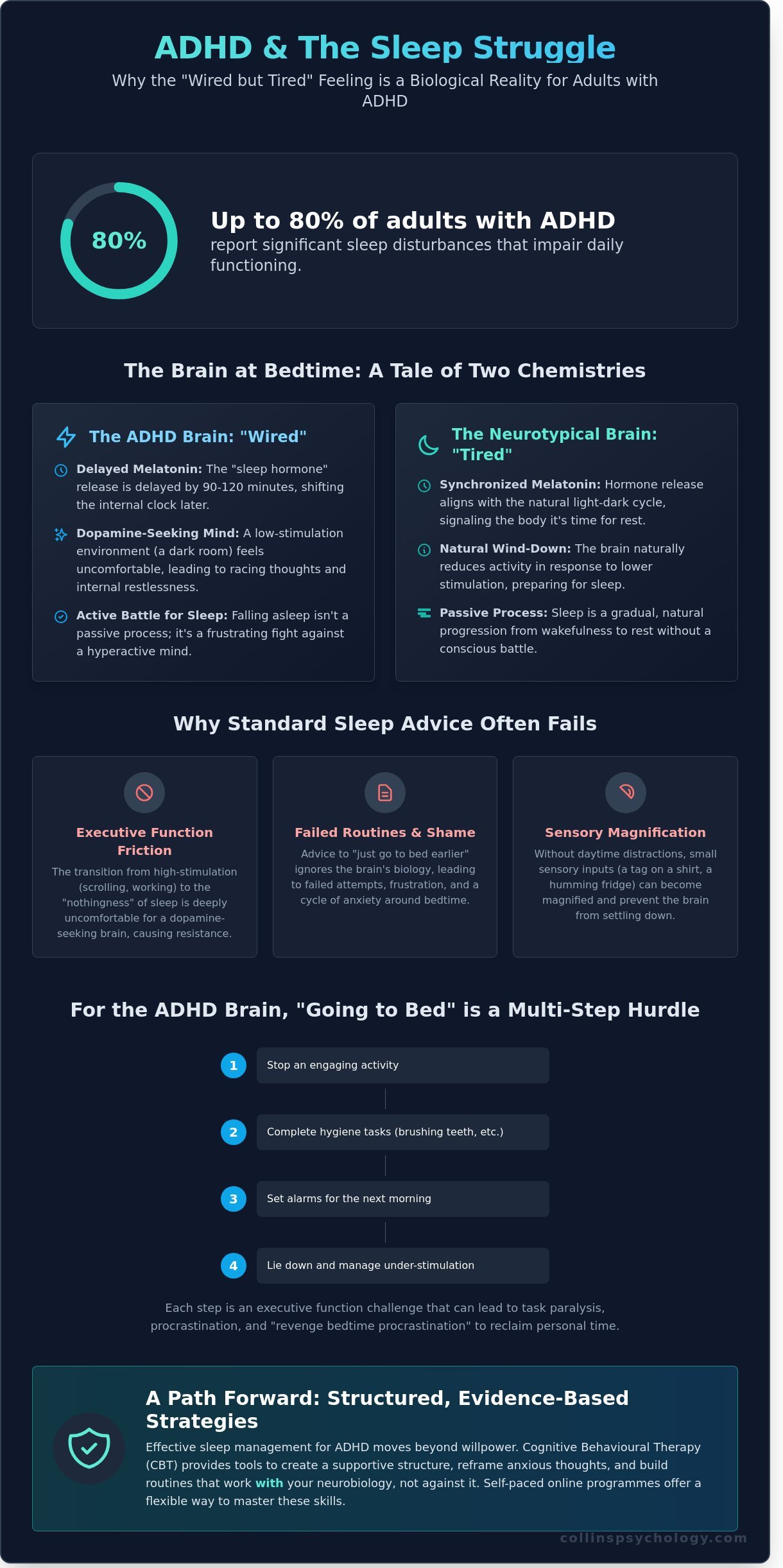
The connection between ADHD and sleep is deeply rooted in neurobiology. The brain's regulation of dopamine, a key neurotransmitter related to motivation and reward, also plays a role in managing our circadian rhythm, the 24-hour internal clock (Wulff et al., 2010). This can lead to the classic "wired but tired" phenomenon, where you feel physically exhausted but mentally alert and unable to switch off. Furthermore, research has indicated a delay in the release of melatonin, the hormone that signals sleep, in many individuals with ADHD, which provides a biological explanation for why it is so difficult to feel sleepy at a conventional bedtime.
Why Standard Sleep Advice Often Fails
If you have ever been frustrated by well-meaning advice to "just go to bed earlier," it is because this guidance misunderstands the ADHD brain. Standard sleep hygiene recommendations often rely heavily on executive functions, the very skills that are challenging in ADHD. The suggestion to simply stop an activity and start a bedtime routine is a significant hurdle in task switching and initiation. This creates a cycle of failed attempts and frustration, reinforcing the belief that you are "bad at sleeping." The reality is that the neurodivergent brain requires a different approach: one based on structure, external cues, and a gradual reduction in stimulation, rather than an abrupt demand for compliance.
Executive Functioning and the Difficulty of Winding Down
The process of winding down and preparing for sleep is a complex executive function task. It requires transitioning from high-stimulation activities to a state of low stimulation, a process that can feel jarring and unrewarding for a dopamine-seeking brain. The primary barrier is often task switching: disengaging from an interesting activity to begin a mundane bedtime routine. This difficulty is worsened by poor time perception, a common ADHD trait, which can lead to "losing" the evening hours and suddenly finding it is much later than intended. Furthermore, challenges with emotional regulation mean that without the distractions of the day, worries and anxieties can surface, leading to a racing mind that is impossible to quiet. You can learn more about how to manage disorganisation and poor time management with CBT.
The Challenge of Task Switching
Stopping a high-dopamine activity, like watching a compelling series, playing a video game, or scrolling through social media, can be physically difficult for the ADHD brain. The brain is receiving a steady stream of rewarding stimulation, and the thought of switching to a low-dopamine activity like brushing your teeth feels like a punishment. This creates the "one more video" or "one more chapter" loop, where the intention to stop is constantly overridden by the desire for another hit of stimulation. In the context of sleep, executive dysfunction can be defined as the brain's inability to build and execute a bridge from the engaging activities of the evening to the necessary, unstimulating state of rest.
Internal Distractions and Racing Thoughts
When the external stimuli of the day are finally removed, the ADHD brain often lacks a "mental filter" to keep internal thoughts at bay. Unfinished tasks, conversations from the day, and future worries can rush in to fill the silence, creating a significant cognitive load at night. This mental clutter makes it nearly impossible to relax. Learning strategies to manage this internal noise is a core component of effective sleep management for ADHD. For a deeper dive into building these skills, our CBT for ADHD Executive Function course provides structured systems and tools.
Breaking the Cycle of Revenge Bedtime Procrastination
Revenge bedtime procrastination is a term that describes the decision to sacrifice sleep for leisure time, often because the evening hours are the only time a person feels they have control and autonomy. For many adults with ADHD who spend their days masking, meeting deadlines, and managing responsibilities, the night feels like time they "owe" themselves. This behaviour is not a sign of laziness but a coping mechanism for a lack of personal time during the day. Unfortunately, it creates a vicious guilt-shame cycle: you stay up late for much-needed downtime, feel guilty, and then experience heightened executive dysfunction the next day from exhaustion, making another late night more likely. Common triggers include a stressful workday, feeling overstimulated by family demands, or a sense of not having accomplished enough.
The Psychology of Autonomy and Control
A day spent navigating a world not designed for the ADHD brain is draining. The constant effort of masking symptoms, fighting distraction, and managing time pressure can lead to a profound need for control and decompression in the evening. The quiet hours of the night, free from demands and expectations, can feel like a sanctuary. This is where you can finally pursue your own interests without interruption. Recognising revenge bedtime procrastination as a coping mechanism for an overstimulating world is the first step toward finding healthier ways to meet the underlying need for autonomy. You can find more tips for managing your emotional responses on our Instagram profile, which offers practical insights.
Cognitive Distortions at Bedtime
Cognitive distortions, or unhelpful thinking patterns, often fuel late nights. A common one is "all or nothing" thinking, such as, "It is already 11 PM, I have already ruined tomorrow, so I might as well stay up." This thought can be challenged by recognising that some sleep is always better than none. To counter this, try a structured reflection exercise before you reach for your phone. Ask yourself: "What do I truly need right now? Is it more screen time, or is it rest so I can have a better day tomorrow?" This simple act of pausing can help you challenge the automatic thought and make a more conscious choice.
The ADHD Insomnia Cycle
Why You Feel Wired But Tired
Delayed Melatonin
Your brain's "sleepy" signal is late, making it hard to feel tired at a conventional bedtime.
Dopamine Seeking
Your brain craves stimulation. Winding down feels boring and difficult, so you seek engaging activities (scrolling, gaming, watching TV).
Executive Function Hurdles
The "simple" act of starting a bedtime routine requires task switching, planning, and initiation, skills that are challenging for ADHD.
Emotional Overflow
With fewer distractions at night, worries and anxieties from the day surface, causing a racing mind.
Breaking the Cycle with a CBT System
Reframe the Goal
Instead of "Go to Sleep," focus on "Create a Transition Zone." This is a 30-60 minute buffer between your day and bedtime.
Dopamine Taper
Switch from high-dopamine activities (phone) to low-dopamine, relaxing ones (listening to a podcast, doodling, light stretching).
Externalise Your Brain
Use a "Brain Dump." Write down every worry, to-do, and random thought onto a notepad by your bed to clear your mental clutter.
Structure Your Environment
Set alarms for your transition zone, not just for waking up. Use smart lighting that dims automatically. Make your bedroom a calm, single-purpose space.
Stop relying on motivation. Build systems that work with your brain.
Evidence-Based CBT Strategies for ADHD Sleep Management
Cognitive Behavioural Therapy (CBT) is widely recognised as a highly effective framework for managing the challenges of adult ADHD, including insomnia. The core principle of CBT is to shift the focus from "trying harder" to "structuring better." It provides a set of practical tools to identify and change the unhelpful thoughts and behaviours that prevent sleep. This involves creating supportive environments, implementing sensory regulation strategies, and using time management techniques that respect ADHD traits rather than fighting against them. The goal is to build a reliable system that reduces the cognitive load required to wind down each night.
Structuring the Transition Zone
Forget the idea of a rigid "Bedtime Routine." For the ADHD brain, a more flexible concept is the "Transition Zone," a 30-to-60-minute period that acts as a buffer between your active day and rest. The goal is not to follow a perfect sequence of steps but to gradually lower stimulation and taper dopamine. This could involve low-friction activities like listening to a calm podcast, tidying one small area of a room, or doing a simple skincare routine. The key is to make the activities appealing enough to initiate. Building this kind of personalised structure is a skill, and our CBT for ADHD Goal Setting course provides a framework for creating routines that you can actually stick with.
Cognitive Defusion and Mind Quieting
To manage a racing mind, you must get the thoughts out of your head. The "Brain Dump" technique is a powerful CBT tool for this. Keep a notepad by your bed and spend five minutes writing down everything on your mind: worries, to-do lists, creative ideas, and random thoughts. This act of externalising the executive load frees up mental space. For persistent nighttime anxiety, a CBT thought record can help you identify, challenge, and reframe worries. For example, you can reframe the thought "I will never get to sleep" to "My body is resting even if my mind is active, and I will manage tomorrow regardless." Recognising and addressing these patterns is a key step in understanding emotional over-arousal in adult ADHD.
Implementing a Structured Approach with Online CBT Programmes
At Collins Psychology, we provide structured, self-paced online learning systems designed for adults with ADHD. We understand that traditional therapy appointments can be a barrier due to time, cost, or executive function challenges. Our programmes offer a flexible alternative, allowing you to learn practical, evidence-based CBT tools on your own schedule. These are designed to help you build systems that work with your brain, so you can stop starting over every Monday and finally know what to do and actually do it. It is not therapy. It is not coaching. It is a system.
The Benefit of Self-Paced Learning
One-to-one therapy is not always the right fit for everyone. The pressure of weekly appointments can be difficult to manage with ADHD. Our online programmes are designed for self-paced learning, giving you the ability to revisit modules as many times as you need for reinforcement. You can start where you struggle most, whether it is with emotional regulation, focus, or time management. This approach allows you to build your ADHD support system over time, creating a personalised toolkit of strategies that you can rely on long-term.
Taking the Next Step
If you are ready to move beyond generic advice and build a structured system for better sleep and improved daily functioning, we invite you to explore our resources. You can view the full CBT for Adult ADHD collection to see all available programmes. Please note that Collins Psychology provides educational programmes and does not offer one-to-one therapy.
Ready to build a system that works? Enrol in our structured CBT for Adult ADHD programme and start your journey towards a quieter mind and more restful nights.
Frequently Asked Questions
Is insomnia a common symptom of adult ADHD?
Yes, insomnia and other sleep disturbances are very common in adults with ADHD. This is often due to a combination of biological factors, such as a delayed circadian rhythm, and challenges with executive functions like task switching and emotional regulation.
How does Cognitive Behavioural Therapy help with ADHD sleep problems?
CBT provides a structured, practical approach to changing the thoughts and behaviours that interfere with sleep. It teaches skills like cognitive reframing to manage racing thoughts, behavioural strategies to create effective wind-down periods, and systems to overcome executive function hurdles.
What is revenge bedtime procrastination in ADHD adults?
It is the act of intentionally delaying sleep to reclaim personal time that felt lost during a busy or stressful day. For adults with ADHD, it is often a coping mechanism used to seek autonomy and decompress in the quiet hours of the night.
Can I improve my sleep without taking medication for ADHD?
Many individuals successfully improve their sleep by implementing behavioural and cognitive strategies. Building structured systems based on CBT principles can significantly reduce insomnia challenges by addressing the root causes related to executive functioning and emotional regulation.
How do online CBT programmes work for someone with ADHD?
Online, self-paced programmes are ideal for many with ADHD because they offer flexibility. You can learn at your own pace, revisit content as needed, and focus on the specific areas you struggle with most, all without the pressure of scheduled appointments.
Why does my brain feel more active at night than during the day?
This "wired but tired" feeling is common in ADHD. It can be caused by a delayed release of the sleep hormone melatonin, as well as the removal of daytime distractions, which allows underlying thoughts, worries, and creative ideas to come to the forefront.
How can I stop racing thoughts when I am trying to fall asleep?
A key CBT technique is the "Brain Dump," where you write down all your thoughts on paper before bed to externalise them. Other methods include mindfulness, guided meditation, and using a thought record to challenge and reframe anxious thoughts.
What is the difference between sleep hygiene and CBT for insomnia?
Sleep hygiene offers generic tips (e.g., cool, dark room). CBT for insomnia (CBT-I) is a structured programme that addresses the underlying psychological and behavioural drivers of sleeplessness, such as unhelpful thought patterns, anxiety about sleep, and routines that are incompatible with the ADHD brain.
References
Barkley, R. A. (2022). Taking charge of adult ADHD: Proven strategies to succeed at work, at home, and in relationships. Guilford Press.
Faraone, S. V., Asherson, P., Banaschewski, T., Biederman, J., Buitelaar, J. K., Ramos-Quiroga, J. A., ... & Franke, B. (2015). Attention-deficit/hyperactivity disorder. Nature Reviews Disease Primers, 1(1), 1-23.
Hallowell, E. M., & Ratey, J. J. (2021). ADHD 2.0: New science and essential strategies for a complicated life. Ballantine Books.
Ramsay, J. R., & Rostain, A. L. (2020). Cognitive-behavioral therapy for adult ADHD: An integrative psychosocial and medical approach. Routledge.
Wulff, K., Gatti, S., Wettstein, J. G., & Foster, R. G. (2010). Sleep and circadian rhythm disruption in psychiatric and neurodegenerative disease. Nature Reviews Neuroscience, 11(8), 589-599.