.png)

If you live with ADHD, you likely know the frustration of wanting to do something but feeling physically unable to start. This cycle of avoidance, often mislabelled as laziness, can lead to feelings of shame and underachievement. This article will help you understand the real reasons behind ADHD procrastination. Discover how to break the cycle of avoidance and improve your executive functioning through evidence-based Cognitive Behavioural Therapy (CBT) strategies designed specifically for the ADHD brain.
Understanding why the ADHD brain stalls: More than just laziness
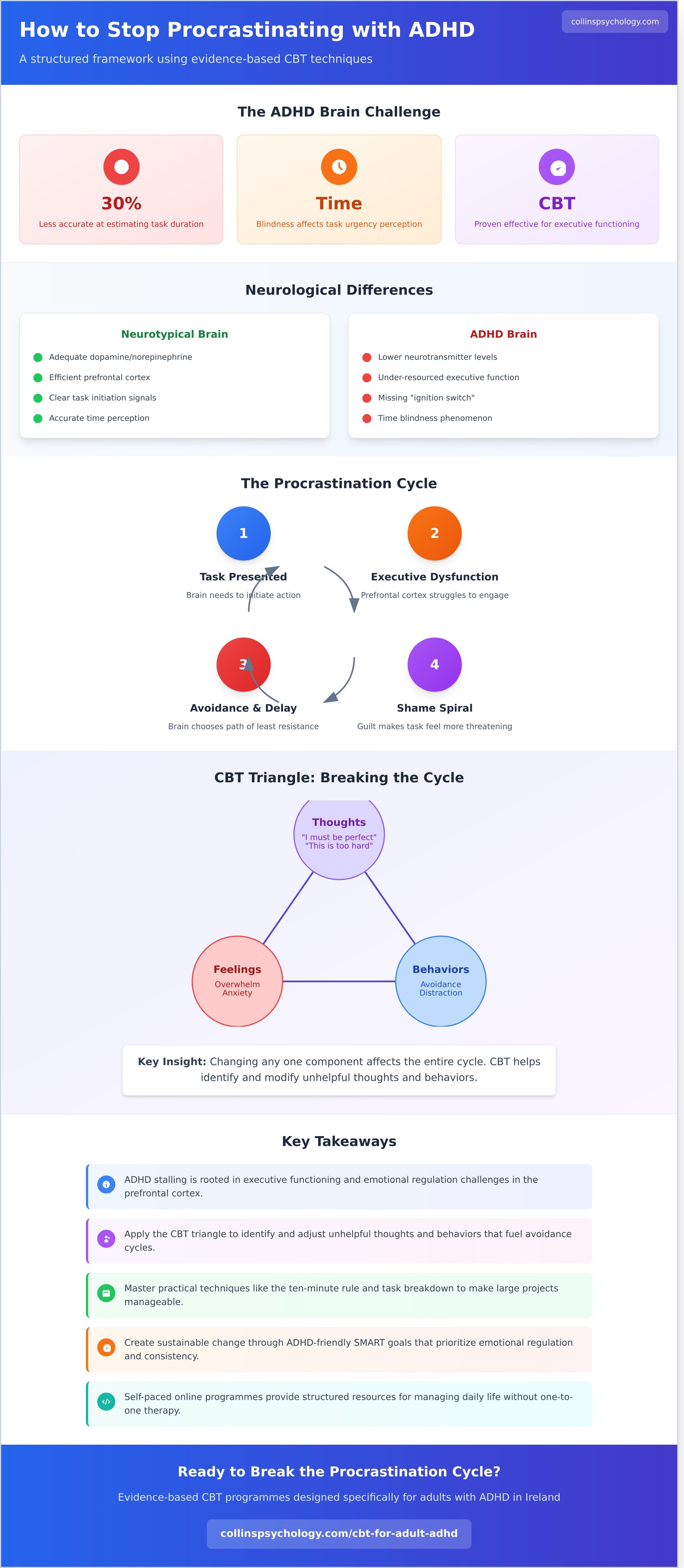
Procrastination in adults with ADHD is not a character flaw or a sign of laziness; it is a direct consequence of challenges with executive functioning and emotional regulation (Barkley, 2015). The brain’s prefrontal cortex, responsible for organising, planning, and regulating impulses, functions differently in individuals with ADHD. This can make initiating tasks, especially those that are not immediately rewarding, feel like an insurmountable challenge.
This difficulty is compounded by "time blindness," a common ADHD trait where the perception of time is skewed. This makes it difficult to gauge how long a task will take or to feel the urgency of a future deadline. When you repeatedly miss deadlines or fail to start important tasks, it can trigger a "shame spiral," a cycle of negative self-talk and avoidance that keeps you feeling stuck and overwhelmed.
The role of executive functioning in task initiation
Executive functions are the set of mental skills that include working memory, flexible thinking, and self-control. For many adults with ADHD, these skills are significantly impaired, which makes the first step of any task the most difficult. "Just starting" requires a complex sequence of brain activity: retrieving the goal from working memory, planning the steps, and inhibiting distractions. As Brown (2013) explains, executive dysfunction is a "management deficit of the brain" that affects one's ability to organise and act on intentions. This is why a simple instruction like "clean the kitchen" can feel completely paralysing.
Emotional regulation: The hidden engine of procrastination
The most overlooked aspect of ADHD procrastination is its deep connection to emotional regulation. We often avoid tasks not because they are difficult, but because of the negative emotions they trigger. These can include boredom, frustration, anxiety about not performing perfectly, or the fear of failure. For the ADHD brain, which seeks stimulation and struggles to tolerate discomfort, avoiding these negative feelings provides immediate relief (Barkley, 2015). Therefore, the first step in managing your time is learning to manage your emotions.
The CBT framework for breaking the procrastination cycle
Cognitive Behavioural Therapy (CBT) is a highly effective, evidence-based approach for managing the core symptoms of adult ADHD (Safren et al., 2017). It provides a structured framework for understanding and changing the patterns that fuel procrastination. CBT operates on the principle that our thoughts, feelings, and behaviours are interconnected, a concept often called the CBT triangle (Beck, 2021). By changing one corner of the triangle, such as your thoughts, you can influence your feelings and, ultimately, your actions.
Adults with ADHD often experience common "thinking errors" or cognitive distortions, such as "all-or-nothing thinking" ("If I cannot do this perfectly, I will not do it at all") or "catastrophising" ("If I fail this, my whole career is over"). These thoughts generate intense negative feelings, which lead to the behaviour of avoidance. This creates a powerful "Avoidance-Reinforcement" loop: avoiding the task provides short-term relief from anxiety, which reinforces avoidance as a coping strategy for the future.
Identifying your unique procrastination triggers
The first step in applying a CBT framework is to become a detective of your own mind. When you notice yourself avoiding a task, pause and ask: "What thought just went through my head?" Tracking these thoughts helps you identify your specific triggers. Are you avoiding "boring" tasks that lack stimulation, or "scary" tasks that activate your fear of failure? CBT helps you reframe these triggers not as insurmountable obstacles, but as manageable data points that you can work with.
Reframing thoughts to reduce task-related anxiety
Once you have identified a negative thought, the next step is to challenge and reframe it. This does not mean forcing yourself into unrealistic positivity. Instead, it means finding a more balanced and realistic perspective. For example, you can reframe the thought "I must do this whole project perfectly" to "I will work on this for just 10 minutes." This simple shift lowers the emotional stakes and makes the task feel more approachable. The efficacy of CBT in helping adults with ADHD develop these practical coping skills is well-supported by clinical research (Safren et al., 2017).
Practical strategies for better focus and time management
While understanding your thought patterns is crucial, CBT also provides practical, behavioural tools to help you get moving. These strategies are designed to work with the ADHD brain, not against it.
The "10-Minute Rule"
Commit to working on a dreaded task for only 10 minutes. Anyone can do something for 10 minutes. Often, the hardest part is starting, and this small commitment is enough to overcome the initial inertia.
Task Breakdown
Turn a large, overwhelming "project" into a list of small, concrete "micro-actions." Instead of "write report," your first step might be "open new document and write title."
Externalise Time
Use visual timers, like a Time Timer or even a simple kitchen timer, to make the passage of time tangible. This helps counter time blindness.
Body Doubling
Work alongside another person, either in person or virtually. Their quiet presence can provide the accountability and mild stimulation needed to stay on task.
Mastering the art of breaking tasks down
The ADHD brain often perceives a multi-step project as a single, overwhelming monolith. Breaking it down is therefore a critical skill. For example, "clean the kitchen" is not a single action. It is a series of micro-actions:
• Gather all the dirty dishes and place them by the sink.
• Load the dishwasher.
• Wipe down the counters.
• Sweep the floor.
Each step is small, specific, and achievable. For more in-depth tools on developing this skill, our
Tools for managing time blindness
Because you cannot rely on an internal sense of time, you must use external tools. When scheduling, always add "buffer time" between appointments and for tasks. Many people with ADHD find that analogue planners or simple to-do lists work better than complex digital apps, as the physical act of writing can improve memory and focus. A powerful tip is to set "start times" for your tasks, not just "due by" deadlines. This shifts your focus from a distant future point to an immediate, actionable present.
Goal setting and emotional regulation for long-term change
Traditional goal-setting advice, like "just be more disciplined," often fails for those with ADHD because it ignores the underlying challenges with motivation and emotional regulation. A more effective approach is to adapt goals to your unique brain wiring.
Using the "SMART" (Specific, Measurable, Achievable, Relevant, Time-bound) goal framework is a good start, but it needs an ADHD-friendly twist. For example, make your goals visually engaging and ensure they have an immediate reward component to activate the brain’s dopamine system. More important than any single goal is adopting a "Practice Mindset," where you view progress as a skill to be developed over time, not an all-or-nothing outcome.
Building a practice mindset
A practice mindset involves treating yourself with self-compassion, especially on days when things do not go as planned. For the ADHD brain, perfect consistency is a myth. The real goal is "persistence": the ability to get back on track after a setback without falling into a shame spiral. Acknowledge your effort, celebrate small wins, and remember that you are learning a new way of functioning. For dedicated support in this area, you may find our Emotional Regulation Course helpful.
The importance of fitness and sleep for focus
No strategy will be effective without a solid foundation of physical well-being. Physical movement is one of the most powerful ways to support neurotransmitter regulation, which directly impacts focus and mood (Barkley, 2015). Similarly, consistent sleep hygiene is non-negotiable for executive functioning. Sleep deprivation has been shown to worsen ADHD symptoms, making it even harder to initiate tasks and regulate emotions.
Navigating your progress with self-paced CBT programmes
At Collins Psychology, we provide online, self-paced learning resources designed to empower you with the skills discussed in this article. It is important to clarify that we do not offer one-to-one therapy. Instead, our focus is on providing structured, evidence-based tools that you can use to make meaningful changes in your life. This model allows you to learn at your own pace, without the pressure of weekly appointments, and to build a sustainable system for managing your ADHD.
Why self-paced learning works for ADHD
The flexibility of a self-paced programme is ideally suited to the ADHD brain. You can revisit complex topics like goal setting or emotional regulation as many times as you need. Our programmes are built with practical exercises and resources that you can apply directly to your real-world challenges. This active, engaged learning style helps solidify new habits and skills. To see how this works, we encourage you to take the first step by exploring the CBT for Adult ADHD collection.
Connecting with a supportive community
Building new skills is easier when you feel connected and supported. For daily tips and insights, you can follow Elaine Collins on Instagram. If you have any queries about our programmes or how they can help you, please reach out via our Contact Us page. All of our materials are developed with a commitment to professional guidelines set by the Psychological Society of Ireland (PSI) and a dedication to clinical excellence.
Frequently Asked Questions
Why do I procrastinate even when I really want to do the task?
This is known as task-initiation paralysis. It happens because the ADHD brain struggles with executive functions and emotional regulation. The task may trigger feelings of boredom, anxiety, or overwhelm, and your brain defaults to avoidance for immediate relief, even if you logically want to complete it.
Can Cognitive Behavioural Therapy (CBT) actually help with ADHD procrastination?
Yes. CBT is an evidence-based approach that helps you identify and change the unhelpful thought patterns and behaviours that fuel procrastination. It provides practical tools for managing emotions, breaking down tasks, and building new habits (Safren et al., 2017).
What is the "10-minute rule" and how does it work for ADHD?
The "10-minute rule" is a behavioural strategy where you commit to working on an overwhelming task for just ten minutes. This lowers the mental barrier to starting. For the ADHD brain, initiating a task is often the hardest part; once you begin, the momentum can often carry you forward for longer.
How is self-paced CBT different from traditional one-to-one therapy?
Self-paced CBT, like the programmes we offer, provides structured learning modules, tools, and exercises that you can work through on your own schedule. This offers flexibility and the ability to revisit material. Traditional one-to-one therapy involves scheduled, live sessions with a psychologist for personalised intervention and support.
Why is emotional regulation more important than time management for ADHD?
Many people with ADHD know what they should be doing but cannot make themselves do it. This is because the primary driver of their procrastination is avoiding the negative emotions a task brings up. Until you learn to manage those feelings, no planner or time-management app will be effective.
Does Collins Psychology offer one-to-one therapy for ADHD?
No, Collins Psychology does not offer one-to-one therapy. We focus on providing high-quality, self-paced online CBT programmes that empower you with the skills and knowledge to manage adult ADHD effectively and flexibly.
How can I set goals that I will actually stick to with ADHD?
Set small, specific, and achievable goals that have an immediate and rewarding component. Use visual aids to track your progress and focus on persistence rather than perfect consistency. Acknowledge that setbacks will happen and have a plan to get back on track without self-criticism.
What should I do if I feel overwhelmed by my to-do list?
When you feel overwhelmed, pick just one item from your list. Then, break that single item down into the smallest possible first step. For example, if the item is "do laundry," the first step is "gather clothes into the basket." Focus only on completing that tiny step. This reduces the feeling of overwhelm and helps you build momentum.
Procrastination is not a life sentence. By understanding that it is a challenge of emotional regulation and executive functioning, not a moral failing, you can begin to approach it with new tools. A structured CBT framework gives you the power to change your thoughts, manage your feelings, and take meaningful action.
Start your journey toward better focus with our self-paced CBT programmes for Adult ADHD
References
Barkley, R. A. (2015). Attention-deficit hyperactivity disorder: A handbook for diagnosis and treatment (4th ed.). The Guilford Press.
Beck, J. S. (2021). Cognitive behavior therapy: Basics and beyond (3rd ed.). The Guilford Press.
Brown, T. E. (2013). Smart but stuck: Emotions in teens and adults with ADHD. Jossey-Bass.
Safren, S. A., Sprich, S. E., Perlman, C. A., & Otto, M. W. (2017). Mastering your adult ADHD: A cognitive-behavioral treatment program, therapist guide (2nd ed.). Oxford University Press.