.png)

For adults with ADHD, the persistent gap between knowing what needs to be done and being able to do it can be a source of significant frustration. This challenge often stems from difficulties with executive function, the brain’s core management system responsible for planning, organising, and regulating behaviour. Fortunately, executive function is not a fixed trait but a set of skills that can be systematically improved. This article explores how a structured Cognitive Behavioural Therapy (CBT) approach provides evidence-based strategies to strengthen working memory, manage time, and regulate emotions, offering a practical pathway toward greater control and a sense of accomplishment in daily life.
What is Executive Function and How Does it Impact Adult ADHD?
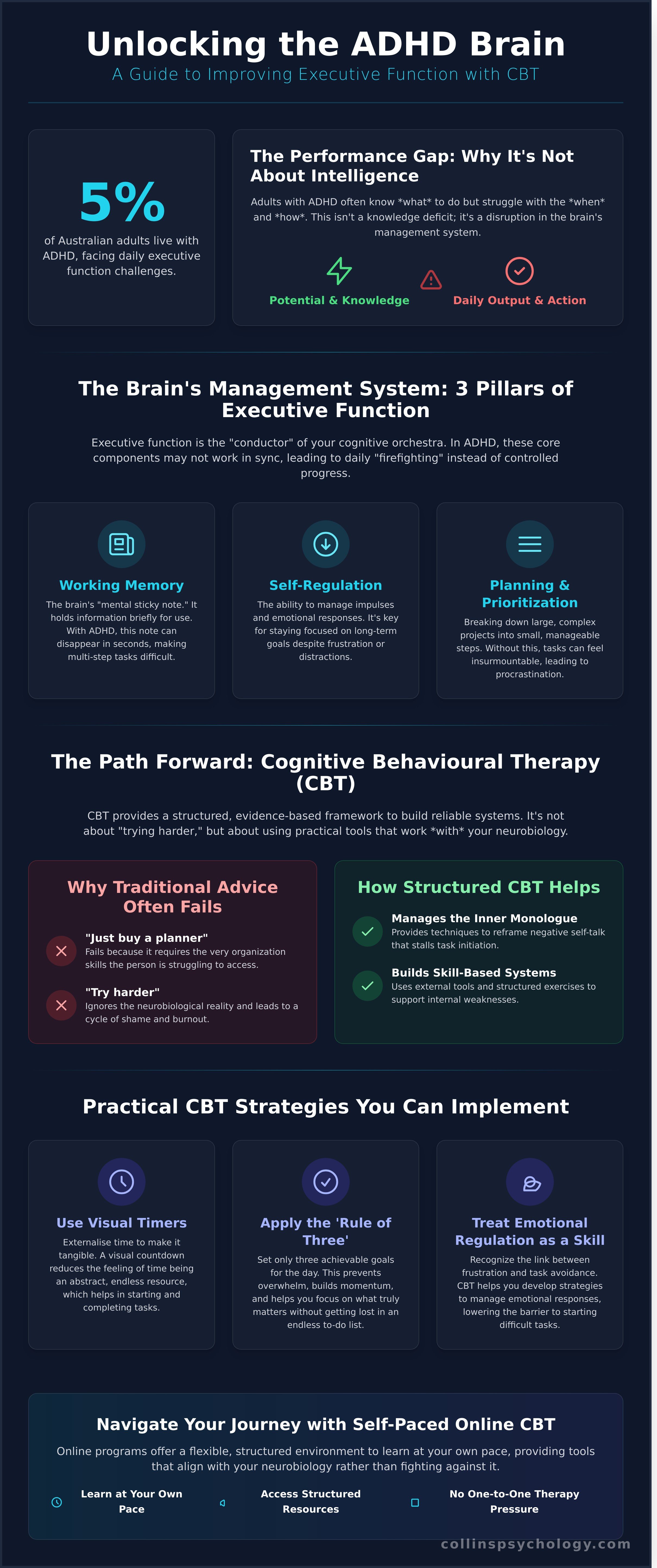
Executive function is best understood as the brain's chief executive or management system. It is a set of mental skills that includes working memory, flexible thinking, and self-control. These are the skills we use daily to manage time, pay attention, switch focus, plan, organise, and remember details (Barkley, 2012). For adults with ADHD, these functions can be inconsistent, leading to what is often called the 'performance gap'. This is the frustrating experience of knowing exactly what you should do but finding yourself unable to execute the task. This is a common challenge for many, particularly in modern Irish and UK workplaces where demands for self-management and organisation are high.
The Core Components of the Executive System
The executive system is not a single entity but a collection of interconnected cognitive processes. The main components include:
Working memory
This is like your brain's temporary mental sticky note. It allows you to hold and manipulate information in your mind for short periods, which is essential for following multi-step directions, solving problems, or even remembering why you walked into a room.
Self-regulation
This is the ability to manage your impulses, emotions, and behaviours to achieve long-term goals. It involves inhibiting immediate reactions and delaying gratification, a process that can be particularly challenging for the ADHD brain.
Planning and prioritisation
This skill involves looking ahead, setting goals, and breaking down complex projects into smaller, more manageable steps. It is the foundation of effective task management and project completion.
Why Traditional Advice Often Fails ADHD Adults
Many adults with ADHD are intelligent and capable, yet they struggle with execution. This leads to well-meaning but unhelpful advice from others.
The myth of 'just try harder'
The challenges of executive dysfunction are rooted in neurobiology, not a lack of willpower or effort. Telling someone with ADHD to simply try harder ignores the underlying cognitive differences and can increase feelings of shame and inadequacy.
Why standard planners don't work alone
A new planner or app can feel like a fresh start, but without addressing the underlying skills needed to use it consistently, it often becomes another abandoned tool. The problem is not the planner itself but the cognitive bottleneck in planning, prioritising, and initiating the tasks within it (Ramsay & Rostain, 2015).
Moving from shame to skills
The goal is to transition from a cycle of shame-based motivation, where action is driven by last-minute panic, to a skill-based approach. This involves building reliable systems and strategies that work with your brain, not against it.
The Role of Cognitive Behavioural Therapy in Strengthening Executive Skills
Cognitive Behavioural Therapy (CBT) is a structured, evidence-based psychological approach that is highly effective for managing the challenges of adult ADHD. It works by helping individuals identify and change unhelpful thinking patterns and behaviours that interfere with their ability to function effectively. Rather than just focusing on the 'doing' of a task, CBT for ADHD targets the 'thinking about doing', which is often where the real breakdown occurs (Safren et al., 2017). The strategies discussed here are aligned with the professional guidelines of the Psychological Society of Ireland (PSI), ensuring a sound therapeutic foundation.
Cognitive Restructuring for Productivity
Our thoughts have a powerful influence on our actions. For many with ADHD, a negative inner monologue can paralyse them before a task even begins. Cognitive restructuring is the process of reframing these unhelpful thoughts to facilitate action.
Identifying 'all-or-nothing' thinking
This is the tendency to see tasks as either a complete success or a total failure. For example, thinking, "If I can't clean the entire house perfectly, there's no point in starting." CBT helps you challenge this by finding a middle ground, such as, "I will spend 15 minutes tidying the kitchen."
Challenging the 'I'll do it later' distortion
Procrastination is often fuelled by the thought that your future self will be more motivated or capable. CBT techniques help you realistically assess this belief and focus on taking a small, imperfect action in the present moment.
Behavioural Activation and Scaffolding
CBT also focuses on practical, behavioural changes. Since executive functions are weaker internally, the strategy is to build external supports, or 'scaffolding', to compensate.
Creating external cues
This involves using your environment to prompt action. Instead of relying on memory, you might put your gym bag by the front door or place a bill on your keyboard so you see it when you start work.
The 'Point of Performance' concept
This powerful idea involves placing reminders, tools, and supports at the exact place and time you need to perform a task. This reduces the cognitive load required to remember and initiate the action.
Integrating a routine
Structured programs, like our CBT for ADHD programs, provide a framework for integrating these behavioural strategies into a consistent daily routine, helping to turn conscious effort into lasting habits.
Practical CBT Strategies for Time Management and Organisation
Effective time management for an adult with ADHD is less about managing minutes and more about managing focus, energy, and attention. CBT offers tangible tools to make abstract concepts like time and organisation more concrete.
Externalising time
Make the invisible visible. Use visual timers (like a Time Timer) or alarms to create an external sense of urgency and awareness of time passing.
The 'Rule of Three'
At the start of each day, identify just three things you want to accomplish. This prevents the overwhelm that comes from a long to-do list and focuses your energy on what truly matters.
Developing a 'Home Base'
Designate a specific spot for essential items like keys, wallet, and phone. Consistently returning items to their 'home' reduces the mental energy spent searching for them.
'Time Blocking'
Instead of a simple to-do list, schedule tasks directly into your calendar. This technique helps you manage your energy levels by allocating specific blocks of time for focused work, breaks, and administrative tasks.
Mastering the Art of Time Perception
A common experience for adults with ADHD is 'time blindness', or a distorted sense of time's passage (Ramsay & Rostain, 2015). This can be compensated for with practical strategies.
The 'Plus 50 Percent' rule
When estimating how long a task will take, make your best guess and then add 50 percent more time. This buffer accounts for unexpected interruptions and the natural tendency to underestimate task duration.
Using analog clocks
Unlike digital clocks, analog clocks provide a visual representation of time as a quantity. Seeing the physical movement of the hands can help ground your perception of how much time has passed and how much is left.
Organisational Systems That Stick
The key to organisation is creating simple systems that are easy to maintain.
The 'One-Touch' rule
When handling mail or email, aim to deal with it immediately. Decide if you will act on it, file it, or delete it. Avoid letting items pile up in a 'deal with it later' stack.
Creating a 'Sunday Reset' ritual
Dedicate a short period each Sunday to plan the week ahead. This might include a quick review of your calendar, meal planning, or tidying your workspace. This ritual reduces decision fatigue during the busy week.
• For a deeper dive into these methods, our Executive Function course provides detailed modules and worksheets.
Overcoming Barriers: Emotional Regulation and Focus
Executive function and emotional regulation are deeply intertwined. In fact, emotional regulation can be considered the 'hidden' executive function, as our ability to manage feelings directly impacts our ability to execute tasks. Frustration, boredom, and anxiety can quickly derail productivity if not managed effectively. The brain's 'fuel tank' for executive tasks is also heavily dependent on fundamentals like adequate sleep and physical fitness (Barkley, 2012).
Managing Task-Related Anxiety
The feeling of overwhelm is a major barrier to starting tasks. CBT provides tools to lower this initial hurdle.
The 'Five-Minute Rule'
Commit to working on a dreaded task for just five minutes. Anyone can do something for five minutes. Often, the hardest part is starting, and this small commitment is enough to overcome the initial inertia.
Grounding techniques
When you feel overwhelmed by a to-do list, take a moment to ground yourself. A simple technique is the 5-4-3-2-1 method: name five things you can see, four things you can feel, three things you can hear, two things you can smell, and one thing you can taste. This pulls your attention back to the present moment.
• Critically, emotional regulation acts as the gateway to accessing other executive functions; when our emotions are overwhelming, our capacity for planning and focus is significantly reduced.
Building Focus and Sustaining Attention
Maintaining focus in a world full of distractions requires a proactive approach.
Environmental engineering
Actively design your environment to support focus. This could mean using noise-cancelling headphones, turning off phone notifications, or clearing physical clutter from your desk.
The role of 'Body Doubling'
This involves working, either physically or virtually, alongside another person. The quiet presence of someone else can provide a subtle form of accountability that helps you stay on task and maintain momentum.
• Our Emotional Regulation modules offer practical exercises to build these essential skills.
Navigating Your Journey with Self-Paced CBT Programs
Developing executive function skills is a long-term process, not a quick fix. It requires patience, practice, and the right tools. Recognising the need for flexible and accessible support, we have developed a suite of online resources.
Please note: Collins Psychology provides online, self-paced CBT programs. We do not offer one-to-one therapy. Our model is designed to empower you with structured, evidence-based knowledge and exercises that you can work through at a pace that suits your life and learning style.
The Benefits of Self-Paced Learning
This approach offers several advantages for the ADHD brain:
Learn at your own speed
There is no pressure of weekly appointments. You can engage with the material when your brain is most receptive and take breaks when you need to.
Revisit complex modules
Topics like goal setting or emotional regulation may require more than one review. With online modules, you can revisit lessons whenever you need a refresher.
Accessibility for busy professionals
Our online collections are designed to fit into a busy schedule, providing high-quality tools without the logistical challenges of traditional therapy.
Taking the Next Step Toward Mastery
The skills you build can be applied to all areas of life, from improving your career performance to navigating parenting challenges. By investing in evidence-based tools, you are choosing a reliable path over the unverified advice often found on social media. You are building a foundation of skills that will serve you for a lifetime.
Ready to start building a more effective management system for your brain? Access our self-paced CBT for Adult ADHD programs today.
Frequently Asked Questions
Can executive function actually be improved in adults with ADHD?
Yes. While ADHD is a lifelong neurodevelopmental condition, the skills associated with executive function can be significantly strengthened. Through consistent practice of CBT strategies and the use of external supports, adults can learn to compensate for and improve their executive functioning.
How long does it take to see results from CBT for executive function?
Results vary for each individual. Some people notice small improvements in areas like task initiation within a few weeks of consistently applying new strategies. More significant and lasting changes in organisation and time management typically develop over several months of dedicated practice.
Is this program suitable if I don't have a formal ADHD diagnosis?
Yes. The strategies and skills taught in our CBT programs are beneficial for anyone who struggles with executive function challenges, such as procrastination, poor time management, and disorganisation, regardless of whether they have a formal diagnosis.
What is the difference between executive function and simple laziness?
Laziness is a choice not to act despite having the ability to do so. Executive dysfunction is a neurobiological challenge that creates a gap between intention and action. People with executive dysfunction often want to complete tasks and feel significant distress about their inability to do so.
How does emotional regulation affect my ability to stay organised?
Emotional regulation is foundational to organisation. When you feel overwhelmed, frustrated, or anxious, it becomes very difficult to access the parts of your brain needed for planning, sorting, and decision-making. A calm and regulated emotional state is essential for effective executive functioning.
Can I do these CBT exercises on my own without a therapist?
Yes, our programs are specifically designed for self-paced, independent learning. They provide the structure, lessons, and exercises needed to learn and apply CBT principles on your own. We do not offer one-to-one therapy.
What are the best time management tools for ADHD adults?
The best tools are often visual and external. Visual timers, large analog wall clocks, whiteboards for mapping out projects, and calendar-blocking apps are highly effective. The key is to make time a physical, tangible thing you can see and interact with.
How do I manage executive dysfunction at work?
Strategies like breaking large projects into small, concrete tasks, using noise-cancelling headphones to minimise distractions, setting timers for focused work sessions (the Pomodoro technique), and requesting deadlines and instructions in writing can be very helpful in a professional environment.
References
Barkley, R. A. (2012). Executive functions: What they are, how they work, and why they evolved. The Guilford Press.
Ramsay, J. R., & Rostain, A. L. (2015). The adult ADHD tool kit: Using CBT to facilitate coping inside and out. Routledge.
Safren, S. A., Sprich, S. E., Perlman, C. A., & Otto, M. W. (2017). Mastering your adult ADHD: A cognitive-behavioral treatment program, therapist guide (2nd ed.). Oxford University Press.