.png)

Key Takeaways
Disclosure is a Strategic Choice
Deciding whether to tell your boss about your ADHD is a personal decision that involves weighing the potential benefits, like accommodations, against risks like misunderstanding or bias.
Focus on Function, Not the Label
Frame the conversation around your working style and specific workplace challenges, such as time management or focus, rather than simply stating the diagnosis.
Use CBT to Prepare
Cognitive Behavioural Therapy (CBT) strategies can help you manage the anxiety of disclosure, reframe negative thoughts, and handle potential pushback with professional composure.
Request Practical Accommodations
Propose specific, low-cost adjustments like noise-cancelling headphones or written meeting summaries that can be presented as tools to improve your productivity and efficiency.
Know Your Rights in Ireland
The Employment Equality Act provides legal protections against discrimination and supports your right to request reasonable accommodations for ADHD in the workplace.
Table of Contents
• Evaluating the Decision to Disclose ADHD in a Professional Setting
• Preparing for the Meeting Using Cognitive Behavioural Strategies
• A Structured Framework for the Disclosure Conversation
• Requesting Workplace Accommodations for Executive Functioning
• Enhancing Professional Focus with Structured Self Paced Programs
Deciding how to explain ADHD to your boss can feel like a significant hurdle, filled with uncertainty about their reaction and the potential impact on your career. This guide provides a practical framework, grounded in Cognitive Behavioural Therapy (CBT) principles, to help you navigate this professional conversation with confidence. It moves beyond simply sharing a diagnosis and instead focuses on a structured approach to negotiating a better work environment, securing helpful accommodations, and reframing your ADHD as a unique working style, all while protecting your professional standing in the Irish workplace.
Evaluating the Decision to Disclose ADHD in a Professional Setting
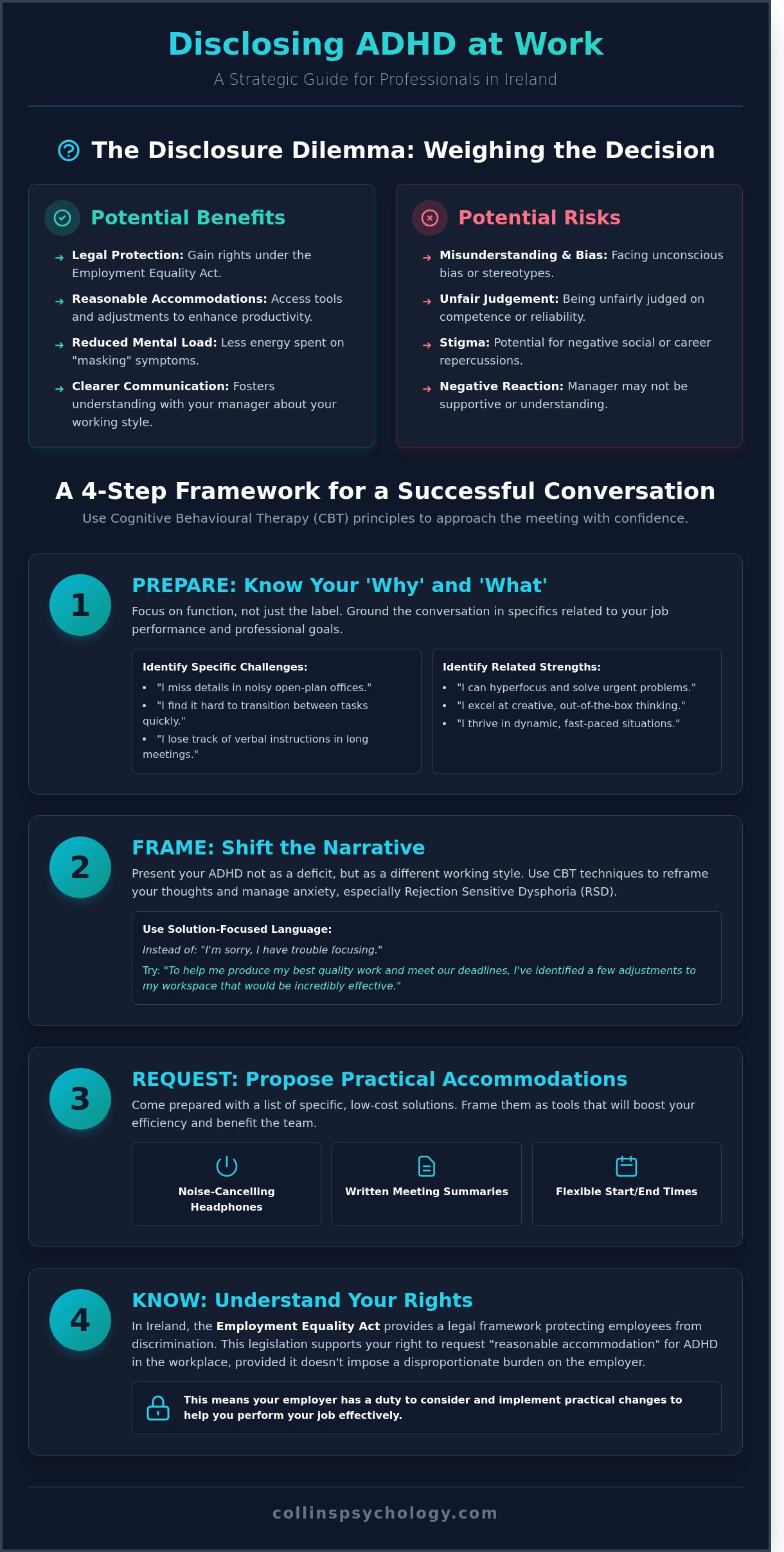
The choice to disclose an ADHD diagnosis at work is a complex one, often referred to as the "disclosure dilemma" in modern Irish workplaces. There is no single right answer, and the decision depends heavily on your individual circumstances, your relationship with your manager, and the overall company culture. Signs that disclosure might be beneficial include situations where your performance is noticeably impacted by specific challenges, or when you feel that simple accommodations could significantly improve your output and well being. Before making a decision, it is crucial to assess the psychological safety of your environment; consider how your organisation has handled similar situations in the past and whether leadership fosters a culture of trust and support. Research indicates that the outcomes of disclosing an invisible disability can vary widely depending on these environmental factors (Santuzzi et al., 2014).
Weighing the Benefits and Risks of Sharing Your Diagnosis
Sharing your diagnosis can unlock significant benefits, including legal protections and access to reasonable accommodations that can transform your workday. It can also reduce the mental load of "masking," which is the process of hiding your symptoms, allowing you to redirect that energy toward your tasks. However, it is also important to acknowledge the risks, which can include unconscious bias from managers, a misunderstanding of what adult ADHD entails, or being subjected to unfair stereotypes about competence or reliability. To make an informed choice, you can use a simple decisional framework: list the pros and cons specific to your role and workplace, and consider the best and worst case scenarios for both disclosing and not disclosing.
Identifying Your Core Workplace Challenges
To have a productive conversation, it is vital to move beyond general symptoms and identify the specific executive function hurdles you face. Instead of saying "I have trouble focusing," you might document instances where an open plan office makes it difficult to complete detailed reports. It is also important to distinguish between temporary burnout, which can affect anyone, and the persistent, lifelong traits associated with a neurodivergent brain. To prepare, spend a week noting down not just your challenges, but also your strengths; perhaps your ability to hyperfocus on an urgent project or your creative problem solving skills can be highlighted as valuable assets.
Preparing for the Meeting Using Cognitive Behavioural Strategies
Approaching your disclosure meeting as a professional negotiation, rather than a confession, can fundamentally shift your mindset. Your goal is to collaborate with your manager to find a better environmental fit that allows you to perform at your best. Cognitive Behavioural Therapy (CBT) offers powerful techniques to manage the anxiety that often precedes such a significant conversation, helping you challenge intrusive thoughts like "they will think I am incompetent." By learning to regulate your emotions, you can maintain professional composure throughout the meeting, ensuring the focus remains on solutions. This process also involves separating your professional identity from your ADHD traits, recognising that how your brain works does not define your commitment or your skills. The effectiveness of CBT in helping adults manage the emotional and practical challenges of ADHD is well documented (Safren et al., 2010).
Managing Rejection Sensitive Dysphoria or RSD
Rejection Sensitive Dysphoria (RSD), a common experience for many with ADHD, can intensify the fear of a negative reaction from your boss. This intense emotional sensitivity can skew your perception, causing you to interpret neutral feedback or simple questions as criticism or rejection. Before the meeting, try a grounding exercise: sit in your chair, press your feet firmly into the floor, and take five deep, slow breaths, focusing on the physical sensation of being grounded. This can help calm your nervous system. During the conversation, consciously reframe your manager's questions as genuine curiosity aimed at understanding, rather than as a challenge to your credibility. You can learn more about understanding emotional over arousal and rejection sensitivity in adult ADHD.
Reframing ADHD as a Different Working Style
Shift the narrative away from a deficit model and toward a functional description of your working style. Instead of apologising for your challenges, frame them as characteristics of how you process information and manage tasks. Use language that reinforces your dedication to the organisation's objectives, such as "To help me meet our team's deadlines more effectively, I've found that..." or "I am committed to producing high quality work, and I believe these adjustments will help me do that even more consistently." This approach aligns with foundational CBT skills like goal setting, as it positions you as a proactive, solution focused employee who is invested in your own performance and the company's success.
A Structured Framework for the Disclosure Conversation
The success of your disclosure often depends on careful planning of the logistics. Schedule a private meeting at a time when neither you nor your manager will feel rushed, such as the end of the day, and choose a neutral setting like a small meeting room. A helpful structure for the conversation itself follows a three part script: first, state the context and your commitment to your role; second, provide a high level, functional explanation of your challenges; and third, propose clear, actionable solutions. You can use the "sandwich method" by starting and ending with positive statements about your job and your desire to contribute, which keeps the overall tone constructive and focused on productivity. It is generally advisable to avoid sharing extensive medical details; the conversation should centre on workplace function, not clinical history, in line with professional communication guidelines from bodies like the Psychological Society of Ireland (PSI).
Focusing on Executive Functioning Rather Than Labels
You do not need to use the words "ADHD" or "disability" to have a productive conversation. Instead, describe the functional impact on your work, which is often easier for managers to understand and act upon. For example, instead of saying "I have working memory problems," you could say, "To ensure I capture all the key action points from our verbal briefings, a quick written summary via email would be incredibly helpful for me." Use professional phrases like "I want to discuss optimising my workflow" or "I have some ideas for improving my project delivery." You can also link a challenge directly to a strength, such as, "While I sometimes get lost in the details of a project because I am so focused, having a clear, final deadline helps me pull everything together efficiently."
Handling Scepticism or Misunderstanding with Calm Authority
Be prepared for potential misconceptions, as some people still incorrectly view ADHD as only a childhood condition or an issue of willpower. If your manager seems sceptical, gently steer the conversation back to your professional performance and the solutions you are proposing. You might say, "I understand there are many different views on this, but what I am focused on is my performance in this role and how we can work together to make it even stronger." Your calm, confident, and solution oriented approach is your most powerful tool. If you feel the conversation is not productive or you need further guidance, you can always seek additional support by reaching out through the Collins Psychology contact page.
Requesting Workplace Accommodations for Executive Functioning
In an Irish context, "reasonable accommodations" refer to appropriate measures that enable a person with a disability to participate fully in employment, without imposing a disproportionate burden on the employer. Many of the most effective accommodations for ADHD related executive function challenges are low cost or even no cost, yet they can have a significant positive impact on productivity. When you make your request, frame it as a strategic investment that will deliver a better return for the company by allowing you to work more efficiently and produce higher quality results. It can also be helpful to suggest a trial period for any new adjustments, such as a month, to demonstrate their effectiveness and show your flexibility. Research consistently shows that well implemented workplace supports are a key factor in job retention and success for adults with disabilities (Mitchell & Kortering, 2006).
Practical Examples of Professional ADHD Supports
There are many simple adjustments that can make a substantial difference in a professional setting. For those who are easily distracted in an open plan office, requesting the use of noise cancelling headphones can be a simple and effective solution. If you find it difficult to retain information from verbal meetings, asking for a written follow up of key decisions and action items can ensure clarity and accountability. For those who struggle with time blindness or initiating tasks, proposing flexible start times or structuring the day with "deep work" sessions broken up by short breaks can help align your work schedule with your natural energy patterns.
Knowing Your Rights Under the Employment Equality Act
It is empowering to know that in Ireland, your rights are protected by law. The Employment Equality Acts 1998-2015 prohibit discrimination on nine grounds, including disability, which covers neurodevelopmental conditions like ADHD. This legislation mandates that employers must provide reasonable accommodations for employees unless doing so would impose a "disproportionate burden" on the organisation. If you believe you have been treated unfairly, the Workplace Relations Commission (WRC) is the independent body responsible for resolving workplace disputes. Organisations seeking to build a more inclusive and neurodivergent friendly workplace can find more information at Collins Psychology for Organisations.
Enhancing Professional Focus with Structured Self Paced Programs
Disclosing your ADHD to your boss is just one part of a much wider strategy for self management and professional growth. True empowerment comes from building robust systems that help you manage your executive functions consistently. At Collins Psychology, we provide online self paced CBT programs specifically designed for adults with ADHD. It is important to clarify that these programs do not include one to one therapy sessions; they are designed to give you the tools and structure to learn at your own pace. This is not therapy. Not coaching. A system. This flexibility allows you to build your ADHD support system over time, starting where you struggle most.
Developing Long Term Skills for Time Management and Focus
You can stop relying on motivation and stop starting over every Monday by building systems that work with your brain. Our online course on improving executive function uses structured exercises to help you develop durable habits for workplace success. The self paced modules are designed for the ADHD brain, allowing you to repeat lessons and practise techniques until they become second nature. The goal is to help you know what to do and actually do it, creating a reliable framework for managing your time, attention, and projects.
Taking the Next Step Toward Professional Empowerment
Viewing your ADHD as a manageable part of your career, rather than a barrier, is the final step toward professional empowerment. With the right strategies and systems, you can thrive in your role.
Your Checklist for the Day of the Meeting:
• Review your notes with your key points and proposed solutions.
• Do a 5 minute grounding exercise before you go in.
• Bring a notepad to jot down key points from the discussion.
• Remember your goal: this is a collaborative conversation about productivity.
Ready to build a complete toolkit of strategies? Explore the full Collins Psychology collection of self paced programs and discover how our structured systems can help you succeed. One system. Multiple entry points.
Frequently Asked Questions
Do I have a legal obligation to tell my boss I have ADHD in Ireland?
No, you do not have a legal obligation to disclose your ADHD. Disclosure is a personal choice. However, if you wish to avail of your right to reasonable accommodations under the Employment Equality Act, you will need to inform your employer about your condition and how it affects you at work.
What are some common reasonable accommodations for ADHD in an office?
Common accommodations include noise cancelling headphones, a quieter desk location, flexible working hours, written instructions and follow ups, task management software, and regular check in meetings with a manager to help with prioritisation and structure.
How can I explain my ADHD challenges without using the medical label?
Focus on the functional impact. You can say things like, "I work most effectively when I can focus on one task at a time in a quiet environment," or "I find it very helpful to receive a written summary of tasks after a meeting to ensure I've captured all the details accurately."
What should I do if my manager reacts poorly to my disclosure?
If your manager reacts in a negative or unsupportive way, remain calm and professional. Reiterate that your goal is to improve your performance and contribute effectively to the team. If the reaction feels discriminatory, document the conversation and familiarise yourself with your company's HR policies and your rights under the Employment Equality Act.
Can CBT help me manage my ADHD symptoms at work without medication?
Cognitive Behavioural Therapy (CBT) is an evidence based approach that provides practical strategies for managing the core challenges of adult ADHD, such as time management, organisation, and emotional regulation. Many people find CBT alone or in combination with other supports to be highly effective. Our structured CBT program for ADHD offers a non-medicalised, skills based system for managing symptoms.
How do I handle Rejection Sensitive Dysphoria when receiving performance reviews?
Prepare ahead of time by reminding yourself that feedback is a tool for growth, not a personal judgement. Use CBT techniques to challenge catastrophic thinking. During the review, focus on listening to the specific, actionable points and ask clarifying questions to ensure you understand. It can also be helpful to ask for the feedback in writing so you can review it later when you are feeling less emotionally activated.
Is it better to disclose ADHD during the interview or after being hired?
Most guidance suggests waiting until after you have been hired and have established a track record of your work and commitment. Disclosing after you have a job offer and have started the role allows you to first demonstrate your skills and value to the company. This puts you in a stronger position to negotiate accommodations as a valued employee.
What resources can I share with my boss to help them understand ADHD?
You can share articles from reputable organisations like ADHD Ireland or the UK ADHD Foundation. It may also be helpful to provide them with a link to a resource that is specifically for employers, explaining their role in providing reasonable accommodations and the business benefits of supporting neurodivergent staff.
References
Mitchell, R. J., & Kortering, L. J. (2006). The use of workplace accommodations by adults with disabilities: A new look at the data. Journal of Vocational Rehabilitation, 24(3), 177-186.
Safren, S. A., Sprich, S., Mimiaga, M. J., Surman, C., Knouse, L., Groves, M., & Otto, M. W. (2010). Cognitive behavioral therapy for ADHD in medication-treated adults with continued symptoms. Behaviour Research and Therapy, 48(11), 1161-1167.
Santuzzi, A. M., Waltz, P. R., Finkelstein, L. M., & Rupp, D. E. (2014). Invisible disabilities: Unique challenges for employees and organizations. Industrial and Organizational Psychology, 7(2), 204-219.