.png)

For adults with ADHD, the idea of a routine can feel like a contradiction. You know structure could reduce the daily chaos, yet every attempt to follow a rigid schedule ends in frustration and guilt. This article moves beyond traditional productivity advice to offer a different path. Discover how to build a flexible daily rhythm using evidence-based Cognitive Behavioural Therapy (CBT) strategies. We will explore why typical routines fail, how to work with your brain's unique wiring, and how to create a supportive structure that reduces decision fatigue and helps you achieve your goals, one consistent step at a time.
Understanding why traditional routines fail for the ADHD brain
If you have adult ADHD, you have likely experienced the frustrating cycle of setting a new routine, following it for a few days, and then watching it fall apart. It is not a lack of willpower. For the ADHD brain, a routine should be seen as supportive scaffolding, not a rigid cage. The core challenge often lies in the "Intention-Action Gap," a concept that describes the difficulty in executing a planned task, even when you genuinely want to do it (Barkley, 2012). This gap is widened by decision fatigue; when faced with too many choices, the brain defaults to the path of least resistance, which is rarely the most productive option. This leads to a familiar pattern of frustration, self-criticism, and the feeling of constantly having to "start over."
The ADHD routine paradox
A significant paradox for those with ADHD is that the brain craves the stability of a routine but also instinctively resists it. This resistance is partly driven by the brain's dopamine-seeking nature, which is drawn to novelty and excitement over repetitive, predictable tasks. A standard to-do list often feels like a list of demands, triggering this resistance. A functional rhythm, however, is different. It is not about scheduling every minute but about creating a predictable flow to your day that conserves mental energy for the tasks that truly matter.
Moving beyond the guilt of inconsistency
The constant struggle to maintain a routine can lead to feelings of failure and guilt. A perspective aligned with the Psychological Society of Ireland (PSI) encourages self-compassion as a cornerstone of habit building. It is crucial to understand that "trying harder" is often an ineffective strategy against neurobiological challenges. The key is not to exert more force but to "build smarter" by creating systems that support your brain's needs. This is where Cognitive Behavioural Therapy (CBT) provides a practical and effective toolset, helping you change unhelpful thought patterns and build new, sustainable behaviours.
The role of executive function in creating daily structure
Building a routine is a complex process that relies heavily on a set of mental skills known as executive functions. These include working memory (holding information in mind to complete a task), inhibition (resisting distractions), and planning. For adults with ADHD, challenges in these areas make it difficult to initiate tasks, stay on track, and manage time effectively. This is why a common routine breaker like "time blindness," the inability to accurately perceive the passage of time, can derail an entire day. CBT helps by teaching you how to "externalise" these functions, using physical tools and environmental cues to do the heavy lifting your brain struggles with. Furthermore, improving emotional regulation through CBT is vital, as intense feelings can easily hijack your focus and disrupt your plans.
How CBT bridges the executive function gap
CBT offers a two-pronged approach to bridging the executive function gap. First, through cognitive restructuring, it helps you identify and challenge the negative, all-or-nothing thoughts that sabotage your efforts (e.g., "I missed my morning walk, so the whole day is ruined"). Second, through behavioural activation, it encourages you to engage in small, rewarding activities that build momentum and create positive feedback loops. These techniques work together to create a system that supports your executive functions rather than fighting against them.
Our self-paced online course, CBT for ADHD Executive Function, provides a structured programme to develop these skills.
Breaking down complex tasks into micro-steps
A core CBT strategy for managing executive function challenges is "chunking." This clinical strategy involves breaking down a large, overwhelming task into a series of small, manageable micro-steps. Instead of "organise the office," the first step might be "clear one surface." This dramatically reduces the cognitive load required to get started, making it much easier to take that first step. By lowering the bar for what constitutes success, you create opportunities for early wins, which in turn builds the motivation needed to continue.
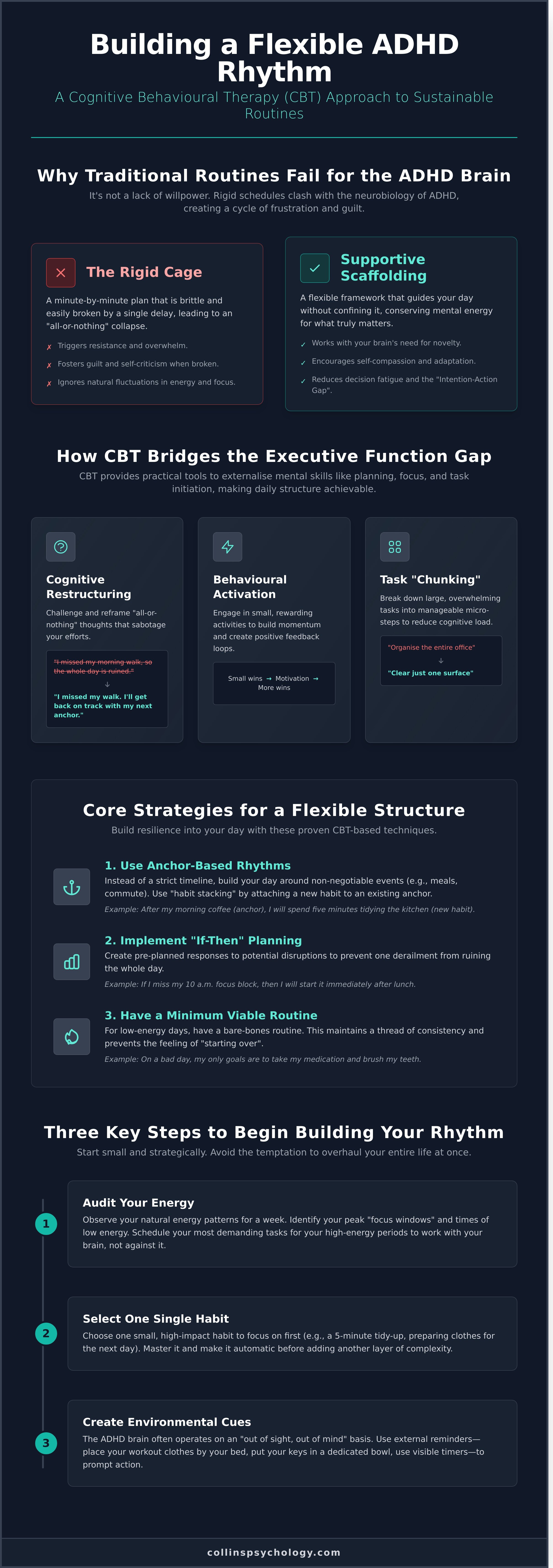
Flexible vs rigid structure: A CBT framework for success
The most common reason routines fail for adults with ADHD is rigidity. A minute-by-minute schedule is brittle; one unexpected delay can shatter the entire plan. A more effective approach is to create a flexible structure built around "anchor-based" rhythms. Instead of a strict timeline, you build your day around a few key, non-negotiable events. To make this structure resilient, you can use the "If-Then" planning strategy, which involves creating a pre-planned response to potential disruptions (Gollwitzer, 1999). For example, "If I get distracted and miss my 10 a.m. focus block, then I will start it immediately after lunch." It is also essential to build in "buffer zones" between tasks to account for the inevitable distractions and transitions that are a part of life with ADHD. For days when energy is low, having a "Minimum Viable Routine" (e.g., just taking medication and brushing your teeth) ensures you maintain a thread of consistency.
Identifying your daily anchors
Anchors are the non-negotiable points in your day that happen consistently, such as waking up, mealtimes, or leaving for work. These existing habits provide a powerful foundation for building new ones. The technique of "habit stacking" involves attaching a new desired habit to an established anchor. For example, after you finish your morning coffee (the anchor), you immediately spend five minutes tidying the kitchen (the new habit). For a professional in an Irish context, anchors might include the commute home, the 11 a.m. tea break, or putting the children to bed.
Managing the "All-or-Nothing" mindset
A common cognitive distortion for those with ADHD is the belief that a single missed day means the entire routine is broken and must be abandoned. This "all-or-nothing" thinking is a significant barrier to long-term consistency. CBT directly challenges this mindset by reframing a lapse as a data point, not a failure. If you miss a day, the goal is not to feel guilty but to get curious. Why did it happen? What can be adjusted? The objective is to get back on track with the very next anchor point. The guiding principle of a CBT approach is always "consistency over perfection."
Five steps to building your sustainable daily rhythm
Creating a routine that sticks is a process of strategic implementation, not just wishful thinking. This five-step, CBT-informed method is designed to work with your ADHD brain.
•
Audit your energy: Before imposing a structure, observe your natural energy patterns for a week. Identify your peak "focus windows" and times of low energy. Schedule demanding tasks for your high-energy periods.
•
Select one single habit: Avoid the temptation to overhaul your entire life at once. Choose one small, high-impact habit to focus on first. Master it before adding another layer of complexity.
•
Create environmental cues: The ADHD brain often operates on an "out of sight, out of mind" basis. Use visual and physical cues to trigger your routine. If you want to exercise in the morning, lay out your gym clothes the night before.
•
Establish a weekly "Review and Refine" session: Set aside 15 minutes each week to assess what is working and what is not. A routine is a living system that requires adjustment. This is not a failure review; it is a strategic planning session.
•
Identify externalised rewards: The ADHD brain responds well to immediate feedback and rewards. Link the completion of your routine to a tangible, enjoyable reward, such as 15 minutes of a favourite podcast or a walk outside.
Visual cues and environmental design
Because "out of sight, out of mind" is a literal challenge for ADHD, intentionally designing your environment is crucial. This means making your desired actions visible and easy, and your undesired actions invisible and difficult. Use physical checklists on the fridge, set recurring alarms on your phone, or use a digital timer for focus blocks. A dedicated "launch pad" by the door where you place your keys, wallet, and work bag every night can eliminate frantic morning searches and reduce decision fatigue.
Setting realistic goals for long-term change
For goals to be effective, they must be structured in a way that promotes action. The SMART (Specific, Measurable, Achievable, Relevant, Time-bound) goal framework, when viewed through a CBT lens, becomes a powerful tool for adults with ADHD (Safren et al., 2005). Instead of a vague goal like "be more organised," a SMART goal would be: "For the next week, I will spend 10 minutes every evening tidying my desk." This clarity reduces overwhelm and makes progress easy to measure without triggering feelings of shame.
To learn how to apply this framework to your personal and professional life, explore our Goal Setting for ADHD course.
Mastering your routine with self-paced CBT programmes
At Collins Psychology, we provide structured, online, self-paced learning programmes designed specifically for adults with ADHD. Recognising that traditional one-to-one therapy is not accessible or suitable for everyone, we have developed a flexible alternative. Our model allows you to learn evidence-based CBT strategies at your own pace, fitting the modules into your life when it suits you. This approach is ideal for busy Irish professionals who need a practical, effective way to manage their ADHD without the commitment of weekly appointments. Please note that we do not offer one-to-one therapy; our focus is entirely on providing comprehensive, self-guided digital programmes.
The Collins Psychology approach to ADHD
Our digital curriculum is grounded in evidence-based psychological principles. The modules are designed to be highly practical, providing you with exercises, tools, and video content that you can apply immediately. The programme covers essential skills for managing adult ADHD, including building focus, improving sleep, mastering time management, and regulating emotions.
You can explore our full collection of ADHD modules to find the support you need.
Your next steps toward a structured life
Building a routine that works for your ADHD brain is not about forcing yourself into a mould that does not fit. It is about understanding your unique neurology and using clinical strategies to build a supportive, flexible structure. Change happens through small, consistent, and compassionate interventions, not through grand, unsustainable overhauls. You can take the first step toward a calmer, more predictable life today.
Enrol in the CBT for Adult ADHD Programme
Frequently Asked Questions
How long does it take to build a routine with ADHD?
There is no set timeline, as it varies for each individual. The key is to focus on consistency over speed. Using a CBT approach, you focus on building one small habit at a time, which may take a few weeks to become automatic before you add another. The goal is sustainable, long-term change, not a quick fix.
What should I do if I miss a day of my routine?
The most important thing is to avoid the "all-or-nothing" trap. Missing one day does not erase your progress. Acknowledge it without judgement and simply aim to get back on track with your next planned anchor point. Use it as a learning opportunity: was there a specific trigger that threw you off?
Can CBT help with time blindness?
Yes, CBT can be very effective. It does not cure time blindness but provides practical strategies to manage it. This includes "externalising" time using visual timers, setting multiple alarms for transitions, and learning to break down tasks into timed blocks to better estimate how long things will take.
Are digital or paper planners better for ADHD routines?
Neither is inherently better; it depends entirely on the individual. Some people find the tactile nature of a paper planner helps them remember tasks. Others prefer the convenience and reminder functions of a digital calendar. The best system is the one you will use consistently. Experiment with both to see what works for you.
How do I stop my phone from ruining my morning routine?
This requires creating intentional friction. Instead of using your phone as an alarm, use a separate alarm clock and charge your phone in another room overnight. This prevents you from immediately getting drawn into scrolling. Create a simple, phone-free sequence for the first 30 minutes of your day to set a productive tone.
Why do I feel physically resistant to following a schedule?
This feeling, sometimes called "demand avoidance," is common in ADHD. The brain can perceive a schedule as a threat to its autonomy and a source of boredom, triggering a desire to resist. This is why a flexible, anchor-based rhythm often works better than a rigid, time-blocked schedule. It provides structure without feeling overly restrictive.
Is it possible to build a routine without one-to-one therapy?
Absolutely. While therapy can be very helpful, it is not the only path. Structured, self-paced programmes, like the ones offered by Collins Psychology, are designed to teach you the same evidence-based CBT skills. They provide the tools and frameworks needed to build effective routines independently and at your own pace.
How can I make boring routine tasks more engaging for my brain?
Try "gamifying" the task or pairing it with something enjoyable. This is called "temptation bundling." For example, only listen to your favourite podcast while you are doing household chores. You can also use a timer and challenge yourself to beat your previous time for a task like unloading the dishwasher. Introducing novelty or a competitive element can satisfy the ADHD brain's need for stimulation.
References
Barkley, R. A. (2012). Executive functions: What they are, how they work, and why they evolved. Guilford Press.
Gollwitzer, P. M. (1999). Implementation intentions: Strong effects of simple plans. American Psychologist, 54(7), 493–503.
Safren, S. A., Otto, M. W., Sprich, S., Winett, C. L., Wilens, T. E., & Biederman, J. (2005). Cognitive-behavioral therapy for ADHD in medication-treated adults with continued symptoms. Behaviour Research and Therapy, 43(7), 831–842.