.png)

Discover how the persistent challenges of adult ADHD impact self-worth and learn structured, evidence-based CBT strategies to rebuild your confidence. This article breaks down the clinical link between executive dysfunction and the internalised "failure" narrative, offering a practical system to move beyond shame. It is not therapy or coaching, but a system designed to help you build skills that work with your brain, so you can know what to do AND actually do it.
Key Takeaways
• Low self-esteem in adult ADHD is often a direct result of a lifetime of challenges with executive functions like time management, organisation, and emotional regulation, which are frequently misinterpreted as personal failings.
• Cognitive Behavioural Therapy (CBT) offers a structured, evidence-based framework that is more effective than generic "positive thinking" for the ADHD brain. It provides tools to identify, challenge, and reframe the negative thought patterns that fuel the shame spiral.
• Practical CBT techniques like thought challenging and behavioural activation can be learned and applied independently. These strategies help you build self-efficacy by creating small, consistent wins and reframing symptoms as challenges to be managed, not character flaws.
• Self-paced online CBT programs provide a flexible and accessible alternative to traditional therapy, allowing you to build your ADHD support system over time and start where you struggle most.
Table of Contents
• What is the Relationship Between Adult ADHD and Low Self-Esteem?
• The Invisible Weight of Executive Dysfunction and Self-Perception
• Moving Beyond Positive Thinking: Why CBT is Effective for ADHD Self-Esteem
• Actionable CBT Techniques to Improve Self-Worth Today
• Accessing Structured Support with Self-Paced CBT Programs
What is the Relationship Between Adult ADHD and Low Self-Esteem?
For many adults with Attention Deficit Hyperactivity Disorder (ADHD), low self-esteem is a constant companion. This is not a personal failing but a predictable outcome of navigating a world not designed for your neurotype. A lifetime of receiving negative feedback for symptoms like forgetfulness, lateness, or disorganisation can lead to a deeply ingrained belief that you are somehow broken or not good enough, creating a painful "shame spiral." Research consistently shows that adults with ADHD report significantly lower levels of self-esteem compared to their neurotypical peers, highlighting a critical need for targeted support (Weibel et al., 2019).
The Clinical Link Between ADHD and Self-Worth
The connection between ADHD and low self-worth is rooted in the chronic mismatch between intention and action. ADHD symptoms are often mislabelled by others, and even by oneself, as character flaws like laziness, carelessness, or a lack of intelligence. This constant sense of underperformance, despite genuine effort, creates a powerful internal narrative of failure. Consequently, ADHD-related low self-esteem can be defined as a persistent negative self-perception resulting from the cumulative psychological impact of unmanaged executive function deficits.
Why Diagnosis Often Comes with a Sense of Grief
Receiving an ADHD diagnosis in adulthood can be a double-edged sword. While it brings validation and an explanation for lifelong struggles, it also frequently triggers a sense of grief. Many adults grapple with a "what if" narrative, mourning the opportunities lost and the person they might have been if they had received support earlier. However, understanding that your brain is wired differently is the first crucial step in the healing process. This knowledge allows you to separate your identity from your symptoms and introduces the empowering idea that self-esteem is not a fixed trait but a skill that can be systematically rebuilt.
The Invisible Weight of Executive Dysfunction and Self-Perception
Executive functions are the management systems of the brain, responsible for planning, organising, regulating emotions, and sustaining focus. When these functions are impaired by ADHD, the impact on self-perception is profound and often invisible to others. Each missed deadline, forgotten appointment, or cluttered room is not just a logistical problem; it becomes another piece of "evidence" for the internal critic who says you are incapable. This cycle erodes your trust in your own ability to manage your life, a concept known as self-efficacy.
How Planning and Organisation Affect Your Confidence
The chronic struggle with planning and organisation leaves a trail of unfinished projects, missed opportunities, and a constant feeling of being overwhelmed. This directly impacts your internal self-image, reinforcing the belief that you cannot follow through on your goals. Furthermore, challenges with working memory, a key executive function, can make it difficult to recall information during conversations, leading to social anxiety and a reluctance to engage with others. This link between executive function deficits and poor self-esteem is well documented in clinical research (Beaton et al., 2021).
The Role of Emotional Regulation
Difficulty with emotional regulation is a core feature of ADHD for many adults. This can manifest as Rejection Sensitive Dysphoria (RSD), an intense emotional pain in response to perceived criticism or rejection. These "big emotions" can feel overwhelming and lead to social withdrawal to avoid potential pain, further isolating you and lowering your self-worth. Learning to manage these intense feelings is a critical step in rebuilding confidence, and our structured system, the CBT for ADHD Emotional Regulation course, provides a dedicated framework for developing this skill.
Moving Beyond Positive Thinking: Why CBT is Effective for ADHD Self-Esteem
Many adults with ADHD have tried "positive thinking" or generic self-help advice only to find it falls flat. Telling yourself to "just be more confident" is ineffective because it does not address the underlying cognitive patterns and executive function challenges. Cognitive Behavioural Therapy (CBT) is different because it is a structured, evidence-based approach that provides a practical toolkit for changing how you think and act. CBT targets the "Cognitive Triad," which involves your negative views of yourself, the world, and the future, and gives you a method for systematically testing and changing those beliefs (Beck, 2011).
The Limitations of General Self-Help
Advice like "just try harder" can be particularly damaging for someone with ADHD, as it ignores the neurobiological reality of the condition and reinforces the idea that the problem is a lack of willpower. This creates immense frustration, as you may know exactly what you need to do but struggle to execute it. CBT is designed to bridge this "intention-action" gap by breaking down tasks, challenging demotivating thoughts, and building behavioural momentum through small, achievable steps.
Infographic below shows The ADHD Shame Cycle vs. The CBT Skill Cycle:
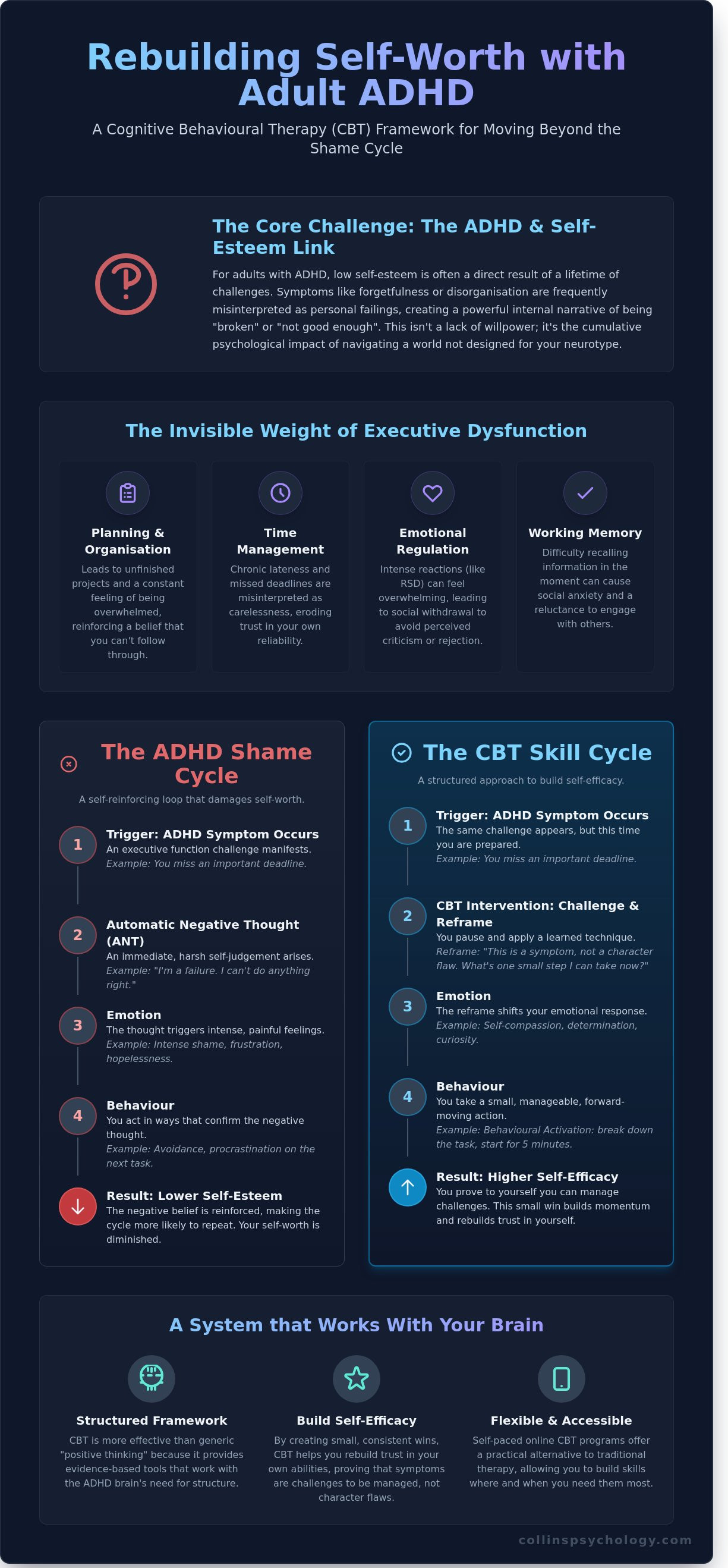
(The ADHD Shame Cycle)
Trigger
An ADHD symptom occurs (e.g., you miss a deadline).
Automatic Negative Thought (ANT)
"I am a failure. I can't do anything right."
Emotion
Intense shame, frustration, and hopelessness.
Behaviour
Avoidance, procrastination on the next task, social withdrawal.
Result
The negative belief is reinforced, and self-esteem lowers.
(The CBT Skill Cycle)
Trigger
An ADHD symptom occurs (e.g., you miss a deadline).
Identify the Thought
"I'm having the thought that I am a failure."
Challenge & Reframe
"Missing a deadline is a symptom of my executive function challenges, not a reflection of my worth. What is a more helpful next step?"
Emotion
Self-compassion, problem-solving mindset.
Behaviour
Break down the task, ask for help, or adjust the timeline.
Result
Self-efficacy is built, and the negative belief is weakened.
The Structured Approach of Collins Psychology
Collins Psychology provides structured systems that work with your brain, not against it. We offer self-paced learning because we understand that building new habits requires consistency, not intensity. Our programs break down complex skills into manageable modules, reducing the sense of overwhelm that so often accompanies ADHD. It is not therapy or coaching; it is a system that allows you to start where you struggle most and build your ADHD support system over time. You can explore the full CBT for Adult ADHD collection to find the entry point that is right for you.
Actionable CBT Techniques to Improve Self-Worth Today
You do not have to wait to begin changing your relationship with yourself. CBT offers practical techniques you can start using immediately to challenge negative self-talk and build a more balanced self-view. The goal is not to eliminate all negative thoughts but to learn how to respond to them differently. It is about building systems to stop relying on motivation and stop starting over every Monday.
Challenging the "I am a Failure" Narrative
A core CBT exercise is challenging your Automatic Negative Thoughts (ANTs). When you notice a critical thought like "I am a failure," pause and treat it as a hypothesis, not a fact. Ask for the evidence. What is the evidence for this thought? What is the evidence against it? This process helps you move from an emotional conclusion to a more logical one, allowing you to practise cognitive reframing. Cognitive reframing is the psychological process of identifying and then disputing irrational or unhelpful thoughts, which is a cornerstone of CBT. For example, you can reframe being late from "I am a bad person" to "I struggle with time perception, a common ADHD symptom, and I can work on strategies to manage it."
Building Self-Efficacy Through Goal Setting
Low self-esteem often comes from a history of not being able to trust yourself to follow through. Behavioural activation, a key component of CBT, helps rebuild this trust through small, tangible wins. By setting and achieving tiny goals, you create fresh evidence that you are capable. Using the SMART (Specific, Measurable, Achievable, Relevant, Time-bound) goal framework, adapted for the ADHD brain, is crucial. For a deeper dive into creating effective goals, our Goal Setting course provides a structured system to build your internal trust bank.
Accessing Structured Support with Self-Paced CBT Programs
Change is possible with the right tools and a system that fits your life. Collins Psychology provides structured, self-paced online programs designed specifically for the ADHD lifestyle, offering a professional alternative to one-to-one therapy. Our resources include practical exercises, tools, and flexible modules that empower you to learn and grow on your own terms. One system, multiple entry points, allows you to build a comprehensive support structure for your unique needs.
The Flexibility of Online Learning
Traditional therapy appointments can present significant barriers for adults with ADHD, including the time, cost, and executive function skills required to schedule and attend consistently. Online, self-paced learning removes these obstacles. You can engage with the material when your brain is most receptive, review lessons as often as needed, and integrate new skills into your life without the pressure of a fixed schedule. A great place to begin is by strengthening your core skills with our foundational Executive Function course.
Next Steps for Rebuilding Your Confidence
The journey to healthy self-worth is a marathon, not a sprint, but it is a journey you do not have to take without a map. By focusing on skill-building instead of vague "self-love," you can make measurable progress in dismantling the shame spiral and building genuine, lasting confidence. We invite you to explore our full curriculum and discover a new way to manage your ADHD.
Explore our CBT for Adult ADHD programs here.
Frequently Asked Questions
How does ADHD specifically cause low self-esteem in adults?
ADHD contributes to low self-esteem through the chronic, cumulative impact of its symptoms. Difficulties with executive functions like organisation, time management, and emotional regulation can lead to repeated negative experiences at school, work, and in relationships. Over time, this can create a core belief that one is inherently flawed, lazy, or incapable, rather than recognising these challenges as symptoms of a neurodevelopmental condition.
Can CBT really help if I have felt this way since childhood?
Yes. While these negative beliefs may be deeply ingrained, CBT is designed to address long-standing thought patterns. It provides a structured process for identifying the origins of these beliefs, evaluating their accuracy in your current life, and systematically developing new, more balanced, and compassionate ways of thinking and behaving. It is about building new neural pathways, which is possible at any age.
Is this program a substitute for a formal ADHD diagnosis?
No. Our programs are educational systems designed to help you build skills to manage ADHD-related challenges. They are not a substitute for a formal medical diagnosis or treatment from a qualified healthcare professional. A formal diagnosis is essential for a comprehensive understanding of your needs and to explore all available treatment options.
How long does it take to see improvements in self-esteem using CBT?
The timeline for improvement varies for each individual. However, many people begin to notice small shifts in their thinking and emotional responses within a few weeks of consistently applying CBT techniques. The key is consistent practice. Meaningful, lasting change in core beliefs about oneself typically develops over several months of dedicated effort.
What is the difference between ADHD coaching and a structured CBT program?
ADHD coaching is often goal-oriented and forward-looking, helping individuals develop practical strategies and accountability. Our structured CBT programs are different; they are evidence-based psychological systems that teach you how to fundamentally change the underlying thought patterns and behaviours that contribute to challenges like low self-esteem and emotional dysregulation. It is not coaching. It is a system.
Do I need to be on medication to benefit from these CBT strategies?
No. CBT skills are effective and can be beneficial for individuals whether they take ADHD medication or not. For many, a combination of medication (to manage core symptoms) and CBT (to build coping skills and address thought patterns) is a highly effective approach. However, our programs are designed to provide value as a standalone system for skill development.
What if I struggle to stay motivated with a self-paced online course?
This is a common concern for adults with ADHD. Our programs are designed with this in mind, breaking down information into short, digestible modules to minimise overwhelm. The self-paced nature allows you to work when you feel most focused. The key is to build a system: schedule short, regular times to engage with the material, just as you would any other important appointment, and focus on small, consistent progress rather than perfection.
Are these programs aligned with professional psychological guidelines?
Yes. The content and strategies taught in our programs are grounded in the established principles of Cognitive Behavioural Therapy, an evidence-based practice widely endorsed by psychological bodies, including the Psychological Society of Ireland (PSI) and the American Psychological Association (APA), for managing ADHD and related conditions.
References
Beaton, D. M., Sirois, F., & Milne, E. (2021). Appraising the role of the executive functions in the well-being of university students with and without ADHD. Journal of Attention Disorders, 25(14), 2009–2021. https://doi.org/10.1177/1087054720952002
Beck, J. S. (2011). Cognitive behavior therapy: Basics and beyond (2nd ed.). The Guilford Press.
Weibel, S., Giersch, A., Dehaene, S., & Foucher, J. R. (2019). Twenty-four-hour rhythm of self-esteem in adult patients with ADHD. Frontiers in Psychiatry, 10, 70. https://doi.org/10.3389/fpsyt.2019.00070