.png)

If you are an adult in Ireland with a recent ADHD diagnosis, or suspect you might have it, finding the right support can feel overwhelming. You are likely facing long waiting lists for public services and struggling to find private clinicians who offer practical, actionable strategies for the daily challenges of executive dysfunction and emotional regulation. This guide will help you move beyond simply searching for a name in a directory and empower you to identify a structured, evidence-based system that works with your brain, not against it. You will learn how to evaluate different approaches, understand the benefits of Cognitive Behavioural Therapy (CBT), and discover how a self-paced, online programme can provide the flexible support you need to build systems for a more focused and organised life.
Key Takeaways
Methodology Over Directories
The effectiveness of ADHD support lies in the clinical methodology used, not just the clinician's title. Structured Cognitive Behavioural Therapy (CBT) is a leading evidence-based approach for managing adult ADHD symptoms.
Core Skills for ADHD Management
Effective programmes focus on three key areas: improving executive functioning (planning and organisation), developing emotional regulation skills, and implementing structured goal-setting techniques.
Flexibility is Key
For many adults with ADHD, rigid weekly appointments are impractical. Self-paced, online learning programmes offer a flexible and accessible alternative to traditional one-to-one therapy, allowing you to learn and apply strategies on your own schedule.
Evaluating Quality
Look for programmes that are transparent about their approach, use evidence-based frameworks, are aligned with professional guidelines like those from the Psychological Society of Ireland (PSI), and provide clear, actionable tools rather than vague advice.
Table of Contents
• Navigating the Search for Adult ADHD Support in Ireland
• Defining ADHD-Informed Care: What to Look For
• Comparing Traditional 1-to-1 Therapy and Structured Online Programmes
• A Checklist for Evaluating an ADHD Programme's Approach
• Taking the Next Step with Collins Psychology Online Modules
Navigating the Search for Adult ADHD Support in Ireland
The landscape for adult ADHD services in Ireland presents significant challenges, from extensive waiting lists for assessment to a shortage of clinicians offering ongoing, practical support post-diagnosis. Many adults find themselves searching for help but are unsure what effective support actually looks like. It is crucial to distinguish between a one-off diagnostic service and the ongoing therapeutic support needed to manage the daily realities of ADHD. A diagnosis is a starting point, but the real work lies in developing systems to manage executive functions, emotional responses, and life administration.
When seeking support, it is important to find services aligned with the professional guidelines set by bodies like the Psychological Society of Ireland (PSI). This ensures the approach is grounded in ethical and evidence-based practice. For the ADHD brain, a structured, skills-based approach is often far more effective than traditional, unstructured talk therapy, as it provides the concrete tools needed to create lasting behavioural change.
According to Understanding Adult ADHD, this is a well-documented area of ongoing research and practical application.
The Difference Between Clinical Support and Coaching
It is important to understand the distinction between support provided by a registered psychologist and that offered by a coach. A psychologist provides evidence-based behavioural interventions rooted in clinical research and is bound by a strict ethical framework. This clinical oversight ensures a high standard of care and a deep understanding of the psychological principles that underpin ADHD challenges, such as working memory deficits and emotional dysregulation. While coaching can be helpful, a clinical approach provides a more robust and scientifically validated foundation for building management strategies.
Why Methodology Matters More Than a Directory Listing
General directories are useful for finding names and contact details, but they often lack information about a practitioner's specific methodology for working with ADHD. Simply having "ADHD" listed as an interest is not enough; the therapeutic framework is what drives results. Cognitive Behavioural Therapy (CBT) is widely recognised as a gold-standard, evidence-based approach for adult ADHD because it provides practical, structured strategies to change unhelpful thinking patterns and behaviours that impact daily functioning (Ramsay, 2017). This focus on actionable skills is perfectly suited to addressing the core challenges of ADHD, helping you to not only know what to do but actually do it.
Defining ADHD-Informed Care: What to Look For
True ADHD-informed care moves beyond generic productivity hacks and addresses the real-world impact of ADHD on your life, from managing work projects to navigating relationships. A central component of this is emotional regulation, as many adults with ADHD grapple with challenges like rejection sensitivity and frustration tolerance. Evidence-based strategies are specific, measurable, and drawn from clinical research, unlike the vague advice often found in self-help articles. This is why a structured framework is so important, as it prevents the "therapy drift" where sessions become unfocused, a common frustration for clients with ADHD seeking tangible outcomes.
An effective programme will provide you with a system to build skills incrementally. It acknowledges that living with ADHD requires a different approach to organisation and motivation. The goal is to stop relying on fleeting motivation and instead build reliable systems that work with your brain's unique wiring, helping you to stop starting over every Monday and create sustainable momentum.
Research published by Expert Insights on Adult ADHD shows that this is a well-documented area of ongoing research and practical application.
Core Pillars of Evidence-Based ADHD Management
A comprehensive approach to adult ADHD should be built on three core pillars. First is executive functioning, which involves learning concrete strategies for planning, prioritising tasks, and overcoming the inertia of task initiation. Second is emotional regulation, using a CBT lens to manage the intense emotional responses, rejection sensitivity, and frustration that often accompany ADHD. The third pillar is structured goal setting, which teaches you how to break down overwhelming long-term objectives into clear, manageable, and achievable steps.
Integrating Lifestyle Factors into Clinical Support
Effective ADHD management is not just about psychological tools; it also involves integrating supportive lifestyle habits. There is a strong clinical link between improved sleep quality and reduced ADHD symptom severity, making sleep hygiene a foundational part of any good programme. Similarly, regular physical activity is a powerful tool for improving focus and regulating dopamine, a key neurotransmitter involved in ADHD. A thorough programme will also address common life challenges, such as the unique difficulties of parenting when you have ADHD yourself, providing strategies to manage both your own needs and those of your family.
Build Your ADHD Support System
Finding the right support is not about finding a magic cure. It is about building a system of tools and strategies that work for your brain. This infographic outlines the key components of a structured, evidence-based approach.
FOUNDATION: Evidence-Based Methodology
Look for programmes built on Cognitive Behavioural Therapy (CBT), a clinically proven framework for managing adult ADHD.
PILLAR 1: Executive Function Skills
Learn practical techniques for time management, organisation, and planning. Stop starting over every Monday and build consistent habits.
PILLAR 2: Emotional Regulation Tools
Develop strategies to manage frustration, rejection sensitivity, and emotional reactivity. Understand your emotional triggers and learn to respond more calmly.
PILLAR 3: Lifestyle Integration
Incorporate foundational habits like better sleep and fitness to support brain function and improve focus.
THE GOAL: Sustainable Self-Management
Move from knowing what to do to actually doing it. Build a personalised system that allows you to manage your ADHD with confidence and consistency.
Not therapy. Not coaching. A system.
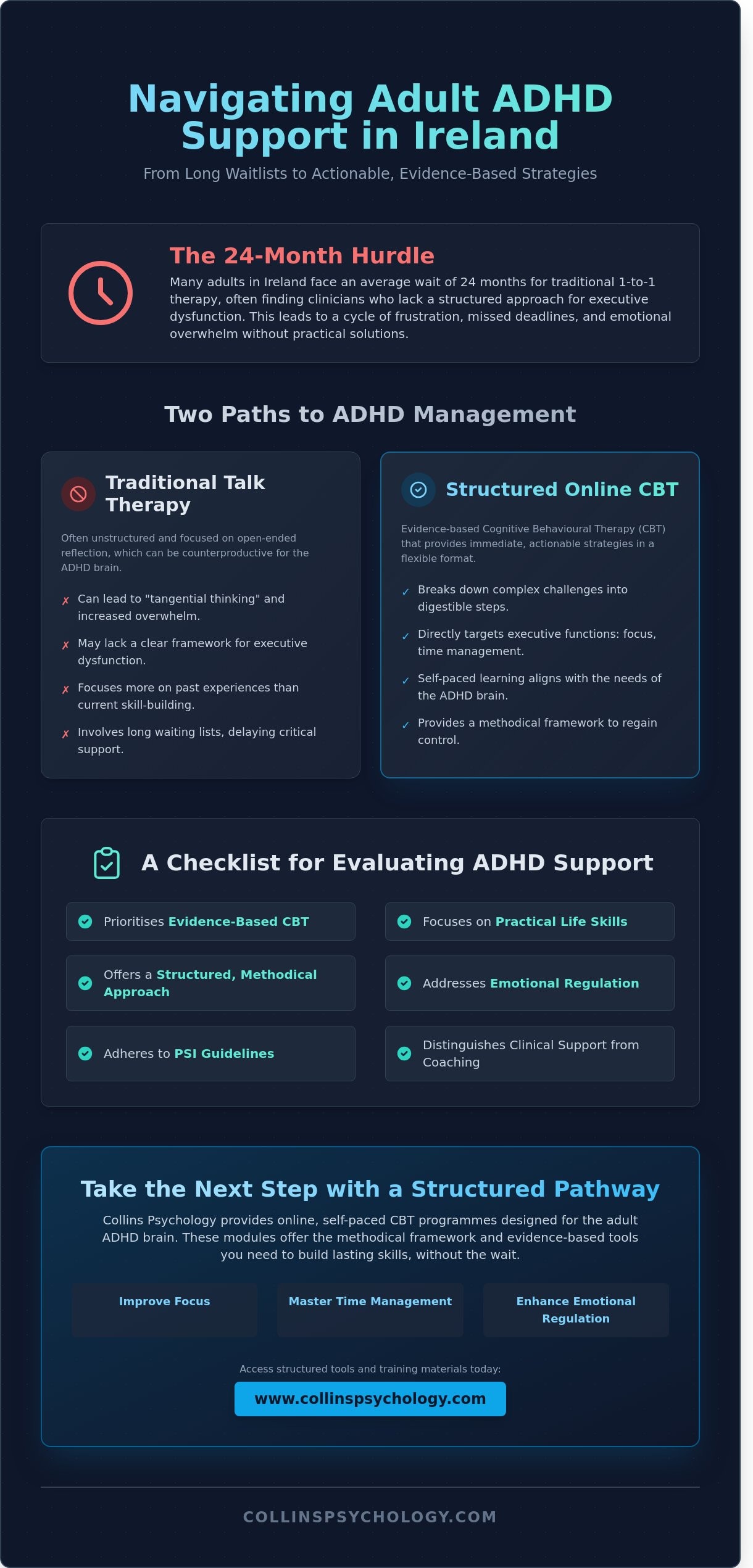
Comparing Traditional 1-to-1 Therapy and Structured Online Programmes
When considering support, it is important to evaluate the accessibility, cost, and effectiveness of different models available in Ireland and beyond. Traditional one-to-one therapy can be highly effective but often comes with high costs, long waiting lists, and the challenge of fitting rigid weekly appointments into a busy life. For adults with ADHD who struggle with time management and scheduling, this model can sometimes create more stress than it relieves.
This is where structured online programmes offer a powerful alternative. Collins Psychology provides online, self-paced CBT programmes designed specifically for adults with ADHD. It is important to be clear: we do not offer one-to-one therapy or diagnostic services. Our focus is on providing a structured, skills-based system that allows you to learn evidence-based strategies at your own pace, from anywhere in the world, including Ireland.
The Flexibility of Self-Paced CBT
The ability to learn at your own pace is a significant advantage for the ADHD brain. It removes the pressure and performance anxiety that can come with scheduled appointments, allowing you to engage with the material when you are most receptive. With our programmes, you receive long-term access to the modules, videos, and worksheets, meaning you can revisit key concepts whenever you need a refresher. This creates a lasting resource you can rely on as you continue to build your ADHD support system over time. You can start where you struggle most, with our range of self-paced collections offering multiple entry points to a single, cohesive system.
When a Structured Programme Outperforms 1-to-1 Sessions
A well-designed structured programme ensures that every user receives the same high-quality, consistent clinical information, which is something that can vary between individual therapists. Pre-recorded modules deliver a focused, evidence-based curriculum without distraction or 'drift'. The integrated self-reflection exercises and digital tools encourage you to internalise CBT strategies and apply them directly to your life, fostering genuine self-management skills. This model empowers you to track your own progress in areas like time management and focus, building confidence and a sense of agency over your own ADHD management.
A Checklist for Evaluating an ADHD Programme's Approach
When you are researching a psychologist or a programme for ADHD support, it is vital to look past the marketing and evaluate the substance of the approach. A credible programme will be transparent and grounded in scientific principles. This checklist can help you identify high-quality, evidence-based support for ADHD and avoid services that are unlikely to deliver meaningful results.
The following criteria will help you assess whether a programme is built on a solid clinical foundation. Ask these questions to ensure you are investing your time and resources into a system designed for long-term success. A reputable provider will be clear about what they offer and the clinical basis for their methods.
Is the approach based on Cognitive Behavioural Therapy (CBT)?
Ensure that CBT is explicitly named as the primary therapeutic intervention, as this is the most well-researched psychological approach for adult ADHD (Safren et al., 2010).
Does it address core ADHD challenges?
The content should specifically target executive function, emotional regulation, and time management, not just general wellbeing.
Is the content clinically supported?
Look for references to clinical research or professional guidelines. For instance, does the programme use APA style referencing to support its claims?
Is the format structured for adult learners?
The materials should be clear, organised, and broken down into manageable sections to suit the ADHD learning style.
Is the provider transparent?
The business model should be clear about what is and is not included, such as the absence of one-to-one therapy or diagnostic services.
Questions to Ask Before Enrolling in a Programme
Before committing to a programme, dig a little deeper into the specifics of what is offered. You should be able to get clear answers about the tools and strategies included. Ask what specific CBT techniques are taught for managing daily focus and procrastination. Enquire how the programme supports the development of better sleep and fitness habits as part of a holistic ADHD management plan. Finally, ask if the content is regularly updated to reflect modern psychological standards and research.
Identifying Red Flags in ADHD Support Marketing
Be cautious of vague promises that lack a clear clinical framework, such as claims to "unlock your potential" without explaining the methodology. The absence of references to evidence-based practices like CBT should be a significant concern. In Ireland, it is important to check for professional registration and adherence to clinical standards, but even for online programmes, a commitment to a governing ethical code is a mark of a credible provider. Avoid any service that promises a quick fix and instead look for one that focuses on building sustainable skills over time.
Taking the Next Step with Collins Psychology Online Modules
Collins Psychology provides a structured pathway for adults with ADHD who are tired of knowing what to do but still struggling to do it. Our online, self-paced programmes are designed to move you from a state of overwhelm to one of empowered self-management. The foundational strategies covered are all rooted in Cognitive Behavioural Therapy, providing a robust and evidence-based system for creating lasting behavioural change. This approach allows you to build systems that work with your brain, helping you achieve your goals with greater consistency and less stress.
Our model is built on the principle of "One system. Multiple entry points." This means you can begin with the area that is causing you the most difficulty right now, knowing it is part of a larger, integrated framework for comprehensive ADHD support. Whether you struggle most with emotional reactivity, procrastination, or planning, there is a starting point for you.
Targeted Modules for Specific ADHD Challenges
We offer several targeted programmes that allow you to focus your efforts where they are needed most. You can take a deep dive into managing frustration and rejection sensitivity with our course on CBT for ADHD Emotional Regulation. If your primary challenge is procrastination and organisation, you can build practical skills with the CBT for ADHD Executive Function course. For those who feel stuck and unable to move forward on big life goals, our module on CBT for ADHD Goal Setting provides a structured method for setting and achieving meaningful milestones.
Your Path to Better Focus and Time Management
These self-paced tools are designed to be integrated into a busy lifestyle, whether you are in Ireland or anywhere else in the world. The long-term benefit of this structured, evidence-based approach is the development of internal systems that you can rely on for life. It is not about finding more motivation; it is about building a reliable framework for focus, organisation, and emotional balance. If you are ready to stop the cycle of starting over and build a support system that truly understands the ADHD brain, we invite you to get started today.
Frequently Asked Questions (FAQs)
- Does Collins Psychology offer one-to-one therapy sessions for ADHD?
- No, Collins Psychology does not provide one-to-one therapy. Our focus is on delivering structured, self-paced online CBT programmes that teach you the skills to manage adult ADHD independently.
- Can a psychologist at Collins Psychology provide a formal ADHD diagnosis?
- No, we do not offer diagnostic services. Our programmes are designed for adults who already have a diagnosis or strongly suspect they have ADHD and are seeking practical management strategies.
- What is the benefit of a self-paced CBT programme over traditional therapy?
- A self-paced programme offers flexibility, allowing you to learn on your own schedule without the pressure of weekly appointments. It provides a consistent, structured curriculum and long-term access to materials, making it a cost-effective and accessible resource for building sustainable skills.
- Are the ADHD programmes at Collins Psychology suitable for children or adolescents?
- Our programmes are designed specifically for adults (18+) and the content is tailored to the challenges they face in work, relationships, and daily life.
- Do I need a referral from a GP to start an online ADHD programme?
- No, a GP referral is not required. You can enrol in our online programmes directly through our website whenever you are ready to begin.
- How long does it take to see results from a structured CBT approach for ADHD?
- The timeline for results varies for each individual. However, because the programmes are focused on practical, actionable skills, many users begin to see positive changes in their daily routines, focus, and emotional management within a few weeks of consistent engagement with the material.
- Is the content of the online modules clinically supported?
- Yes, all of our content is evidence-based and grounded in Cognitive Behavioural Therapy (CBT), a well-researched and effective approach for adult ADHD. We reference clinical literature to ensure our strategies are aligned with current professional standards.
- Can I access the ADHD modules from anywhere in Ireland?
- Yes, our online programmes are accessible from anywhere in Ireland and worldwide. All you need is an internet connection to access the learning materials on your computer, tablet, or smartphone.
References
Ramsay, J. R. (2017). Cognitive behavioral therapy for adult ADHD. Journal of Cognitive Psychotherapy, 31(1), 3-18.
Safren, S. A., Sprich, S. E., Mimiaga, M. J., Surman, C., Knouse, L., Groves, M., & Otto, M. W. (2010). A randomized controlled trial of cognitive behavioral therapy for ADHD in medication-treated adults. Journal of the American Medical Association, 304(8), 875-880.
Skirrow, C., & Asherson, P. (2013). Emotional lability, comorbidity and impairment in adults with attention-deficit hyperactivity disorder. Journal of Affective Disorders, 147(1-3), 80-86.
Disclaimer
Our programmes are designed to provide educational, evidence based CBT strategies to support adults with ADHD in everyday life. They are not a substitute for individual therapy or personalised care. If you are experiencing significant difficulties, we encourage you to seek support from a local qualified healthcare professional.