.png)
For adults with ADHD, the feeling of being a failure can become a constant, unwelcome companion. This article dismantles that cycle of inadequacy, explaining why the ADHD brain is prone to self-criticism and how the structured, evidence-based strategies of Cognitive Behavioural Therapy (CBT) can help you reframe your personal story. You will learn how to move beyond validation and into a clinical framework that helps you build a life defined by competence rather than frustration. It is time to stop relying on motivation and start building systems that work with your brain, so you can know what to do AND actually do it.
Key Takeaways
Failure is a Symptom, Not a Flaw
The feeling of failure in ADHD is often a result of a mismatch between a neurodivergent brain and neurotypical expectations, not a character deficit.
CBT Offers a Structured Path
Cognitive Behavioural Therapy provides a clear, evidence-based system for identifying and challenging the negative thought patterns that fuel the shame spiral.
Systems Trump Willpower
Lasting change comes from building reliable systems for time management, goal setting, and emotional regulation that support your executive functions, rather than relying on fluctuating motivation.
Physiology is Foundational
Consistent sleep and regular physical activity are not optional wellness trends; they are critical components for improving focus and emotional stability in adults with ADHD.
Table of Contents
• The Silent Burden of the ADHD Failure Narrative
• Why the ADHD Brain Defaults to Feeling Inadequate
• Breaking the Cycle: Using CBT to Challenge Cognitive Distortions
• Practical Strategies to Build Competence and Focus
• Navigating Your Path with Structured Online Support
The Silent Burden of the ADHD Failure Narrative
For many adults with ADHD, life can feel like a recurring pattern of high intentions, followed by the frustrating reality of executive dysfunction, and concluding with a wave of shame. This is the ADHD failure loop, a cycle that can erode self-worth over time. With each missed deadline, forgotten appointment, or unfinished project, you might add another piece of "proof" to an internalised Evidence Folder, reinforcing the core belief that you are simply not good enough. This emotional toll is often compounded by years of masking symptoms and trying to meet societal standards that were not designed for a neurodivergent brain.
The Psychological Impact of Late Diagnosis
Receiving an ADHD diagnosis in adulthood can bring a complex mix of relief and grief. While it is validating to finally have an explanation for lifelong struggles, it can also trigger a mourning process for the years spent feeling misunderstood and blaming yourself. Decades of undiagnosed ADHD often lead to a core belief of being fundamentally broken or lazy, a narrative that becomes deeply ingrained (Young & Bramham, 2012). The failure narrative is a byproduct of an environmental mismatch, where your brain's unique wiring was not supported, rather than a reflection of your true capabilities.
Comparison as the Thief of ADHD Joy
In our hyper-connected world, it is easy to fall into the trap of comparing your internal struggles to the curated external highlights of others. For adults with ADHD, this can be particularly damaging, as challenges with executive functioning and emotional regulation are largely invisible. Social media often amplifies the perception of being behind in life, whether in career, relationships, or personal achievements. A crucial step in breaking the failure cycle is to stop measuring your progress against neurotypical benchmarks and instead learn to set individual goals based on your own neurodivergent reality.
Why the ADHD Brain Defaults to Feeling Inadequate
The chronic feeling of inadequacy is not a personal failing; it has a biological basis rooted in the neuroscience of ADHD. The condition directly impacts executive functions, the brain's management system responsible for planning, organising, and executing tasks. This creates a significant gap between knowing what you need to do and being able to actually do it (Barkley, 2015). This struggle is often compounded by dopamine dysregulation, which affects motivation, and the intense emotional response of Rejection Sensitive Dysphoria (RSD), making perceived criticism feel catastrophic. These are clinically recognised challenges, not a result of a lack of effort.
Executive Functioning and the Intention Gap
Difficulties with working memory and task initiation are hallmarks of ADHD and a primary source of unfinished projects and unfulfilled intentions. You might map out a simple household task, like organising a wardrobe, but find yourself completely unable to start, leading to immense psychological distress. This intention-action gap is a direct result of executive dysfunction, not a moral failing. For those looking to build practical skills in this area, our structured CBT for ADHD executive function course provides deeper strategies to bridge that divide.
Emotional Regulation and the Shame Spiral
Emotional dysregulation in ADHD can amplify the sting of small mistakes, turning a minor error into a perceived catastrophe. A single forgotten email or a slightly burnt dinner can trigger a shame spiral, making you feel as though your entire identity has collapsed. This is because the ADHD brain can struggle to modulate emotional responses, leading to feelings that are disproportionate to the event. Learning to manage these intense emotions is fundamental, and our emotional regulation module offers practical, evidence-based tools to help you navigate these challenges without judgement.
Breaking the Cycle: Using CBT to Challenge Cognitive Distortions
Cognitive Behavioural Therapy (CBT) is widely recognised as a highly effective approach for managing the psychological impact of adult ADHD (Safren et al., 2017). It provides a structured system for identifying the connection between your thoughts, feelings, and behaviours, empowering you to interrupt the failure loop. In line with professional guidelines from bodies such as the Psychological Society of Ireland (PSI), evidence-based interventions like CBT offer a reliable path forward. These strategies are most effectively learned through structured programmes that guide you through the process step by step.
Common Cognitive Distortions in Adult ADHD
Cognitive distortions are unhelpful thinking patterns that reinforce negative feelings. For adults with ADHD, they often include:
All or Nothing Thinking
Viewing situations in black and white terms. For example, "If I don't complete this entire project perfectly, I am a complete failure."
Overgeneralisation
Taking one negative event and turning it into a never-ending pattern of defeat. For instance, "I forgot my keys again. This proves I will never be a responsible adult."
Emotional Reasoning
Believing that what you feel must be true. A common example is, "I feel like a failure, therefore I must be one."
The Process of Cognitive Restructuring
Cognitive restructuring is a core component of CBT that teaches you how to challenge these distortions. The process involves catching a negative thought before it triggers a shame spiral and actively looking for evidence that contradicts your failure narrative. For example, if you think, "I never finish anything," you would challenge this by listing projects you have completed, no matter how small. CBT does not ignore problems or encourage toxic positivity; instead, it provides a realistic framework for solving them by separating objective facts from subjective feelings.
Breaking The ADHD Failure Cycle
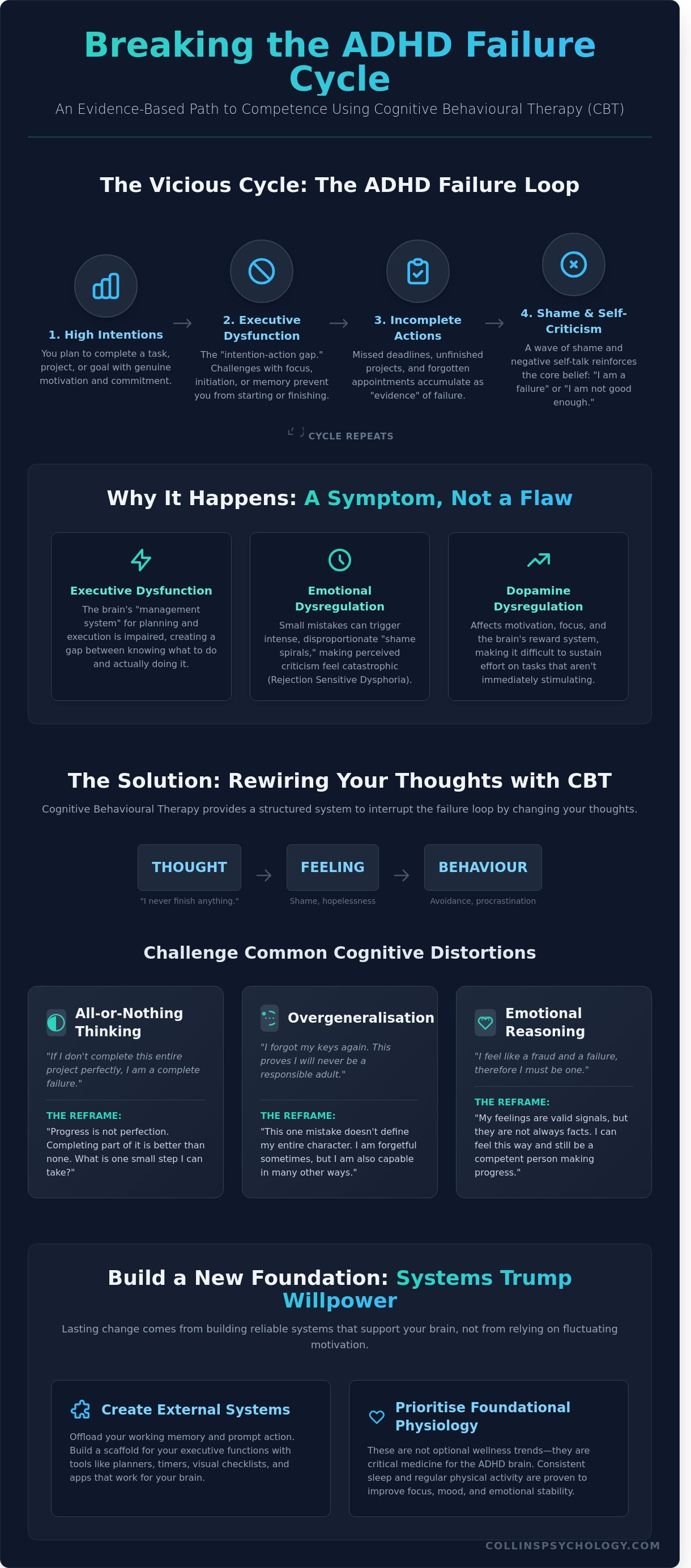
The Failure Loop (The Problem)
High Intention
"This time will be different! I am going to finish this."
Executive Dysfunction
Procrastination, distraction, and overwhelm kick in.
Incomplete Task
The project stalls or is abandoned.
Shame & Self-Criticism
"I have failed again. I am useless."
Reinforced Belief
The internal "I am a failure" evidence folder gets thicker.
The CBT System (The Solution)
Realistic Intention
"I will work on this for 25 minutes." (Micro-goal)
CBT Strategy
Use a visual timer and break the task down. (System)
Small Progress
A small part of the task is completed.
Self-Compassion & Evidence
"I did what I planned to do. I can make progress."
Reinforced Belief
The "I am competent" evidence folder starts to grow.
Practical Strategies to Build Competence and Focus
The goal is not to "fix" your ADHD brain, but to build effective systems that support it. This means shifting your focus from correcting perceived flaws to creating an environment where you can thrive. By setting achievable goals, you can generate a series of small wins that systematically rebuild self-esteem and create positive momentum. This process is supported by physiological foundations like sleep and fitness, and by leveraging external tools to compensate for internal challenges with willpower.
Goal Setting and Time Management for Real Life
Overwhelm is a significant barrier to progress for adults with ADHD. To combat this, introduce the concept of micro-goals, breaking down large tasks into small, manageable steps that can be completed in a short amount of time. Combine this with strategies like time-blocking and using visual timers to help manage time blindness and maintain focus. These techniques are not just productivity hacks; they are essential tools for working with your brain's natural tendencies. Our goal setting resources offer structured guidance on implementing these systems effectively.
The Foundation of Sleep, Fitness, and Focus
A consistent sleep routine is non-negotiable for managing ADHD, as poor sleep significantly impairs executive functioning the following day (Wajszilber et al., 2018). Similarly, regular physical activity has been clinically shown to improve dopamine levels, which can enhance concentration and mood. For parents with ADHD, maintaining these personal foundations can feel impossible, but even small adjustments, like a consistent bedtime or a short daily walk, can make a substantial difference. For more on this, you might find it helpful to read about a guide to focus and sleep.
Navigating Your Path with Structured Online Support
At Collins Psychology, we provide structured, self-paced CBT programmes for adults with ADHD. It is important to clarify that these are educational systems, not one-to-one therapy sessions. Our programmes are designed for adults who are tired of knowing what to do but still struggling to do it. This is not therapy and not coaching, but a system you can use to build your ADHD support structure over time, starting where you struggle most.
The Benefits of Self Paced Learning
A structured, modular approach is often more effective for the ADHD brain than traditional talk therapy. It allows you to learn at your own pace, focusing on the areas that are most relevant to your current challenges. The ability to revisit materials whenever a specific issue arises means you have a lifelong toolkit at your disposal. This flexible model provides access to evidence-based support from any location, fitting into your life rather than requiring you to fit into a rigid appointment schedule. You can view the full collection of courses to see the different entry points into the system.
Taking the First Step Toward Change
From my perspective as an Irish Psychologist, it is crucial to understand that feeling like a failure is a manageable symptom of ADHD, not a life sentence. The first step toward change is recognising that you can build systems that work with your brain instead of fighting against it. You have the capacity to reframe your story and build a life of competence and self-respect.
Ready to stop starting over every Monday? Start your journey with our evidence-based CBT for Adult ADHD programme.
Frequently Asked Questions
Is it normal to feel like a failure when you have ADHD?
Yes, it is very common. The chronic challenges with executive functions like task initiation, time management, and emotional regulation can lead to a long history of perceived failures, which builds a negative self-concept over time.
How does CBT help with the feeling of failure in adults?
CBT helps by teaching you to identify, challenge, and reframe the negative automatic thoughts and core beliefs that drive the feeling of failure. It provides a structured system to build more realistic and compassionate ways of thinking about yourself and your abilities.
Can I learn to manage my ADHD symptoms without one to one therapy?
Many adults find success using structured, self-paced educational programmes. These systems provide the evidence-based tools and strategies of CBT in a flexible format, allowing you to build skills independently. Collins Psychology provides these systems but does not offer one-to-one therapy.
What are the most common cognitive distortions for people with ADHD?
Common distortions include "all-or-nothing thinking" (seeing things as total success or total failure), "overgeneralisation" (one mistake means you will always fail), and "emotional reasoning" (believing "I feel like a failure, so I must be one").
Why do I feel behind in life compared to my friends?
This is often due to a combination of the invisible struggles of ADHD and the tendency to compare your internal reality with the external, often curated, successes of others. ADHD can impact the traditional timelines for career and life milestones, making direct comparisons unhelpful and disheartening.
What is the first step to breaking the ADHD shame spiral?
The first step is awareness. Learn to recognise the physical and mental signs that a shame spiral is beginning. Then, use a simple CBT technique to pause and question the thought that triggered it, asking yourself, "Is this thought 100% true?"
How do sleep and fitness affect my ability to focus with ADHD?
Sleep is crucial for brain restoration and directly impacts executive functions. Lack of sleep worsens ADHD symptoms. Fitness, particularly aerobic exercise, boosts dopamine and norepinephrine, neurotransmitters that are vital for focus and attention.
Are the Collins Psychology programmes suitable for a late diagnosis?
Absolutely. Our programmes are designed for adults with ADHD, many of whom receive their diagnosis later in life. The content addresses the long-term impact of living with undiagnosed ADHD, including low self-esteem and the ingrained feeling of failure.
References
Barkley, R. A. (2015). Attention-deficit hyperactivity disorder: A handbook for diagnosis and treatment (4th ed.). The Guilford Press.
Safren, S. A., Sprich, S. E., Perlman, C. A., & Otto, M. W. (2017). Mastering your adult ADHD: A cognitive-behavioral treatment program, therapist guide (2nd ed.). Oxford University Press.
Wajszilber, D., Santiseban, J. A., & Gruber, R. (2018). Sleep disorders in patients with ADHD: a review of the literature. Journal of the Canadian Academy of Child and Adolescent Psychiatry, 27(4), 226–236.
Young, S., & Bramham, J. (2012). Cognitive-behavioural therapy for adult ADHD: An integrative psychosocial and medical approach. John Wiley & Sons.