.png)

Key Takeaways
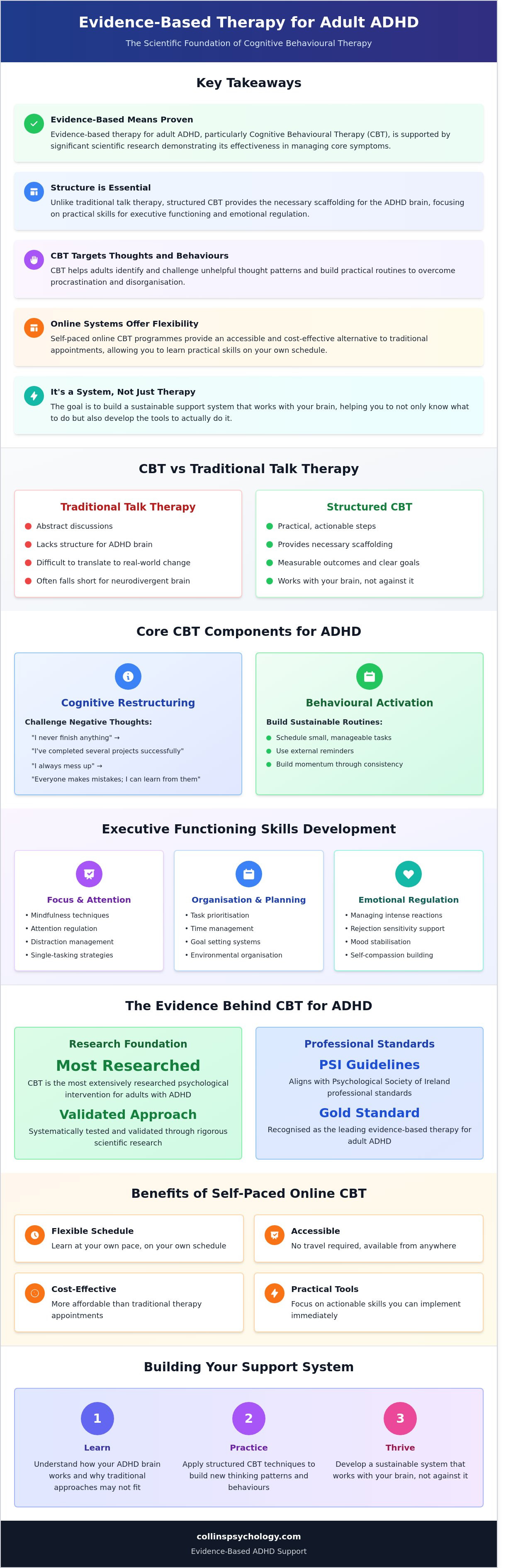
Evidence-Based Means Proven
Evidence-based therapy for adult ADHD, particularly Cognitive Behavioural Therapy (CBT), is supported by significant scientific research demonstrating its effectiveness in managing core symptoms.
Structure is Essential
Unlike traditional talk therapy, structured CBT provides the necessary scaffolding for the ADHD brain, focusing on practical skills for executive functioning and emotional regulation.
CBT Targets Thoughts and Behaviours
CBT helps adults identify and challenge unhelpful thought patterns and build practical routines to overcome procrastination and disorganisation.
Online Systems Offer Flexibility
Self-paced online CBT programmes provide an accessible and cost-effective alternative to traditional appointments, allowing you to learn practical skills on your own schedule.
It's a System, Not Just Therapy
The goal is to build a sustainable support system that works with your brain, helping you to not only know what to do but also develop the tools to actually do it.
Table of Contents
• Defining Evidence-Based Therapy for Adult ADHD
• The Role of Cognitive Behavioural Therapy in Managing ADHD Symptoms
• Practical Strategies for Executive Functioning and Emotional Regulation
• The Benefits of Self-Paced Online Learning for ADHD Support
• Accessing Structured CBT Programmes through Collins Psychology
Discover the scientific foundations of Cognitive Behavioural Therapy for adult ADHD and how structured online programmes provide practical tools for daily life. For adults with ADHD, sifting through generic advice and life hacks can be exhausting and unproductive. The search for what truly works often leads to evidence-based therapy, a term that signifies a commitment to methods proven effective through rigorous scientific research. This guide explores why structured Cognitive Behavioural Therapy (CBT) is considered a leading evidence-based therapy for ADHD and how modern, self-paced online systems make these powerful strategies more accessible than ever.
Defining Evidence-Based Therapy for Adult ADHD
In a clinical context, "evidence-based practice" means that therapeutic approaches are chosen based on the best available scientific research, clinical experience, and a person's individual values and preferences. This approach ensures that the support you receive is not based on guesswork but on methods that have been systematically tested and validated. For psychologists in Ireland, adhering to these standards is a core part of the professional guidelines set by the Psychological Society of Ireland (PSI), ensuring ethical and effective care. Adults with ADHD require different therapeutic strategies compared to children, focusing less on external management and more on developing internal skills for self-regulation, organisation, and emotional balance, marking a shift from purely medical models to empowering psychosocial skill-building.
The Gold Standard: Cognitive Behavioural Therapy
Cognitive Behavioural Therapy (CBT) is the most extensively researched and validated psychological intervention for adults with ADHD (Knouse & Safren, 2010). Its effectiveness lies in its practical and structured approach to understanding the powerful connection between our thoughts, emotions, and subsequent behaviours. Specifically for ADHD, CBT is adapted to target the core executive functioning and emotional regulation deficits that impact daily life, helping individuals develop coping skills to manage procrastination, inattention, and impulsivity (Safren et al., 2005). The therapy provides a clear framework for changing the unhelpful patterns that so often accompany an ADHD diagnosis.
Moving Beyond Traditional Talk Therapy
While traditional, non-structured talk therapy can be beneficial for many, it often falls short for the neurodivergent brain, which thrives on clarity, structure, and actionable steps. The executive function challenges inherent in ADHD can make it difficult to translate abstract discussions into real-world change. Structured programmes, in contrast, provide the necessary scaffolding for success by breaking down complex skills into manageable components. This focus on measurable outcomes and clear goal setting ensures that progress is tangible and empowering, helping you build systems that work with your brain rather than against it.
The Role of Cognitive Behavioural Therapy in Managing ADHD Symptoms
Cognitive Behavioural Therapy directly addresses the core challenges of adult ADHD by providing practical tools to modify both thinking patterns and behaviours. A key component of this evidence-based therapy for ADHD is psychoeducation, which involves learning about the neurobiological basis of ADHD, helping to de-stigmatise the condition and foster self-compassion. By understanding how the ADHD brain works, individuals can better implement CBT strategies for long-term symptom management. This process is also highly effective for addressing common co-occurring conditions like anxiety and low self-esteem, which often stem from a lifetime of misunderstanding one's own challenges (Ramsay & Rostain, 2015).
Cognitive Restructuring for ADHD
A cornerstone of CBT is cognitive restructuring, a process of identifying, questioning, and changing the negative thought patterns that fuel emotional distress and unhelpful behaviours. For many adults with ADHD, years of struggling with deadlines, organisation, or social cues can create a powerful inner critic and a deep-seated "failure" narrative. CBT provides a structured method to challenge these automatic thoughts, such as "I never finish anything" or "I always mess up." By learning to examine the evidence for these beliefs, you can reframe the 'failure' narrative and develop more balanced and adaptive ways of viewing your capabilities.
Behavioural Activation and Routine
Procrastination and difficulty with task initiation are hallmark struggles in adult ADHD, often driven by feelings of overwhelm. CBT utilises behavioural strategies, such as behavioural activation, to counteract this inertia by focusing on scheduling small, manageable, and rewarding activities. This process helps break the cycle of avoidance and builds momentum. Furthermore, CBT teaches the science of habit formation specifically adapted for the ADHD brain, emphasising the use of external reminders and consistent routines to compensate for internal organisational challenges. These are foundational strategies for managing disorganisation and poor time management and building sustainable daily structures.
Practical Strategies for Executive Functioning and Emotional Regulation
Executive functions are the high-level mental processes that allow us to plan, focus, remember instructions, and manage multiple tasks successfully. Evidence-based therapy for ADHD breaks these functions down into teachable skill sets, providing concrete techniques for improving focus, organisation, and time management. Alongside cognitive challenges, many adults with ADHD experience significant emotional dysregulation, characterised by intense emotional reactions and rapid mood shifts (Barkley, 2015). CBT offers specific strategies for managing these emotional challenges, including the intense fear of criticism or social rejection often referred to as rejection sensitive dysphoria (RSD).
Mastering Executive Functioning
Structured CBT programmes provide a toolkit of practical strategies to support and enhance executive functioning. This includes learning how to break large, intimidating projects into small, sequential steps, a technique that reduces overwhelm and makes it easier to get started. It also involves using external cues, such as calendars, timers, and visual reminders, to support internal cognitive processes that may be unreliable. These tools are not just life hacks; they are evidence-based interventions designed to create an external support structure that compensates for challenges with working memory and planning.
Learn more with our system for CBT for Executive Function.
Tools for Emotional Regulation
Managing intense emotions is a critical skill for adults with ADHD. CBT incorporates mindfulness-based techniques adapted for a wandering attention span, helping you notice your emotions without immediately being consumed by them. The goal is to develop a "pause" between an emotional trigger and your reaction, creating space to choose a more considered response rather than acting on impulse. This is particularly helpful for managing rejection sensitive dysphoria (RSD), as it allows you to challenge catastrophic interpretations of social interactions and regulate the intense feelings that follow.
The Benefits of Self-Paced Online Learning for ADHD Support
While effective, the traditional one-to-one therapy model does not suit everyone's life or learning style. Finding a clinician with availability can be difficult, and the pressure of weekly appointments can be a barrier for busy professionals, parents, or those who feel anxious in clinical settings. Self-paced online CBT programmes have emerged as a highly effective and flexible alternative, supported by research showing their efficacy in delivering psychological skills (Pettersson et al., 2017). These digital systems offer a cost-effective way to access high-quality, evidence-based content without the logistical challenges of in-person sessions.
Accessibility and Consistency
One of the greatest advantages of online learning systems is the removal of geographic barriers, giving you access to high-quality psychological support regardless of your location. You can work through the material at a pace that feels comfortable for you, which is particularly beneficial for the ADHD brain. The ability to revisit modules, worksheets, and tools whenever you need a refresher is invaluable for reinforcing new skills and maintaining momentum over the long term. This consistency is key to turning learned strategies into lasting habits.
A Focus on Skills over Appointments
Collins Psychology provides structured, CBT-based systems for adults with ADHD who are tired of knowing what to do but still struggling to do it. It is important to clarify that these programmes are not therapy or coaching, but a system designed for practical skill acquisition. Instead of focusing on appointment schedules, the emphasis is on building a personal library of resources and tools that are available to you 24/7. This model empowers you to be proactive, allowing you to build your ADHD support system over time and start where you struggle most.
Accessing Structured CBT Programmes through Collins Psychology
At Collins Psychology, we provide self-paced online CBT programmes designed specifically for the challenges of adult ADHD. Our business model is focused on delivering these high-quality digital resources directly to you, so we do not offer one-to-one therapy sessions. This approach allows us to help more people build the skills they need in a way that fits their lives. Our systems address core areas like executive functioning and emotional regulation, as well as specific life domains such as parenting, fitness, and sleep, providing multiple entry points to your journey toward better management.
The Collins Psychology Approach
Our dedication is to providing high-quality digital psychological tools that are grounded in evidence-based practice. Each module is carefully designed to be engaging and accessible for the adult ADHD experience, helping you stop relying on motivation and stop starting over every Monday. We encourage a proactive approach to mental health, empowering you to build systems that work with your brain. Our goal is to help you not only know what to do but to finally, and consistently, be able to do it.
Getting Started Today
Beginning your journey is straightforward. You can explore our available systems and choose the module that best addresses your most pressing challenges right now. With one system and multiple entry points, you can start where you struggle most and build from there. Upon enrolment, you gain immediate access to all the tools, video lessons, and exercises, allowing you to begin building your new support system without delay.
Explore our self-paced CBT programmes for adult ADHD and start building a system that works for you.
Frequently Asked Questions (FAQs)
What is the most effective evidence-based therapy for adult ADHD?
Research consistently points to Cognitive Behavioural Therapy (CBT) as one of the most effective and well-supported psychological interventions for adult ADHD. It provides practical skills for managing executive function deficits and emotional dysregulation.
Can I use CBT for ADHD if I am not taking medication?
Yes, absolutely. CBT can be effective as a standalone intervention or used in conjunction with medication. It focuses on building behavioural and cognitive skills that are beneficial regardless of medication status.
How does a self-paced programme differ from one-to-one therapy?
A self-paced programme provides structured learning content (videos, exercises, tools) that you work through independently on your own schedule. It focuses on skill acquisition rather than the conversational, dynamic relationship of one-to-one therapy, which involves live sessions with a clinician.
Is Cognitive Behavioural Therapy effective for emotional regulation in ADHD?
Yes, CBT is very effective for emotional regulation. It teaches you to identify triggers, challenge the unhelpful thoughts that intensify emotions, and use behavioural strategies to pause and respond more calmly rather than reacting impulsively.
How long does it take to see results from an ADHD CBT programme?
The timeline varies for each individual, but many people begin to notice positive changes within a few weeks of consistently applying the strategies. The self-paced nature allows you to work at a speed that is effective for you, and the skills you learn are designed for long-term benefit.
Are these programmes suitable for adults who were diagnosed later in life?
Yes, these programmes are ideal for adults diagnosed at any stage of life. They provide the foundational understanding and practical skills that are often missing for those who grew up without a diagnosis and the right support.
Do I need a formal diagnosis to start an online CBT programme?
No, a formal diagnosis is not required to benefit from our programmes. If you struggle with symptoms of inattention, disorganisation, procrastination, or emotional dysregulation, the skills taught in these systems will be relevant and helpful.
How can CBT help with ADHD-related parenting challenges?
CBT can help parents with ADHD develop better organisational systems for managing family life, improve their emotional regulation to respond more calmly to stress, and model effective problem-solving skills for their children.
References
Barkley, R. A. (2015). Attention-deficit hyperactivity disorder: A handbook for diagnosis and treatment (4th ed.). The Guilford Press.
Knouse, L. E., & Safren, S. A. (2010). Current status of cognitive behavioral therapy for adult ADHD. Journal of Consulting and Clinical Psychology, 78(6), 787–798. https://doi.org/10.1037/a0020984
Pettersson, R., Söderström, S., Edlund-Söderström, K., & Nilsson, K. W. (2017). Internet-based cognitive behavioral therapy for adults with ADHD in a psychiatric setting: A randomized controlled trial. Journal of Attention Disorders, 21(6), 508–521. https://doi.org/10.1177/1087054714539998
Ramsay, J. R., & Rostain, A. L. (2015). Cognitive-behavioral therapy for adult ADHD: An integrative psychosocial and medical approach (2nd ed.). Routledge.
Safren, S. A., Otto, M. W., Sprich, S., Winett, C. L., Wilens, T. E., & Biederman, J. (2005). Cognitive-behavioral therapy for ADHD in medication-treated adults with continued symptoms. Behaviour Research and Therapy, 43(7), 831–842. https://doi.org/10.1016/j.brat.2004.07.001