.png)

Struggling with focus, organisation, or intense emotions can leave you feeling overwhelmed and questioning whether your challenges are just personality flaws or something more. This guide helps you recognise the common, yet often subtle, signs of adult Attention-Deficit/Hyperactivity Disorder (ADHD). We will explore how ADHD presents in adulthood, moving beyond childhood stereotypes to focus on internalised experiences like emotional dysregulation and executive dysfunction. By understanding these signs, you can move from uncertainty to empowerment, learning how structured, self-paced Cognitive Behavioural Therapy (CBT) programmes can provide the systems you need to work with your brain, not against it.
Key Takeaways
Adult ADHD is Different
It often presents not as physical hyperactivity, but as internal restlessness, inattentiveness, and challenges with executive functions like planning and organisation.
Emotional Regulation is Key
Many adults with ADHD signs experience intense emotional responses, low frustration tolerance, and a cycle of procrastination and shame, which are frequently overlooked indicators.
It is Not Just Modern Distraction
While digital life affects everyone's focus, ADHD involves a lifelong, pervasive pattern of challenges across multiple areas of life, distinct from situational stress or burnout.
Executive Dysfunction Has Real-World Costs
Difficulties with time management, working memory, and task initiation can lead to practical problems, including financial strain (the "ADHD tax") and difficulties maintaining household routines.
CBT Offers a Path Forward
Structured, evidence-based CBT provides a non-medical route to managing ADHD signs by building practical skills and systems for emotional regulation, focus, and productivity.
Table of Contents
• Understanding the Adult Presentation of ADHD
• Emotional Regulation and the Internalised Experience of ADHD
• Distinguishing ADHD Signs from Modern Burnout and Stress
• Identifying Executive Functioning Challenges in Daily Life
• From Recognition to Management: The Role of Structured CBT Programmes
Understanding the Adult Presentation of ADHD
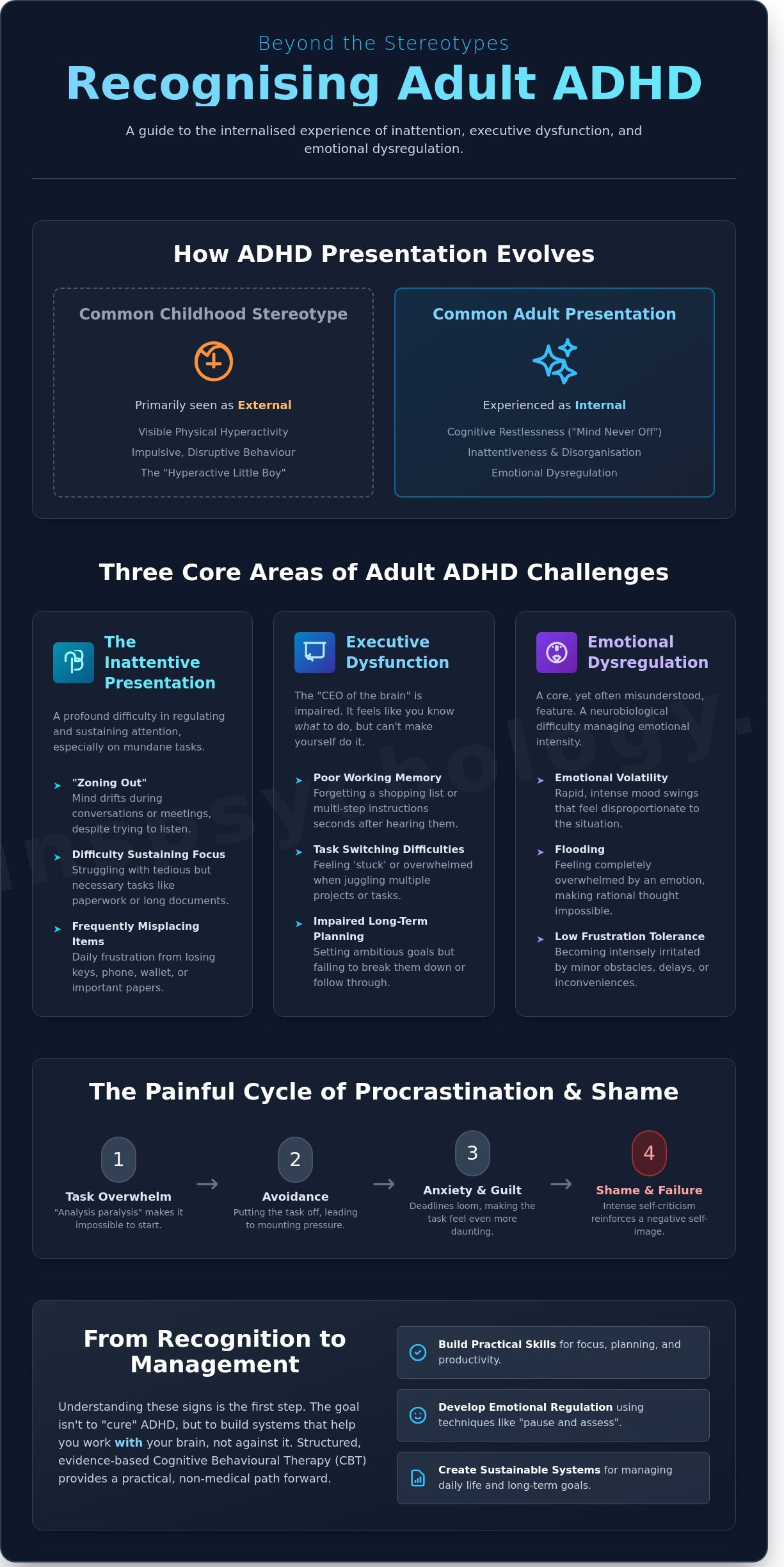
ADHD is a neurodevelopmental condition, meaning it originates in brain development and affects functioning throughout a person's life. In adults, the defining characteristic is a persistent impairment of executive functions, which are the cognitive processes responsible for managing ourselves and our resources to achieve goals (Ramsay, 2020). Many adults with ADHD were never identified as children because their symptoms did not fit the classic "hyperactive little boy" stereotype. The demands of adult life, such as managing finances, careers, and households, often amplify underlying executive function challenges that were previously less apparent.
The familiar image of physical hyperactivity frequently evolves into a more subtle, internalised experience. Adults may describe this as a constant cognitive restlessness, a mind that never switches off, or an inability to relax without feeling agitated. This internal state can be just as disruptive as external hyperactivity. This understanding aligns with professional guidelines from bodies like the Psychological Society of Ireland (PSI), which encourage a broader awareness of how neurodevelopmental conditions present across the lifespan.
The Inattentive Presentation in Adulthood
For many adults, the most prominent signs fall under the inattentive presentation. This is not simply a matter of being easily distracted; it is a profound difficulty in regulating and sustaining attention, especially on tasks that are mundane or uninteresting. Key signs include:
"Zoning out"
during conversations or meetings, even when you are trying to listen.
Difficulty sustaining focus
on necessary but tedious tasks, such as filling out forms, completing expense reports, or reading lengthy documents.
Frequently misplacing essential items
like keys, phones, wallets, or important paperwork, leading to daily frustration and wasted time.
Recognising Executive Dysfunction
Executive function is often described as the "CEO of the brain," responsible for planning, organising, initiating, and monitoring tasks (Barkley, 2012). When these functions are impaired, it can feel like you know what to do but simply cannot make yourself do it. This manifests as:
Poor working memory
Difficulty holding information in your mind to complete a task, such as remembering a short list of items from the shop or following multi-step instructions.
Task switching difficulties
Struggling to disengage from one activity and move to the next, or feeling overwhelmed when juggling multiple projects.
Impaired long-term planning
Setting ambitious goals but consistently failing to break them down into manageable steps or follow through on them.
Emotional Regulation and the Internalised Experience of ADHD
One of the most misunderstood and challenging aspects of adult ADHD is its impact on emotions. Emotional dysregulation is now recognised as a core feature of the condition for many adults (Shaw et al., 2014). This is not a matter of being "too sensitive"; it is a neurobiological difficulty in managing the intensity and duration of emotional responses. This can manifest as:
Emotional volatility
Experiencing rapid and intense mood swings that seem disproportionate to the situation.
Flooding
Feeling completely overwhelmed by an emotion, such as anger, frustration, or anxiety, to the point where rational thought becomes impossible.
Low frustration tolerance
Becoming quickly and intensely irritated by minor obstacles, delays, or inconveniences.
These emotional challenges can place significant strain on personal relationships, contribute to low self-esteem, and create a feeling of being constantly on edge. For many, this internal emotional turmoil is far more distressing than the more visible signs of inattention or disorganisation.
The Cycle of Procrastination and Shame
The combination of executive dysfunction and emotional dysregulation often creates a painful cycle of procrastination and shame. An inability to initiate a task, often due to feeling overwhelmed, leads to avoidance. As deadlines loom, anxiety and guilt build, which in turn makes the task seem even more daunting. This "analysis paralysis" can be debilitating. When the task is finally completed under immense pressure or missed entirely, the relief is often followed by intense self-criticism and feelings of failure, reinforcing a negative self-image.
CBT Strategies for Emotional Balance
Cognitive Behavioural Therapy (CBT) provides a structured, skills-based approach to managing this emotional fallout. It is not about eliminating emotions but about learning to respond to them more effectively. By identifying and challenging the unhelpful thought patterns that fuel emotional spirals, you can change your behavioural responses. For example, a simple "pause and assess" technique involves stopping before reacting, taking a few deep breaths, and asking yourself if your emotional response matches the reality of the situation. This creates a crucial gap between trigger and reaction. Our emotional regulation modules are designed to teach these cognitive reframing techniques in a systematic way.
Distinguishing ADHD Signs from Modern Burnout and Stress
A common objection is that "everyone has a bit of ADHD these days." The constant connectivity and information overload of modern life have certainly impacted everyone's ability to focus. However, it is crucial to distinguish between situational distraction and a neurodevelopmental condition. The key differences lie in duration and pervasiveness.
Duration
ADHD symptoms are lifelong. An adult with ADHD will be able to trace patterns of inattention, impulsivity, or emotional dysregulation back to childhood or adolescence, even if they were not labelled as such. Burnout or stress, in contrast, typically have a clearer starting point linked to a specific period of high pressure. You can find more information in our guide to understanding the ADHD burnout cycle.
Pervasiveness
ADHD signs affect multiple areas of life, including work, home, relationships, and hobbies. Stress-related inattention is often confined to the source of the stress, for example, only appearing at work.
Signs of Burnout versus ADHD
Onset
- Burnout: Develops after a prolonged period of intense stress or overwork
- ADHD: Symptoms are long-standing and typically present since childhood or adolescence
Cognition
- Burnout: Often experienced as brain fog or mental exhaustion
- ADHD: Often experienced as a racing mind or difficulty quieting thoughts
Energy
- Burnout: Marked by persistent fatigue and low motivation
- ADHD: Can include bursts of hyperfocus and high energy, alongside difficulty starting tasks
Context
- Burnout: Symptoms tend to improve with rest and reduced stress
- ADHD: Symptoms are ongoing and present even in low-stress situations, though stress can intensify them
When to Seek Further Professional Guidance
If you recognise a persistent and pervasive pattern of these signs in your own life, it may be helpful to gather more information. A good first step is to track your symptoms over a two or three-month period, noting how they impact different areas of your life. This can provide clarity and a valuable record. While a formal diagnosis requires a comprehensive clinical assessment, understanding your signs is the first step toward management. For general enquiries about our non-diagnostic, skills-based programmes, please use our contact page.
Identifying Executive Functioning Challenges in Daily Life
Executive function difficulties are not abstract concepts; they create tangible, everyday problems. In a professional setting, they can manifest as missing deadlines, forgetting important details in meetings, or struggling to manage complex projects. At home, they can lead to piles of unfolded laundry, a chronically disorganised kitchen, or difficulty establishing and maintaining routines.
This often results in what is known as the "ADHD tax," which refers to the financial costs incurred due to executive dysfunction. This includes late fees on forgotten bills, expired food that was never cooked, or paying extra for last-minute services because of poor planning (Faraone et al., 2021). Another common challenge is "time blindness," a consistent difficulty in perceiving the passage of time, which can lead to chronic lateness and unreliability in social and professional settings.
Time Management and Goal Setting
Traditional time management tools like detailed planners and to-do lists often fail for individuals with ADHD signs because they do not address the core issue of task initiation. A beautifully written plan is useless if you cannot start. A CBT-based approach focuses on building systems that work with your brain. This involves breaking "mammoth tasks" down into small, concrete micro-steps to lower the barrier to entry. Our programmes on structured goal setting teach you how to build these systems.
Impact on Home Life and Parenting
The demands of managing a household and raising children can be particularly challenging for adults with ADHD signs. The constant need for organisation, routine, and emotional regulation can feel overwhelming. A key strategy is to create "frictionless" systems, such as having designated places for essential items or automating bill payments, to reduce the daily cognitive load. Recognising how your own ADHD signs impact your parenting can also lead to more self-compassion and a search for more effective strategies, a topic we explore further in our article on how a psychologist can help you succeed with adult ADHD.
From Recognition to Management: The Role of Structured CBT Programmes
Recognising the signs of adult ADHD is the first step. The next is building a system for managing them. At Collins Psychology, we provide structured, self-paced online CBT programmes designed for adults who are tired of knowing what to do but still struggling to do it.
It is important to be clear about our model. We do not provide one-to-one therapy, formal diagnosis, or medication management. Our approach is educational and skills-based. It is not therapy. It is not coaching. It is a system. We provide the tools to help you build your ADHD support system over time, allowing you to start where you struggle most.
CBT is considered a gold standard approach for the non-medical management of adult ADHD symptoms (National Institute for Health and Care Excellence, 2018; Safren et al., 2017). It works by helping you understand the connection between your thoughts, emotions, and behaviours and provides practical strategies to change unhelpful patterns.
The Benefits of Self-Paced Learning
A structured, digital format is often well-suited to the ADHD brain. It provides the autonomy to learn at your own pace, engage with material when you are most focused, and revisit exercises as often as needed. Our programmes focus on practical skill development, with an emphasis on executive function training through downloadable tools and repeatable exercises.
This approach empowers you to:
Stop relying on motivation.
Stop starting over every Monday.
Build systems that work with your brain.
Know what to do AND actually do it.
Taking the First Step Toward Change
Understanding the "why" behind your struggles is validating, but real change comes from learning the "how." Moving from self-identification to active skill-building is the most crucial step you can take. Learning to work with your brain fosters self-compassion and replaces cycles of shame with a sense of competence and control.
If you are ready to move from recognition to action, we invite you to explore our comprehensive system.
Access our structured CBT programmes for Adult ADHD
Frequently Asked Questions
Is it possible to have ADHD and not be hyperactive as an adult?
Yes, absolutely. Many adults, particularly women, experience the inattentive presentation of ADHD. The hyperactivity often becomes internalised, presenting as a racing mind, restlessness, or an inability to relax, rather than overt physical movement.
How do I know if my focus issues are ADHD or just stress?
The key difference is the timeline and pervasiveness. ADHD signs are lifelong and typically affect multiple areas of your life (work, home, social). Stress-related focus issues usually have a more recent onset tied to a specific stressor and may resolve when the stress is removed.
Can I manage ADHD signs without taking medication?
Yes. While medication can be an effective tool for many, it is not the only option. Cognitive Behavioural Therapy (CBT) is an evidence-based approach that focuses on developing practical skills and strategies to manage the core challenges of ADHD, such as executive dysfunction and emotional dysregulation.
What is the "ADHD tax" and how can I avoid it?
The "ADHD tax" refers to the extra money spent due to symptoms like forgetfulness, poor planning, and impulsivity; for example, late fees, wasted food, or paying for express shipping. You can reduce it by building systems, such as automating bill payments, using shopping lists, and creating household routines that simplify daily tasks.
How does Cognitive Behavioural Therapy help with ADHD symptoms?
CBT helps you identify and change the unhelpful thinking patterns and behaviours that worsen ADHD challenges. It provides structured techniques for managing procrastination, regulating emotions, improving organisation, and breaking down overwhelming tasks into manageable steps.
Is an online CBT programme as effective as one-to-one therapy?
For many individuals seeking to build practical skills, a structured online programme can be highly effective. It offers flexibility, the ability to learn at your own pace, and the chance to revisit materials. It is a different model from one-to-one therapy, focused on providing a system and tools for self-management rather than traditional therapeutic processing.
What are the most common signs of ADHD in women?
In women, ADHD signs are often more internalised. Common signs include chronic disorganisation, feeling overwhelmed by daily tasks, intense emotional responses (sometimes misdiagnosed as anxiety or depression), people-pleasing tendencies to mask difficulties, and a persistent feeling of not living up to one's potential.
Can I start a CBT programme before receiving a formal diagnosis?
Yes. Our programmes are skills-based and designed to help anyone struggling with challenges related to executive function, emotional regulation, and focus, regardless of their diagnostic status. The strategies are beneficial for managing these symptoms, whether they are part of a formal ADHD profile or not.
References
Barkley, R. A. (2012). Executive functions: What they are, how they work, and why they evolved. The Guilford Press.
Faraone, S. V., Banaschewski, T., Coghill, D., Buitelaar, J. K., Danckaerts, M., Dopfner, M., ... & Zuddas, A. (2021). The World Federation of ADHD International Consensus Statement: 208 Evidence-based conclusions about the disorder. Neuroscience & Biobehavioral Reviews, 128, 789–818. https://doi.org/10.1016/j.neubiorev.2021.01.022
National Institute for Health and Care Excellence. (2018). Attention deficit hyperactivity disorder: diagnosis and management (NICE Guideline NG87). https://www.nice.org.uk/guidance/ng87
Ramsay, J. R. (2020). Rethinking adult ADHD: Helping clients turn intentions into actions. American Psychological Association.
Safren, S. A., Sprich, S. E., Perlman, C. A., & Otto, M. W. (2017). Mastering your adult ADHD: A cognitive-behavioral treatment program, therapist guide (2nd ed.). Oxford University Press.
Shaw, P., Stringaris, A., Nigg, J., & Leibenluft, E. (2014). Emotional dysregulation and attention-deficit/hyperactivity disorder. American Journal of Psychiatry, 171(3), 276–293. https://doi.org/10.1176/appi.ajp.2013.13070966