.png)

For many adults with Attention Deficit Hyperactivity Disorder (ADHD), the most persistent challenge is not the missed appointments or the misplaced keys, but a quiet, internal struggle with confidence and self-esteem. Years of feeling misunderstood, falling short of expectations, and battling with a brain that works differently can leave deep-seated feelings of inadequacy. This article explores the profound connection between adult ADHD and low self-esteem, examines the psychological mechanisms behind this link, and offers practical, evidence-based strategies to help you understand your experiences and begin rebuilding a healthier sense of self.
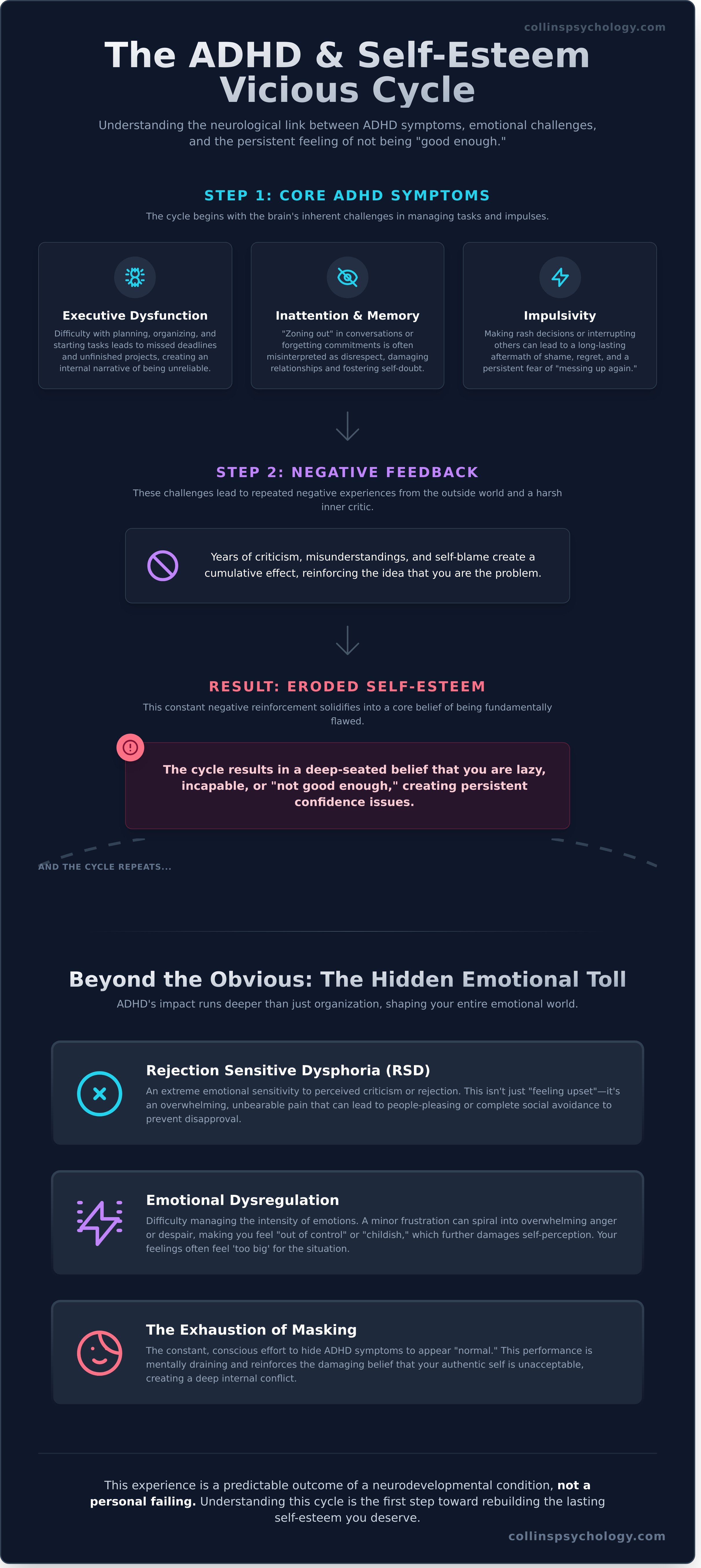
The Vicious Cycle: How Core ADHD Symptoms Erode Self-Esteem
Living with undiagnosed or unsupported ADHD can feel like running a race with your shoelaces tied together. The constant effort and frequent stumbles can create a vicious cycle of negative feedback. Over years, experiences of being told you are 'lazy' or 'not trying hard enough' can become internalised, leading to a core belief that you are somehow flawed or not good enough (Michielsen et al., 2013). It is crucial to understand that this is an incredibly common experience for adults with ADHD; it is a consequence of the condition, not a personal failing. The cumulative impact of daily struggles directly shapes how you see yourself.
Executive Dysfunction and the Feeling of Failure
Executive functions are the management system of the brain, responsible for skills like planning, organising, initiating tasks, and managing time (Barkley, 2015). When these functions are impaired, as they are in ADHD, the results manifest in everyday life. Missed deadlines, incomplete projects, and a constantly disorganised environment are not due to a lack of intelligence or effort, but a neurological difference. However, the outside world, and often our own inner critic, interprets these outcomes as personal failures. This can create a persistent narrative that you are unreliable, incompetent, or incapable of achieving your goals.
Inattention, Memory Lapses, and Self-Doubt
The inattentive aspects of ADHD can be just as damaging to self-worth. You might 'zone out' during important conversations, not because you are disinterested, but because your attention has been pulled elsewhere. Forgetting a friend's birthday, a partner's request, or a work commitment can strain relationships and erode trust. These repeated experiences can lead you to question your own mind. You might start to doubt your intelligence, your reliability, and your ability to be a good friend, partner, or colleague, fuelling a cycle of profound self-doubt.
Impulsivity and the Aftermath of Regret
ADHD-related impulsivity can mean speaking without thinking, making sudden decisions, or interrupting others. While not driven by malice, these actions can have significant social and personal consequences. The immediate aftermath is often a wave of shame, embarrassment, or regret. This feeling can lead to social anxiety, as you become afraid of 'messing up' again. You might start to see yourself as a liability in social situations, withdrawing to avoid the potential for regret and reinforcing the belief that you are somehow 'too much' for others.
Beyond the Obvious: The Hidden Emotional Toll of ADHD
The impact of ADHD on your life goes far beyond challenges with focus and organisation. The emotional components of the condition are often less discussed but can be the most damaging to your self-worth. The intense emotional experiences that many adults with ADHD face are valid and real. Understanding these hidden aspects is the first step toward healing the relationship you have with yourself.
Rejection Sensitivity: The Intense Fear of Criticism
Many people with ADHD experience an extreme emotional sensitivity to perceived rejection, criticism, or failure. This is often described as Rejection Sensitive Dysphoria (RSD). This is not a formal diagnosis but a term that describes a common experience of intense, painful emotional reactions to social feedback (Bunford et al., 2015). This heightened sensitivity can make you internalise even minor negative comments, viewing them as confirmation of your deepest insecurities. As a result, you might engage in intense people-pleasing to avoid disapproval or withdraw from social situations altogether to protect yourself from potential pain.
Emotional Dysregulation: Why Feelings Feel 'Too Big'
Emotional dysregulation, a core feature of ADHD for many, is the difficulty in managing the intensity and duration of emotional responses (Shaw et al., 2014). This can mean a small frustration quickly escalates into overwhelming anger, or a minor disappointment plunges you into deep despair. This volatility can be confusing and frightening, making you feel as though you are not in control of your own emotions. It can lead to a self-perception of being 'childish' or 'overly dramatic', further chipping away at your self-esteem.
The Exhaustion of Masking
Masking, or camouflaging, is the process of actively hiding your ADHD symptoms to fit in with neurotypical expectations (Miller et al., 2021). It involves immense effort to appear organised, attentive, and calm. You might double-check your work obsessively, rehearse conversations in your head, or suppress your natural energy levels. While it may be a useful survival strategy, masking is mentally and emotionally exhausting. More insidiously, it reinforces the damaging belief that your authentic self is unacceptable and must be hidden at all costs.
Rebuilding Your Foundation: 4 ADHD-Friendly Strategies for Better Self-Esteem
Understanding the 'why' behind your struggles is empowering, but the next step is taking action. The following strategies are designed to work with, not against, the ADHD brain. They are practical first steps toward breaking the negative cycle and fostering a mindset of self-compassion. Remember that this is a process, and patience with yourself is key.
Strategy 1: Externalise Your Executive Functions
Instead of relying on your brain's internal, and often unreliable, management system, offload that work onto external tools. 'Externalising' means using physical and digital systems to support your executive functions. This could involve using a large visual timer to track your focus, a physical planner to map out your day, or an app that reminds you of important tasks. Each time you successfully use a tool to complete a task, you build a small but powerful piece of evidence that you are competent and capable.
Strategy 2: Redefine 'Success' with Micro-Goals
All-or-nothing thinking is a common trap for the ADHD brain. A task either feels impossibly huge or not worth doing at all. The antidote is to break it down into micro-goals. If 'clean the kitchen' feels overwhelming, your first goal could be 'put one dish in the dishwasher'. Completing these tiny, achievable steps provides your brain with a small hit of dopamine, the neurotransmitter involved in motivation. This builds momentum and, more importantly, reframes success as a series of small, manageable wins rather than one monumental effort.
Strategy 3: Practise Self-Compassion and Reframe Negative Self-Talk
The harsh inner critic is a constant companion for many with ADHD. The first step is to notice the negative self-talk, such as "I'm so useless" or "I always mess things up". When you catch these thoughts, challenge them with a simple, three-step process:
Acknowledge
Notice the thought without judgement.
Challenge
Ask yourself, "Is this 100% true? What is a more balanced perspective?"
Reframe
Change the thought to something more compassionate and realistic, like "I'm struggling with this task because of my ADHD, but I am capable of figuring it out." Self-compassion means treating yourself with the same kindness you would offer a good friend who was struggling (Neff, 2011).
Strategy 4: Focus on Your ADHD Strengths
For years, you have likely focused on the deficits of ADHD. It is time to shift your focus to its inherent strengths. Many adults with ADHD are highly creative, excellent problem-solvers in a crisis, deeply empathetic, and capable of intense hyperfocus on subjects they are passionate about. Take a moment this week to identify one of your strengths. Make a conscious effort to use that strength, whether it is brainstorming a creative solution at work or dedicating time to a passion project. Acknowledging and using your strengths is fundamental to building a more balanced and authentic sense of self.
The Power of Structured Therapy: How CBT Can Re-wire Self-Perception
While the strategies above can make a significant difference, deep-seated negative beliefs about yourself can be difficult to change alone. For this, professional support within a structured framework can be invaluable. Cognitive Behavioural Therapy (CBT) is an evidence-based approach that has been adapted effectively to address the core challenges of adult ADHD (Ramsay, 2017). It provides a practical, skills-based method for changing the unhelpful thought patterns that erode self-esteem.
What is CBT and How Does it Work for ADHD?
CBT operates on the core principle that your thoughts, feelings, and behaviours are interconnected. For an adult with ADHD, a thought like "I forgot that appointment, I'm a complete failure" (thought) leads to feelings of shame and hopelessness (feelings), which might cause you to avoid looking at your calendar for the rest of the day (behaviour). A therapist helps you identify these cycles and the negative core beliefs that fuel them. CBT provides practical tools to challenge these beliefs with real-world evidence, helping you develop more balanced and helpful ways of thinking.
Targeting Specific Challenges with a CBT Programme
A structured CBT programme provides a clear roadmap for improvement, breaking down the overwhelming goal of 'feeling better' into manageable modules. You can learn specific skills for managing emotional regulation, improving executive function, and overcoming procrastination.
At Collins Psychology, we provide online, self-paced CBT programmes designed for the unique needs of adults with ADHD. It is important to note that we do not offer one-to-one therapy. Our programmes are created to be flexible, providing you with a wealth of resources, exercises, and tools that you can work through at your own pace, empowering you to build skills and confidence in a way that fits your life.
Learn how our structured CBT programme can help you build lasting confidence.
Frequently Asked Questions
Can ADHD medication help improve my self-esteem?
Medication for ADHD primarily targets core symptoms like inattention, hyperactivity, and impulsivity. By reducing these symptoms, medication can make it easier to succeed at tasks, which can indirectly improve self-esteem. However, it does not directly change the long-standing negative thought patterns and beliefs you may have about yourself. Therapy like CBT is often recommended alongside medication to address these deeper issues.
How do I know if my low self-esteem is from ADHD or something else, like depression?
There is a significant overlap between ADHD, anxiety, and depression, and they often coexist. Low self-esteem is a feature of all three. A key difference is the origin; in ADHD, low self-esteem is often rooted in a lifetime of challenges with executive function and emotional regulation. A mental health professional can help you understand the interplay between these conditions.
Is it ever too late to start working on confidence issues caused by a lifetime of ADHD?
It is never too late. The brain has a remarkable ability to change and learn at any age, a concept known as neuroplasticity. Learning new coping strategies and ways of thinking through a structured approach like CBT can help you reshape your self-perception and build confidence regardless of how long you have been struggling.
How is therapy for ADHD different from general talk therapy?
While general talk therapy can be helpful, therapy for ADHD is typically more active, skills-based, and present-focused. It concentrates on providing practical strategies for managing daily life challenges, rather than focusing primarily on past experiences. CBT for ADHD, for example, is highly structured and goal-oriented.
What's the first step I should take if I suspect my ADHD is harming my self-esteem?
A great first step is education. Reading articles like this one helps you understand that your struggles are a symptom, not a character flaw. The next step could be to start implementing one of the small, practical strategies mentioned above, like using a visual timer or breaking down a task. This begins the process of building evidence that you can make positive changes.
Why do I feel like an imposter even when I succeed at something?
This is often described as 'imposter syndrome' and is very common in adults with ADHD. It stems from a core belief that you are not truly competent, and that your successes are due to luck or tricking others. Because you are so used to struggling, success can feel unfamiliar and undeserved. CBT is an effective way to challenge the distorted thoughts that fuel imposter syndrome.
References
Barkley, R. A. (2015). Attention-deficit hyperactivity disorder: A handbook for diagnosis and treatment (4th ed.). The Guilford Press.
Bunford, N., Evans, S. W., & Wymbs, F. (2015). ADHD and emotion dysregulation among children and adolescents. Clinical Child and Family Psychology Review, 18(3), 185–217.
Michielsen, M., Semeijn, E., Comijs, H. C., van de Ven, P., Beekman, A. T., Deeg, D. J., & Kooij, J. S. (2013). The role of personality and social functioning in the association between ADHD and quality of life in older adults. Journal of Attention Disorders, 17(6), 507–516.
Miller, D., Luyten, P., & Fonagy, P. (2021). The role of social-camouflaging in the development of anxiety and depression in adults with ADHD. Journal of Affective Disorders, 293, 339-347.
Neff, K. D. (2011). Self-compassion: The proven power of being kind to yourself. William Morrow.
Ramsay, J. R. (2017). Cognitive behavioral therapy for adult ADHD: An integrative psychosocial and medical approach (2nd ed.). Routledge.
Shaw, P., Stringaris, A., Nigg, J., & Leibenluft, E. (2014). Emotional dysregulation and attention-deficit/hyperactivity disorder. The American Journal of Psychiatry, 171(3), 276–293.