.png)

Living with Adult ADHD can feel like navigating a constant state of chaos, where managing daily tasks, emotions, and focus becomes an overwhelming challenge. For adults looking for a practical, non-medication approach, structured Cognitive Behavioural Therapy (CBT) offers a clear path forward. This article explores how a self-paced, online CBT program provides the specific, evidence-based tools needed to master emotional regulation and executive functioning, allowing you to build a calmer, more competent life on your own terms, without the constraints of traditional therapy schedules.
Understanding Cognitive Behavioural Therapy for Adult ADHD
Cognitive Behavioural Therapy, or CBT, is a goal-oriented therapeutic approach that focuses on the powerful connection between our thoughts, feelings, and actions. It operates on the principle that by identifying and changing unhelpful thinking patterns, we can change our subsequent behaviours and emotional responses. Unlike traditional talk therapy, which can sometimes feel unstructured, CBT provides a practical framework with clear strategies. This structured nature is particularly effective for the ADHD brain, which thrives on clarity and actionable steps. All the methods discussed are grounded in evidence-based approaches, consistent with the high professional standards outlined by bodies.
Why Adult ADHD Requires a Unique Therapeutic Path
Many adults with ADHD receive their diagnosis later in life, having spent years developing complex coping mechanisms and grappling with a diminished sense of self-esteem. Behaviours often mistaken for laziness, such as procrastination, are frequently rooted in the anxiety and overwhelm that accompany executive functioning challenges (Ramsay, 2020). A therapeutic approach for adults must therefore go beyond general discussion and provide practical, skills-based interventions. It needs to address the real-world difficulties of managing a career, relationships, and home life while navigating the internal landscape of ADHD. For a deeper look into this approach, you can read our practical guide to Cognitive Behavioural Therapy (CBT).
The Core Pillars of CBT for Neurodivergence
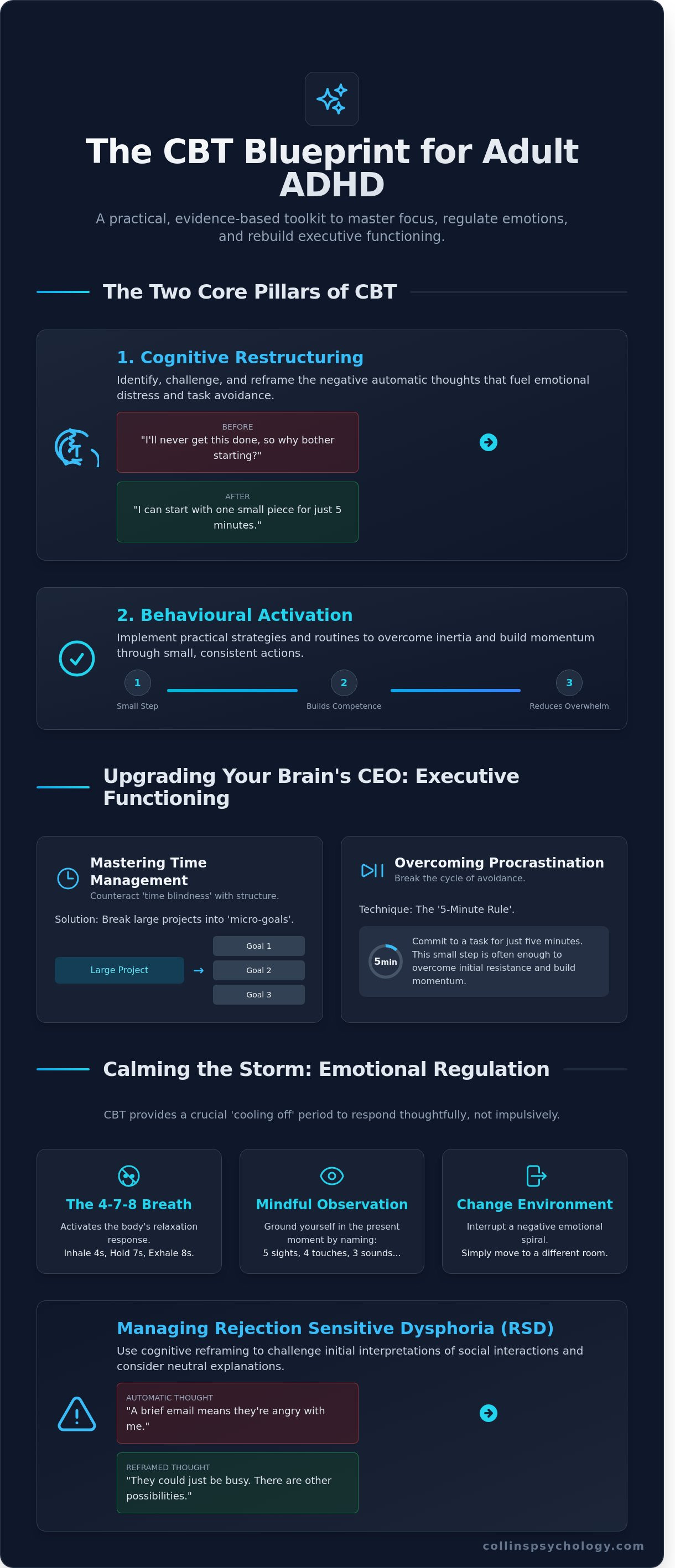
CBT for adult ADHD is built on two foundational pillars: cognitive restructuring and behavioural activation.
Cognitive Restructuring
This involves learning to identify, challenge, and reframe the negative automatic thoughts that fuel emotional distress and task avoidance. For example, changing "I'll never get this done, so why bother starting?" to "I can start with just one small piece of this task for five minutes."
Behavioural Activation
This pillar focuses on implementing practical strategies and routines to overcome inertia and build momentum. It’s about taking small, consistent actions that build competence and reduce feelings of being overwhelmed.
Together, these pillars help you construct a more structured and predictable lifestyle, and they are highly effective when delivered in a self-paced online format that allows you to learn and apply them in your own environment.
How CBT Rebuilds the Brain's Executive Functioning
Think of executive functioning as the management team or 'CEO' of your brain, responsible for planning, organising, initiating tasks, and regulating focus. In adults with ADHD, this internal CEO can be inconsistent. CBT provides the external scaffolding needed to support these internal cognitive deficits. By teaching tangible strategies for organisation and time management, CBT helps you build reliable systems outside of your head, reducing the cognitive load. Research consistently shows that this skills-based approach leads to significant improvements in focus, planning, and overall life management for adults with ADHD (Safren et al., 2010). These improvements are not abstract concepts; they are achievable results that come from dedicated practice with the right online resources.
Mastering Time Management and Goal Setting
A common experience for adults with ADHD is 'time blindness'—the persistent difficulty in sensing the passage of time. This can make planning and meeting deadlines feel impossible. CBT tackles this head-on by teaching you to break large, intimidating projects into manageable 'micro-goals'. This approach not only makes tasks less daunting but also provides a steady stream of accomplishments that build momentum. By creating clear, visual plans and external reminders, you can navigate your days with greater confidence.
Developing Focus and Overcoming Procrastination
Procrastination is rarely about laziness; it's often a response to cognitive distortions like 'all-or-nothing thinking' ("I have to do this perfectly or not at all") or 'catastrophising' ("If I fail at this, it will be a disaster"). CBT teaches you to recognise these thought patterns and counter them with behavioural strategies. One powerful technique is the 'five-minute rule', where you commit to working on a task for just five minutes. This small step is often enough to overcome the initial resistance. The structured modules within our online programs are specifically designed to help you maintain focus on the therapy itself, building your concentration skills as you learn. If you find yourself struggling, our guide on why adults with ADHD struggle with procrastination offers further insights.
Practical CBT Strategies for Emotional Regulation
The emotional component of adult ADHD is significant yet often overlooked. Intense feelings of frustration, impatience, and sensitivity can arise quickly, a phenomenon sometimes described as emotional 'flooding'. CBT provides a crucial 'cooling' period by teaching you to pause and identify the thought that triggered the intense emotion. Techniques like deep breathing, stepping away from a situation, or engaging in physical activity can create the space needed to respond thoughtfully rather than react impulsively. Furthermore, establishing consistent routines around fitness and sleep is fundamental to maintaining a stable emotional baseline.
Here are a few immediate techniques you can use to manage frustration:
The 4-7-8 Breath
Inhale for 4 seconds, hold for 7, and exhale slowly for 8. This activates the body's relaxation response.
Mindful Observation
Name five things you can see, four you can touch, three you can hear, two you can smell, and one you can taste. This grounds you in the present moment.
Change Your Environment
Simply moving to a different room can interrupt a negative emotional spiral.
Managing Rejection Sensitive Dysphoria (RSD)
Rejection Sensitive Dysphoria (RSD) is a term used to describe an extreme emotional sensitivity and pain triggered by the perception of being rejected, teased, or criticised. It is a common and challenging experience for many adults with ADHD. Using cognitive reframing, you can learn to question your initial interpretations of social interactions. For instance, you can learn to challenge the automatic thought that a colleague's brief email means they are angry with you, and instead consider alternative, more neutral explanations. This is a skill that can be developed over time, and a self-paced learning environment provides a safe space to practise without pressure. We offer more detailed guidance on unpacking Rejection Sensitive Dysphoria (RSD) for adults with ADHD.
Building Resilience Through Self-Paced Learning
The pressure of scheduled appointments can be a barrier to therapy. Online, self-paced programs remove this pressure, creating a sense of emotional safety that is conducive to learning. When you are feeling overwhelmed or are in a period of high stress, you have the ability to revisit specific exercises and modules on emotional regulation whenever you need them. This builds resilience by empowering you with the tools to manage your emotional state independently.
Why Structured Online Programs Outperform Traditional Methods
There is a common misconception that therapy is only effective when conducted one-to-one in a clinical setting. While that model works for some, a structured online program offers unique advantages for the ADHD brain. It is important to clarify that Collins Psychology does not offer one-to-one therapy. Our focus is entirely on providing high-quality, comprehensive online programs that empower you with lifelong skills. A key benefit of this model is the ability to 'learn in situ', you can immediately apply a strategy for managing distraction in your actual work environment, not just talk about it in an office. This real-world application is crucial for creating lasting change.
The Flexibility of the Self-Paced Model
Life with ADHD often involves fluctuating energy and focus levels. A rigid weekly appointment can be difficult to manage. With a self-paced model, you are in control. You can work through the material when you feel most receptive, repeat sections that are particularly relevant, and skip those you already feel confident with. This eliminates the 'therapy anxiety' associated with travel and scheduling, and ensures that your complete library of tools, worksheets, and exercises is accessible 24/7 on any device, whenever you need support.
Evidence-Based Tools at Your Fingertips
Our programs are designed to be a permanent reference library for managing adult ADHD. They include a variety of resources designed for different learning styles, such as concise video lessons, practical worksheets, and guided focus exercises. These digital tools are not just for one-time use; they are resources you can return to again and again as new challenges arise in your life. You can view the full collection of programs to see the breadth of support available.
The Collins Psychology Approach to Adult ADHD
At Collins Psychology, our philosophy, guided by Psychologist Elaine Collins, is rooted in a commitment to evidence-based practice and professional standards aligned with professional bodies. We focus on empowering adults by providing structured, accessible self-help programs that translate complex psychological principles into practical, everyday skills. Our programs are designed to address not just the core symptoms of ADHD, but also the broader life challenges that accompany it, such as navigating the demands of parenting or improving workplace performance. We provide a clear roadmap for your journey, helping you move from a life of chaos to one of calm and competence.
Comprehensive Support for Life's Challenges
The strategies you learn for managing ADHD have a positive ripple effect across all areas of your life. By improving executive functioning and emotional regulation, you will find it easier to establish and maintain healthy routines for sleep and fitness. The skills are also transferable to a professional context. For this reason, we also provide support for organisations looking to better understand and accommodate their neurodivergent staff members.
Enrol Today: Your Path to a Structured Life
The journey from chaos to calm begins with the decision to equip yourself with the right tools. Our structured CBT programs are designed to provide that toolkit, helping you build a life defined by your strengths, not your challenges. For daily tips and insights, you can follow us on Instagram.
When you are ready to start building a more structured and fulfilling life, we invite you to enrol in the CBT for Adult ADHD program.
Frequently Asked Questions
Is CBT effective for ADHD without using medication?
Yes, CBT is a highly effective, non-pharmacological approach for managing the core symptoms of adult ADHD. It focuses on building practical skills and strategies to improve executive functioning and emotional regulation, which can lead to significant life improvements, independent of medication.
How long does it take to see results from a self-paced CBT program?
The timeline for results varies from person to person. Because the program is self-paced, progress depends on your engagement. However, many individuals report noticing small but meaningful changes in their daily routines, focus, and emotional responses within the first few weeks of consistently applying the techniques.
Can I do CBT for ADHD online if I have trouble staying focused?
Absolutely. Our online programs are specifically designed for the ADHD brain. Lessons are broken down into short, digestible segments with clear, actionable takeaways. The flexibility to learn when your focus is at its peak, and to take breaks as needed, makes it a more manageable format than a traditional, hour-long therapy session.
What is the difference between a self-paced program and one-to-one therapy?
A self-paced program provides a structured curriculum of evidence-based tools and strategies that you can access anytime. It empowers you to learn and apply skills independently. One-to-one therapy involves scheduled, real-time sessions with a clinician. Collins Psychology focuses exclusively on providing high-quality, self-paced online programs and does not offer one-to-one therapy.
Does this program cover emotional regulation and RSD?
Yes, emotional regulation is a core component of our CBT program. We have dedicated modules that address emotional intensity, frustration tolerance, and specific strategies for managing Rejection Sensitive Dysphoria (RSD) through cognitive reframing and other techniques.
Are the Collins Psychology programs aligned with professional guidelines?
Yes, all of our programs and materials are developed in accordance with the professional and ethical guidelines of the Psychological Society of Ireland (PSI), ensuring you receive high-quality, evidence-based support.
What happens if I need help while completing the online modules?
Our programs are designed to be comprehensive and self-guided. While we do not offer one-to-one therapeutic support, each module contains detailed instructions and resources. For technical questions or issues accessing the material, you can reach out to our support team via the contact information on our website.
References
Ramsay, J. R. (2020). Rethinking Adult ADHD: Helping Clients Turn Intentions into Actions. American Psychological Association.
Safren, S. A., Sprich, S. E., Mimiaga, M. J., Surman, C., Knouse, L., & Otto, M. W. (2010). Cognitive behavioral therapy for ADHD in medication-treated adults with continued symptoms. Behaviour Research and Therapy, 48(11), 1161–1167.