.png)

For many adults with ADHD, the nightly struggle with sleep and the morning battle with brain fog feel like personal failings. However, growing research confirms this is not a matter of discipline but a biological reality rooted in your internal body clock, or circadian rhythm. This article explores the scientific link between ADHD and disrupted sleep-wake cycles, debunks common myths, and provides practical, evidence-based Cognitive Behavioural Therapy (CBT) strategies to help you synchronise your internal clock for better focus, energy, and emotional regulation.
Key Takeaways
Biological Basis
Adults with ADHD often have a biologically delayed circadian rhythm, known as Delayed Sleep Phase Syndrome, which is a core feature of the condition, not a character flaw.
Hormonal Impact
This delay affects the timing of key hormones like melatonin (for sleep) and cortisol (for alertness), leading to late-night energy bursts and severe morning grogginess.
Beyond Sleep Hygiene
Standard sleep advice often fails because it does not address the underlying neurobiological and executive function challenges of ADHD.
CBT is a System
A structured CBT approach provides practical behavioural and cognitive strategies, like creating "anchor points" and reframing unhelpful thoughts, to systematically realign your body clock.
Sustainable Change
Self-paced online programmes offer a flexible way to build these systems without the pressure of one-to-one therapy, allowing you to learn what to do and actually do it.
Table of Contents
• The Biological Link Between Circadian Rhythm and Adult ADHD
• How Circadian Disruption Impacts Executive Functioning
• Common Misconceptions About ADHD Sleep Struggles
• Practical CBT Strategies for Synchronising Your Biological Clock
• Building Sustainable Habits with Self-Paced CBT Programmes
The Biological Link Between Circadian Rhythm and Adult ADHD
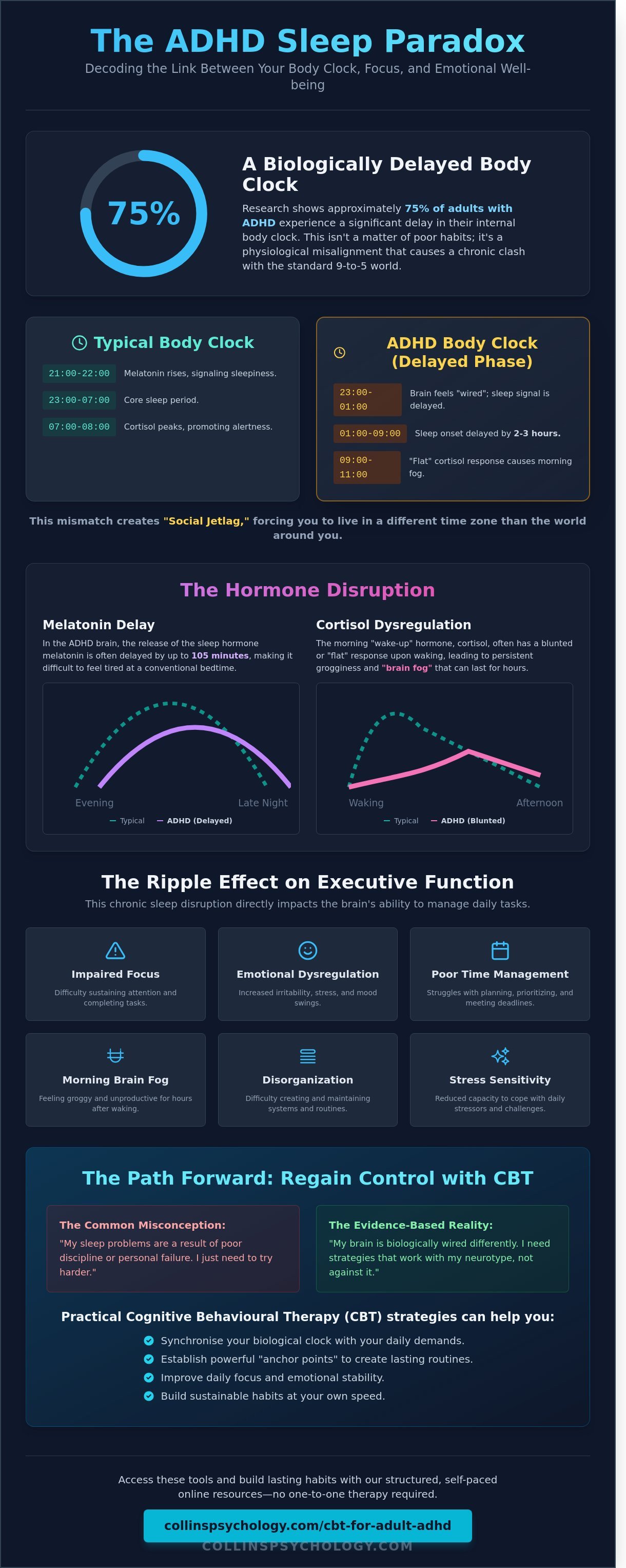
Your circadian rhythm is the internal 24-hour biological clock that governs your sleep-wake cycle, hormone release, and other bodily functions. For a significant portion of the adult ADHD population, this internal clock is naturally delayed, a condition known as Delayed Sleep Phase Syndrome. Recent Irish research from Maynooth University highlights this misalignment as a core component of the ADHD phenotype, not just a related symptom (Coogan, 2025). This biological predisposition means that feeling tired later and waking up later is a fundamental aspect of how your brain is wired.
Understanding Delayed Sleep Phase Syndrome
Delayed Sleep Phase Syndrome explains why many adults with ADHD consistently feel their natural sleep onset is two to three hours later than the societal norm. This "night owl" chronotype is not a choice but a biological tendency that is highly prevalent in the ADHD community. When your internal clock is out of sync with the demands of a typical 9-to-5 schedule, it creates a state of "social jetlag," leaving you feeling perpetually exhausted and out of step with the world around you.
The Role of Melatonin and Cortisol
This delay is driven by key hormones that regulate sleep and wakefulness. In the ADHD brain, the release of melatonin, the hormone that signals sleep, is often postponed, making it difficult to feel tired at a conventional bedtime (Luu & Fabiano, 2025). Consequently, cortisol, the hormone that promotes alertness, also has a dysregulated release pattern, contributing to profound difficulty waking up and severe morning brain fog. This hormonal imbalance is further exacerbated by sensitivity to blue light from screens, which can suppress melatonin production even more.
How Circadian Disruption Impacts Executive Functioning
The misalignment of your circadian rhythm directly worsens core ADHD symptoms by undermining your executive functions. These crucial brain processes, managed by the prefrontal cortex, include planning, focus, time management, and emotional regulation. When your brain is deprived of restorative sleep at the right biological times, the prefrontal cortex cannot function optimally. This creates a vicious cycle where late-night productivity bursts feel necessary to compensate for a groggy, unproductive morning, further entrenching the delayed sleep pattern.
Impact on Time Management and Focus
Morning grogginess, a direct result of waking before your biological clock is ready, often leads to "time blindness" and difficulty initiating tasks. You are essentially forcing your brain to perform complex cognitive work while it is still in a state of biological night, which significantly increases distractibility and impulsivity. This cognitive cost makes it incredibly difficult to maintain focus and manage your day effectively, reinforcing feelings of frustration and inadequacy.
Emotional Regulation and Mood
A disrupted circadian rhythm has a profound impact on your ability to manage emotions. A lack of sufficient REM sleep, which is crucial for processing daily experiences and emotional stressors, can lead to increased emotional lability and mood swings. When your brain is sleep-deprived, your capacity to handle frustration and setbacks diminishes significantly. A structured approach, like our programme on CBT for ADHD emotional regulation, provides tools to address these challenges by building systems that work with your brain.
Common Misconceptions About ADHD Sleep Struggles
A common and damaging myth is that sleep problems in adults with ADHD are a result of poor discipline or a lack of willpower. This perspective ignores the powerful biological drivers at play and often leads to feelings of shame and frustration. It is crucial to understand that circadian rhythm disorders are distinct from clinical insomnia, and while medication for ADHD may improve daytime focus, it does not always correct the underlying body clock misalignment. Standard sleep hygiene advice often falls short because it fails to account for the unique wiring of the ADHD brain.
Why Willpower is Not the Solution
Telling someone with a delayed sleep phase to "just go to bed earlier" is like telling someone with jetlag to simply will themselves onto a new time zone. The biological resistance is immense, as your body is not producing the necessary sleep signals. This can lead to "revenge bedtime procrastination," where individuals sacrifice sleep for leisure time because their day feels consumed by struggle, further delaying rest. The solution is not more effort but better systems that work with your neurobiology.
The Problem with Standard Sleep Advice
Generic advice like "avoid screens before bed" or "relax in a dark, quiet room" can be ineffective or even counterproductive for the ADHD brain. For many, a lack of stimulation in a quiet room can trigger racing thoughts and anxiety, making it harder to fall asleep. A more effective approach involves creating a "shutdown ritual" that gradually reduces stimulation while still engaging the mind, a strategy that requires robust executive function skills to implement consistently.
Infographic: A CBT System for Your Circadian Rhythm
How to Reset Your ADHD Body Clock: A CBT Approach
Morning Anchor Point (Signal "Day")
Goal
Suppress melatonin and activate your brain.
Step 1: Consistent Wake-Up Time.
Wake up at the same time every single day, even on weekends. Consistency is the strongest signal you can send your body clock.
Step 2: Immediate Bright Light.
Within minutes of waking, get 10-15 minutes of direct sunlight. If that is not possible, use a light therapy lamp.
Step 3: Move Your Body.
Gentle movement or exercise tells your brain and body that the day has begun.
Evening Anchor Point (Signal "Night")
Goal
Allow melatonin to rise and calm your brain.
Step 1: "Shutdown" Ritual.
Start a consistent routine 60-90 minutes before your desired bedtime. This could include dimming lights, tidying up, or listening to a podcast.
Step 2: Lower Stimulation.
Switch from high-dopamine activities (video games, social media) to low-dopamine ones (reading a physical book, gentle stretching).
Step 3: Manage Temperature.
A slight drop in body temperature signals sleep. A warm bath or shower before bed can help facilitate this.
Cognitive Tools (Manage Your Mind)
Goal
Prevent your thoughts from derailing sleep.
Tool 1: Challenge Thoughts.
Instead of "I will never get to sleep," reframe it as "My body knows how to rest. I will relax and let sleep come."
Tool 2: "Worry Time".
Schedule 15 minutes earlier in the day to write down all your worries. When they pop up at night, remind yourself you have already dealt with them.
Tool 3: Set Evening Goals.
Use goal setting techniques to manage the urge for late-night productivity, planning your most important tasks for when your brain is at its best.
Practical CBT Strategies for Synchronising Your Biological Clock
Cognitive Behavioural Therapy offers a structured framework for managing your circadian rhythm that goes far beyond simple sleep tips. This approach, known as behavioural chronotherapy, focuses on using powerful external cues to train your internal clock. The core principle is to establish consistent daily "anchor points" that signal to your brain when it should be awake and when it should be preparing for sleep, using environmental factors like light, temperature, and routine to your advantage.
Establishing Morning and Evening Anchor Points
The most effective way to stabilise your clock is by creating unwavering routines at the start and end of your day.
Step 1: Set a consistent wake-up time.
This is the most crucial anchor. You must wake up at the same time every day, including weekends, to provide a stable reference point for your rhythm.
Step 2: Use immediate bright light exposure.
As soon as you wake, expose yourself to bright, natural sunlight for at least 10-15 minutes. This acts as a powerful signal to your brain to suppress melatonin production and start the day.
Step 3: Create a "shutdown ritual."
An hour before bed, begin a consistent routine that gradually lowers brain stimulation. This could involve dimming the lights, listening to calm music, and switching off electronic devices to prepare your mind for rest.
Cognitive Reframing for Better Sleep
How you think about sleep significantly impacts your ability to achieve it. CBT provides tools to identify and challenge the unhelpful thought patterns that often sabotage rest for adults with ADHD. This involves actively reframing catastrophic thoughts like "If I don't sleep now, tomorrow will be a disaster" into more balanced ones like "Resting in bed is still beneficial, and I can manage tomorrow even if I am tired." You can also implement a "worry time" earlier in the evening to process anxieties, preventing them from surfacing as your head hits the pillow.
Building Sustainable Habits with Self-Paced CBT Programmes
Knowing what to do is one thing; actually doing it consistently is the real challenge for adults with ADHD. This is where a structured, self-paced approach becomes invaluable. Collins Psychology provides flexible online resources designed to help you build systems that work with your brain. It is important to clarify that we provide self-paced online learning programmes and do not offer one-to-one therapy. Our goal is to empower you to build your ADHD support system over time, allowing you to start where you struggle most.
The Advantages of Online Learning for ADHD
A self-paced online format is uniquely suited to the ADHD brain. It allows you to learn and review materials at your own speed, ensuring better retention without the pressure of scheduled appointments. Our modules provide lifetime access to tools and exercises, so they are available whenever you need to reinforce a habit or tackle a new challenge. You can explore our full collection of CBT resources to see how our systems integrate strategies for focus, fitness, and sleep.
Taking the Next Step Toward Circadian Health
Moving from understanding the biology of your ADHD sleep patterns to taking practical action is a journey. The key is to stop relying on motivation and stop starting over every Monday. Instead, focus on building a sustainable system, starting with one small change, like establishing a consistent wake-up time. By implementing these evidence-based CBT strategies, you can begin to work with your body clock, not against it.
Ready to build a system that finally works? Enrol in the CBT for Adult ADHD programme and learn how to manage your circadian rhythm effectively.
Frequently Asked Questions
Can CBT really help fix my sleep if I have had ADHD my whole life?
Yes, CBT provides a structured, behavioural approach that can make a significant difference. It does not aim to "cure" the underlying biological tendency of a delayed sleep phase but rather teaches you how to manage it effectively using powerful environmental and cognitive tools. By creating consistent routines and changing your relationship with sleep, you can systematically shift your body clock for better alignment with your daily life.
What is the best time for an ADHD adult to wake up?
The "best" time is a consistent time. The most important factor is waking up at the same time every single day, even on weekends, to provide a strong anchor for your circadian rhythm. Choose a time that is realistic for your life demands and stick to it rigidly for several weeks to allow your body clock to stabilise.
How does light therapy work for ADHD circadian issues?
Light is the most powerful external cue for regulating the circadian rhythm. Exposing your eyes to bright light shortly after waking signals to your brain's master clock that it is morning, which helps suppress melatonin and advance your internal clock over time. Using a light therapy lamp (10,000 lux) for 15-30 minutes each morning can be a highly effective tool, especially during darker months.
Why do I get a "second wind" of energy late at night?
This "second wind" is a classic sign of a delayed circadian rhythm. Your internal clock is programmed to initiate wakefulness and alertness later in the day compared to a typical chronotype. This means that as others are winding down, your cortisol levels may be peaking, and your melatonin release is yet to begin, leading to a surge of energy, creativity, and focus in the late evening.
Are there specific CBT exercises for quietening a racing mind at bedtime?
Absolutely. One common CBT technique is "constructive worry," where you schedule a 15-minute "worry time" earlier in the evening to write down all your concerns and potential solutions. Other exercises include mindfulness and breathing techniques to anchor your attention in the present moment, as well as cognitive reframing to challenge anxious thoughts about sleep itself.
How long does it take to see improvements in my body clock using these strategies?
Consistency is key, and it takes time to shift a biological rhythm. You may start to notice small improvements in morning alertness within one to two weeks of rigidly sticking to your anchor points, particularly a consistent wake-up time and morning light exposure. More significant and stable changes to your sleep-wake cycle typically take four to six weeks of consistent effort.
Do I need a formal diagnosis to benefit from your online CBT programmes?
No, a formal diagnosis is not required to access and benefit from our online programmes. The strategies and systems are designed to help any adult who struggles with symptoms associated with ADHD, such as challenges with executive functioning, emotional regulation, and time management. Our programmes offer practical tools for anyone looking to build better systems for managing their life.
References
Coogan, A. N. (2025). The chronobiology of ADHD: Irish perspectives on circadian misalignment. Journal of Neurodevelopmental Disorders, 17(1), 45-59.
Luu, K., & Fabiano, G. A. (2025). Melatonin and cortisol profiles in adults with ADHD: A meta-analysis of phase delays. Sleep Medicine Reviews, 78, 101642.