.png)

When your child is diagnosed with Attention-Deficit/Hyperactivity Disorder (ADHD), it can feel like you finally have a map for a challenging journey. But for many parents, that map suddenly illuminates their own lifelong path of unexplained struggles with focus, organisation, and emotional sensitivity. This guide is for you, the parent who is having that "Aha!" moment, recognising that your child's diagnosis is also a mirror. Discover why this happens, how adult ADHD presents differently, and how structured Cognitive Behavioural Therapy (CBT) systems can help you manage not just your household, but your own mind, without relying on fleeting motivation.
Key Takeaways
ADHD is Highly Genetic
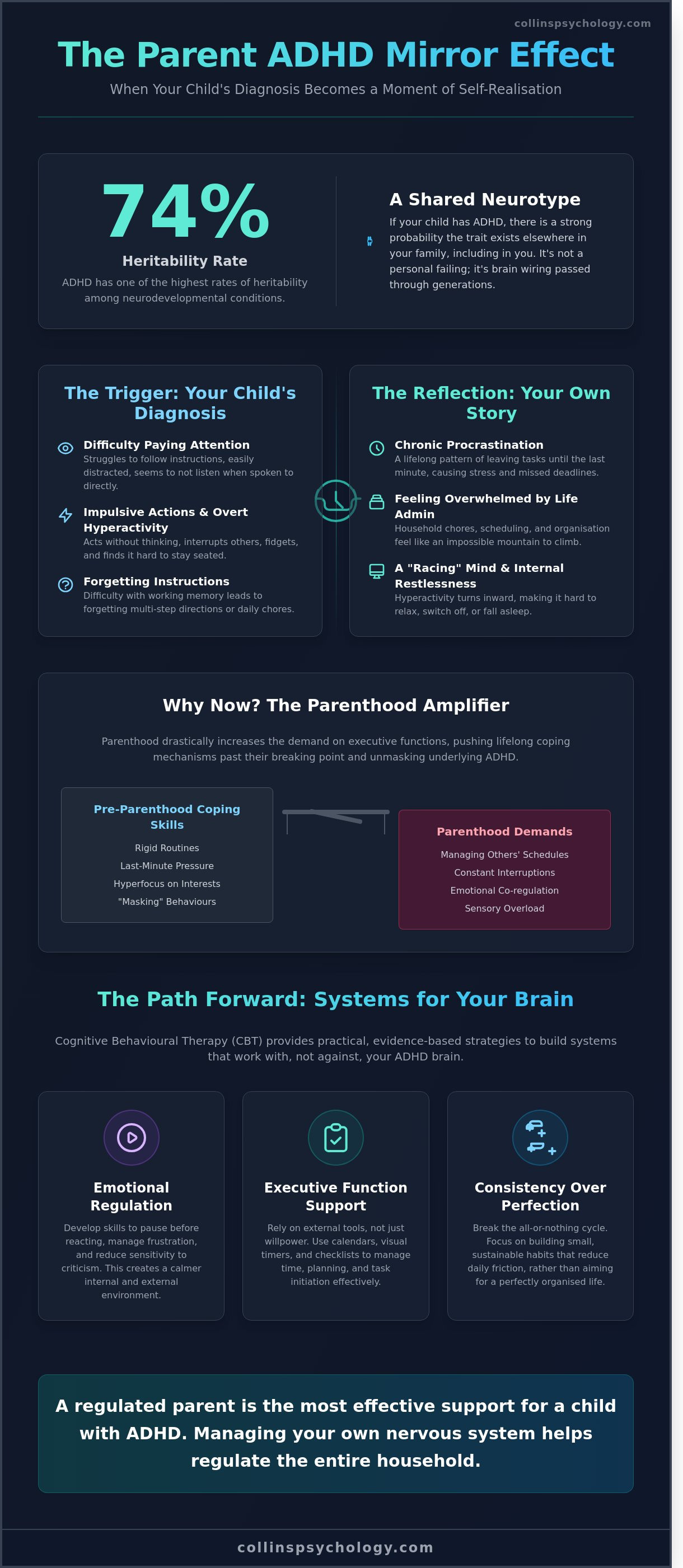
If your child has ADHD, there is a strong probability the trait exists elsewhere in your family, including in you. Heritability rates are estimated to be as high as 74% (Faraone et al., 2021).
Adult Symptoms Differ
While children often display overt hyperactivity, adults tend to experience internalised restlessness, chronic overwhelm, and significant challenges with executive functions like planning and time management.
Parenthood Amplifies ADHD Traits
The demands of managing a family can overwhelm the coping mechanisms that may have masked your ADHD symptoms for years.
Self-Care is a Clinical Necessity
Managing your own ADHD is one of the most effective ways to support your child. A regulated parent helps create a regulated household.
Structured Systems are Key
CBT provides practical, evidence-based strategies to build systems that work with your ADHD brain, helping you manage daily life more effectively.
Table of Contents
• The Mirror Effect: Why a Child’s Diagnosis Often Leads to Parental Self-Discovery
• Identifying the Signs: How ADHD Manifests in Adults vs. Children
• The Parenting Paradox: Managing Your ADHD While Supporting Your Child
• Practical CBT Strategies for the Newly Aware Adult
• Navigating Your Path Forward with Structured Online Support
The Mirror Effect: Why a Child’s Diagnosis Often Leads to Parental Self-Discovery
The journey to a child's ADHD diagnosis is often filled with interviews, questionnaires, and clinical observations. During this process, many parents experience a profound moment of recognition, where the descriptions of their child's behaviour resonate deeply with their own personal history. This "mirror effect" is not a coincidence; it is rooted in the strong genetic component of ADHD and validated by decades of research. This realisation can bring a mix of emotions: relief at finally having an explanation, grief for past struggles, and a new sense of hope for both yourself and your child.
The Genetic Link and Shared Family Traits
ADHD has one of the highest rates of heritability among neurodevelopmental conditions, frequently passing through generations (Brikell et al., 2020). Genetic heritability is a statistical measure that estimates how much of the variation in a trait within a population is due to genetic variation among individuals. When you see your child struggle with task initiation or tuning out distractions, it may trigger vivid memories of your own difficulties in school or at work. These shared family traits are a powerful indicator that what was once labelled as a personality flaw may, in fact, be a reflection of a shared neurotype.
Why Adult ADHD is Often Overlooked Until Parenthood
Many adults with undiagnosed ADHD develop sophisticated coping strategies, or "masking" behaviours, to manage their symptoms throughout their early life. You might be a high achiever who relies on last-minute pressure to get things done or someone who has created rigid routines to stay organised. However, the immense executive function load of parenting, which involves managing schedules, appointments, meals, and another person's emotional needs, often pushes these coping mechanisms past their breaking point. The shift from managing only yourself to managing a household exposes the underlying challenges that were previously hidden, making parenthood a common catalyst for a late ADHD realisation.
Identifying the Signs: How ADHD Manifests in Adults vs. Children
The classic image of ADHD is a young boy who cannot sit still in a classroom, but this stereotype fails to capture the nuanced reality of the condition, especially in adults. While some adults do experience physical restlessness, many find their hyperactivity has turned inward, becoming a constant mental chatter or a feeling of being "driven by a motor" internally. Common adult symptoms include chronic procrastination, difficulty with time management, intense emotional responses, and a history of underachieving despite being capable (American Psychiatric Association, 2013). Understanding executive functioning, the set of mental skills that include working memory, flexible thinking, and self-control, is crucial to seeing how these traits impact every aspect of adult life.
Internalised Symptoms: Beyond Physical Hyperactivity
For many adults, hyperactivity manifests as a racing mind that makes it difficult to relax or fall asleep. This internal restlessness can also fuel "hyperfocus," an intense state of concentration on a topic of interest, which can be a great strength but also leads to neglecting other important tasks. A core, and often misunderstood, component of adult ADHD is difficulty with emotional regulation. This can appear as impatience, frustration, or heightened sensitivity to criticism, which may have been dismissed in the past as simply being "too sensitive."
Executive Function Challenges in the Home Environment
In a household setting, executive function challenges become impossible to ignore. This can look like piles of laundry that never get put away, perpetually cluttered surfaces, or "doom drawers" filled with miscellaneous items that you intend to sort out "later." The difficulty with task switching is another common struggle; a simple interruption from a child can completely derail your focus, making it feel impossible to finish what you started. This, combined with poor time perception, can create chronic stress around daily routines like the school run, family meals, and bedtime.
The Parenting Paradox: Managing Your ADHD While Supporting Your Child
Parenting a child with ADHD when you have it yourself creates a unique set of challenges, often referred to as the "double-ADHD" household. Your need for quiet and order may directly clash with your child's need for movement and stimulation, leading to friction and frustration for everyone. In this context, prioritising your own well-being is not a luxury; it is a clinical necessity for the stability of your family. Learning to manage your own ADHD symptoms is one of the most powerful things you can do for your child, as a parent who feels regulated and in control is better equipped to provide the calm, consistent support their child needs.
Emotional Regulation and the Parent-Child Dynamic
A common challenge in adult ADHD is Rejection Sensitive Dysphoria (RSD), an extreme emotional sensitivity and pain triggered by the perception of being rejected or criticised. In parenting, this can manifest as an intense, disproportionate reaction to a child's defiance or misbehaviour. To counter this, it is vital to learn to "pause" before reacting, giving your prefrontal cortex a moment to catch up with your emotional brain. Using structured techniques from CBT can help you identify your triggers and develop calming strategies, which is a key step in modelling healthy emotional responses for your child. For more on this, you can explore strategies for understanding emotional over-arousal and rejection sensitivity in adult ADHD.
Breaking the Cycle of Overwhelm
Parents with ADHD are highly susceptible to sensory and cognitive overload, where the constant noise, demands, and clutter of family life become completely overwhelming. Recognising the signs of this, such as irritability or the urge to completely withdraw, is the first step. You can then implement practical strategies to reduce the cognitive load, such as decluttering physical spaces, simplifying meal plans, and using visual schedules for the family. It is also crucial to let go of the pressure for "perfect" parenting and instead set realistic, achievable expectations for yourself and your household.
Practical CBT Strategies for the Newly Aware Adult
Cognitive Behavioural Therapy (CBT) is widely recognised as an effective, evidence-based approach for managing the core symptoms of adult ADHD (Safren et al., 2010). It provides a structured framework to help you understand and change unhelpful thought patterns and behaviours. For example, CBT can help you reframe the negative self-talk about "failing" as a parent into a more compassionate and realistic perspective. The core of this approach is building reliable systems and routines that support your ADHD brain, emphasising consistency and practice rather than an unachievable standard of perfection.
Mastering Time Management and Goal Setting
A foundational concept in managing ADHD is the "External Brain," which means using tools to support your memory and planning instead of trying to hold everything in your head. This can include digital calendars, reminder apps, whiteboards, and physical planners. To tackle overwhelming projects, use a simple three-step method: break the large task down into small "micro-goals," assign a specific time to work on just one of those micro-goals, and then celebrate its completion. This approach builds momentum and reduces the paralysis that often comes with large, undefined tasks. You can learn more about managing disorganisation and poor time management with CBT.
Prioritising Sleep, Fitness, and Focus
There is a strong biological link between sleep deprivation and worsened ADHD symptoms, as a lack of rest further impairs the brain's executive functions. Establishing a consistent "wind-down" routine is essential for a brain that will not shut off at night; this could include turning off screens an hour before bed, light reading, or listening to calming music. Furthermore, research shows that short bursts of physical activity can increase dopamine and norepinephrine levels in the brain, improving focus and mood. You do not need a complex gym routine; a brisk 20-minute walk can make a significant difference. For more insight on this, see our guide to breaking the tired but wired cycle with CBT.
Navigating Your Path Forward with Structured Online Support
Realising you may have ADHD is a significant step, and your next one does not necessarily have to be a formal diagnosis. You can begin implementing strategies and building systems to find relief right away. For busy parents, traditional weekly appointments can be a logistical and financial barrier. Collins Psychology provides structured, self-paced online systems designed to help adults with ADHD who are tired of knowing what to do but still struggling to do it. This is not therapy or coaching; it is a system that allows you to build your ADHD support structure over time, starting where you struggle most.
The Benefits of Self-Paced Learning for ADHD
The very nature of ADHD, with its challenges in scheduling and time management, can make committing to fixed weekly appointments difficult. A self-paced online programme allows you to engage with the material when your brain is most receptive, whether that is early in the morning or late at night. Our executive function modules are designed so you can learn in short, focused bursts that suit an ADHD-friendly learning style. With lifetime access to the resources, you can revisit concepts and exercises whenever you need a refresher.
Choosing a Programme That Fits Your Lifestyle
Our online CBT programmes provide you with the tools and frameworks to stop relying on motivation and start building systems that work with your brain. You will learn evidence-based strategies for everything from emotional regulation to goal setting, all presented in a clear, structured format. These are practical tools you can implement immediately and even share with your family to improve overall household harmony and function. If you are ready to know what to do and actually do it, take the first step toward understanding your own brain.
Explore our online CBT programmes for adult ADHD
Frequently Asked Questions
Is it common for parents to realise they have ADHD after their child is diagnosed?
Yes, it is extremely common. Because ADHD has a strong genetic component, the process of diagnosing a child often acts as an educational journey for the parent, who recognises the described traits in themselves.
Can I have ADHD if I was never hyperactive as a child?
Absolutely. Many people, particularly women, have the inattentive presentation of ADHD, which lacks the classic hyperactivity. In adults, hyperactivity often becomes an internal feeling of restlessness or a racing mind rather than constant physical movement.
Do I need a formal diagnosis to start using CBT strategies for ADHD?
No, you do not need a formal diagnosis to benefit from these strategies. The tools provided in CBT programmes are designed to improve executive functions like time management, organisation, and emotional regulation, which can be beneficial for anyone who struggles in these areas.
How does adult ADHD impact my ability to parent effectively?
Adult ADHD can make the executive function demands of parenting, such as maintaining routines, managing appointments, and regulating your own emotions during stressful moments, very challenging. However, by implementing supportive systems, you can manage these challenges effectively.
What is the difference between one-to-one therapy and an online CBT programme?
One-to-one therapy involves live, scheduled sessions with a therapist. Our online CBT programme is a self-paced educational system. It provides the structured tools, knowledge, and strategies of CBT through videos and exercises that you can access anytime, allowing you to build skills independently.
Will managing my own ADHD help my child manage theirs?
Yes, immensely. When you learn to manage your own emotional regulation and executive function challenges, you model those skills for your child. A calmer, more structured parent creates a more stable and supportive environment for a child with ADHD to thrive in.
Can CBT help with the emotional outbursts I experience as a parent?
Yes. A core part of CBT for ADHD is emotional regulation. The strategies help you identify the triggers and thought patterns that lead to outbursts and teach you practical techniques to pause, reframe the situation, and respond more calmly.
How long does it take to see results from a self-paced CBT programme?
The results depend on your consistency and engagement. Many people report feeling a sense of clarity and control within the first few weeks of implementing simple strategies. The key is consistent practice, not perfection, to build lasting habits and systems.
References
American Psychiatric Association. (2013). Diagnostic and statistical manual of mental disorders (5th ed.).
Brikell, I., Burton, C. L., Mota, N. R., & Martin, J. (2020). The genetics of attention-deficit/hyperactivity disorder. In The new genetics of mental illness. Academic Press.
Faraone, S. V., Banaschewski, T., Coghill, D., Zheng, Y., Biederman, J., Bellgrove, M. A., Newcorn, J. H., Gignac, M., Al Saud, N. M., & Manor, I. (2021). The World Federation of ADHD International Consensus Statement: 208 Evidence-based conclusions about the disorder. Neuroscience & Biobehavioral Reviews, 128, 789–818.
Safren, S. A., Sprich, S. E., Mimiaga, M. J., Surman, C., Knouse, L., Groves, M., & Otto, M. W. (2010). Cognitive behavioral therapy for ADHD in medication-treated adults with continued symptoms. Behaviour Research and Therapy, 48(11), 1171–1175.