.png)

If you are an adult with ADHD, you likely know the frustration of trying traditional time management methods only to feel more overwhelmed. The cycle of chronic procrastination, difficulty estimating time, and the shame of disorganisation can be exhausting. This guide explores how Cognitive Behavioural Therapy (CBT) for time management and organisation offers a different approach, one that works with your ADHD brain instead of against it. Here, you will discover evidence-based psychological tools designed to help you build systems that stop the cycle of starting over every Monday and allow you to not only know what to do but to actually do it.
Key Takeaways
• Traditional time management tools like planners often fail adults with ADHD because they do not address the underlying executive dysfunction and cognitive patterns that drive procrastination.
• Cognitive Behavioural Therapy (CBT) provides a framework to identify and reframe the negative thought patterns, such as all-or-nothing thinking, that prevent you from starting and finishing tasks.
• Practical, CBT-based strategies like task chunking, time externalisation, and environmental design help reduce cognitive load and make organisation more manageable.
• Self-paced, online CBT programmes offer a flexible and effective way to learn these skills without the pressure of traditional therapy, allowing you to build a support system that fits your life.
Table of Contents
• Why Standard Time Management Fails the ADHD Brain
• Cognitive Restructuring: Challenging Thoughts That Fuel Procrastination
• Executive Functioning Tools: From Lists to Action
• Implementing Self-Paced CBT for Long-Term Organisation
• Enhancing Your Daily Life with Structured Online CBT
Why Standard Time Management Fails the ADHD Brain
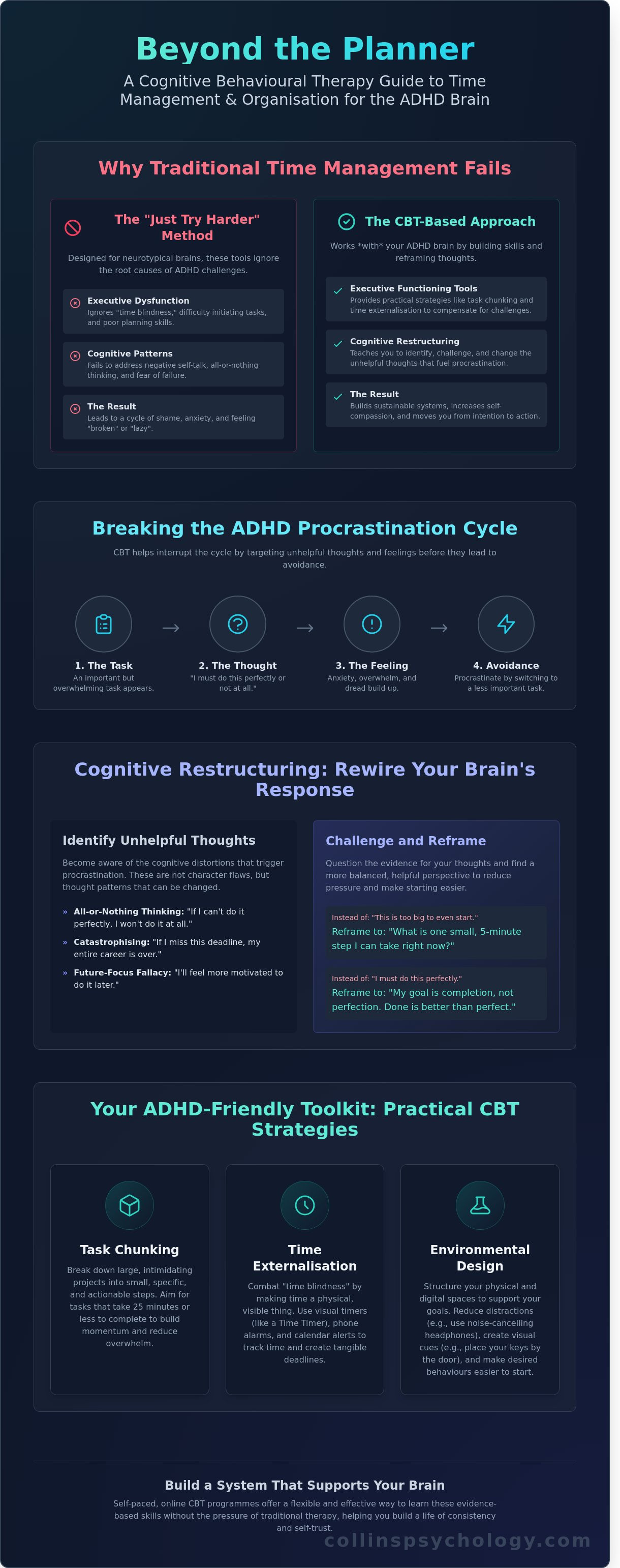
For many adults with ADHD, the advice to "just use a planner" or "make a to-do list" feels like a constant reminder of failure. These tools often do not work because they are designed for neurotypical brains and fail to account for the unique challenges of executive dysfunction. This disconnect can lead to increased feelings of shame and inadequacy, reinforcing the belief that you are simply not trying hard enough. Cognitive Behavioural Therapy offers a bridge, providing strategies that address the core cognitive and behavioural patterns associated with ADHD.
The Reality of Executive Dysfunction
Executive functions are the brain's management system, controlling tasks like planning, organising, initiating tasks, and regulating focus. In adults with ADHD, these functions are often impaired, leading to challenges like "time blindness" where estimating how long a task will take is incredibly difficult. Research has consistently shown that CBT tailored for adult ADHD can significantly improve these executive functioning skills, offering practical ways to manage daily life more effectively (Safren et al., 2005). This approach moves beyond simple tips and into building robust, sustainable systems.
According to Cognitive Behavioral Therapy, this is a well-documented area of ongoing research and practical application.
Moving Beyond Simple To-Do Lists
The barrier to getting things done is rarely a lack of knowledge; it is the psychological hurdle of starting. Procrastination in ADHD is not about laziness, but often stems from feeling overwhelmed, fearing failure, or struggling with task initiation. Evidence-based psychological interventions like CBT help you understand and tackle these mental blocks. By focusing on the thoughts and feelings behind your actions, you can develop a structure that supports your brain and helps you move from intention to action (Stevens et al., 2018).
Cognitive Restructuring: Challenging Thoughts That Fuel Procrastination
A core component of CBT is cognitive restructuring, a process of identifying, challenging, and changing unhelpful thought patterns. For adults with ADHD, these thoughts often manifest as cognitive distortions like "all-or-nothing thinking" ("If I cannot do it perfectly, I will not do it at all") or catastrophising ("If I miss this deadline, my career is over"). This negative self-talk directly impacts motivation, making it feel impossible to start even simple tasks and fuelling a cycle of avoidance and anxiety.
Identifying Your Cognitive Triggers
The first step is to become aware of the specific thoughts that trigger your procrastination. Common examples include "I will feel more like doing it later," "This is too big to even start," or "I work better under pressure." These thoughts can lead to a "shame spiral," where missed deadlines and disorganisation reinforce negative beliefs about yourself. A simple and effective self-monitoring exercise is to jot down these thoughts in a notebook or on your phone whenever you notice yourself avoiding a task, without judgment.
Research published by ADHD treatment options shows that this is a well-documented area of ongoing research and practical application.
Strategies for Reframing Negative Beliefs
Once you have identified these thoughts, you can begin to challenge them by questioning the evidence. Ask yourself: "Is it really true that I will have more energy later?" or "What is a small, imperfect step I can take right now?" The goal is not to force positive thinking but to find a more balanced and helpful perspective. For example, instead of "This must be perfect," you could reframe it as, "My goal is to complete this task, not to achieve perfection." This shift reduces the pressure and makes it easier to begin. For more practical exercises, our programmes on CBT for goal setting provide a structured system for applying these techniques.
Executive Functioning Tools: From Lists to Action
Cognitive restructuring is powerful, but it works best when combined with practical, behavioural tools that support your executive functions. These strategies are not about finding the "perfect" planner but about creating external systems that reduce the mental effort required to stay organised. By modifying your environment and your approach to tasks, you can make it easier for your brain to focus and follow through. These tools are designed to help you build systems that work with your brain, not against it.
Mastering Task Breakdown and Prioritisation
Large, complex projects are a common source of overwhelm for the ADHD brain. The "chunking" method involves breaking down a big task into its smallest, most manageable components. For example, instead of "write report," the first step might be "open a new document and write a title." This technique lowers the barrier to entry and generates momentum. Learning to distinguish between what is urgent and what is truly important also helps you allocate your energy more effectively. Our executive function course provides in-depth guidance on these prioritisation frameworks.
Externalising Time and Organisation
To combat time blindness, it is essential to make time visible and tangible. Using visual timers, setting alarms for transitions, and keeping clocks in your line of sight can help you stay grounded in the present moment. Another helpful concept is creating a "launchpad" by your door with all your daily essentials like keys, wallet, and phone. These external systems act as an extension of your working memory, reducing the cognitive load required to remember everything and freeing up mental space for more important tasks.
Implementing Self-Paced CBT for Long-Term Organisation
Collins Psychology provides structured, CBT-based systems for adults with ADHD who are tired of knowing what to do but still struggling to do it. Our online programmes are designed for flexible, self-paced learning, allowing you to build skills without the scheduling pressure or cost of traditional appointments. It is important to note that Collins Psychology does not offer one-to-one therapy; instead, we provide a system of tools and strategies you can learn and apply independently. I am a Registered Psychologist in Australia (for therapy clients only) and provide access to my online Adult ADHD Programmes worldwide.
The Power of Self-Directed Learning
Online modules can be particularly effective for the ADHD brain, which often craves novelty and autonomy. You can engage with the material when your focus is highest and move through the content at a speed that suits you. This self-directed approach empowers you to take control of your learning journey, making it easier to integrate new habits into a busy Irish lifestyle or any schedule, anywhere in the world. Our programmes are built on the evidence-based principles of self-help CBT formats, which have been shown to be effective for a range of challenges.
Building Sustainable Daily Habits
Lasting change comes from consistent practice. Our programmes are structured to help you build sustainable habits by breaking down complex CBT concepts into practical, daily exercises. Repetition is key to forming new neural pathways and making these strategies second nature. To stay consistent, try scheduling a specific, short time each week to work on the modules. For ongoing tips and community connection, you can also find support via Elaine Collins on Instagram.
Enhancing Your Daily Life with Structured Online CBT
By applying the principles of CBT, you can transform your relationship with time management and organisation. This approach moves beyond surface-level tips to address the root causes of procrastination and overwhelm, empowering you to build a more structured and less stressful life. The journey begins with understanding that your challenges are not a moral failing but a matter of brain wiring, and that there are effective, clinically supported strategies to help. It is time to stop relying on motivation and start building systems that last.
Selecting the Right Programme for Your Needs
Our online programmes are designed so you can start where you struggle most. Whether your biggest challenge is emotional regulation, executive functioning, or goal setting, there is a clear entry point. This model is built on the principle of "one system, multiple entry points," allowing you to build your ADHD support system over time, piece by piece. This proactive approach to your mental health and focus puts you in control, helping you tackle specific ADHD-related difficulties with targeted tools.
Getting Started Today
If you are ready to move from feeling overwhelmed to feeling in control, the next step is to explore the tools available to you. Taking a structured, evidence-based approach is key to creating lasting change and building a life where you can not only know what to do but also have the systems to do it. You can find out more and gain immediate access to our training materials to begin your journey.
Frequently Asked Questions
How does CBT help with ADHD time management specifically?
CBT helps by addressing the unhelpful thoughts and beliefs that fuel procrastination and avoidance. It teaches you to challenge all-or-nothing thinking and perfectionism, while also providing practical behavioural strategies like task chunking and using external timers to manage time blindness and reduce overwhelm.
Can I learn CBT techniques for organisation on my own?
Yes. Structured, self-paced online programmes are designed to teach you core CBT principles and exercises effectively. These systems provide the framework, tools, and psychoeducation you need to apply these skills to your daily life independently and at your own pace.
What is the difference between ADHD coaching and CBT?
While there is some overlap, ADHD coaching is typically forward-focused on goals and accountability, whereas CBT is a therapeutic modality that addresses the underlying cognitive and emotional patterns driving behaviour. Our programmes integrate principles from both to provide a comprehensive system. This is not therapy. Not coaching. A system.
How long does it take to see results from a CBT programme?
The timeline varies for everyone, but many people begin to notice small, positive changes within a few weeks of consistent practice. The key is applying the strategies regularly to build new habits and ways of thinking. Lasting change is a process of building your support system over time.
Is an online CBT programme as effective as traditional therapy?
Research shows that for many individuals, structured online CBT can be highly effective, particularly for developing practical skills related to ADHD. It offers a flexible and accessible alternative, though it is different from one-to-one therapy. It is a system designed to teach you lifelong skills.
Do I need a formal diagnosis to start an online CBT course?
No, a formal diagnosis is not required to benefit from our programmes. If you experience challenges with executive functioning, time management, and organisation that are characteristic of ADHD, these structured systems can provide valuable tools and support.
What are the best executive functioning tools for adults?
The best tools are those you will actually use. Effective options often include visual timers, digital calendars with multiple reminders, noise-cancelling headphones to aid focus, and creating designated spots for essential items (a "launchpad") to reduce mental clutter.
How much time should I dedicate to the self-paced modules each week?
We recommend setting aside 1-2 hours per week to engage with the material and practise the exercises. Consistency is more important than intensity, so even short, regular sessions can lead to significant progress over time.
References
Safren, S. A., Otto, M. W., Sprich, S., Winett, C. L., Wilens, T. E., & Biederman, J. (2005). Cognitive-behavioral therapy for ADHD in medication-treated adults with continued symptoms. Behaviour Research and Therapy, 43(7), 831–842. https://doi.org/10.1016/j.brat.2004.07.001
Stevens, M. C., Waford, R. N., De-Vito, E., & Grodin, D. (2018). A randomized-controlled trial of a novel cognitive behavioral therapy for adult ADHD targeting executive dysfunction. Journal of Consulting and Clinical Psychology, 86(12), 1011–1025. https://doi.org/10.1037/ccp0000355
Disclaimer
Our programmes are designed to provide educational, evidence based CBT strategies to support adults with ADHD in everyday life. They are not a substitute for individual therapy or personalised care. If you are experiencing significant difficulties, we encourage you to seek support from a local qualified healthcare professional.