.png)
.jpg)
This guide explores evidence-based cognitive behavioural therapy (CBT) techniques designed to help adults with ADHD manage impulsivity. You will learn practical strategies to interrupt the impulse-action cycle, identify personal triggers, and strengthen your executive functioning skills. We focus on a structured, self-paced online learning model that provides the tools to build systems that work with your brain, moving beyond a reliance on motivation to create lasting change.
Key Takeaways
Impulsivity is Neurological
ADHD-related impulsivity stems from challenges with inhibitory control in the brain’s prefrontal cortex, not a lack of willpower.
CBT Provides Structure
Cognitive Behavioural Therapy offers a methodical framework to identify and restructure the unhelpful thought patterns that drive impulsive actions.
Trigger Identification is Key
Recognising your unique emotional and environmental triggers is the first step toward regaining control and making more deliberate choices.
Self-Paced Learning is Effective
Online, self-directed CBT programmes offer a flexible and accessible way for adults with ADHD to learn and apply new skills without the pressure of weekly appointments.
Article Contents
• Understanding the Link Between ADHD Impulsivity and Cognitive Behavioural Therapy
• Identifying Personal Triggers for Impulsive Behaviours
• How to Implement Practical CBT Strategies for Better Self-Control
• Strengthening Executive Functioning to Reduce Impulsive Urges
• Accessing Structured Support Through Online CBT Programmes
Understanding the Link Between ADHD Impulsivity and Cognitive Behavioural Therapy
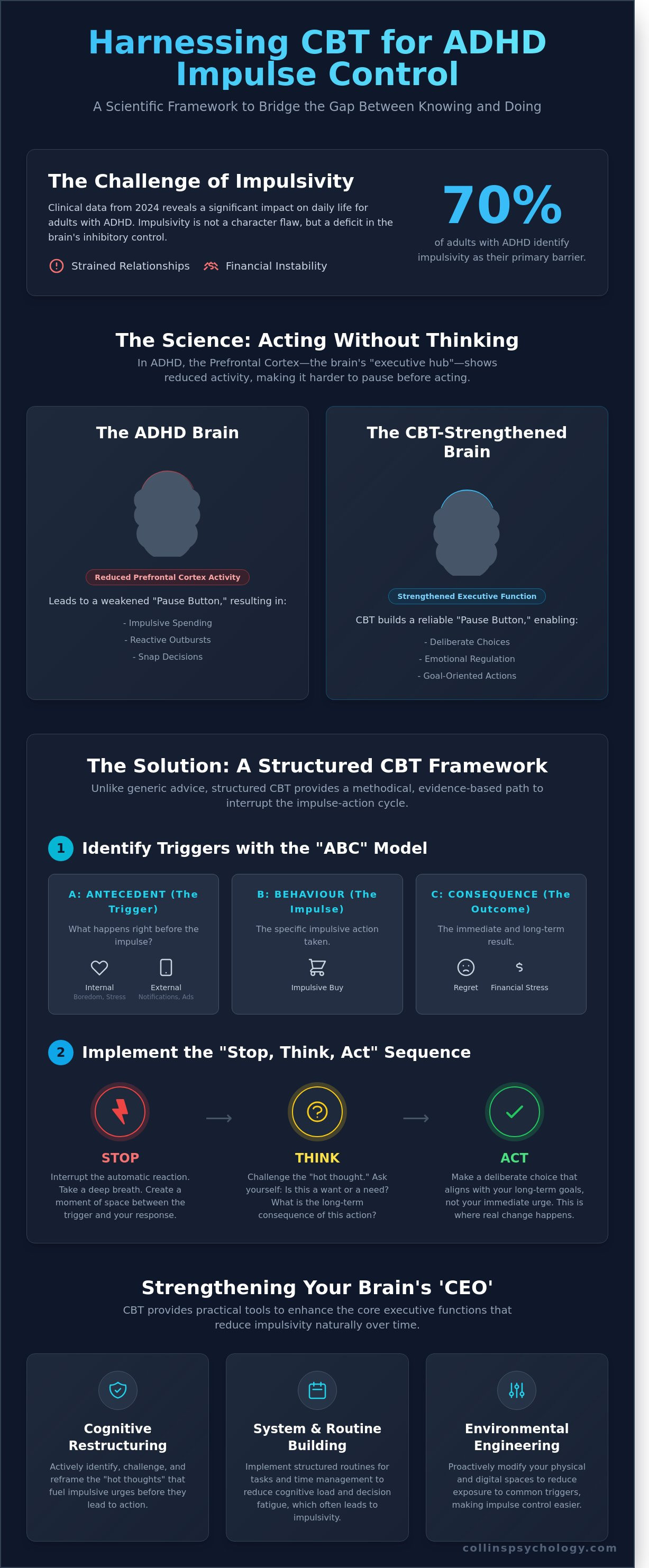
ADHD impulsivity is clinically understood as a deficit in inhibitory control, which is the brain’s ability to pause and suppress a compelling urge or action (Ramsay, 2020). This can manifest as speaking out of turn, making hasty decisions, or engaging in risky behaviours without fully considering the consequences. Cognitive Behavioural Therapy (CBT) provides a structured approach to address this by targeting the cognitive distortions, or unhelpful thinking patterns, that fuel these impulsive actions. By learning to identify, challenge, and reframe these thoughts, you can create the mental space needed to choose a more considered response.
The Science of the ADHD Brain and Impulse Control
The brain’s prefrontal cortex is responsible for executive functions like planning, decision making, and self-regulation. In the ADHD brain, this area may function differently, making it harder to put the brakes on an immediate impulse. This is why "acting without thinking" is a genuine neurological challenge, not a character flaw or a sign of carelessness. Research has consistently shown the efficacy of CBT in helping individuals build new neural pathways, effectively restructuring these ingrained behavioural patterns to improve self-control over time (Safren et al., 2010).
Why a Structured Approach is Essential
Generic advice like "just think before you act" often fails because it lacks the necessary framework for the ADHD brain. Structure provides the external scaffolding needed to support internal self-regulation. A methodical CBT programme offers predictable steps, tools, and exercises that reduce mental clutter and make it easier to practise new skills consistently. This is where self-paced online learning becomes particularly powerful, allowing you to revisit concepts and build habits in a way that aligns with your unique learning style and schedule.
Identifying Personal Triggers for Impulsive Behaviours
Before you can manage impulsivity, you must understand what sets it off. This process begins with structured self-observation to collect data on your own behaviour without judgment. Your triggers can be divided into two main categories: internal emotional triggers (like frustration or excitement) and external environmental cues (like a notification on your phone or a sale at a shop). Often, these triggers activate "hot thoughts," which are immediate, emotionally charged beliefs that demand an instant reaction and lead to actions you may later regret. Using a simple practice of functional analysis, where you note the situation, thought, feeling, and resulting action, helps you uncover the "why" behind your impulses.
Recognising Emotional Highs and Lows
Intense emotions, both positive and negative, can effectively hijack the logical part of your brain, making you more susceptible to impulsive behaviour. For example, the excitement of a new idea can lead to an impulsive purchase, while a surge of anger can result in a reactive comment you cannot take back. Social impulsivity is also common, often driven by a desire for immediate validation or a fear of being left out. Acknowledging the direct link between poor emotional regulation and impulsivity is a critical step in developing better control (Ramsay & Rostain, 2015).
Environmental Cues and Sensory Overload
Your physical and digital surroundings can be filled with triggers that prompt impulsive actions. A cluttered desk might trigger feelings of overwhelm, leading you to abandon a task for a more stimulating distraction. Similarly, the constant ping of digital notifications creates a state of perpetual reactivity, training your brain to respond immediately rather than thoughtfully. You can start tracking these triggers using a simple notebook or a notes app, which allows you to identify patterns without feeling overwhelmed by the process.
How to Implement Practical CBT Strategies for Better Self-Control
A core goal of CBT for impulse control is to create a deliberate pause between an urge and an action. This interruption is where you can apply cognitive strategies to make a more intentional choice. The "Stop, Think, Act" framework is a simple yet powerful tool: you physically stop what you are doing, take a moment to think through the potential outcomes, and then decide on a course of action. It is also important to practise self-compassion; learning new skills takes time, and if a strategy does not work perfectly at first, it is an opportunity for learning, not a reason for criticism.
The Wait and Weigh Technique
When you feel a strong urge to make an impulsive purchase or send a reactive message, implement the 10-minute rule. Commit to waiting just ten minutes before acting on the impulse. During this time, you can conduct a quick cost-benefit analysis by asking yourself: What is the benefit of doing this right now? What is the potential cost or downside? This simple delay often allows the initial emotional intensity to fade, giving your rational brain a chance to catch up. For more in-depth strategies, our online module on emotional regulation provides further tools.
Visual Reminders and Environmental Design
Your environment can be designed to support your goals rather than sabotage them. Use "point-of-performance" reminders, such as a sticky note on your credit card that asks, "Is this a want or a need?" or a digital prompt on your computer screen that says, "Pause before posting." You can also "friction-proof" your environment by making impulsive acts harder to perform; for example, unsubscribing from marketing emails or keeping tempting snacks out of sight. For emotional reactivity, consider creating a "calm down" kit with items that help you self-soothe, such as a stress ball, a calming scent, or a playlist of relaxing music.
The 3-Step Impulse Interruption System
1. STOP: Create a Physical Pause
• Take one deep, slow breath.
• Step away from the situation if possible (e.g., close the laptop, leave the room).
• This creates a crucial space between the triggering urge and your automatic reaction.
2. THINK: Ask Probing Questions
• What is the likely outcome of this action?
• Does this align with my long-term goals or values?
• How will I feel about this in an hour? Tomorrow? Next week?
3. ACT: Make a Deliberate Choice
• Choose the action that serves your future self, not just the immediate urge.
• This might mean doing something different, or it might mean doing nothing at all.
• You are now responding, not reacting.
Strengthening Executive Functioning to Reduce Impulsive Urges
Improving your core executive functioning skills is a proactive way to manage impulsivity. When your skills in areas like planning, time management, and focus are stronger, you are less likely to be derailed by in-the-moment urges. High cognitive load, which happens when your brain is trying to juggle too many tasks at once, significantly depletes your capacity to resist impulses. This is why foundational habits related to sleep and fitness are so important, as they directly impact your brain's ability to self-regulate and perform executive tasks effectively.
Managing Cognitive Load and Decision Fatigue
Have you ever noticed you are more impulsive at the end of a long day? This is due to decision fatigue, a state of mental depletion that occurs after making numerous choices. You can preserve your mental energy by simplifying daily decisions, such as planning your outfits or meals for the week in advance. By reducing the number of small choices you have to make, you free up cognitive resources to manage more significant impulses. Our structured system for executive functioning offers practical tools to help you manage your cognitive load.
Building Consistency Through Routine
Routines are powerful because they put positive behaviours on autopilot, reducing the need to rely on willpower or make impulsive decisions. A structured morning routine, for example, can set a productive and intentional tone for the entire day, preventing you from starting in a reactive state. Setting clear, achievable goals also helps you prioritise long-term rewards over short-term gratification. By consistently focusing on what is truly important, you strengthen your ability to say "no" to impulses that conflict with your goals. For guidance on this, see our article on managing disorganisation and poor time management with CBT.
Accessing Structured Support Through Online CBT Programmes
Collins Psychology provides structured, CBT-based systems for adults with ADHD who are tired of knowing what to do but still struggling to do it. It is important to clarify that we offer online, self-paced programmes, not one-to-one therapy. This model is designed to give you the flexibility to learn evidence-based strategies at your own pace, from anywhere in the world. Our programmes are designed to align with professional guidelines for adult ADHD support, providing a credible and effective way to build your skills.
It's not therapy. It's not coaching. It's a system designed to help you stop relying on motivation and build systems that work with your brain. You can start where you struggle most and build your ADHD support system over time.
The Benefits of Self-Paced Learning for ADHD
A self-directed digital environment is uniquely suited to the ADHD brain. The ability to revisit materials, re-watch videos, and practise exercises as many times as needed is crucial for long-term retention and skill development. This approach removes the pressure of keeping up with a fixed schedule, allowing you to learn when you are most focused and receptive. Our modules include a variety of resources, including videos, worksheets, and practical tools, to keep you engaged and support different learning styles.
Getting Started with Collins Psychology
You can begin building a more structured and intentional life today. Our programmes offer one system with multiple entry points, allowing you to focus on the area that challenges you the most, whether it is emotional regulation, executive functioning, or goal setting. To learn more about our approach, visit the main CBT for Adult ADHD page. When you are ready to take the next step, you can explore our course collections and enrol directly online.
Enrol in our structured programmes today and start building systems that last.
Frequently Asked Questions
Can CBT help with ADHD impulse control without using medication?
Yes, CBT is a non-pharmacological approach that focuses on teaching you practical skills to manage your thoughts and behaviours. Many people use CBT as a standalone strategy or in conjunction with other supports to improve their impulse control. Our programmes do not involve medication and focus entirely on behavioural and cognitive techniques.
How long does it take to see results from CBT for impulsivity?
The timeline for seeing results varies for each individual and depends on the consistency of practice. Some people notice small changes in their awareness and ability to pause within a few weeks. Lasting change comes from applying the strategies consistently over time to build new habits and neural pathways.
Is an online CBT programme as effective as in-person therapy for ADHD?
Online CBT programmes can be highly effective, particularly for individuals who value flexibility and a self-paced learning structure. Research shows that for many people, structured digital interventions are a powerful way to learn and apply CBT skills. This format is ideal for those who want to build a system of tools without the commitment of traditional weekly therapy appointments.
What are some immediate techniques to stop an impulsive action?
One of the most immediate techniques is the "Stop, Think, Act" model. Physically pause, take a deep breath, and ask yourself about the consequences of the action. Another effective tool is the 10-minute rule, where you delay the action for ten minutes to let the initial emotional intensity subside.
Does CBT help with emotional reactivity and anger in ADHD?
Absolutely. A significant part of managing impulsivity involves improving emotional regulation. CBT helps you identify the triggers and thought patterns that lead to emotional reactivity and anger, and it teaches you techniques to respond more calmly and thoughtfully.
Can I complete the Collins Psychology programme while working full-time?
Yes, our programmes are specifically designed for busy adults. The self-paced format means you can work through the materials on your own schedule, whether that is in the evenings, on weekends, or in short bursts during the day. There are no live sessions or strict deadlines.
Do I need a formal diagnosis to start an online CBT programme?
No, a formal diagnosis is not required to enrol in our online programmes. Our systems are designed for any adult who struggles with symptoms commonly associated with ADHD, such as impulsivity, disorganisation, or emotional dysregulation, and wants to learn structured, evidence-based coping strategies.
What happens if I struggle to stay focused on the self-paced modules?
Our programmes are designed with the ADHD brain in mind. They include a mix of video content, practical exercises, and downloadable tools to maintain engagement. The self-paced nature means you can take breaks whenever you need to and return to the material when you are ready, without pressure or penalty.
References
Ramsay, J. R. (2020). Rethinking adult ADHD: A clinician's guide. Routledge.
Ramsay, J. R., & Rostain, A. L. (2015). The adult ADHD tool kit: Using CBT to facilitate coping and adaptation. Routledge.
Safren, S. A., Otto, M. W., Sprich, S., Winett, C. L., Wilens, T. E., & Biederman, J. (2010). Cognitive-behavioral therapy for ADHD in medication-treated adults with continued symptoms. Behaviour Research and Therapy, 48(11), 1161–1165. https://doi.org/10.1016/j.brat.2010.08.004