.png)

Discover how Cognitive Behavioral Therapy is specifically adapted to provide practical, evidence-based strategies for managing adult ADHD challenges like procrastination, disorganisation, and emotional dysregulation. If you feel like medication helps with focus but doesn't teach you the practical skills needed to navigate daily life, you're not alone. Many adults with ADHD find themselves searching for a structured approach that goes beyond medication to build lasting habits and a stronger sense of control.
This guide explains exactly how Cognitive Behavioral Therapy (CBT) is modified for the ADHD brain. We’ll explore concrete techniques to manage executive function deficits, emotional intensity, and chronic disorganisation, offering a clear path toward feeling more empowered and effective.
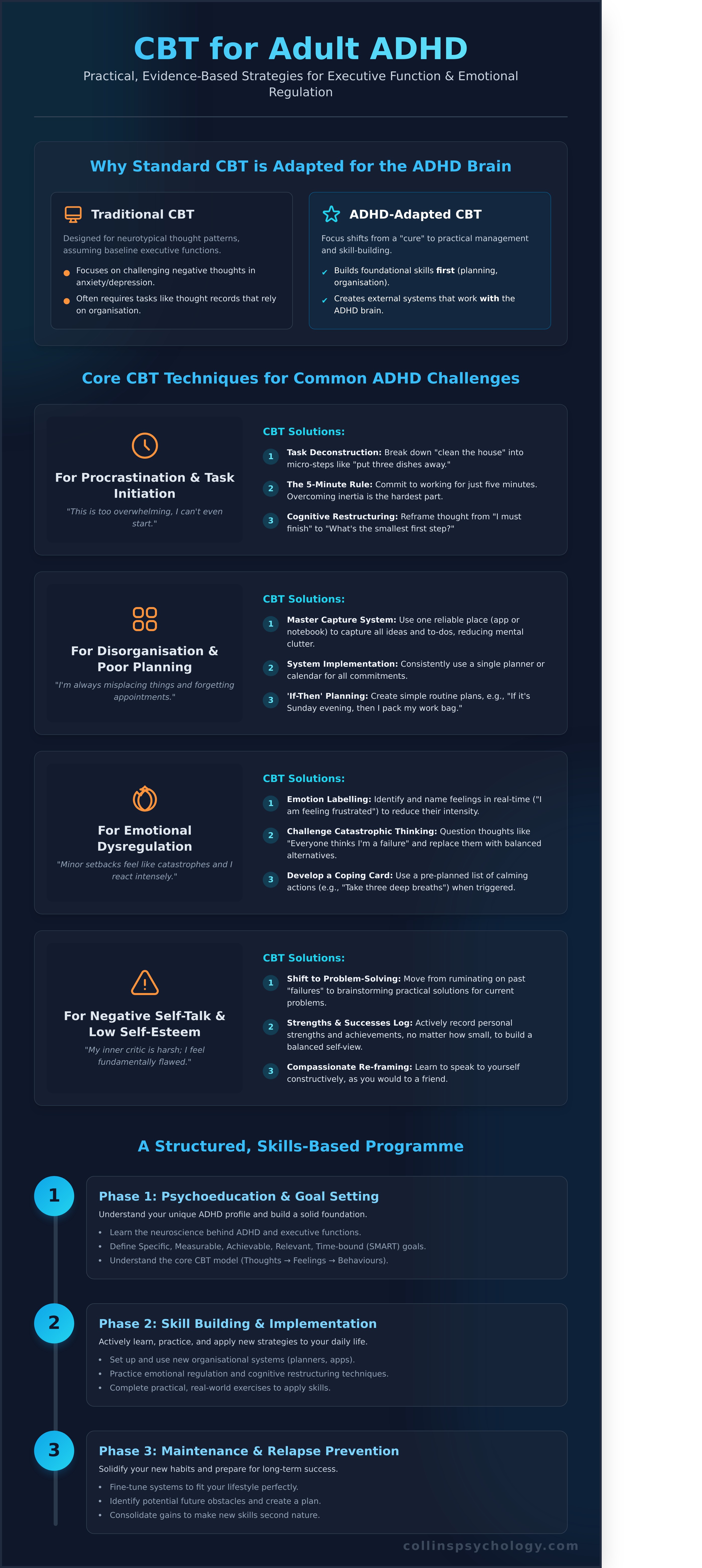
## Why Standard CBT is Adapted for the ADHD Brain
Cognitive Behavioral Therapy (CBT) is a highly effective, evidence-based psychological treatment. However, the traditional form was primarily designed for neurotypical thought patterns, often seen in treating anxiety and depression. The ADHD brain, with its unique wiring for attention, motivation, and emotional processing, requires a more specialised approach.
The goal of CBT for ADHD is not to 'cure' the condition but to provide practical management and adaptation strategies. It shifts the focus from solely challenging negative thoughts to building tangible, structural skills that support the ADHD brain's executive function challenges.
### Addressing Executive Function Deficits
Traditional CBT often assumes a person has a baseline ability to organise thoughts, plan tasks, and follow through. For adults with ADHD, these very skills—known as executive functions—are the primary areas of difficulty. ADHD-adapted CBT acknowledges this by focusing on externalising motivation and creating robust systems. Instead of just talking about getting organised, the therapy actively teaches *how* to build and use those systems, breaking down every technique into smaller, more manageable steps.
### Tackling Emotional Dysregulation
While standard CBT uses thought records to challenge unhelpful beliefs, ADHD-adapted CBT goes further. It helps you understand the specific triggers for your emotional responses, which are often more intense and rapid in ADHD. The focus is on recognising the early signs of emotional escalation and developing practical 'pause' strategies. This allows you to manage impulsivity and intense reactions before they become overwhelming, a common challenge for those with Rejection Sensitivity Dysphoria (RSD).
### Working with Time Blindness and Motivation
The ADHD brain often operates on a simple, two-part timeline: 'now' and 'not now'. This "time blindness" makes it incredibly difficult to motivate for future tasks or deadlines. CBT for ADHD directly addresses this by using tangible, visible planning tools like whiteboards, timers, and specific apps. It provides a framework for creating artificial urgency and immediate rewards for 'not now' tasks, bridging the gap between intention and action.
## Core CBT Techniques for Common ADHD Challenges
This section provides practical examples of how CBT is applied to common, relatable ADHD struggles. The emphasis is on the 'how-to' aspect of these strategies, moving from theory to real-world application.
### For Procrastination and Task Initiation
* **Problem:** An important task feels so overwhelming that you can't even start.
* **CBT Solution:**
* **Cognitive Restructuring:** Reframe the thought from "I have to finish this huge, perfect project" to "What is the smallest possible first step I can take right now?" This lowers the barrier to entry.
* **Behavioural Activation:** Use the '5-minute rule'. Commit to working on the task for just five minutes. Often, overcoming the initial inertia is the hardest part, and you'll find you can continue for longer.
* **Task Deconstruction:** Work with your therapist to break down an overwhelming task (e.g., "do my taxes") into a series of clear, sequential micro-steps (e.g., 1. Find the accountant's email. 2. Draft a one-sentence email asking for the document list. 3. Hit send).
### For Disorganisation and Poor Planning
* **Problem:** Your physical and digital spaces are cluttered, and you constantly lose track of appointments, ideas, and obligations.
* **CBT Solution:**
* **Skill-Building with Tools:** Therapy sessions are used to actively set up and learn how to consistently use a planner, digital calendar, or task management app. The focus is on finding a system that works for *your* brain, not a one-size-fits-all solution.
* **Master Capture System:** Develop a single, reliable place (like a specific notebook or app) to "capture" every idea, to-do, and reminder that pops into your head. This reduces mental clutter and the anxiety of trying to remember everything.
* **'If-Then' Planning:** Create simple, automatic plans for routines. For example, "If it's Sunday evening, then I will spend 15 minutes planning my week." This reduces the need for in-the-moment decision-making.
### For Emotional Outbursts and Rejection Sensitivity
* **Problem:** Small setbacks or perceived criticism trigger intense emotional reactions that feel uncontrollable.
* **CBT Solution:**
* **Emotion Labelling:** Practice identifying and naming your emotions in real-time ("I am feeling overwhelmed," "I am feeling rejected"). This simple act creates a small space between you and the emotion, reducing its intensity.
* **Challenge Catastrophic Thinking:** When you feel rejected, your brain might jump to the worst-case scenario ("My boss thinks I'm incompetent and I'm going to be fired"). CBT helps you challenge this by looking for alternative, less catastrophic explanations.
* **Develop a Coping Card:** Create a physical or digital card with pre-planned, calming responses to use when you feel triggered. This could include a reminder to take three deep breaths, go for a short walk, or text a supportive friend.
### For Negative Self-Talk and Low Self-Esteem
* **Problem:** Years of struggling with ADHD symptoms have led to a harsh inner critic and a deep-seated belief that you are a "failure."
* **CBT Solution:**
* **Shift from Past to Present:** The focus moves away from ruminating on past mistakes and towards practical, present-day problem-solving. The question becomes, "What can I do about this situation *now*?"
* **Strengths and Successes Log:** Actively identify and record personal strengths and past successes, no matter how small. This provides concrete evidence to counter the narrative of failure.
* **Compassionate Re-scripting:** Learn to reframe harsh self-criticism into more compassionate and constructive self-talk. Instead of "I'm so stupid for forgetting that," you might practice saying, "I forgot, which is a common ADHD trait. What system can I put in place to help me remember next time?"
## What a Structured CBT for ADHD Program Looks Like
Unlike open-ended talk therapy, CBT for ADHD is an active, skills-based process delivered in a structured program. It’s a collaborative, goal-oriented partnership between you and your therapist, focused on building practical skills for your real life.
### Phase 1: Psychoeducation and Goal Setting
The first phase is about building a foundation. You will work with your therapist to understand your unique ADHD profile and how its symptoms specifically impact your life. Together, you will set specific, measurable, achievable, relevant, and time-bound (SMART) goals. You will also learn the core CBT model (how thoughts, feelings, and behaviours are connected) and how it is adapted for ADHD.
### Phase 2: Skill Building and Implementation
This is the core of the program. Each session focuses on introducing and practising new skills and organisational systems. You might spend time setting up a digital calendar, role-playing a difficult conversation, or developing a plan to tackle a procrastinated task. You will be given practical 'homework' assignments to apply these skills in your daily life between sessions, which is crucial for turning knowledge into habit.
### Phase 3: Maintenance and Relapse Prevention
As you gain confidence and proficiency with the new strategies, the focus shifts to maintenance. You will review your progress, identify any remaining challenges, and develop a long-term plan for managing future ADHD-related obstacles. The goal is to build self-reliance, so you can continue to use and adapt your CBT skills long after the program ends.
## CBT vs. Other ADHD Treatments: Finding Your Best Approach
The most effective treatment for adult ADHD is often a multi-modal approach. CBT is a powerful component that works best when integrated into a comprehensive care plan, tailored to your individual needs.
### CBT and Medication
Medication and CBT are a powerful combination. Stimulant or non-stimulant medication can improve focus, attention, and impulse control, creating a crucial 'window of opportunity'. CBT provides the practical skills and strategies to *use* that improved focus effectively. In short, medication can help your brain be more receptive, while CBT teaches you the life skills to build lasting change.
### CBT vs. ADHD Coaching
While there can be overlap, there are key differences. ADHD coaching is typically forward-focused, action-oriented, and centered on goal achievement. CBT is a clinical therapy delivered by a licensed mental health professional that addresses the underlying thought patterns, emotional responses, and behaviours that create challenges. CBT delves into the 'why' behind your actions to help you build more effective coping mechanisms from the inside out.
### When to Consider Other Therapies
For some individuals, especially those with severe emotional dysregulation or co-occurring conditions, other therapies may be recommended. For instance, Dialectical Behavior Therapy (DBT) offers intensive skills for managing extreme emotions. If past trauma is a significant factor, therapies specifically designed to address it may also be a necessary part of your treatment plan.
---
### Take the Next Step
Feeling understood is the first step. Taking action is the next. Our structured, evidence-based programs are designed by experienced psychologists to give you the practical tools you need to manage adult ADHD effectively.
[Learn about our evidence-based CBT programs for adult ADHD.](https://collinspsychology.com/)
* Specialists in structured therapy for adult ADHD
* Evidence-based programs developed by experienced psychologists
* Trusted provider of clinical training for health professionals across Australia
---
## Frequently Asked Questions
**Is CBT a 'cure' for ADHD?**
No, CBT is not a 'cure' for ADHD, which is a lifelong neurodevelopmental condition. Instead, it is a highly effective management strategy. It provides the skills and tools to minimise the negative impact of ADHD symptoms on your life and helps you build systems to leverage your strengths.
**Can CBT replace my ADHD medication?**
CBT and medication work on different aspects of ADHD. Medication addresses the core neurobiological issues of focus and impulsivity, while CBT teaches behavioural skills and coping strategies. For many, the combination is more effective than either treatment alone. You should never stop taking prescribed medication without consulting your prescribing doctor.
**How is CBT for ADHD different from general life coaching?**
CBT for ADHD is a clinical treatment provided by a licensed mental health professional. It addresses the underlying cognitive and emotional patterns associated with ADHD. Life coaching is a non-clinical, supportive partnership focused on setting and achieving future goals, and coaches are not required to have mental health licensure.
**Can I do CBT for ADHD online?**
Yes. Structured CBT programs for ADHD can be delivered very effectively through online telehealth sessions. This provides a convenient and accessible way to engage in therapy with a specialist, regardless of your location.
**What's the first step to starting a CBT program for my ADHD?**
The first step is typically to book an initial consultation with a psychologist or clinic that specialises in adult ADHD. This session allows you to discuss your challenges, understand the program structure, and determine if it's the right fit for your specific goals.