.png)

For many adults with ADHD in Ireland, the feeling of a constantly racing mind is all too familiar. This state of high alert can make focus feel impossible and emotional regulation a daily battle. This article moves beyond generic wellness advice to offer a practical, evidence-based brain training tip for adults with ADHD: using your breath to calm your stressed mind. You will discover how to use specific physiological breathing techniques as a manual override for the ADHD nervous system, a powerful tool within a Cognitive Behavioural Therapy (CBT) framework to improve focus, manage overwhelm, and regain a sense of control.
Understanding the ADHD Stress Response and Executive Dysfunction
The link between ADHD and a heightened stress response is not just a feeling; it is a biological reality. The neurodivergent brain often perceives daily demands as threats, triggering the "fight or flight" response more readily than in a neurotypical brain. This state of chronic activation significantly impacts the prefrontal cortex, the brain's command centre for executive functions like planning, decision-making, and emotional control. For adults in Ireland managing work, family, and personal goals, this can manifest as emotional dysregulation, making it difficult to stay productive and navigate high-pressure situations. This is why traditional advice to simply "sit quietly" or "just relax" often fails; without a structured, physiological approach, the ADHD mind can find stillness more agitating than calming.
The Nervous System and the ADHD Racing Mind
The persistent feeling of being "on edge" is often due to an overactive sympathetic nervous system, the body's accelerator. In adults with ADHD, this system can be stuck in a high gear, leading to a constant state of physiological arousal. The "brain fog" that so many report is not a lack of intelligence but a consequence of this chronic stress, where the brain is too busy managing perceived threats to allocate resources to higher-level thinking (Meppelink et al., 2016). Understanding this allows us to shift our approach from "top-down" control (trying to think our way out of stress) to "bottom-up" regulation, where we use the body to send signals of safety back to the brain.
Why Breathwork is a Valid Clinical Tool
Within evidence-based frameworks like Cognitive Behavioural Therapy (CBT), breathwork is a foundational clinical tool, not a passing trend. Its power lies in its ability to create physiological changes that can bypass the need for immediate, intense mental focus—something the overwhelmed ADHD brain struggles with. By intentionally changing our breathing pattern, we can directly influence our nervous system, providing a tangible way to manage our internal state (Jerath et al., 2015). In Irish psychological practice, adhering to evidence-based methods endorsed by bodies like the Psychological Society of Ireland (PSI) is paramount, and controlled breathing is a well-established component of effective stress and anxiety management protocols.
The Science of the Breath-Brain Connection in Adult ADHD
To appreciate why this brain training tip for adults with ADHD is so effective, we need to look at the science. Our breathing patterns send constant, powerful messages to our brain. Shallow, rapid chest breathing signals panic and danger, while slow, deep breathing signals safety and calm. This communication happens largely through the Vagus nerve, a critical component of our nervous system. By learning to consciously control our breath, we gain a direct line of communication to the parts of our brain that regulate stress, focus, and emotion.
The Vagus Nerve: Your Internal Manual Override
The Vagus nerve is the main pathway of the parasympathetic nervous system—the body's "brake" system. It runs from the brainstem down into the abdomen, and when stimulated, it slows our heart rate and tells our brain we are safe. Diaphragmatic breathing, or "belly breathing," physically stimulates the Vagus nerve, triggering an immediate chemical shift that reduces stress hormones (Gerritsen & Band, 2018). This improved "Vagal tone" is directly linked to better executive functioning, as it helps quieten the brain's alarm system, freeing up cognitive resources for focus and impulse control.
Nasal Breathing vs Mouth Breathing for Cognitive Load
How you breathe matters as much as how fast you breathe. Nasal breathing is biochemically superior for cognitive function. When we breathe through our nose, we produce nitric oxide, a gas that improves the brain's oxygenation and acts as a neurotransmitter. In contrast, chronic mouth breathing is often correlated with higher anxiety levels and a state of sympathetic nervous system activation. A simple way to enhance focus is to cultivate "nasal resonance"—the gentle, steady hum of air moving through the nasal passages, which provides a consistent, calming sensory input for the brain.
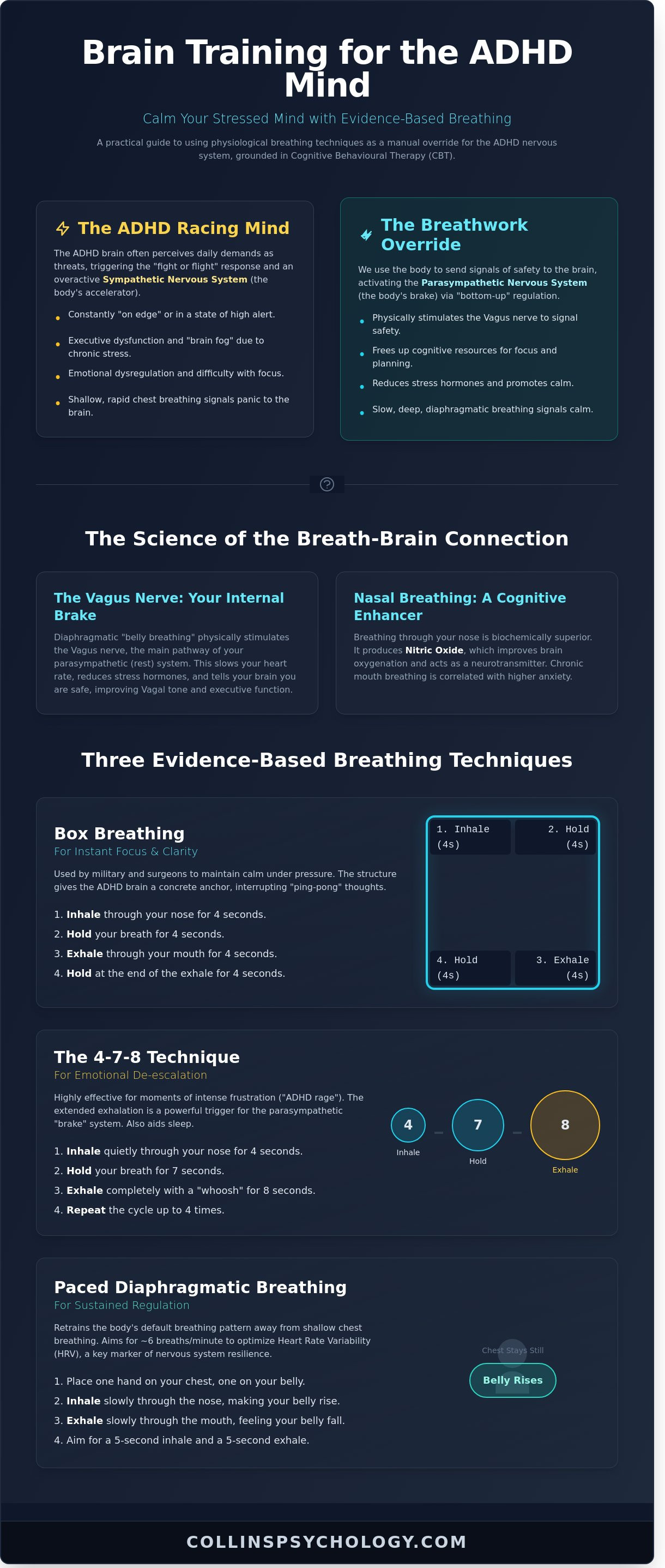
Three Evidence-Based Breathing Techniques for ADHD Brain Training
Think of these techniques not as spiritual practices but as practical tools for your mental utility belt. They are designed to be short, high-impact exercises that can fit into the schedule of a busy professional. The goal is "training"—like building a muscle, the more you practise, the stronger your ability to self-regulate becomes.
Box Breathing for Instant Focus and Clarity
Used by military personnel and surgeons to maintain calm under pressure, Box Breathing is a powerful tool for stabilising a scattered mind. The structure of the count gives the ADHD brain something concrete to focus on.
Inhale
Breathe in slowly through your nose for a count of four.
Hold
Gently hold your breath for a count of four. This hold phase is crucial for interrupting the "ping-pong" thoughts common in ADHD.
Exhale
Breathe out slowly through your mouth for a count of four.
Hold
Hold your breath at the end of the exhale for a count of four.
Repeat
Continue for 1-2 minutes before starting a difficult task or heading into a meeting.
The 4-7-8 Technique for Emotional De-escalation
This technique is particularly effective for moments of intense frustration or what is sometimes called "ADHD rage." The extended exhalation is a powerful trigger for the parasympathetic "brake" system.
Inhale
Breathe in quietly through your nose for a count of four.
Hold
Hold your breath for a count of seven.
Exhale
Exhale completely through your mouth, making a "whoosh" sound, for a count of eight.
Repeat
Complete the cycle four times. This is also highly effective for improving sleep onset, a common challenge for adults with ADHD.
Paced Diaphragmatic Breathing for Sustained Regulation
Many of us engage in shallow chest breathing when stressed, which perpetuates the anxiety cycle. Diaphragmatic breathing retrains the body's default pattern.
Position
Sit or lie down comfortably. Place one hand on your chest and the other on your belly.
Inhale
Breathe in slowly through your nose, focusing on making your belly rise. Your chest should remain relatively still.
Exhale
Breathe out slowly through your mouth, feeling your belly fall.
Pace
Aim for a rhythm of around six breaths per minute (e.g., a five-second inhale and a five-second exhale). This is widely considered the "sweet spot" for optimising Heart Rate Variability (HRV), a key marker of nervous system resilience.
For more skills on building sustained regulation, you can explore our Collins Psychology CBT for ADHD resources.
[INFOGRAPHIC: A Visual Guide to Three Breathing Techniques for ADHD]
Integrating Breathwork into Your Daily ADHD Management Routine
The most common objection to breathwork is, "I always forget to do it." For the ADHD brain, a new habit needs to be anchored to an existing routine to stick. The key is not to set aside 20 minutes for a daunting meditation session but to sprinkle "micro-sessions" of breathing throughout your day.
Habit Stacking: Making Breathwork Automatic
Habit stacking involves pairing a new habit with one you already do automatically. This removes the need to remember.
Trigger
While you wait for the kettle to boil, do two rounds of Box Breathing.
Trigger
Before you open your email inbox, take one deep diaphragmatic breath.
Trigger
Every time you hang up the phone, practise one 4-7-8 breath.
These 30-second micro-sessions are far more achievable and add up over time. For a deeper dive into habit formation strategies, our Executive Function course provides a structured approach.
Using Breath to Manage Transitions and Overwhelm
Transitions between tasks are a major point of friction for the ADHD brain. A single, conscious "cleansing breath" can act as a mental full stop, signalling to your brain that one task is complete and you are preparing for the next. During moments of "ADHD paralysis," where you feel stuck and unable to start, focusing on the physical sensation of a few deep breaths can help you regain physical and mental momentum, breaking you out of the freeze response. For example, before a social event, taking a minute to do some paced breathing can significantly reduce social anxiety by calming your physiological state first.
Beyond the Breath: Structured CBT Programmes for Long-Term Change
While breathing is a vital and immediate brain training tip, it is one tool in a comprehensive CBT toolkit. True long-term change comes from developing a range of skills to manage the core challenges of adult ADHD. This is where structured, evidence-based programmes become essential for building lasting resilience and capability.
The Role of Self-Paced CBT in ADHD Success
For the ADHD brain, the flexibility of self-paced, online learning is often a perfect fit. Structured modules allow you to focus on one area at a time—from emotional regulation and goal setting to sleep and time management—without feeling overwhelmed. At Collins Psychology, our programmes are designed by a qualified practitioner following PSI guidelines, ensuring you receive credible, effective strategies. You can explore the variety of online modules available to find the support that matches your specific challenges.
Starting Your Journey with Collins Psychology
It is important to clarify our service model: Collins Psychology provides self-paced online CBT programmes and resources designed specifically for adults with ADHD. We do not offer one-to-one therapy. This approach provides an accessible, private, and flexible way for you to learn proven strategies at your own pace, with tools tailored for the neurodivergent mind.
To begin building your complete ADHD management toolkit, we encourage you to explore our CBT for Adult ADHD landing page. For businesses looking to support their neurodivergent employees, please contact us for more information on our organisational programmes.
Frequently Asked Questions (FAQs)
Is breathwork actually effective for adults with ADHD?
Yes. Breathwork is effective because it directly influences the autonomic nervous system. It provides a "bottom-up" way to regulate the physiological stress and arousal common in ADHD, which in turn helps improve focus, reduce impulsivity, and manage emotional reactivity.
How long does it take to see results from ADHD breathing exercises?
The immediate calming effects can be felt in as little as 60-90 seconds. However, for the benefits to become more automatic and lasting, consistent practice is key. Think of it like physical exercise; regular, short sessions over several weeks build the "muscle" of self-regulation.
Can I do these breathing techniques while I am at work or in public?
Absolutely. Techniques like Box Breathing and Paced Diaphragmatic Breathing are very discreet. You can do them during a meeting, on public transport, or at your desk without anyone noticing. The 4-7-8 breath is slightly more noticeable due to the "whoosh" exhale, but can easily be done in a quiet moment or a restroom.
Why does my mind wander so much when I try to focus on my breath?
This is completely normal, especially for the ADHD brain. The goal is not to have a perfectly clear mind, but to gently notice when your mind has wandered and guide it back to the breath. Each time you bring your attention back, you are strengthening your focus. The counting in Box Breathing or 4-7-8 is designed to give your mind a simple anchor to hold onto.
Is this a replacement for other ADHD treatments?
No. Breathwork is a powerful self-regulation tool that can be used alongside other strategies within a comprehensive management plan. It is one component of a broader Cognitive Behavioural Therapy (CBT) approach and is not intended to replace professional advice or other prescribed treatments.
What is the best time of day for an adult with ADHD to practice breathing?
The best time is whenever you can fit it in consistently. Many find it helpful to practice first thing in the morning to start the day centred, during transitions between tasks to reset focus, or before bed to aid sleep. The key is linking it to an existing habit ("habit stacking") to make it automatic.
What if deep breathing makes me feel more anxious?
For some people, especially those with a history of anxiety or trauma, focusing on the breath can initially increase anxiety. If this happens, do not force it. Try focusing on the exhale only, making it slightly longer than the inhale without holding your breath. You can also shift your focus to a different physical sensation, like the feeling of your feet on the floor.
How does this fit into a Cognitive Behavioural Therapy (CBT) plan?
In CBT, breathwork is a foundational "state-change" tool. It is used to de-escalate emotional intensity in the moment, allowing you to then apply other CBT skills like identifying unhelpful thoughts or problem-solving. It is the first step in breaking the reactive cycle, creating the mental space needed for more strategic thinking.
References
Gerritsen, R. J., & Band, G. P. (2018). Breath of life: The respiratory vagal stimulation model of contemplative activity. Frontiers in Human Neuroscience, 12, 397.
Jerath, R., Crawford, M. W., Barnes, V. A., & Harden, K. (2015). Self-regulation of breathing as a primary treatment for anxiety. Applied Psychophysiology and Biofeedback, 40(2), 107-115.
Meppelink, R., de Bruin, E. I., & Bögels, S. M. (2016). Meditation or medication? A randomised controlled trial of mindfulness-based cognitive therapy and medication on symptom reduction and relapse in recurrent depression. Behaviour Research and Therapy, 87, 120-128.