.png)
%20for%20Adult%20ADHD%20online%20support%20psychologist.jpg)
For adults with ADHD, the gap between knowing what you need to do and actually doing it can feel vast and frustrating. While motivation can be fleeting, Cognitive Behavioural Therapy (CBT) offers a structured, evidence-based approach to bridge that gap. This guide explores the best CBT techniques for ADHD, providing practical strategies to build systems that work with your brain. Instead of relying on willpower, you will learn how to create external scaffolding and internal resilience, helping you manage executive functioning, regulate emotions, and gain control over your daily life.
Key Takeaways
CBT is a System, Not a Cure
CBT for ADHD focuses on building practical skills and systems to manage symptoms, rather than trying to "fix" the ADHD brain.
Executive Functioning is Key
Techniques like 'Chunking' and 'Externalising Information' directly target core ADHD challenges like task initiation and working memory.
Emotional Regulation is a Skill
CBT provides tools like 'Cognitive Restructuring' to manage the intense emotions and Rejection Sensitive Dysphoria (RSD) often associated with ADHD.
Self-Paced Learning Works
Structured online programmes offer a flexible and accessible way to learn and implement CBT techniques without the pressure of weekly appointments.
Table of Contents
• Understanding Why Cognitive Behavioural Therapy Works for Adult ADHD
• Essential CBT Techniques for Improving Executive Functioning
• Managing Emotional Regulation and Rejection Sensitive Dysphoria
• Practical CBT Strategies for Time Management and Focus
• Implementing These Techniques via Structured Online Programmes
Understanding Why Cognitive Behavioural Therapy Works for Adult ADHD
Cognitive Behavioural Therapy is a highly structured, goal-oriented psychological approach that examines the crucial link between our thoughts, emotions, and actions. For adults with ADHD, whose executive functions are often impaired, simply trying harder or relying on willpower is rarely a sustainable solution. CBT provides evidence-based strategies, consistent with professional guidelines from bodies like the Psychological Society of Ireland (PSI), that build a reliable "scaffolding" system to support the ADHD brain, helping you to not only know what to do but also actually do it.
The Science of Behavioural Change
CBT is effective because it directly addresses the neurobiological challenges of ADHD, helping individuals move from a cycle of self-blame towards a functional analysis of their behaviour (Ramsay, 2020). Instead of asking "Why can't I do this?", the question becomes "What is getting in the way, and what system can I build to help?". This shift in perspective is fundamental. Structured programmes are particularly effective because they provide a consistent framework for applying these new skills, preventing the all too common pattern of starting over every Monday.
Cognitive Behavioural Therapy vs Traditional Talk Therapy
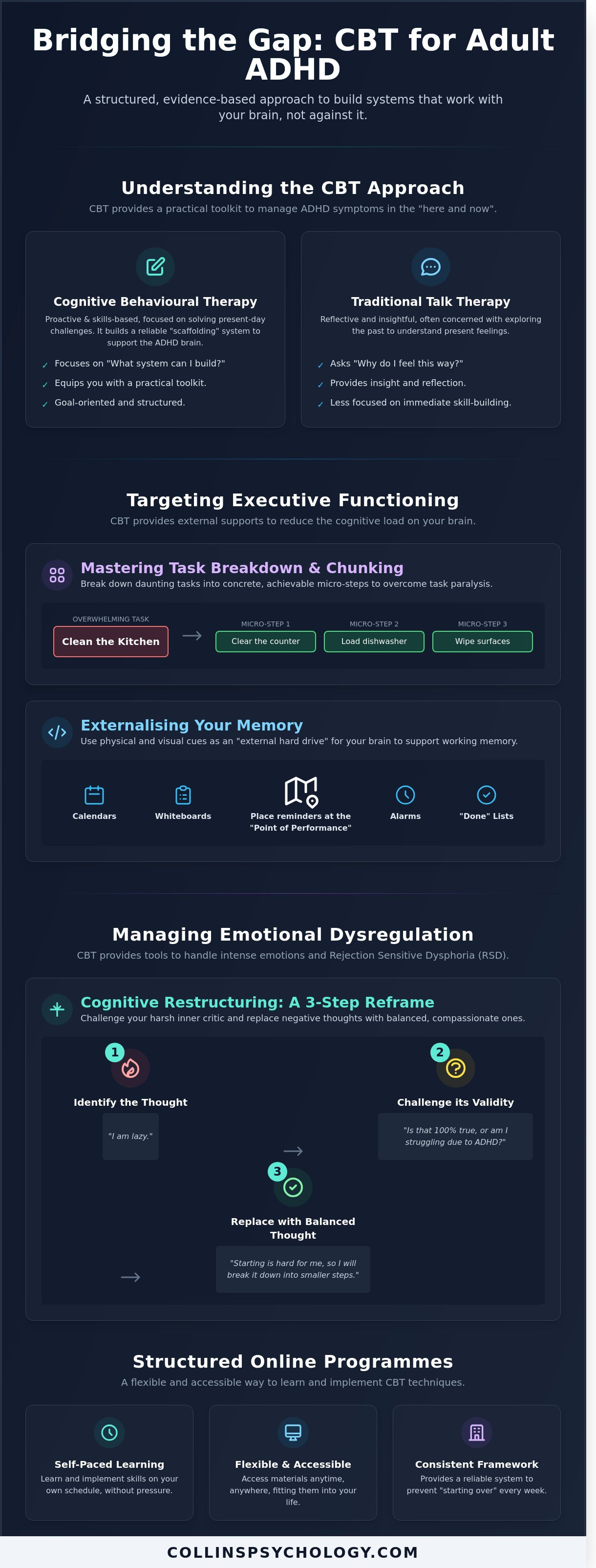
While traditional talk therapy can be reflective and insightful, CBT is proactive and focuses on the "here and now". It is less concerned with exploring the distant past and more focused on solving present day challenges like chronic procrastination, poor time management, and emotional overwhelm. The goal is to equip you with a toolkit of practical techniques that you can apply immediately to see tangible improvements in your daily life. This practical, skills-based approach makes it a powerful tool for managing adult ADHD.
Essential CBT Techniques for Improving Executive Functioning
Executive functioning refers to the set of mental skills that include working memory, flexible thinking, and self control. ADHD directly impacts these skills, making tasks like planning, organising, and starting projects incredibly difficult. Essential CBT techniques for ADHD are designed to create external support systems that reduce the cognitive load on your brain. These tools include breaking large tasks into manageable steps (Chunking), getting important information out of your head and into your environment (Externalisation of Information), and shaping your surroundings to support your goals (Environmental Engineering).
Mastering Task Breakdown and Chunking
Task paralysis, the overwhelming feeling of being unable to start a big project, is a common experience for adults with ADHD. The technique of "chunking" involves breaking down daunting tasks into concrete micro-steps that are small enough to feel achievable. For example, instead of "clean the kitchen," the micro-steps might be "clear the counter," "load the dishwasher," and "wipe the surfaces." This approach reduces overwhelm and creates momentum. Our structured programmes explore these strategies in depth, helping you apply them to your unique challenges.
Externalising Your Memory
The ADHD brain often struggles with working memory, which can feel like trying to hold sand in your hands. CBT encourages the "externalisation" of memory by using physical and visual cues in your environment. This means using calendars, whiteboards, sticky notes, and alarms as an external hard drive for your brain. A key tip is to place these reminders at the "point of performance" where you need to do the task. Furthermore, using a "done list" to track completed tasks can provide a satisfying dopamine boost and build a sense of accomplishment.
Managing Emotional Regulation and Rejection Sensitive Dysphoria
Emotional dysregulation is a core, yet often overlooked, feature of adult ADHD. It can manifest as intense frustration, irritability, and overwhelming emotional responses that seem disproportionate to the situation. A significant aspect of this is Rejection Sensitive Dysphoria (RSD), an extreme emotional sensitivity and pain triggered by the perception of being rejected or criticised. CBT offers powerful techniques to manage this inner turmoil, such as Cognitive Restructuring to challenge your harsh inner critic and "Pause and Plan" strategies to curb impulsivity.
Challenging Negative Thought Patterns
Adults with ADHD often develop negative core beliefs due to years of struggling with tasks that seem easy for others. This can lead to cognitive distortions like "All or Nothing" thinking, where anything less than perfection is seen as a total failure. A simple three step process for reframing these thoughts is: 1. Identify the automatic negative thought (e.g., "I am lazy"). 2. Challenge its validity (e.g., "Is that 100% true, or am I struggling with a difficult task due to ADHD?"). 3. Replace it with a more balanced thought (e.g., "Starting this is hard for me, so I will break it down into smaller steps."). Research confirms that building self compassion is a critical component of successful outcomes (Safren et al., 2017). For more on this, you might find our guide on feeling like a failure with ADHD helpful.
Strategies for Emotional Stability
When emotional overwhelm strikes, having go to strategies is essential. Grounding techniques, which pull your attention to the present moment through your senses (e.g., holding a cold object, focusing on the feeling of your feet on the floor), can be incredibly effective during moments of high distress. Over time, a key CBT skill is learning to identify your personal emotional triggers. By recognising the situations or thoughts that tend to lead to emotional hijacking, you can proactively use your strategies to prevent or lessen the intensity of the emotional storm. Our ADHD Emotional Regulation module provides a systematic approach to building these skills.
Practical CBT Strategies for Time Management and Focus
"Time blindness," the inability to accurately perceive the passing of time, is a hallmark of ADHD that leads to chronic lateness and missed deadlines. CBT provides concrete exercises to anchor your sense of time in reality. Strategies like the "5 Minute Rule" help you overcome the inertia of starting a task, while "Distractibility Delay" teaches you to manage the constant urge to switch focus. A foundational element supporting all these techniques is recognising the profound connection between physical wellbeing, particularly sleep, and your ability to focus.
Overcoming Time Blindness
To combat time blindness, you must become a detective of your own time. Start by actively timing how long it takes you to complete routine tasks like showering, eating breakfast, or commuting. You will likely be surprised by the results. Once you have a more realistic baseline, you can implement the "Buffer Zone" technique by adding a 25-50% time cushion to all appointments and travel plans. This external system accounts for the unexpected delays and transitions that the ADHD brain struggles to anticipate.
Building Sustainable Focus
Sustaining focus requires a multi-pronged approach. The "Pomodoro Technique," adapted for ADHD, involves working in short, timed bursts (e.g., 15-25 minutes) followed by a brief rest. This works with, not against, a shorter attention span. Another powerful tool is "Body Doubling," where you work quietly alongside another person, either physically or virtually, which creates a sense of gentle accountability that can significantly improve focus. Finally, do not underestimate the power of sleep; poor sleep hygiene dramatically worsens executive function, which is why we have a guide to better rest for adults with ADHD.
Implementing These Techniques via Structured Online Programmes
Understanding these techniques is the first step, but consistent implementation is what creates lasting change. Collins Psychology provides structured, CBT based systems for adults with ADHD who are tired of knowing what to do but still struggling to do it. It is important to clarify that we provide self paced online programmes and do not offer one to one therapy sessions. This model is designed specifically to provide flexibility and accessibility, allowing you to build your ADHD support system over time, starting where you struggle most.
The Benefit of Self-Paced Learning
The ADHD lifestyle can be unpredictable, making it difficult to commit to fixed weekly appointments. A 24/7 accessible online programme allows you to learn and practise skills when your energy and focus are at their best. Our modules include a variety of evidence based exercises, downloadable tools, and practical video lessons designed by a qualified psychologist. This approach empowers you to move at your own pace, revisiting key concepts as needed to ensure they become ingrained habits. It is one system with multiple entry points, tailored to your needs.
Getting Started with Your ADHD Toolkit
Moving from knowing to doing is the most critical step on this journey. If you are ready to stop relying on motivation and start building systems that work with your unique brain, our programmes can provide the structure and guidance you need. These are not therapy and not coaching, they are a system designed to help you build a more organised, focused, and emotionally balanced life.
Take the next step and explore our comprehensive CBT for Adult ADHD training. For any organisational enquiries, please visit our Contact Us page.
Frequently Asked Questions
What is the most effective CBT technique for ADHD procrastination?
"Chunking" is one of the most effective techniques. It involves breaking down a large, overwhelming task into very small, manageable micro steps. By focusing only on the very first, easy step, you can bypass the executive function paralysis that fuels procrastination.
Can I use CBT techniques for ADHD without a therapist?
Yes, many CBT techniques are practical skills that can be learned and applied through self paced, structured programmes. While therapy has its place, our online systems are designed to teach you these evidence based strategies in a flexible format you can use independently.
How long does it take to see results from CBT for ADHD?
Results vary, but because CBT is skills based, many people notice small improvements within a few weeks of consistent practice. The key is consistency. Lasting change comes from integrating these techniques into your daily routines to form new habits over several months.
Is CBT for ADHD effective for adults diagnosed later in life?
Absolutely. CBT is highly effective for adults diagnosed later in life. It provides a framework for understanding past struggles through the lens of ADHD and offers concrete tools to build new, more effective habits moving forward. You can learn more in our article about what to do when you suspect you have ADHD after your child's diagnosis.
What is the difference between ADHD coaching and CBT?
ADHD coaching is often action oriented and focuses on goal setting and accountability. CBT is a psychological, evidence based approach that goes deeper to address the underlying thoughts and behaviours that create challenges. Our programmes provide a structured system grounded in CBT principles.
Does Collins Psychology offer one to one therapy for ADHD?
No, Collins Psychology does not offer one to one therapy. Our focus is on providing structured, self paced online programmes that teach CBT skills. This allows us to offer an accessible and flexible system for adults with ADHD worldwide.
How does the self paced ADHD programme work?
Our programmes are delivered through an online learning platform. You get access to video modules, downloadable worksheets, and practical exercises that you can work through at your own pace, on your own schedule. You can start with the module that addresses your biggest challenge and build your toolkit from there.
Are these CBT techniques suitable for parenting with ADHD?
Yes, these techniques are incredibly valuable for parents with ADHD. By improving your own executive functioning and emotional regulation, you are better equipped to manage the demands of parenting. The structure and systems you build for yourself can also serve as a model for your children.
References
Ramsay, J. R. (2020). Rethinking adult ADHD: Helping clients turn intentions into actions. American Psychological Association.
Safren, S. A., Sprich, S. E., Perlman, C. A., & Otto, M. W. (2017). Mastering your adult ADHD: A cognitive-behavioral treatment program, client workbook (2nd ed.). Oxford University Press.