.png)

Receiving an adult ADHD diagnosis can feel both like a relief and the start of a new, overwhelming journey. You may be wondering, "What now? How can a psychologist help if it is not about medication?" The answer lies in building practical, life-altering skills. Psychological approaches, particularly Cognitive Behavioural Therapy (CBT), provide a structured, evidence-based roadmap to manage the core challenges of ADHD. This is not about endless talking; it is about learning tangible techniques to master your executive functions, regulate your emotions, and build a life that works with your brain, not against it.
Understanding the Role of Psychology in Managing Adult ADHD
Many people associate psychology with treating mental health conditions, but its role in ADHD is more about functional improvement. It reframes ADHD not just as a deficit, but as a different neurotype that requires a unique set of strategies to thrive. A psychologist works with you to identify the specific behavioural patterns and environmental triggers that cause difficulty, creating a personalised plan for skill development. This approach is distinct from psychiatry, which focuses on biological interventions. Instead, psychological therapy for adult ADHD centres on creating lasting change in your habits, thoughts, and behaviours through evidence-based strategies.
Beyond the Diagnosis: What a Psychologist Actually Does
A psychologist's first step is to understand how ADHD symptoms show up in your life. This goes beyond a simple diagnostic label to explore your unique challenges at work, in relationships, and with daily tasks. They help you differentiate between what feels like a personal failing ("I won't do the task") and a genuine executive function challenge ("I can't start the task"). This compassionate, non-judgemental assessment is the foundation for building a skills-based roadmap. In line with professional guidelines from the Psychological Society of Ireland (PSI), this process is about equipping you with the tools you need for self-management rather than creating a long-term dependency on a therapist.
The Importance of Evidence-Based Intervention
In Ireland, "evidence-based" is the gold standard for psychological care, and for good reason. It means the techniques and strategies you are learning have been rigorously tested and proven effective through clinical research (APA, 2006). When managing ADHD, this is crucial. It ensures you are not wasting time on generic advice but are instead investing your energy in structured programmes built on proven psychological principles. This commitment to validated strategies gives you the confidence that the skills you are learning are designed to create meaningful and sustainable improvements in your life.
The Core Pillars of Cognitive Behavioural Therapy for ADHD
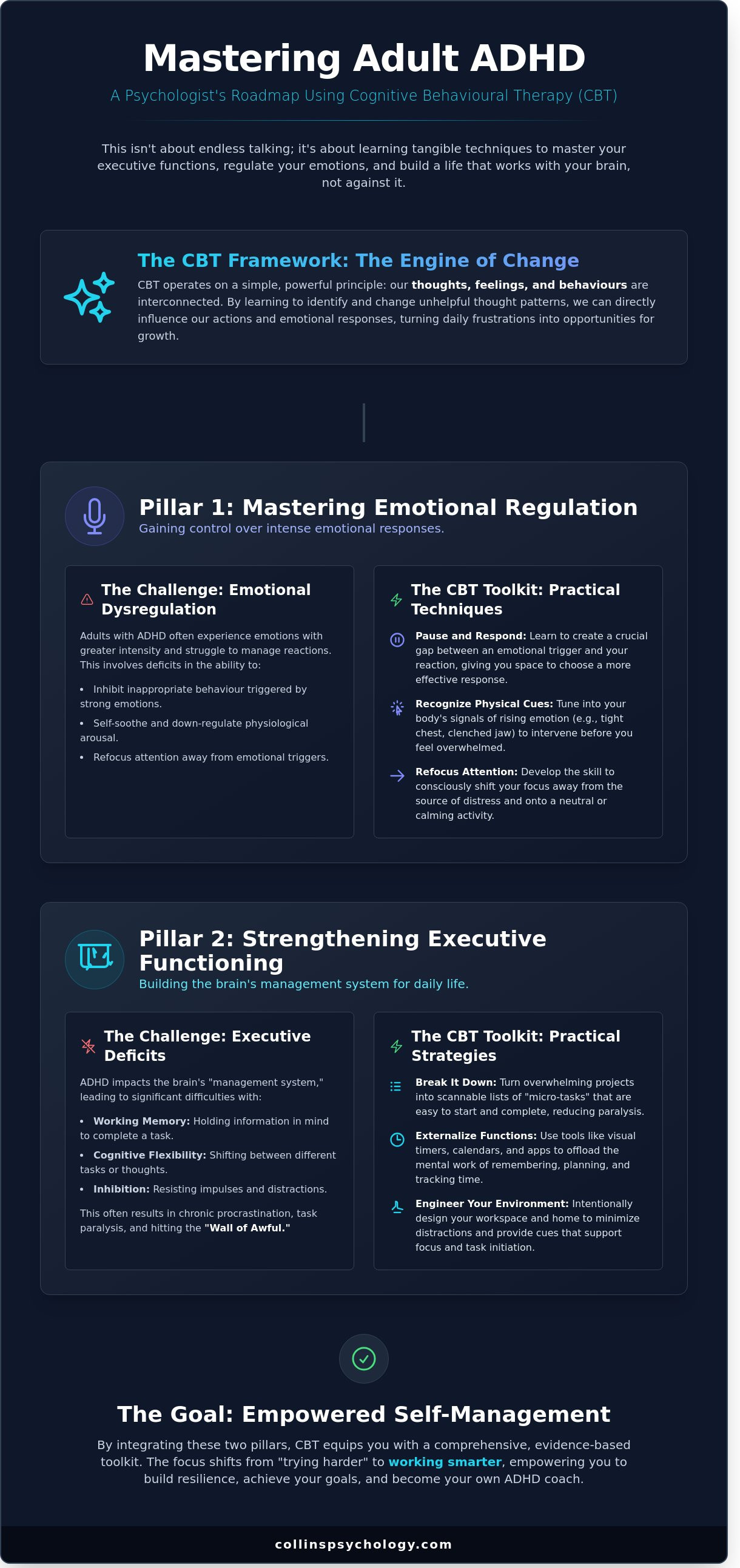
Cognitive Behavioural Therapy (CBT) is a practical and empowering framework perfectly suited for the ADHD brain. It operates on the principle that our thoughts, feelings, and behaviours are interconnected. By learning to identify and change unhelpful thought patterns, we can directly influence our actions and emotional responses. A psychologist uses CBT to help you build resilience against the daily frustrations of ADHD, such as the "ADHD tax" of forgotten appointments or late fees. The goal is to integrate two key areas into a single, cohesive approach: emotional regulation and executive functioning.
Mastering Emotional Regulation
Adults with ADHD often experience emotions with greater intensity and have difficulty managing their reactions, a challenge known as emotional dysregulation. According to leading research, emotional dysregulation involves "deficits in the ability to inhibit inappropriate behaviour triggered by strong positive or negative emotions; to self-soothe and down-regulate physiological arousal that strong emotions induce... and to refocus attention" (Barkley, 2015, p. 221). CBT provides concrete techniques to help you pause between an emotional trigger and your response. You learn to recognise the physical signs of rising emotion and apply calming strategies, giving you more control over your reactions and improving your relationships.
If you are ready to build these skills, our programme on CBT for ADHD Emotional Regulation provides a structured path forward.
Strengthening Executive Functioning
Executive functions are the management systems of the brain, and they are the areas most impacted by ADHD. This includes working memory (holding information in mind), cognitive flexibility (shifting between tasks), and inhibition (resisting impulses). When these functions are weak, it can lead to chronic procrastination and task paralysis, often described as hitting a "wall of awful." A psychologist uses CBT to provide tools to externalise these functions. You will learn techniques like breaking large projects into micro-tasks, using visual timers, and creating environments that support focus. These strategies are not about "trying harder" but about working smarter. For a deeper understanding of these skills, consider exploring our guide to overcoming task paralysis with effective ADHD strategies.
To build a complete toolkit, our CBT for ADHD Executive Function programme offers practical, step-by-step guidance.
[Infographic: A visual diagram showing two main pillars. Pillar 1: "Emotional Regulation" with icons for pausing, breathing, and identifying feelings. Pillar 2: "Executive Function" with icons for planning, time management, and task initiation. A central arrow connects them, labelled "Cognitive Behavioural Therapy (CBT)".]
Why Structured Online Programmes Offer a Unique Path to Progress
For many adults with ADHD, the idea of committing to rigid, weekly therapy appointments is a significant barrier. The ADHD brain thrives on flexibility, novelty, and the ability to revisit information. This is why structured, self-paced online programmes can be a more effective and accessible way to learn essential skills. At Collins Psychology, we focus exclusively on providing these psychologist-led online courses. This model allows us to deliver high-quality, evidence-based content without the scheduling constraints or intimidation of a traditional clinical setting.
The Flexibility of Self-Paced Learning
One of the biggest challenges for adults with ADHD is retaining new information. The ability to pause, rewind, and revisit modules whenever you need a refresher is crucial for long-term learning. A self-paced programme allows you to integrate psychological strategies into your busy Irish lifestyle on your own terms. You can engage with the material when your brain is most receptive, whether that is early in the morning or late at night. The included exercises, worksheets, and tools are designed to be used in your real life, helping to reinforce new, positive behaviours.
A Different Business Model for Better Access
To be clear, Collins Psychology provides online, self-paced CBT programmes and does not offer one-to-one therapy. We believe that for skill acquisition, a structured curriculum is often more efficient and effective than traditional talk therapy. It ensures that every participant receives the complete, evidence-based framework in a logical sequence. This model removes the pressure of weekly appointments and empowers you to become your own ADHD coach, equipped with a comprehensive set of tools to achieve your specific life goals.
Practical Psychological Strategies for Daily ADHD Challenges
Effective ADHD management is built on applying psychological principles to everyday situations. It is about translating knowledge into action. This involves creating external structures and routines to support your internal regulation and focus, helping you navigate common hurdles from time management to parenting.
Time Management and Goal Setting
Time blindness, or a distorted sense of time, is a core feature of ADHD. Psychological strategies focus on making time tangible. This can involve using external cues like visual timers, setting alarms for transitions, and consistently using a planner. When it comes to goals, CBT helps you move from vague intentions ("I want to be more organised") to specific, measurable, achievable, relevant, and time-bound (SMART) outcomes. The key is breaking large, intimidating goals into small, manageable micro-tasks to reduce overwhelm and build momentum. If you struggle with this, our evidence-based guide to understanding and managing ADHD and time blindness can provide immediate help.
For a comprehensive approach, our CBT for ADHD Goal Setting programme can guide you through the entire process.
Optimising Focus Through Sleep and Fitness
Your brain's ability to focus is directly linked to your physical well-being. There is a bidirectional relationship between ADHD and sleep; ADHD symptoms can make it hard to sleep, and poor sleep worsens ADHD symptoms (Wajszilber, 2018). A psychologist can help you implement CBT for Insomnia (CBT-I) principles to create better sleep hygiene. Similarly, physical movement is a powerful tool for the ADHD brain. Exercise acts as a natural dopamine regulator, improving mood, motivation, and concentration. Creating a "focus-friendly" environment also involves optimising your workspace and minimising distractions, all of which are practical skills taught in a structured CBT programme. Learning to manage chronic stress as an adult with ADHD is another critical piece of this puzzle.
Getting Started with Collins Psychology Self-Paced Programmes
Taking the first step is often the hardest part, but it is also the most important. Our programmes are designed to meet you where you are, whether you are struggling most with procrastination, emotional outbursts, or simply feeling overwhelmed by daily life. When you enrol, you will gain immediate access to a structured curriculum of video modules, practical exercises, and downloadable tools designed to help you build lasting skills. The long-term benefit is not just managing symptoms, but becoming a confident self-advocate who understands how your brain works and has the tools to succeed with it.
Your Journey to Better Coping
The journey with ADHD is a transition from feeling overwhelmed and out of control to feeling empowered and capable. It requires consistency and a commitment to applying the psychological tools you learn, even when it feels difficult. Our programmes are designed to support you every step of the way, providing a clear path from chaos to clarity.
To see how our courses can help you, you can browse the full collection of training materials and find the right starting point for your needs.
Connecting with the Collins Psychology Community
Learning does not stop when you finish a course. For ongoing support and daily tips on managing adult ADHD, you are welcome to follow our Instagram profile. If you have further questions about our programmes or how they can help you, please do not hesitate to Contact Us.
Start your journey with our structured CBT programmes for adult ADHD
Frequently Asked Questions
How does a psychologist help with ADHD in adults without using medication?
A psychologist helps by teaching you practical skills and strategies, primarily through Cognitive Behavioural Therapy (CBT). This involves identifying how ADHD impacts your daily life and then building systems to manage challenges related to executive function (like time management and procrastination) and emotional regulation. It is a skills-based, not a biological, approach.
Is CBT effective for adult ADHD if I have struggled with therapy before?
Yes, many people find CBT very effective because it is highly structured, practical, and goal-oriented. Unlike traditional talk therapy, which can feel abstract, CBT for ADHD provides concrete tools, techniques, and worksheets that you can apply immediately to see tangible progress in your life.
Can I manage my ADHD symptoms through an online programme instead of one-to-one therapy?
Absolutely. For many adults, a structured online programme is a more effective way to learn the specific skills needed for ADHD management. It offers flexibility to learn at your own pace and the ability to revisit materials, which is ideal for the ADHD brain. Our programmes are designed by a psychologist to deliver a complete, evidence-based curriculum.
What is the role of a psychologist in helping with ADHD emotional regulation?
A psychologist teaches you to understand the connection between your thoughts, feelings, and actions. Through CBT, you learn to identify emotional triggers, recognise the physical signs of rising emotions, and use specific techniques (like cognitive reframing and mindfulness) to create a pause between a feeling and a reaction, giving you more control.
How long does it take to see results from a structured ADHD CBT programme?
While everyone's journey is different, many people begin to see positive changes within a few weeks of consistently applying the strategies. The benefit of a structured programme is that you can implement tools from the very first module. The key is consistent practice to turn new strategies into lasting habits.
Are these programmes aligned with the Psychological Society of Ireland guidelines?
Yes, all our programmes are developed by an Irish psychologist and are grounded in evidence-based practices that align with the professional and ethical guidelines set forth by the Psychological Society of Ireland (PSI).
What if I find it hard to stay motivated with a self-paced course?
This is a common concern with ADHD. Our programmes are designed to be engaging and are broken down into short, digestible modules to combat overwhelm. The practical, real-world exercises are designed to provide quick wins, which helps build the momentum and motivation to continue.
Do I need a formal diagnosis before I can start a CBT programme?
No, a formal diagnosis is not required to benefit from our programmes. If you are experiencing challenges with focus, organisation, time management, and emotional regulation that are impacting your life, the skills and strategies taught in our CBT courses are designed to help you, regardless of your diagnostic status.
References
American Psychological Association. (2006). Evidence-based practice in psychology. American Psychologist, 61(4), 271–285.
Barkley, R. A. (2015). Attention-deficit hyperactivity disorder: A handbook for diagnosis and treatment (4th ed.). The Guilford Press.
Wajszilber, D., Santiseban, J. A., & Gruber, R. (2018). Sleep and athletic performance: A critical review. Sleep Science, 11(4), 191–201.