.png)

Learn how to move from chronic overwhelm to structured control using evidence-based Cognitive Behavioural Therapy strategies designed specifically for the adult ADHD brain. As a Registered Psychologist in Australia, I provide structured, CBT-based systems for adults with ADHD who are tired of knowing what to do but still struggling to do it. The strategies outlined here are grounded in clinical practice that adheres to the professional guidelines of the Australian Psychological Society (APS), ensuring a high standard of care.
This article will explain the link between adult ADHD and chronic disorganisation and provide a clear, step-by-step framework to help you manage your time and tasks more effectively. It is important to note that the programmes mentioned offer a structured system for skill development; they are not a form of one-to-one therapy or coaching.
Key Takeaways
• Disorganisation in adult ADHD is not a moral failing but a symptom of executive function challenges, particularly with working memory, inhibition, and time perception.
• Cognitive Behavioural Therapy (CBT) provides a structured system to challenge unhelpful thought patterns (like "all or nothing" thinking) and implement practical behavioural tools.
• Managing the emotional impact of disorganisation, such as shame and overwhelm, is a critical first step toward building effective organisational systems.
• Sustainable habits are built through flexible, self-paced learning that works with the ADHD brain, not against it, focusing on consistency over intensity.
Table of Contents
• Understanding the Link Between Adult ADHD and Chronic Disorganisation
• A Structured CBT Framework for Improving Time Management
• Overcoming the Shame Cycle: Emotional Regulation and ADHD
• Actionable Strategies for Focus, Sleep, and Goal Setting
• Building Sustainable Habits with Self-Paced CBT Learning
Understanding the Link Between Adult ADHD and Chronic Disorganisation
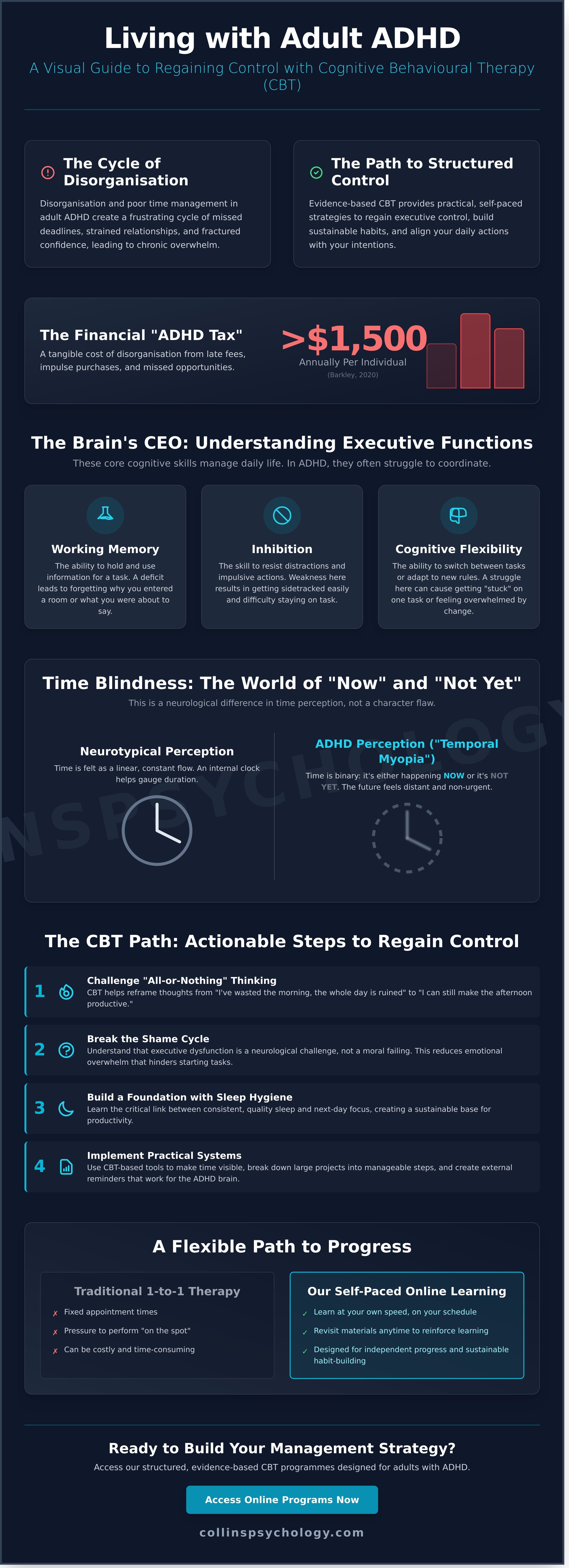
For many adults with ADHD, the struggle with disorganisation is a constant source of frustration and anxiety. While childhood ADHD is often associated with hyperactivity, in adulthood, the primary challenges frequently shift to internal difficulties with executive functions, manifesting as cluttered spaces, missed appointments, and an overwhelming sense of chaos. Executive functioning is the set of mental skills that act as the "CEO of the brain," responsible for planning, organising, and executing tasks. In ADHD, this CEO is often under-resourced, leading to a significant gap between what you intend to do and what you actually accomplish. Cognitive Behavioural Therapy (CBT) offers a practical toolkit to bridge this gap, providing the structure and strategies needed to translate intention into consistent action.
The Role of Executive Functioning in Daily Tasks
Executive functions include several core skills that are essential for organisation. Working memory allows you to hold information in your mind while you complete a task; inhibition helps you resist distractions; and cognitive flexibility enables you to switch between tasks or adapt to changing plans. When these skills are impaired, even simple activities can become monumental challenges. For example, a weak working memory can cause you to forget why you walked into a room, while poor inhibition can lead you down an internet rabbit hole instead of paying bills, directly resulting in a messy desk or a missed appointment. CBT-based training provides targeted exercises to strengthen these skills, helping you build systems that work with your brain.
Why Time Blindness is Not a Choice
A core and often misunderstood aspect of ADHD is "time blindness," or the consistent difficulty in perceiving the passage of time. This is why phrases like "I will just be five minutes" or "I will do it later" can be so problematic. For a person with ADHD, five minutes and thirty minutes can feel almost identical, making it incredibly difficult to accurately estimate how long a task will take or to feel the urgency of a looming deadline. This temporal myopia, as described by Barkley (1997), means that standard tools like planners are often insufficient because the internal sense of time required to use them effectively is not reliably present. Instead of "just trying harder," adults with ADHD need external, tangible systems to make time visible and manageable.
A Structured CBT Framework for Improving Time Management
Cognitive Behavioural Therapy is a highly effective, evidence-based approach for managing the core symptoms of adult ADHD, including disorganisation and poor time management (Safren et al., 2005). Its power lies in its structured, practical nature. CBT helps you identify the specific thought patterns and behaviours that fuel procrastination and then provides concrete tools to change them. For instance, a common cognitive distortion in ADHD is "all or nothing" thinking, where a task is either done perfectly or not at all, leading to paralysis. CBT teaches you to challenge this thinking and replace it with more realistic and helpful approaches, such as "behavioural activation," which focuses on simply starting a small piece of a task to build momentum. These are the kinds of strategies taught in our structured, self-paced online modules, designed to help you know what to do and actually do it.
Cognitive Reframing for Procrastination
Procrastination in ADHD is rarely about laziness; it is often driven by anxiety, overwhelm, or a fear of failure. CBT addresses this at the root by targeting the "thinking traps" that trigger task avoidance, such as "I have to be in the mood to do this" or "This is too big to even start." Through cognitive reframing, you learn to systematically question these thoughts and replace them with more balanced and functional ones, like "I do not need to feel motivated to start; I just need to start for five minutes." This process reduces the emotional weight tied to the task, making it much easier to initiate. For a deeper understanding of these cognitive strategies, explore our guide on using the 2-minute rule for ADHD.
Behavioural Tools for Daily Structure
Alongside changing your thoughts, CBT provides a wealth of behavioural tools to create external structure. One of the most effective is "chunking," which involves breaking down large, intimidating projects into small, concrete micro-steps. Instead of "clean the kitchen," the first step becomes "put three dishes in the dishwasher." Another key strategy is using external cues like visual timers, alarms, and checklists as "prosthetic" executive functions to support your working memory and time perception. The goal is to stop relying on motivation and instead build consistent, repeatable routines that reduce decision fatigue and make organisation a habit, not a daily battle.
From ADHD Overwhelm to CBT-Based Order
The Problem: The ADHD Disorganisation Cycle
Executive Function Difficulties
• Struggling to plan, prioritise, and get started
• Difficulty perceiving time or estimating how long things take
Task Paralysis & Avoidance
• Feeling overwhelmed leads to procrastination
• “All or nothing” thinking (if it can’t be done perfectly, it’s avoided)
Chronic Disorganisation
• Clutter builds up easily
• Deadlines are missed or rushed
• Feeling like you are constantly trying to “catch up”
Shame & Guilt
• Harsh self-talk (“I’m lazy”, “I’m a failure”)
• Reinforces avoidance and keeps the cycle going
The Solution: A Structured CBT System
Cognitive Reframing – Change the Thought Pattern
• Notice unhelpful thoughts as they arise
• Gently challenge and reframe them
Instead of:
“I have to do it all perfectly”
Try:
“Done is better than perfect. I’ll start with one small step.”
Behavioural Activation – Create External Structure
• Reduce overwhelm by making tasks more manageable
Practical strategies:
• Chunking → Break tasks into small, clear steps
• External cues → Use timers, alarms, or reminders to make time visible
• Environment design → Keep items where you actually use them (point of performance)
Emotional Regulation – Reduce the Overwhelm Response
• Address the feelings that drive avoidance
Helpful approaches:
• Self-compassion → “This is difficult, not a personal failure”
• Grounding techniques → Simple breathing or sensory exercises to reset when overwhelmed
The Outcome: A System That Works With Your Brain
• Reduced anxiety around tasks
• More consistent progress (without needing perfection)
• Increased sense of control and confidence
• Less reliance on willpower, more reliance on structure
Overcoming the Shame Cycle: Emotional Regulation and ADHD
For many adults with ADHD, the most challenging part of disorganisation is not the physical mess but the emotional weight it carries. Years of being labelled "the messy one" or "the late one" can lead to a deeply ingrained sense of shame and inadequacy. This emotional burden is not just painful; it actively worsens executive dysfunction. When you feel ashamed or anxious, your brain's prefrontal cortex, the very area responsible for executive functions, becomes less effective, making it even harder to initiate tasks (Pera & Liff, 2021). In line with PSI professional guidelines, a compassionate and evidence-based approach recognises that emotional regulation is a necessary prerequisite for getting organised.
The Impact of Shame on Task Initiation
The fear of failing again, of not meeting your own or others' expectations, can create a powerful "analysis paralysis." You might spend more time worrying about a task than it would take to complete it, leading to further disorganisation and reinforcing the belief that you are incapable. The CBT approach to this is not to "power through" the shame but to cultivate self-compassion as a functional tool for productivity. This involves acknowledging that your brain is wired differently and that these challenges are real, which frees up mental energy to focus on solutions rather than self-criticism. Our programmes on emotional regulation provide a system for this work.
Managing the "ADHD Meltdown" from Overwhelm
When the to-do list becomes too long or a carefully laid plan falls apart, it can trigger a state of intense sensory and cognitive overload often called an "ADHD meltdown." This is your brain's emergency brake, a sign that your executive function capacity has been completely exhausted. Immediate grounding techniques, such as focusing on your breath or naming five things you can see, can help you regain a sense of calm in that moment. Understanding these triggers is why a flexible, self-paced learning model is so beneficial; it removes the pressure of fixed appointments and allows you to engage with the material when your brain is ready, reducing the risk of the overwhelm that triggers these meltdowns in the first place.
Actionable Strategies for Focus, Sleep, and Goal Setting
While CBT provides the core framework, certain lifestyle factors have a profound impact on your ability to manage ADHD symptoms. Sleep, in particular, is critical; a lack of quality sleep significantly impairs executive function the following day, making it even harder to stay organised and focused. Creating an ADHD-friendly environment that minimises distractions is also essential for success. This means designing your physical and digital spaces to support your goals, rather than constantly fighting against them. Finally, learning to set goals in a way that accounts for the unique challenges of the ADHD brain is key to building long-term momentum.
Setting Realistic Goals with the ADHD Brain
Adults with ADHD are often full of ambitious, "aspirational" goals but struggle with the "functional" daily objectives needed to achieve them. The popular SMART (Specific, Measurable, Achievable, Relevant, Time-bound) goal framework can be adapted for ADHD by adding an emphasis on making goals extremely small and immediate. A key clinical strategy is to "under-promise" to yourself; setting a goal to work on a project for just ten minutes is far more effective than planning for two hours and then not starting at all. This approach builds trust in your own ability to follow through. Our CBT-based goal-setting programmes provide a complete template for this process.
Optimising Your Environment for Focus
Your environment can either be your greatest ally or your biggest obstacle. One powerful social tool for staying on task is "body doubling," where you work quietly alongside another person, either physically or virtually, to create a sense of gentle accountability. Another key concept is designing for the "Point of Performance," which means putting tools and items exactly where you will use them (e.g., placing your keys in a bowl right by the door). In the digital world, this means decluttering your desktop, using website blockers, and closing unnecessary tabs to reduce the temptation of "tab-hopping" and the time wastage that comes with it.
Building Sustainable Habits with Self-Paced CBT Learning
The key to lasting change is not a single moment of insight but the gradual building of sustainable habits. Collins Psychology provides online, self-paced programmes that are designed for this exact purpose. We do not offer one-to-one therapy. Instead, we provide a system of evidence-based modules, exercises, and tools that you can access whenever and wherever suits you, without the pressure of weekly appointments or waitlists. This approach allows you to build your ADHD support system over time. You can start where you struggle most, with the flexibility to learn at a pace that works with your brain's fluctuating energy and focus levels.
The Flexibility of Online ADHD Support
A self-paced model is uniquely suited to the ADHD lifestyle. It acknowledges that some days you will have the energy to dive deep into a module, while on other days, simply reviewing a one-page tool is a win. These programmes are designed for long-term habit formation, not quick fixes that fizzle out. All content is clinically supported and follows the professional guidelines of the Psychological Society of Ireland, ensuring you are learning reliable and effective strategies. It is one system with multiple entry points, allowing you to tailor your learning journey to your specific needs.
Next Steps for Your Organisation Journey
The best way to begin is to stop starting over every Monday and instead commit to one small, consistent action. We encourage you to start with a single module that addresses your most significant pain point, whether that is executive function, emotional regulation, or time management. Remember that for the ADHD brain, consistency always beats intensity. Building a more organised life is not about a radical overhaul but about laying one brick at a time, patiently and persistently.
Explore our structured, self-paced CBT programmes for Adult ADHD and begin building a system that finally works for you.
Frequently Asked Questions
Can CBT really help with ADHD disorganisation if I have always been this way?
Yes. CBT is effective because it does not try to change who you are, but instead teaches you skills and systems to work with your brain's wiring. It focuses on changing patterns of thinking and behaviour that you can control, providing practical tools to manage the challenges of ADHD, no matter how long you have experienced them.
Is this programme a substitute for one-to-one therapy?
No. Our programmes are a structured, self-paced system for learning evidence-based skills. They are not a form of therapy, coaching, or a substitute for individual psychological treatment. They are designed to be a flexible resource for adults who want to build practical management systems.
How much time do I need to commit to the self-paced ADHD modules each week?
The time commitment is entirely up to you. The self-paced nature means you can spend as little as 15 minutes a day or dedicate a few hours on a weekend. The key is consistency, not the amount of time spent in a single session.
Do I need a formal diagnosis to benefit from these CBT strategies?
No, a formal diagnosis is not required. The strategies and tools taught in these programmes are beneficial for anyone who struggles with executive function challenges like disorganisation, procrastination, and poor time management, regardless of their diagnostic status.
What is time blindness and how do I know if I have it?
Time blindness is the chronic difficulty in perceiving the passage of time. If you frequently underestimate how long tasks will take, are often late despite your best efforts, and struggle to feel the urgency of future deadlines, you likely experience time blindness.
Can CBT help with the emotional overwhelm of being disorganised?
Absolutely. A core component of our CBT system is emotional regulation. It teaches you to identify and manage the feelings of shame, anxiety, and frustration that accompany disorganisation, which is often the first and most crucial step to making lasting behavioural change. For more on this, consider reading our guide to understanding the ADHD burnout cycle.
Why do standard planners and apps never seem to work for my ADHD?
Standard tools often fail because they assume a reliable internal sense of time and consistent motivation, which are two things the ADHD brain struggles with. They are often not engaging enough to hold attention and can become just another thing to forget. Our approach focuses on building systems around these tools to make them work for you.
Are these programmes suitable for adults who were only recently diagnosed?
Yes, they are ideal for recently diagnosed adults. They provide a structured, foundational education on how ADHD impacts executive functioning and offer a clear roadmap of practical strategies you can begin implementing immediately to manage your symptoms.
References
Barkley, R. A. (1997). Behavioral inhibition, sustained attention, and executive functions: Constructing a unifying theory of ADHD. Psychological Bulletin, 121(1), 65–94.
Pera, G., & Liff, J. (2021). Organizing solutions for people with ADHD: Tips and tools to help you take charge of your life and get organized (2nd ed.). Fair Winds Press.
Safren, S. A., Otto, M. W., Sprich, S., Winett, C. L., Wilens, T. E., & Biederman, J. (2005). Cognitive-behavioral therapy for ADHD in medication-treated adults with continued symptoms. Behaviour Research and Therapy, 43(7), 831–842.