

ADHD overwhelm can make task initiation, time management, emotional regulation and follow-through feel harder than they look from the outside. This guide explains how stress, executive functioning, time blindness, rejection sensitivity and burnout can interact, then offers practical CBT-informed steps and online support to help you choose a manageable next action.
In this article
• Understanding the stress cycle
• Using a practical CBT sequence
• Overwhelm is often linked with executive-functioning demands, emotional load and unclear next steps, rather than a lack of effort.
• Task initiation becomes easier when you name one visible action, add a cue and reduce unnecessary decisions.
• CBT strategies can help you notice unhelpful thoughts, test a smaller action and review what worked.
• Time blindness, rejection sensitivity, late diagnosis, parenting demands and burnout may all affect follow-through.
• The Adult ADHD Foundations Program™ offers structured, self-paced online education for adults with ADHD worldwide. It provides practical daily tools and is not therapy.
What ADHD Stress and Overwhelm Can Feel Like in Everyday Life
You open your messages to reply to one person, notice a form you meant to finish, remember something for work and suddenly can’t decide what to do first. The list may be short, but each item seems to demand attention at once. That shift from “I have a few things to do” to “I can’t manage any of this” is one way ADHD stress and overwhelm can show up.
Everyday stress can feel like pressure while you work out how to meet a demand. Overwhelm can feel different: competing demands seem too difficult to organise or act on, so you become stuck, emotionally flooded or avoidant. It isn’t a character flaw, and it doesn’t look the same for everyone. Some people notice task overload, others emotional or sensory overload, and these experiences can overlap.
Adult ADHD can affect attention and day to day functioning in different ways. The overview of Adult Attention Deficit Hyperactivity Disorder describes a range of features associated with adults, but no single list captures everyone’s experience. Your own early signs and circumstances matter.
How ADHD overwhelm may show up during an ordinary day
You might stare at messages, know a form needs doing but keep putting it off, or start one job and realise much later that time has slipped away. Other possible signs include racing thoughts, irritability, restlessness, avoiding decisions or moving between tasks without finishing them. A busy environment, a change of plan or several requests at once may add to the load. These are examples, not a checklist that every adult with ADHD will recognise.
Try noticing what happens just before you get stuck. Is the next step unclear? Are you worried about getting it wrong? Is noise or activity making it hard to think? Naming the barrier can help you respond more accurately than telling yourself to “just get on with it”. For example, if a form feels too big, identify the first unanswered question and use it as your starting point.
Why overwhelm is not a measure of effort or character
When tasks accumulate, choosing what matters, keeping track of time and beginning can all feel harder. A task that looks simple from the outside may involve several hidden steps, such as finding a document, remembering a password and deciding what to write. If you’re already tired or dealing with other demands, each step may take more effort than expected.
Self criticism can then add another layer: “I should have done this by now” may bring shame or anxiety, making it even harder to return to the task. That response doesn’t prove you’re lazy or careless. If emotional intensity is part of the pattern, practical ADHD emotional regulation strategies can help you pause and identify what you’re feeling before choosing what to do next.
It can be useful to separate the problem from your judgement of yourself. Instead of “I’m useless at paperwork”, try “I’m stuck because I don’t know which part to start with.” That change won’t complete the form for you, but it points towards a workable next step. Understanding why simple tasks can feel overwhelming can also help you find ways to get unstuck without expecting yourself to manage everything perfectly.
How ADHD Stress and Overwhelm Can Reinforce Each Other
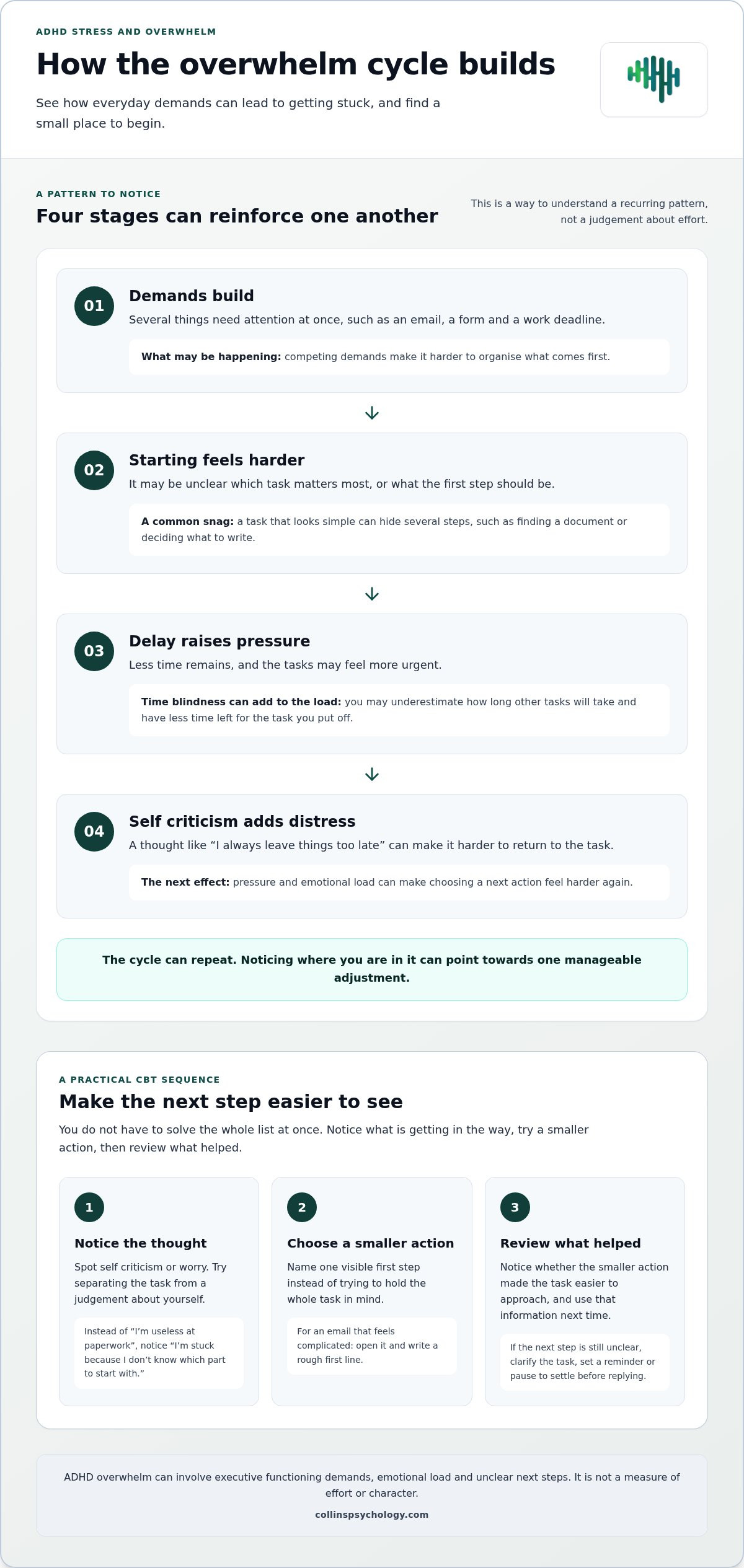
ADHD stress and overwhelm can form a cycle: demands build, starting feels harder, delay increases pressure, and self criticism adds to the emotional load. This is a useful way to make sense of a recurring pattern, not a diagnosis or an experience shared by every adult with ADHD. Recognising the steps can help you spot where pressure is growing and consider a small change.
Executive functioning challenges can make it harder to organise tasks, choose a priority and begin. Emotional regulation can affect the same moment: frustration or worry may rise as the list grows, leaving less attention available for planning. The National Institute of Mental Health overview of ADHD describes how ADHD can affect daily functioning, while CBT approaches also focus on practical planning, coping and follow-through (Ramsay & Rostain, 2015).
Demands build
An email, a form and a work deadline all need attention.
Starting feels harder
It is unclear which task matters most, or what the first step should be.
Delay raises pressure
Less time remains, and the tasks may feel more urgent.
Self criticism follows
Thoughts such as “I always leave things too late” can add distress and make returning to the task harder.
This sequence is not a judgement about effort. It offers a way to notice how practical demands and emotional responses may feed into one another. If it fits your experience, try asking: “What is making the next step difficult right now?” That question can point towards a useful response, such as clarifying the task, setting a reminder or taking a moment to settle before replying.
The link between task initiation, time blindness, and rising pressure
Imagine you plan to answer one email after lunch. You put it off because the reply feels complicated, then other urgent tasks compete for your attention. If you also underestimate how long those tasks will take, you may have little time left to write the email calmly. This example isn’t about a lack of care; starting, estimating time and keeping track of competing demands can all be part of the challenge.
Define the first action rather than the whole job: open the email and write a rough first line. A clear, small starting point can make the task easier to approach. These ADHD task initiation strategies explore ways to work with task paralysis.
When emotional reactivity or rejection sensitivity adds another layer
A short message from a colleague may feel critical, even when its meaning is unclear. If you’re already under pressure, replaying the exchange or worrying about having upset someone can take attention away from other tasks. Some adults describe strong sensitivity to perceived rejection. Rejection sensitive dysphoria is a term used to describe this experience, not a formal diagnosis.
Pausing before responding can create room to separate what was said from what you fear it means. You might note the facts, name the feeling and decide whether a reply is needed now or later. For structured, self paced online learning in practical CBT strategies, explore the Adult ADHD Foundations Program™. It offers tools for daily functioning and is not a substitute for therapy.
What Helps When ADHD Stress Turns into Task Paralysis
When ADHD stress and overwhelm make it hard to act, first identify what is getting in the way. Task paralysis, emotional overload and sensory overload can feel similar, but they may need different responses. A strategy is something to test, not a rule: what helps one day may not help the next.
Shrinking a task can make its starting point easier to see because it replaces a broad demand with one clear action. You don’t have to finish the whole job before you begin. Choose a first step that feels possible in this moment, then notice whether it helps.
| What may be happening | A possible first response | Example |
|---|---|---|
| Task paralysis: the job feels too big or unclear | Name one visible action | Open the laptop and find the document |
| Emotional overload: worry or frustration is taking up attention | Name the feeling and pause before acting | Write a reply as a draft, then revisit it |
| Sensory overload: noise, light or activity is making it harder to focus | Reduce one manageable source of input | Move to a quieter spot or silence non essential alerts |
When the task feels too big to start
“Tidy the room” is a vague goal with many possible starting points. Choose one visible action instead, such as putting the dishes beside the sink or placing clothes in the laundry basket. If you’re postponing an email, the first step might be opening it and reading the request, rather than composing the perfect reply.
Set a brief time to try that action, then decide whether to continue or pause. The aim is to make starting more manageable, not to force yourself to finish everything at once. Strategies for procrastination and ADHD can help you understand why delay happens and how small steps can support follow through.
When emotions or sensory input are taking up attention
Before choosing a technique, ask yourself what feels most demanding: the emotion, the environment or uncertainty about the task? If a message has upset you, a pause before replying may help you avoid responding while distressed. If background noise is making it difficult to think, changing one source of input may be more useful than trying to push through.
Notice what changes, without expecting a particular result. A breathing pause, a quieter space or writing down the next action may help at different times, but no single calming technique works for everyone. Collins Psychology’s Adult ADHD Foundations Program™ provides structured CBT learning that is 100% online and self paced, with practical tools for daily functioning. It is not a substitute for therapy.
A Practical CBT Sequence for Managing ADHD Stress and Overwhelm
When you feel stuck, a short sequence can help turn a stressful moment into a specific next step. This CBT inspired approach moves from noticing what is happening to choosing an action, setting a cue and reviewing what you learned. It is a flexible guide, not a test you need to complete perfectly.
Notice the trigger and name what is happening
Start by identifying what is taking up your attention. Is it the task itself, a feeling about getting it wrong, a distraction or pressure from the time available? Use neutral words, such as “I’m worried about the deadline and unsure where to begin”, rather than turning the moment into a judgement about yourself.
For example, before opening an unfinished work document, you might notice, “I’m focused on how little time I think I have.” Naming the time pressure helps separate the feeling from the task. You can then decide whether you need to check the deadline, clarify what is required or simply open the document.
Choose one small action and make it easier to begin
Pick an action you can see and describe clearly. “Work on the report” is broad; “open the report and write the heading” gives you a defined start. Add a place and cue, such as “After I make tea, I’ll sit at the kitchen table and open the report.” A timer or written prompt may help, but it’s optional. Choose a support that feels useful to you.
If estimating time is part of the difficulty, use an external cue rather than relying on an internal sense of time. Put the start time in your calendar, set an alarm and allow more time than your first estimate suggests. This guide to ADHD time blindness and time management offers further practical ideas.
A five-step reset for ADHD overwhelm
Notice
Identify what is taking up your attention.
Name
Describe the feeling or barrier without blame.
Choose
Select one small, visible action.
Set a cue
Decide when and where you will begin.
Review
Notice what helped, then adjust the plan.
This reset is designed to interrupt the pressure cycle without demanding a perfect result. Use one step if five feel too much. The aim is a repeatable way to begin and return.
Review the result and adjust your plan
After trying the action, pause and ask what happened. Did the cue help you begin? Was the step still too large, or did another demand interrupt you? This is information for your next attempt, not proof that you have failed.
Flexible planning leaves room for real life. If you meant to clear the kitchen but only put away the clean cups, acknowledge that specific progress and choose whether to continue, stop or set another cue. A smaller goal can be more useful than an ideal plan you cannot follow today. The aim is to build a repeatable way to begin and return, not to get everything right first time.
Explore the Adult ADHD Foundations Program™ for structured, self paced CBT learning that is 100% online.
How Online CBT Learning Can Support Adults Feeling Stuck
When ADHD stress and overwhelm keep returning, practical support can make it easier to practise skills in the situations where you need them. Online CBT learning offers structured material and exercises that you can revisit at your own pace. It is educational support rather than individual therapy, and it can help bridge the gap between understanding ADHD and knowing what to do in the moment.
What structured, self paced learning can offer
The Adult ADHD Foundations Program™ is a psychologist-developed, self-paced online programme for adults with or without a formal ADHD diagnosis. Its five core areas are emotional regulation, executive functioning, goal setting, time management and rejection-sensitive dysphoria. With 13 or more hours of content, five comprehensive workbooks and 12 months of access, it is designed to provide practical tools for everyday life rather than serve as therapy.
The programme also addresses areas that commonly affect daily functioning, including late diagnosis, parenting, fitness and focus, and burnout. For example, you might use goal-setting exercises to turn “get organised” into one observable action, then use time-management tools to decide when and where it will happen. These approaches support skills practice without asking you to overhaul your entire life at once.
Learning at your own pace may make it easier to return to an idea when you have the attention and space to try it. You could practise one planning approach during a quieter part of the week, then review what gets in the way when your routine changes. Collins Psychology supports adults with ADHD who feel overwhelmed and stuck to establish practical systems that improve daily life, with worldwide access to the programme.
Choosing a next step that fits real life
Start with one strategy, not a complete life overhaul. If goal setting feels difficult, write down the result you want, the smallest next action and the cue that will prompt you; for example, “after breakfast, open the school form and complete the first line”. If emotional regulation is the priority, practise noticing and naming a feeling before deciding how to respond, then review whether the pause reduced overwhelm or protected your energy.
Late diagnosis, parenting and fitness
If you were diagnosed late, years of coping without an explanation can leave a habit of self criticism. Looking back at old patterns with curiosity, rather than blame, helps you build systems that suit you now. Many adults find this reframing a relief and a practical starting point.
Parenting adds its own load: school runs, forms and other people's needs compete with your plans. Agree one or two fixed anchors for the day, such as a shared calendar check after breakfast, and keep your own tasks small. Good enough routines tend to last longer than perfect ones.
Fitness can support focus. A ten minute walk before a demanding task is an easy cue to begin, and many adults find movement helps them settle their attention. Choose activity you can repeat, and link it to a time or place in your day (Ramsay & Rostain, 2015).
Collins Psychology supports adults with ADHD who experience overwhelm to establish practical systems that improve daily life. The Adult ADHD Foundations Program™ is accessible worldwide, self-paced and educational, with practical daily tools across five core areas. It is not therapy, but it can give you structured material and workbooks to practise between the demands of real life.
Preventing ADHD burnout
ADHD burnout can develop when coping demands stay high for too long and recovery never catches up. You may notice exhaustion, irritability, reduced focus, avoidance or a sudden loss of capacity for routines that usually help. Burnout is a sign to examine the system around you, not evidence that you have failed.
Use a lower-demand plan when your capacity is reduced: choose one essential task, shorten the first step and remove avoidable decisions. Build recovery into the plan with brief movement, food, rest or a quieter transition between activities, especially when parenting, work or household demands compete for attention. Small adjustments can protect follow-through better than pushing until everything stops.
CBT-informed review can help you identify the thought that keeps the cycle going, such as “I must catch up on everything today”. Replace it with a testable plan: “I will complete the urgent form for ten minutes, then reassess.” Collins Psychology’s ADHD burnout guidance explores how to recognise when coping has become exhausting and begin building a more sustainable routine.
Explore the Adult ADHD Foundations Program™ and choose one practical strategy to try in your daily routine.
build systems that work WITH your ADHD brain
Choose a system that supports you
ADHD stress and overwhelm can make it tempting to wait until you feel completely ready. Instead, choose one small strategy to practise with a real task this week, such as naming the first action, setting a start cue or pausing before replying to a difficult message. Notice what makes it easier to begin and adjust the system if it does not fit.
Collins Psychology supports adults with ADHD who feel overwhelmed and stuck to build practical systems for daily life. The Adult ADHD Foundations Program™ offers psychologist-developed, self-paced online education worldwide across emotional regulation, executive functioning, goal setting, time management and rejection-sensitive dysphoria. It provides practical learning, not a diagnosis or a substitute for therapy.
Explore The Adult ADHD Foundations Program™ if structured CBT-informed tools, workbooks and flexible online learning would support your next step. You can begin with one module, one exercise and one real-life situation rather than trying to change everything at once.
Progress is not measured by never feeling overwhelmed. It is measured by noticing the pattern sooner, responding with more choice and returning to a workable plan after life interrupts it. Start small, practise consistently and build systems that work WITH your ADHD brain
Frequently Asked Questions
Why does ADHD make me feel overwhelmed by simple tasks?
A task can look simple but still require several steps, decisions and reminders. If you’re unsure what to do first, try writing down only the next action and what you need to do it. For example, “pay the bill” could begin with finding the invoice. This can make the task easier to approach without expecting yourself to hold every detail in mind at once (Ramsay & Rostain, 2015).
Can ADHD stress cause you to shut down or avoid tasks?
It can contribute to feeling frozen or putting a task off, particularly if the task feels uncertain, demanding or emotionally loaded. If you notice this happening, consider what you’re avoiding: a decision, a possible mistake, or the effort of switching attention. Naming the specific concern may help you decide whether to clarify the task, ask for more information, or return to it at a planned time.
How can I calm down when I feel overwhelmed by ADHD?
Try creating a brief pause before deciding what to do. You might place both feet on the floor, look around and name a few things you can see, or step away from a noisy space if that is practical. Then check what would help most: less input, a moment to settle, or a clearer plan. These are options to experiment with, not techniques that work the same way for everyone.
What should I do first when I cannot start a task?
Make the first action observable and easy to check off. If you need to prepare for an appointment, for instance, put the relevant letter or details somewhere you can see them. You could also write a short prompt such as “open the calendar after breakfast”. If the step still feels difficult, make it smaller or check whether you need information before you can begin.
Is online CBT useful for adults who feel stressed and overwhelmed by ADHD?
Online CBT learning can provide structured exercises for practising skills such as planning, problem solving and responding differently to unhelpful thoughts. The value comes from applying an idea to a real situation and reviewing what happens, rather than simply reading about it. CBT approaches for adult ADHD include practical coping strategies, though what is useful can vary between people (Ramsay & Rostain, 2015).
Can I use an ADHD programme if I do not have a formal diagnosis?
Yes. Collins Psychology’s Adult ADHD Foundations Program™ is intended for adults with or without a formal diagnosis. You can use the learning to explore practical strategies that relate to your routines, while keeping notes about which situations are difficult and what helps. A learning programme cannot determine whether you have ADHD, so use it for skills practice rather than as a way to confirm a diagnosis.
What happens if ADHD overwhelm is affecting my wellbeing or feels urgent?
If ongoing overwhelm is affecting your wellbeing, consider speaking with your GP and describing what has changed in your daily life, such as sleep, work or managing essential tasks. Our private services are not appropriate for acute incidents or urgent support. If you are in crisis, contact Samaritans 116 123, your GP, or dial 112 or 999.
References
National Institute of Mental Health. (n.d.). Attention-deficit/hyperactivity disorder (ADHD). https://www.nimh.nih.gov/health/topics/attention-deficit-hyperactivity-disorder-adhd
Ramsay, J. R., & Rostain, A. L. (2015). The adult ADHD tool kit: Using CBT to facilitate coping inside and out. Routledge.
Medical and Mental Health Disclaimer
The information provided on this page, in the Adult ADHD Foundations Program™, individual Collins Psychology programs and the Adult ADHD Reflection Quiz is for general educational and informational purposes only and is not a substitute for individual medical, psychological or psychiatric assessment, diagnosis or treatment. These resources do not diagnose ADHD or any other condition and are not psychotherapy, counselling, crisis support or personalised treatment. Although the material is psychologist-developed and informed by psychological research and evidence-based approaches, individual outcomes will vary and no specific result can be guaranteed. If you are experiencing severe or worsening psychological symptoms, significant impairment, thoughts of harming yourself or another person, or concerns about your safety, seek support from an appropriately qualified health professional or contact the emergency or crisis service appropriate to your location.